How does a plumb bob show a vertical line?
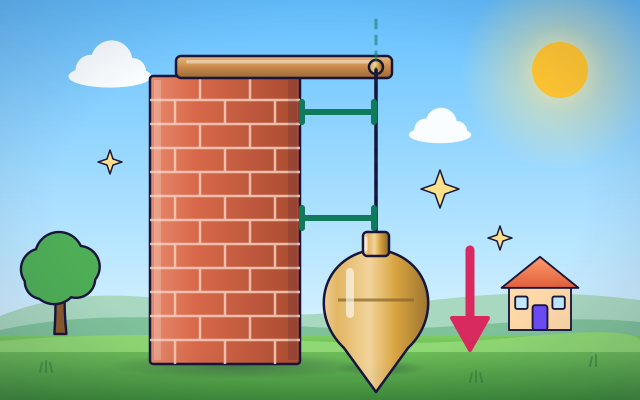
A plumb bob is a pointed weight on a string. Gravity pulls it straight down, so the string shows builders what truly straight up and down looks like.
The big idea: Gravity pulls the weight toward the middle of the Earth. Once it stops swinging, the tight string points exactly down. If a wall stays the same distance from the string all the way up, the wall is straight.
It's like a yo-yo hanging still from your finger: the string makes a perfect straight-down line, even if your hand is tilted.
The interactive parts didn't load. The explanations below still work; try reloading the page.
The string that knows down
- A builder lays bricks, one row on another. If each row is a tiny bit off, the wall slowly leans. From close up, a small lean is very hard to see.
- So the builder hangs a plumb bob beside the wall: a heavy, pointed weight on a thin string. At first it swings from side to side.
- Each swing is a little smaller, because the air slows it down. Soon the bob hangs still. Now the string makes a line that is exactly up and down.
- Why does it point down? Gravity pulls the weight toward the middle of the Earth. Anywhere in the world, a plumb line points at the center of the Earth.
- Now compare. Measure the gap between the wall and the string at the top, then at the bottom. If the two gaps are the same, the wall is straight. If not, it leans.
- The builder nudges the wall until both gaps match. Now it stands plumb, which means truly upright. People have built this way for thousands of years.
Look closely at a plumb bob
Tap each part of the plumb line. See what it does.
- Hanging block. The string hangs from a block or a nail at the top. The block holds the string a little way out from the wall, so the bob can hang freely.
- String. The string is thin and strong. The weight pulls it tight, so it makes a perfectly straight line from the top to the bob.
- Cap. The string goes into the bob through a small cap, exactly in the middle of the top. That way the bob hangs evenly and does not tip.
- Bob. The bob is a heavy piece of metal, often brass or steel. Because it is heavy, it pulls the string tight and a little wind hardly moves it.
- Pointed tip. The tip is a sharp point. It shows the exact spot on the ground that is straight below the place where the string is tied.
- Mark on the ground. A builder can mark the spot under the tip. That mark is exactly below the top of the string, even many floors down.
Check three walls
Tap each wall to hang the plumb bob beside it. When it stops swinging, compare the gap at the top with the gap at the bottom.
Experiment: A wall leans away from the string at the bottom. How will the two gaps compare?
- Tap the first wall and wait for the bob to rest.
- Compare the two gap bars. Then check the other walls.
- Which wall has equal gaps?
What we found: The string always hangs straight down, whatever the wall does. So if the wall leans, the gap changes from top to bottom. Only a wall that is truly upright stays the same distance from the string all the way down.
Turn on JavaScript to try it yourself.
Make it plumb
Move the top of the wall until both gaps match, then press Check. You cannot see the numbers, so compare the gap bars carefully.
Why a hanging weight shows straight down
A plumb bob is one of the simplest tools ever made: a heavy weight with a pointed tip, hanging on a string. Builders in ancient Egypt used them, and builders still use them today.
It works because of gravity. The Earth pulls everything toward its middle. A weight on a string is pulled down until the string is tight. If you give it a push, it swings like a playground swing, but the air slows it and it comes to rest. Then the string points exactly toward the middle of the Earth.
That gives the builder a perfect up-and-down line to compare with. The string hangs a little way out from the top of the wall. If the wall is straight, the gap between the wall and the string is the same at the bottom as at the top. If the gap grows or shrinks, the wall is leaning.
A heavy bob is better than a light one, because wind cannot push it around so easily. Some builders even dip the bob in a bucket of water to stop it swinging sooner. Our swing comparison is not perfect: a swing has two chains and a seat, so it can only move forward and back, but a plumb bob is free to settle in any direction.
Key words
- Plumb
- Standing exactly straight up and down.
- Gravity
- The pull of the Earth that makes things fall down.
- Tension
- The pull along a tight string.
- Pendulum
- A weight on a string or rod that swings back and forth.
- Vertical
- The straight up-and-down direction, in line with gravity.
Check your thinking
-
Why does the string of a plumb bob point straight down?
Show the answer
Gravity pulls the weight toward the middle of the Earth. The weight is pulled down until the string is tight and in line with the pull.
-
The gap between wall and string is 5 centimeters at the top and 5 at the bottom. What does that tell you?
Show the answer
The wall is plumb. The string is straight up and down. A wall that keeps the same distance from it must be too.
-
Why should you wait before reading a plumb bob?
Show the answer
It has to stop swinging before the string shows straight down. While it swings, the string points to one side and then the other. Only at rest does it point down.
-
Why is a heavy bob better than a light one on a windy day?
Show the answer
The wind cannot push a heavy bob around as easily. The same puff of wind is a tiny push compared with a big weight.
-
You swap a 200 gram bob for a 400 gram bob on the same string. What happens to the time for one swing?
Show the answer
It stays about the same. A pendulum's period depends on its length and on gravity, not on its mass.
You're a Measuring & instruments expert!
You watched, looked inside, tried it, solved the challenge and went deeper. Pick another question below, or switch the age at the top to see this topic another way.
More about measuring & instruments
 #175
Measuring & instruments
How does a retractable tape measure work?
Inspect the spring, spool, hook, and locking mechanism inside a transparent case.
#175
Measuring & instruments
How does a retractable tape measure work?
Inspect the spring, spool, hook, and locking mechanism inside a transparent case.
 #176
Measuring & instruments
How does a micrometer measure tiny differences?
Turn a precision screw and connect its movement to readings on the scale.
#176
Measuring & instruments
How does a micrometer measure tiny differences?
Turn a precision screw and connect its movement to readings on the scale.
 #177
Measuring & instruments
How do balance scales compare masses?
Add known masses to two pans and find combinations that balance the beam.
#177
Measuring & instruments
How do balance scales compare masses?
Add known masses to two pans and find combinations that balance the beam.
 #180
Measuring & instruments
How does an hourglass measure time?
Change opening size and sand quantity and compare the time needed to empty.
#180
Measuring & instruments
How does an hourglass measure time?
Change opening size and sand quantity and compare the time needed to empty.
Keep exploring
Games to play next
- Clock TowerKeep the town on time: set the tower clock's hands just right.
- Mapmaker QuestFollow directions to make a map, then read its legend, compass rose and scale.
- Data DetectiveRead the clues hidden in graphs — and build your own.
Guide for grown-ups
- How to start homeschooling: a step-by-step guide for familiesA guide for parents · 7 min read
Science games by grade
Science worksheets by grade
- Preschool Science Worksheets
- Pre-K Science Worksheets
- Kindergarten Science Worksheets
- 1st Grade Science Worksheets
- 2nd Grade Science Worksheets
- 3rd Grade Science Worksheets
- 4th Grade Science Worksheets
- 5th Grade Science Worksheets
- 6th Grade Science Worksheets
- 7th Grade Science Worksheets
- 8th Grade Science Worksheets