How does a retractable tape measure work?
Inside a tape measure, a coiled spring winds tighter as you pull the tape out. Let go, and the spring reels the tape back onto its spool.
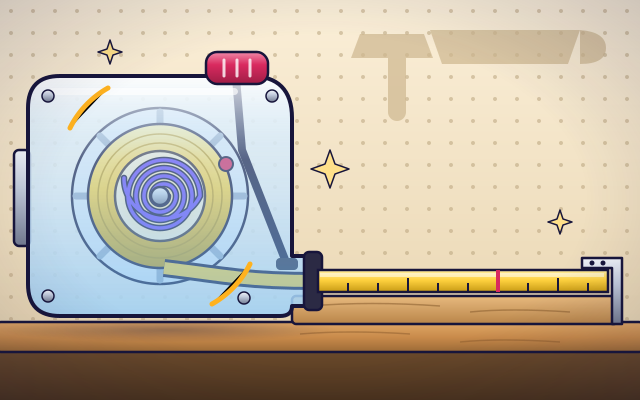
The big idea: The tape is wound on a spool with a flat spiral spring inside. Pulling the tape turns the spool and winds the spring, which stores energy. When you let go, the spring unwinds and turns the spool backward.
It's like a roller window blind: pull it down and a spring inside winds up, give it a tug and the spring rolls the blind back up.
The interactive parts didn't load. The explanations below still work; try reloading the page.
Inside a tape measure
- A tape measure tells you how long things are. Pull the tape along a table and read the number. Then let go, and the tape races back into its case all by itself. How?
- This case is see-through. The tape is wound around a wheel called a spool. As you pull the tape out, it unwinds and the spool spins.
- In the middle of the spool is a flat spring, coiled like a snail shell. One end is fixed to the case and the other to the spool. As the spool turns, the spring winds tighter and stores energy.
- Push the lock button, and a brake presses down hard on the tape. The spring is still pulling, but the brake's grip is stronger, so the tape stays where it is.
- Release the lock and the spring unwinds. It spins the spool backward and reels the tape in. A rubber bumper softens the bang when the hook reaches the case.
- The hook at the end is loose on purpose. Hook it over an edge and it slides out. Push it against a wall and it slides in. It moves by exactly its own thickness, so both ways measure true.
Look inside a tape measure
The case is transparent, so you can see everything. Tap each part to watch it work.
- Case. The case holds the spool and protects the tape. Its back is flat, so you can stand it against a wall to measure from there.
- Spool. The spool is a wheel that the tape winds onto. It spins one way when you pull the tape out and the other way when the tape goes back.
- Spiral spring. A long, thin strip of springy steel, coiled flat like a snail shell. Pulling the tape winds it tighter. When you let go, it unwinds and spins the spool to roll the tape back in.
- Tape blade. The tape, or blade, is thin steel. Look closely: it is curved across its width, like a gutter. That curve keeps it stiff, so it can stick out straight without flopping.
- Markings. Evenly spaced lines are printed on the blade, with numbers for centimeters or inches. You read the line that meets the end of the thing you are measuring.
- End hook. The hook grabs the edge of what you measure. It is loose on its rivets so it can slide by exactly its own thickness. That way, pushing and pulling both give the right answer.
- Lock. Sliding the lock button pushes a brake onto the tape and pins it. The spring cannot pull it back until you release the lock.
Pull it, lock it, let it go
Drag the hook to pull the tape out and watch the spool and spring. Let go with the lock off, then with the lock on. What is different?
Experiment: You pull the tape out and let go with the lock on. What happens?
- Drag the hook out and watch the spring in the round window.
- Press Let go. What does the spring do?
- Pull it out again, tap the lock on the case, and press Let go.
What we found: Pulling the tape winds the spring, and the spring always tries to unwind. With the lock off, it spins the spool and reels the tape in. With the lock on, a brake grips the tape harder than the spring can pull, so the tape stays out.
Turn on JavaScript to try it yourself.
Measure the board
Pull the hook exactly to the far end of the board, lock the tape, and press Check. The star marks the end.
How the tape comes back
A tape measure packs a ruler several meters long into a case that fits in your hand. The ruler is a thin strip of steel called the blade, wound around a wheel called a spool.
In the middle of the spool is a spiral spring: a long, thin strip of springy steel, coiled flat. One end is fixed to the case and the other to the spool. When you pull the blade, the spool turns and winds the spring tighter. You are storing energy in the spring, just as you do when you wind up a toy.
Let go, and the spring unwinds. It spins the spool the other way and rolls the blade back up. If you slide the lock, a brake presses on the blade and holds it, even though the spring is still pulling.
Two more clever details help you measure. The blade is curved across its width, which keeps it stiff enough to reach out across a gap. And the hook on the end is loose: it slides by exactly its own thickness, so the measurement is right whether you hook it over an edge or push it against a wall. Let the tape back in gently, with a grown-up, because a fast blade can sting. Our window blind comparison is close, but a blind stays wherever you leave it, while a tape needs its lock.
Key words
- Blade
- The long, thin steel tape with the markings on it.
- Spool
- The wheel inside the case that the blade winds onto.
- Spiral spring
- A flat coil of springy steel that winds up when the tape is pulled out.
- Stored energy
- Energy saved up in the wound spring, ready to pull the tape back.
- Friction
- The grip between two things that rub, like the brake on the tape.
- Stand-out
- How far the blade can reach out in the air before it bends and folds.
Check your thinking
-
What pulls the tape back into the case when you let go?
Show the answer
A spiral spring that was wound up when you pulled. Pulling the tape winds the spring. When it unwinds, it spins the spool backward.
-
How does the lock stop the tape from going back?
Show the answer
A brake presses on the tape and grips it. The brake's grip is stronger than the spring's pull, so the tape cannot move.
-
Why is the hook at the end of the tape made loose?
Show the answer
So the tape measures right whether you push it or hook it. The hook slides by its own thickness, so its thickness is never counted by mistake.
-
Why is the tape curved across its width, like a gutter?
Show the answer
The curve keeps it stiff, so it can reach out without flopping. A flat strip bends easily, but a curved one resists bending. Try it with a strip of paper!
-
You measure between two walls with the case in the corner. The blade reads 1.80 meters and the case is 8 centimeters long. How wide is the gap?
Show the answer
1.88 meters. The case fills part of the gap, so its length is added: 1.80 plus 0.08 is 1.88 meters.
You're a Measuring & instruments expert!
You watched, looked inside, tried it, solved the challenge and went deeper. Pick another question below, or switch the age at the top to see this topic another way.
More about measuring & instruments
 #176
Measuring & instruments
How does a micrometer measure tiny differences?
Turn a precision screw and connect its movement to readings on the scale.
#176
Measuring & instruments
How does a micrometer measure tiny differences?
Turn a precision screw and connect its movement to readings on the scale.
 #177
Measuring & instruments
How do balance scales compare masses?
Add known masses to two pans and find combinations that balance the beam.
#177
Measuring & instruments
How do balance scales compare masses?
Add known masses to two pans and find combinations that balance the beam.
 #180
Measuring & instruments
How does an hourglass measure time?
Change opening size and sand quantity and compare the time needed to empty.
#180
Measuring & instruments
How does an hourglass measure time?
Change opening size and sand quantity and compare the time needed to empty.
 #182
Measuring & instruments
How does a mechanical pressure gauge work?
Change pressure and watch a flexible sensing element move the dial's pointer.
#182
Measuring & instruments
How does a mechanical pressure gauge work?
Change pressure and watch a flexible sensing element move the dial's pointer.
Keep exploring
Games to play next
- Data DetectiveRead the clues hidden in graphs — and build your own.
- Clock TowerKeep the town on time: set the tower clock's hands just right.
- Mapmaker QuestFollow directions to make a map, then read its legend, compass rose and scale.
Guide for grown-ups
- How to start homeschooling: a step-by-step guide for familiesA guide for parents · 7 min read
Science games by grade
Science worksheets by grade
- Preschool Science Worksheets
- Pre-K Science Worksheets
- Kindergarten Science Worksheets
- 1st Grade Science Worksheets
- 2nd Grade Science Worksheets
- 3rd Grade Science Worksheets
- 4th Grade Science Worksheets
- 5th Grade Science Worksheets
- 6th Grade Science Worksheets
- 7th Grade Science Worksheets
- 8th Grade Science Worksheets