How does electricity reach our homes?
Follow electricity from a power station through transformers, towers and substations to the outlets in your home.
The big idea: Power stations make electricity, and a huge network of wires called the grid carries it to homes. Transformers raise the voltage for the long trip, so less energy is wasted, then lower it again so it is safe to use at home.
It's like
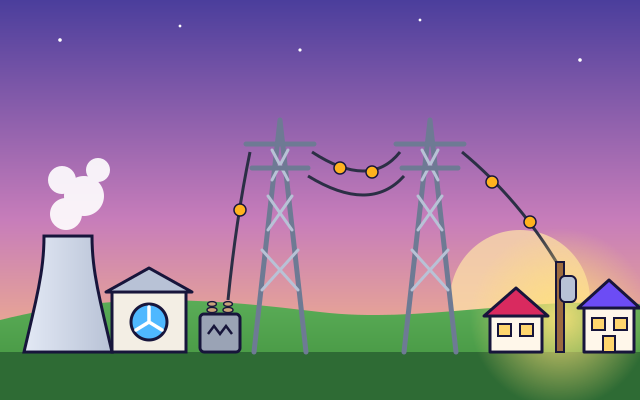
The interactive parts didn't load. The explanations below still work; try reloading the page.
From power station to light switch
- You flip a switch and the light comes on instantly. But that electricity was made far away. Let's follow the wires back to where it started.
- It starts at a power station, where steam, water or wind spins a turbine. The turbine turns a giant generator that makes electricity.
- Next, a transformer raises the voltage a lot, to hundreds of thousands of volts. High voltage lets the electricity travel far without wasting much energy.
- Tall steel towers hold the high-voltage lines far above the ground. The lines carry electricity across hills, fields and rivers to faraway towns.
- Near the town, a substation uses transformers to lower the voltage, then sends electricity out along smaller lines to different neighborhoods.
- A small transformer on a pole lowers the voltage once more, to the level your home uses. The wire runs to a meter, then to your outlets. Never touch power lines or climb poles.
- In a control room, operators watch the whole grid. When everyone gets home and turns things on in the evening, they add more power to keep up.
Follow the electricity, step by step
Press Next step to follow the electricity on its trip from the power station to a lamp.
- Power station. Steam, water or wind spins a turbine, and the turbine spins a generator. This is where the electricity's trip begins.
- Step-up transformer. The transformer raises the voltage a lot. Inside are two coils of wire: the coil going out has many more turns than the coil coming in.
- Transmission lines. High-voltage lines hang from tall steel towers. The high voltage means only a small current flows, so very little energy is wasted as heat.
- Substation. At the substation, transformers lower the voltage and switches send electricity to different neighborhoods.
- Distribution lines. Smaller lines on poles or under the ground carry electricity along the streets of the neighborhood.
- Pole transformer. A small transformer on the pole lowers the voltage again, to the level homes use. One transformer can serve several houses.
- Meter. The meter on the wall measures how much electrical energy the home uses, so the family's bill matches what they used.
- Breaker panel and outlet. Inside, the breaker panel splits the electricity into circuits that run through the walls to outlets and lights. Breakers switch off a circuit if too much current flows.
Build the grid and test the voltage
Connect every part of the grid. Then try sending the electricity at low voltage and at high voltage. What happens to the homes and the wires?
Experiment: What happens to the homes if the electricity travels at low voltage instead of high voltage?
- Connect all four gaps.
- Choose Low voltage. Look at the wires and the homes.
- Choose High voltage and compare.
What we found: At low voltage a big current must flow to carry the same power, and a big current heats the wires a lot, so much of the energy is lost before it reaches town. High voltage needs only a small current, so the wires stay cool and the homes get almost all the energy.
Turn on JavaScript to try it yourself.
Fix the storm outage
A branch hit a power line and three neighborhoods went dark. Cut off the broken line, then reroute power so every home is lit again.
Why the grid uses high voltage
Electricity is hard to store in large amounts, so most of it is made at the same moment we use it. Power stations make it, and the grid, a giant network of wires, delivers it to millions of homes, schools and hospitals.
Wires are not perfect: they warm up a little when electricity flows, and that heat is wasted energy. The bigger the current, the hotter the wires get. To send lots of power over long distances, the grid raises the voltage very high so that only a small current is needed. Then far less energy is lost along the way.
High voltage is far too dangerous for homes, so transformers lower it again in steps: at a substation near town and then in a small transformer on a pole or a box on the ground. By the time it reaches your outlets, it is at the voltage your lamps and fridge are designed for.
When a storm knocks down a line, safety breakers switch it off in a fraction of a second. Then workers and control-room operators open and close switches to send power around the broken part, so most homes get their lights back quickly while the line is repaired.
Key words
- Grid
- The connected network of power stations, lines, substations and transformers that delivers electricity.
- Transformer
- A device that raises or lowers voltage using two coils of wire.
- Substation
- A fenced site with transformers and switches that lowers voltage and routes power to different areas.
- Voltage
- How hard the electricity is pushed along the wires.
- Circuit breaker
- An automatic switch that cuts the power if too much current flows or a fault happens.
Check your thinking
-
What carries electricity from power stations to towns?
Show the answer
Power lines held up by towers. High-voltage lines on tall towers carry electricity over long distances.
-
What is the safe thing to do near power lines?
Show the answer
Stay far away and never climb poles or towers. Power lines carry high voltage. Keep well away and tell an adult about fallen lines.
-
Why does the grid use very high voltage for long trips?
Show the answer
So less energy is wasted as heat in the wires. High voltage needs only a small current, and small currents heat the wires much less.
-
What does a transformer on a pole do?
Show the answer
Lowers the voltage for homes. It steps the voltage down to the safe level your home uses.
-
A line breaks in a storm. How do operators get power back to most homes quickly?
Show the answer
Switch off the broken line and send power around it another way. Isolating the fault and rerouting restores the healthy parts while the line is repaired.
You're a Electricity & energy expert!
You watched, looked inside, tried it, solved the challenge and went deeper. Pick another question below, or switch the age at the top to see this topic another way.
More about electricity & energy
 #48
Electricity & energy
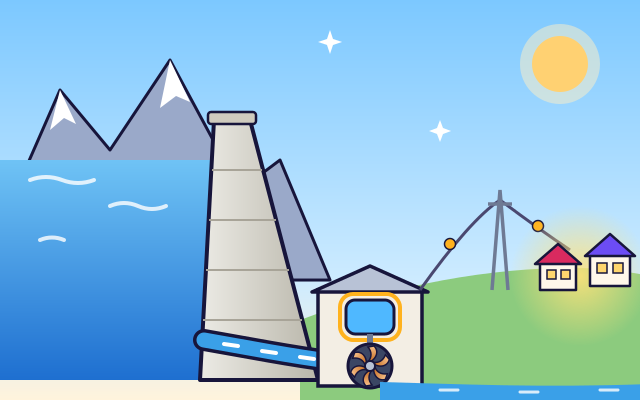
How does flowing water generate electricity?
Guide water through a hydroelectric turbine and generator. Adjust water flow and height in a simplified model and compare electricity output.
#48
Electricity & energy
How does flowing water generate electricity?
Guide water through a hydroelectric turbine and generator. Adjust water flow and height in a simplified model and compare electricity output.
 #376
Electricity & energy
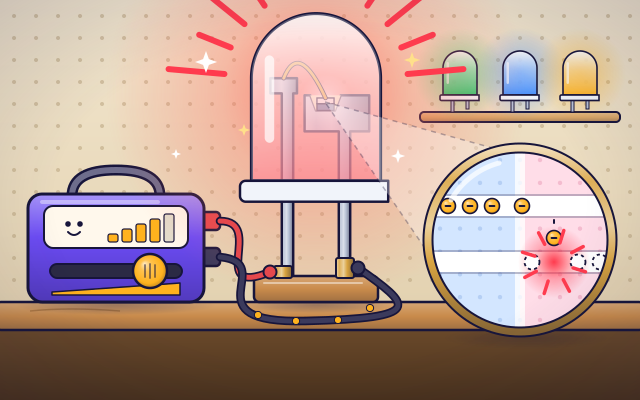
How do LEDs produce light?
Explore a simplified semiconductor junction as electrical energy becomes light.
#376
Electricity & energy
How do LEDs produce light?
Explore a simplified semiconductor junction as electrical energy becomes light.
 #377
Electricity & energy
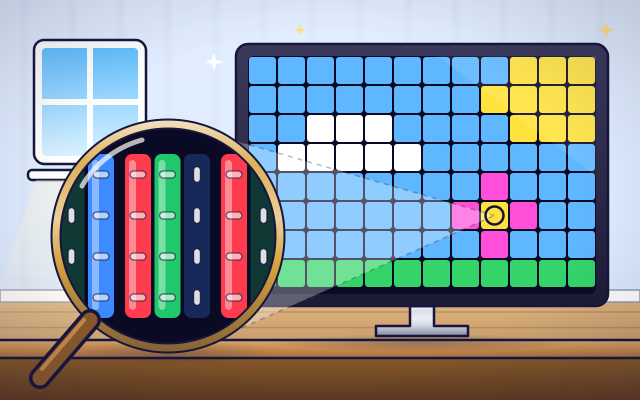
How do LCD screens make pictures?
Control tiny screen elements and color filters to build a pixel-based picture.
#377
Electricity & energy
How do LCD screens make pictures?
Control tiny screen elements and color filters to build a pixel-based picture.
 #378
Electricity & energy
How do transistors act as electronic switches?
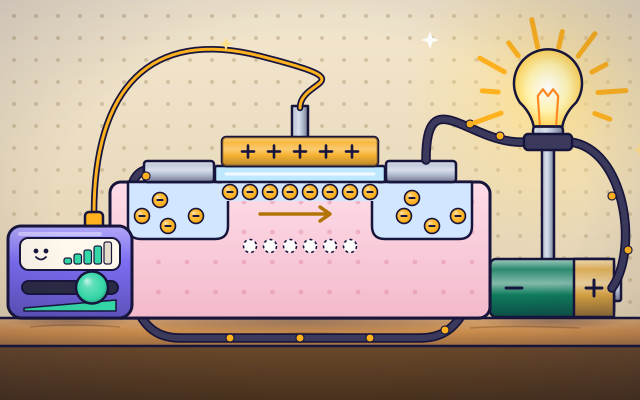
Use a small control signal to switch another current path in a model circuit.
#378
Electricity & energy
How do transistors act as electronic switches?
Use a small control signal to switch another current path in a model circuit.
Keep exploring
Games to play next
- Circuit Workshop 3DWire up batteries, bulbs and switches on a 3D workbench.
- SwitchworksFlip switches to light the lamps in the target pattern — in as few presses as you can.
- Machine RepairFix levers, pulleys, gears and ramps so every contraption works.
Guide for grown-ups
- How to start homeschooling: a step-by-step guide for familiesA guide for parents · 7 min read
Science games by grade
Science worksheets by grade
- Preschool Science Worksheets
- Pre-K Science Worksheets
- Kindergarten Science Worksheets
- 1st Grade Science Worksheets
- 2nd Grade Science Worksheets
- 3rd Grade Science Worksheets
- 4th Grade Science Worksheets
- 5th Grade Science Worksheets
- 6th Grade Science Worksheets
- 7th Grade Science Worksheets
- 8th Grade Science Worksheets