How do predators and prey affect each other?
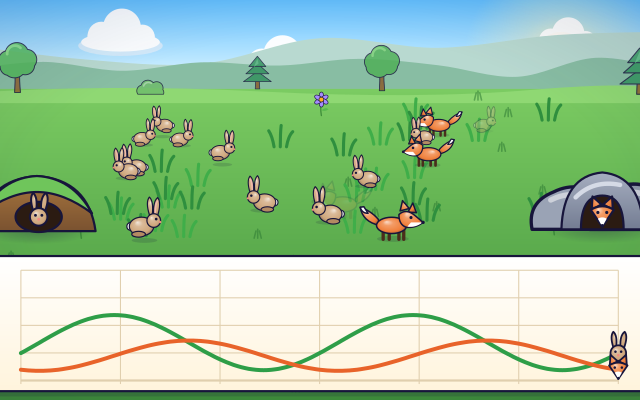
Foxes need rabbits to eat, and rabbits are kept in check by foxes. Watch their numbers chase each other up and down.
The big idea: Predators and prey control each other's numbers. More prey lets predators increase; more predators make prey decrease; then the predators run short of food and decrease too.
It's like two children on swings, one always a little behind the other. The foxes go up just after the rabbits go up, and come down just after them.
The interactive parts didn't load. The explanations below still work; try reloading the page.
Up and down together
- A fox is a predator: it hunts other animals for food. A rabbit is its prey. In this meadow, the number of each one changes from year to year. Why?
- With plenty of grass and only a few foxes, most baby rabbits survive. The number of rabbits climbs quickly. Watch the green line.
- Lots of rabbits means lots of food for foxes. More fox cubs survive, so the number of foxes climbs too, a little while after the rabbits.
- With so many foxes hunting, rabbits are eaten faster than they can have babies. The green line turns and falls.
- Now there is not enough food for all the foxes. Fewer cubs survive and some foxes move away. The orange line falls too.
- With few foxes left, the rabbits recover, and the whole story starts again. The two lines rise and fall like waves, with the foxes always a step behind.
The meadow and its graph
Tap each part of the meadow and each part of the graph to see how they match.
- Grass. Grass is the rabbits' food. A meadow has only so much of it, so even with no foxes the rabbits could not multiply forever.
- Rabbits (prey). Rabbits are the prey. They breed quickly: one pair can have many litters a year. That is how their numbers bounce back.
- Foxes (predators). Foxes are the predators. When food is easy to find, more cubs survive. When food is scarce, fewer cubs are born and some foxes leave.
- The rabbit line. The green line shows how many rabbits there are in each year. It climbs when foxes are few and drops when foxes are many.
- The fox line. The orange line shows how many foxes there are. It copies the shape of the rabbit line, but later, and there are always fewer foxes than rabbits.
- The gap between the peaks. The fox line reaches its top after the rabbit line does. Foxes need time to raise cubs, so they are always a step behind.
Meadow model: who follows who?
The meadow is already running. Tap the burrow to add rabbits or the den to add foxes, and watch the two lines. Or set the starting numbers and start again.
Experiment: You let lots of extra rabbits into the meadow. What happens to the foxes soon after?
- Watch the green rabbit line and the orange fox line for a while.
- Tap the burrow two or three times to add rabbits.
- Keep your eye on the orange line. What does it do, and when?
What we found: More rabbits means more food, so more fox cubs survive and the fox line climbs, a little after the rabbit line. Then the many foxes eat lots of rabbits, the rabbit line falls, and the fox line falls after it.
Turn on JavaScript to try it yourself.
Find the balance
Choose starting numbers of rabbits and foxes, then run 20 years. Keep both lines above the red danger lines.
Hunters, hunted and balance
A predator is an animal that hunts other animals for food. The animals it hunts are its prey. Foxes and rabbits, owls and mice, ladybugs and aphids: each pair is linked, because the predator cannot live without the prey.
Imagine a meadow with lots of rabbits and only a few foxes. The foxes find food easily, so more of their cubs survive, and the number of foxes goes up. But more foxes eat more rabbits. Soon rabbits are being eaten faster than new ones are born, and the number of rabbits goes down.
Now the foxes are in trouble. With fewer rabbits there is not enough food, fewer cubs survive and some foxes move away. The number of foxes goes down. That makes life safer for rabbits, so their numbers climb again, and the cycle starts over. On a graph it looks like two waves, with the fox wave a little behind the rabbit wave.
This is one way nature stays in balance. Without foxes, rabbits could eat a meadow bare and then starve. Without rabbits, the foxes would have nothing to eat. The model in Try it is simplified: real foxes eat many kinds of food, and weather and disease matter too. Like the swings in the comparison, real numbers do not move as smoothly as the model's.
Key words
- Predator
- An animal that hunts and eats other animals.
- Prey
- An animal that is hunted and eaten by a predator.
- Population
- All the animals of one kind living in one place.
- Cycle
- A pattern that repeats: up, down, up, down.
- Carrying capacity
- The largest number of animals a place can feed.
- Model
- A simple copy of something real that helps us understand it.
Check your thinking
-
What is a predator?
Show the answer
An animal that hunts other animals for food. Predators hunt. The animals they hunt are called prey.
-
The rabbits in a meadow have a very good year. What happens to the foxes next?
Show the answer
Their numbers go up, because there is more food for cubs. More prey means more food, so more predator young survive.
-
Why does the fox line reach its top after the rabbit line?
Show the answer
It takes time for extra food to become extra grown-up foxes. Cubs have to be born and grow up, so the foxes are always a step behind.
-
All the foxes are taken out of a meadow. What is most likely to happen?
Show the answer
Rabbits multiply until they run short of grass. With no hunters the rabbits increase, but a meadow has only so much grass.
-
You start the model exactly at its balance point. What do the two curves do?
Show the answer
They stay flat. At the balance point births equal deaths for both species, so neither population changes.
-
Why is the meadow model simpler than a real meadow?
Show the answer
Real foxes eat many foods, and weather and disease also change the numbers. A model keeps only the main idea. Real life has many more things going on.
You're a Plants & ecosystems expert!
You watched, looked inside, tried it, solved the challenge and went deeper. Pick another question below, or switch the age at the top to see this topic another way.
More about plants & ecosystems
 #244
Plants & ecosystems
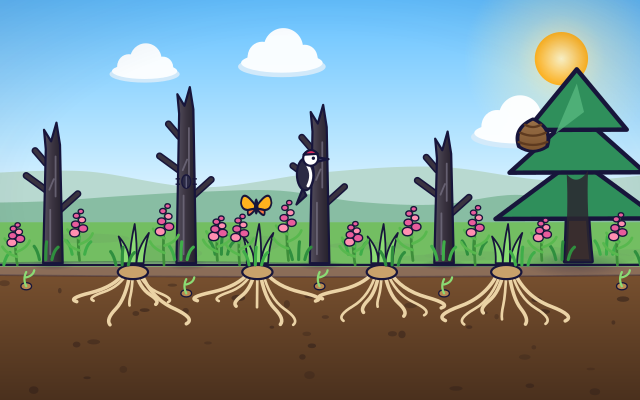
How does a forest recover after a fire?
Follow surviving roots, arriving seeds, and returning animals through a recovery timeline.
#244
Plants & ecosystems
How does a forest recover after a fire?
Follow surviving roots, arriving seeds, and returning animals through a recovery timeline.
 #245
Plants & ecosystems
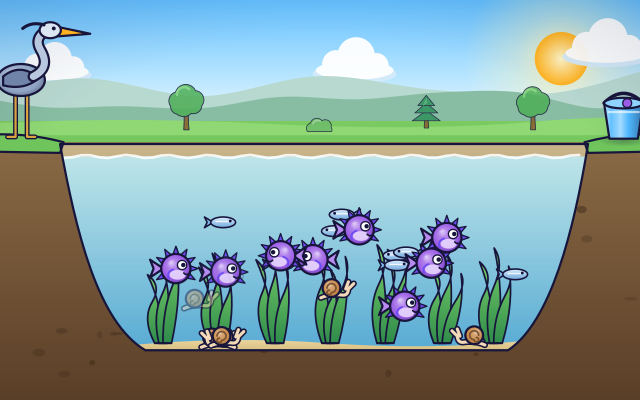
How can an invasive species change an ecosystem?
Introduce a fictional species and investigate changes in competition and food relationships.
#245
Plants & ecosystems
How can an invasive species change an ecosystem?
Introduce a fictional species and investigate changes in competition and food relationships.
 #246
Plants & ecosystems
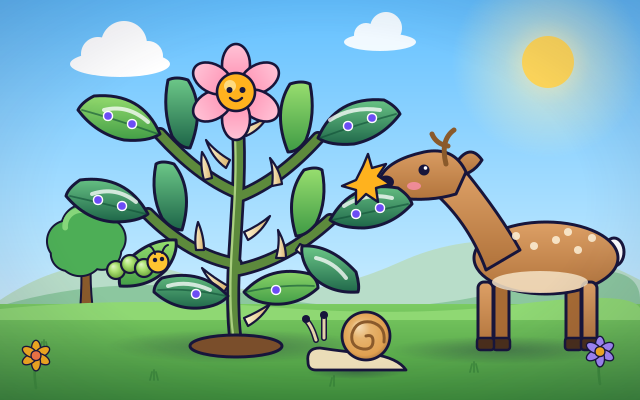
How do plants defend themselves?
Compare thorns, tough leaves, and defensive chemicals against different plant-eating visitors.
#246
Plants & ecosystems
How do plants defend themselves?
Compare thorns, tough leaves, and defensive chemicals against different plant-eating visitors.
 #247
Plants & ecosystems
How do trees survive winter?
Follow seasonal changes in buds, leaves, and growth in selected tree species.
#247
Plants & ecosystems
How do trees survive winter?
Follow seasonal changes in buds, leaves, and growth in selected tree species.
Keep exploring
Games to play next
- Habitat Builder 3DFind the right home for frogs, camels, polar bears and more.
- Classification ExplorerSort living things by what you can see, then follow and build yes-or-no keys.
- Label LabPut the right labels on beautiful science diagrams, from bean plants to heart chambers.
Guide for grown-ups
- How to start homeschooling: a step-by-step guide for familiesA guide for parents · 7 min read
Science games by grade
Science worksheets by grade
- Preschool Science Worksheets
- Pre-K Science Worksheets
- Kindergarten Science Worksheets
- 1st Grade Science Worksheets
- 2nd Grade Science Worksheets
- 3rd Grade Science Worksheets
- 4th Grade Science Worksheets
- 5th Grade Science Worksheets
- 6th Grade Science Worksheets
- 7th Grade Science Worksheets
- 8th Grade Science Worksheets