How do screw threads hold things together?
A screw's thread is a ramp wrapped around a rod. Every turn moves the screw one small step forward, and the wood grips every loop.
The big idea: A screw thread is a ramp wrapped around a rod. One full turn moves the screw forward by the gap between two threads, and the threads hook into the wood so it cannot slide out.
It's like a winding road up a mountain: it goes around and around so each step is easy, but the trip is longer than climbing straight up.
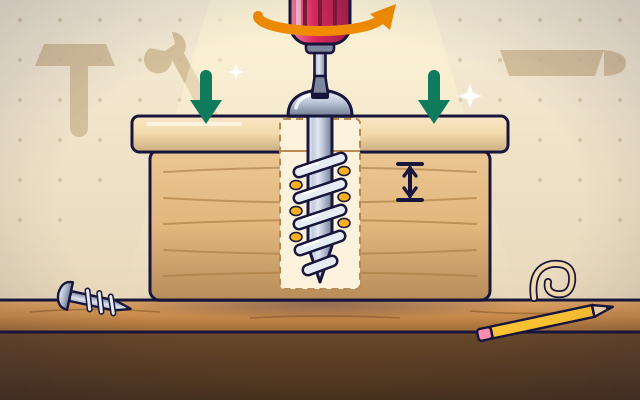
The interactive parts didn't load. The explanations below still work; try reloading the page.
How a screw pulls itself in
- Leo nailed the roof onto his birdhouse. But a nail is smooth. When the roof is pulled up, only rubbing holds the nail, and it slides straight out.
- Take a paper ramp and wrap it around a pencil. The sloping edge becomes a spiral called a thread. A screw is a ramp that goes around and around.
- Turn the screw once and the wood slides one loop along the ramp. So one full turn moves the screw forward by exactly the gap between two threads.
- Wood fibers fill the gaps between the threads. To pull the screw straight out, you would have to tear all of that wood. The only easy way out is to turn it backward.
- Threads far apart make a steep ramp: few turns, but each turn is hard. Threads close together make a gentle ramp: easy turns, but many more of them.
- Jar lids, bottle caps, light bulbs, and nuts and bolts all use threads. Each one turns round and round to move a little and hold on tight.
Look inside a screwed joint
The wood is cut open so you can see the whole screw. Tap each part to see what it does.
- Head. The head is wider than the hole, so it cannot follow the rest of the screw in. When it lands, it presses the top board down against the bottom one.
- Slot and screwdriver. The tip of the screwdriver fits into a slot in the head. The slot lets the screwdriver grip the screw and turn it without slipping.
- Smooth shank. Just under the head the screw is smooth. This part slides freely through the top board, so the threads below can pull the two boards tightly together.
- Thread. The thread is a ramp wrapped around the screw. As the screw turns, the wood slides along this ramp and the screw is pulled forward.
- Thread spacing. The gap from one thread to the next is called the pitch. Every full turn moves the screw forward by one pitch.
- Sharp point. The sharp point pushes into the wood and starts the hole. The first small threads then begin to pull the rest of the screw in.
- Wood between the threads. Wood fills every gap between the threads. That is why the screw cannot be pulled straight out: the wood is in the way of every loop.
Wide threads or close threads?
Tap each screwdriver to give it one full turn. Watch how far each screw moves, and how hard it is to turn.
Experiment: Two screws are the same length. Which one needs more turns to go all the way in?
- Tap each screwdriver once. Which screw moved farther?
- Keep turning until both heads touch the board. Count the turns.
- Switch to hard oak. Which screw can you still turn?
What we found: The screw with close threads needs more turns, because each turn moves it only one small gap forward. But its ramp is gentler, so each turn is easier. In hard oak the wide threads are too hard to turn, while the close threads still go in.
Turn on JavaScript to try it yourself.
Fewest turns
Drive three screws to fix the birdhouse: into pine, oak, then pine. Pick wide or close threads for each. Use as few turns as you can.
Why a screw holds so well
A screw is one of the six simple machines. Its secret is the thread: the ridge that winds around it. If you could unwrap the thread, you would get a long, thin ramp. So a screw is really a ramp wrapped around a rod.
A ramp lets you lift something heavy with a small push, as long as you go a long way. A screw does the same thing in a circle. Your hand goes all the way around, which is a long trip, and the screw moves forward just a little: the gap between two threads. That long trip for a small step is why a gentle twist can push a screw into solid wood.
The spacing of the threads sets the trade. Threads that are close together make a gentle ramp, so the screw is easy to turn but needs many turns. Threads that are far apart make a steep ramp: fewer turns, but each one is harder.
A screw holds well for two reasons. Wood fills the gaps between the threads, so the screw cannot be pulled straight out. And rubbing, called friction, along the whole long thread stops it from turning backward by itself. The mountain road comparison stops working here: a car can roll back down a road, but a screw stays where you leave it.
Key words
- Thread
- The spiral ridge that winds around a screw. It is a ramp wrapped around a rod.
- Pitch
- The gap from one thread to the next. One full turn moves the screw this far.
- Torque
- A twisting force, like the twist your hand gives a screwdriver.
- Inclined plane
- A ramp: a sloping surface that trades a longer distance for a smaller force.
- Friction
- The rubbing force between surfaces. It stops a screw from turning backward by itself.
- Self-locking
- Staying in place under load without being held, because friction is larger than the force trying to undo it.
Check your thinking
-
How far does a screw move forward in one full turn?
Show the answer
The gap between two threads. In one turn the wood slides once around the ramp, which is one thread gap.
-
What would you get if you could unwrap a screw's thread?
Show the answer
A long, thin ramp. A thread is an inclined plane, a ramp, wound around a rod.
-
Two screws are the same length. One has threads that are close together. What is true about it?
Show the answer
It needs more turns, but each turn is easier. Close threads make a gentle ramp: a small step for each easy turn.
-
Why is a screw harder to pull out than a nail?
Show the answer
Wood fills the gaps between its threads and blocks the way. A smooth nail only rubs against the wood. A screw's threads are hooked behind the wood.
-
A screwdriver handle has a radius of 20 mm, and the screw's pitch is 4 mm. What is the ideal mechanical advantage?
Show the answer
About 31. Ideal mechanical advantage = 2πr ÷ p = (2 × 3.14 × 20) ÷ 4, which is about 31.
-
The wood is very hard and your screw is too hard to turn. What would help?
Show the answer
A screw with threads closer together. Closer threads make a gentler ramp, so each turn is easier. You just need more turns.
You're a Forces & mechanisms expert!
You watched, looked inside, tried it, solved the challenge and went deeper. Pick another question below, or switch the age at the top to see this topic another way.
More about forces & mechanisms
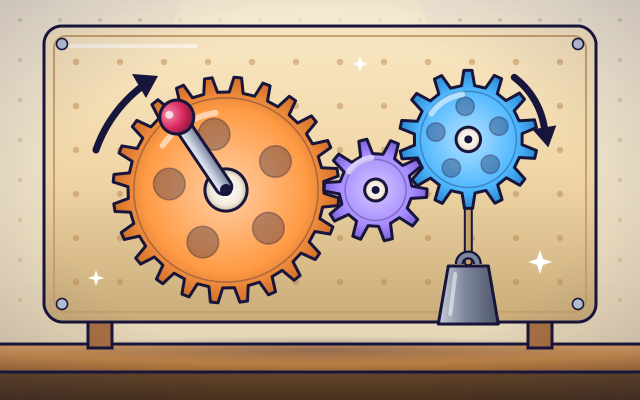 #108
Forces & mechanisms
How do gears change speed and direction?
Connect different-sized gears and observe rotation speed, direction, and turning force.
#108
Forces & mechanisms
How do gears change speed and direction?
Connect different-sized gears and observe rotation speed, direction, and turning force.
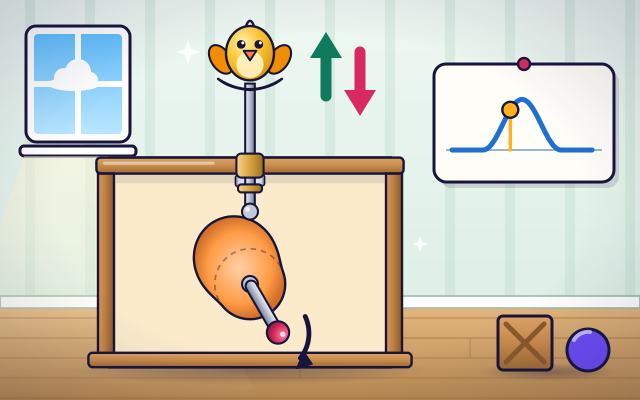 #109
Forces & mechanisms
How do cams create repeating movements?
Rotate differently shaped cams and watch connected parts rise, pause, and fall.
#109
Forces & mechanisms
How do cams create repeating movements?
Rotate differently shaped cams and watch connected parts rise, pause, and fall.
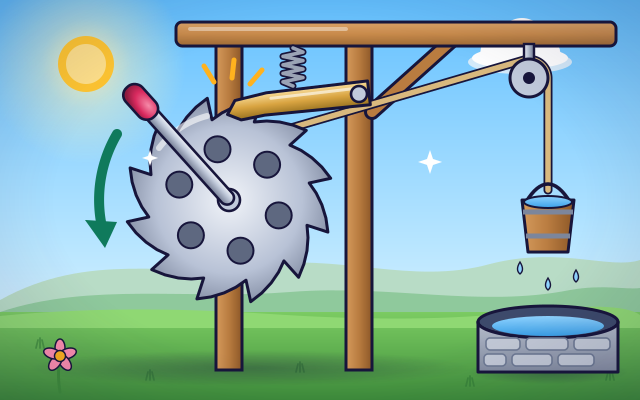 #110
Forces & mechanisms
How do ratchets allow movement in only one direction?
Explore a toothed wheel and pawl, then build a mechanism that prevents backward movement.
#110
Forces & mechanisms
How do ratchets allow movement in only one direction?
Explore a toothed wheel and pawl, then build a mechanism that prevents backward movement.
 #111
Forces & mechanisms
How do springs store and release energy?
Stretch or compress virtual springs and compare the movement produced when released.
#111
Forces & mechanisms
How do springs store and release energy?
Stretch or compress virtual springs and compare the movement produced when released.
Keep exploring
Games to play next
- Machine RepairFix levers, pulleys, gears and ramps so every contraption works.
- Marble MountainLay straights, curves, drops and splitters to roll marbles down the mountain.
- Bridge LabBuild a bridge from beams, brace it with triangles, and stay on budget.
Guide for grown-ups
- How to start homeschooling: a step-by-step guide for familiesA guide for parents · 7 min read
Science games by grade
Science worksheets by grade
- Preschool Science Worksheets
- Pre-K Science Worksheets
- Kindergarten Science Worksheets
- 1st Grade Science Worksheets
- 2nd Grade Science Worksheets
- 3rd Grade Science Worksheets
- 4th Grade Science Worksheets
- 5th Grade Science Worksheets
- 6th Grade Science Worksheets
- 7th Grade Science Worksheets
- 8th Grade Science Worksheets