How do satellites stay in orbit?
Satellites don't float. They fall around Earth! Launch your own and find the speed that makes an orbit.
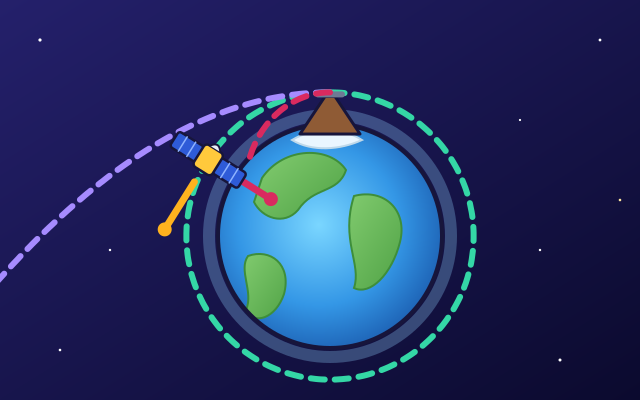
The big idea: Gravity always pulls a satellite toward Earth. But the satellite moves sideways so fast that, as it falls, Earth's round surface curves away beneath it. It keeps falling around Earth: that is an orbit. Too slow and it falls back; too fast and it flies away.
It's like
The interactive parts didn't load. The explanations below still work; try reloading the page.
How do satellites stay up?
- When you throw a ball, gravity pulls it down and it lands. Throw it faster and it travels farther before it hits the ground.
- Imagine launching from a mountain so tall it reaches above the air. Each faster launch lands farther away, partway around the curved Earth.
- If it goes fast enough, Earth curves away as fast as it falls. It never lands! It keeps falling around Earth. That is an orbit.
- Two things make an orbit: gravity pulling toward Earth, and speed carrying the satellite sideways. Without gravity it would zoom off in a straight line.
- Low satellites must go very fast and circle Earth in about an hour and a half. Higher ones can go slower and take much longer to go around.
- Launch even faster and the path stretches into a long oval. Faster still, and it escapes Earth's pull and never comes back.
Inside a satellite
Tap each part of the satellite. Many of them move when you find them!
- Solar panels. Solar panels turn sunlight into electricity. They turn to face the Sun as the satellite goes around Earth.
- Batteries. When the satellite passes through Earth's shadow, there is no sunlight. Batteries charged in the sunshine keep everything running.
- Antenna. The dish antenna sends and receives radio signals, carrying TV, phone calls or pictures down to Earth.
- Thrusters. Small rocket thrusters give tiny pushes to adjust the orbit and keep the satellite where it should be.
- Fuel tank. The fuel tank feeds the thrusters. When the fuel runs out, the satellite can no longer adjust its orbit.
- Computer. An onboard computer runs the satellite, checking temperatures, power and position and following commands from Earth.
- Camera. Some satellites carry cameras or sensors that watch the weather, map the land and track storms.
- Spinning wheel. A heavy wheel inside spins one way, and the satellite slowly turns the other way. It helps point the camera and antenna.
Launch lab: too slow, just right, too fast
Change the sideways speed and the starting height. Each change launches a new satellite. Compare the paths: which ones fall, which orbit and which escape?
Experiment: What happens as you launch faster and faster?
- Set the speed to slow and watch the path.
- Slowly speed it up. When does it go all the way around?
- Try very fast. Then try another height.
What we found: Too slow, and gravity pulls the satellite back to Earth. At just the right speed it falls all the way around: an orbit. Faster makes a stretched-out orbit, and much faster lets it escape into space!
Turn on JavaScript to try it yourself.
Weather satellite ring
Launch the weather satellite so it orbits inside the green ring all the way around Earth.
Why satellites don't fall down
Gravity doesn't switch off in space. At the height of the space station, gravity is still almost as strong as on the ground. So why don't satellites fall down? The surprise is that they do fall, all the time. They just move sideways so fast that they keep missing Earth.
Imagine throwing a ball from a mountain so tall it pokes out of the air. A slow throw lands nearby. A faster one lands farther away, partway around Earth's curve. If you could throw fast enough, about 8 kilometers every second near Earth, the ground would curve away just as fast as the ball falls. It would go all the way around and come back to you: an orbit!
Satellites far from Earth feel weaker gravity, so they can go slower. A satellite close to Earth zooms around in about an hour and a half, but some satellites far away take a whole day, exactly as long as Earth takes to spin. They seem to hover over one spot, which is perfect for TV satellites.
Astronauts float inside the space station because they and the station are falling together. It's like the feeling at the top of a roller coaster drop, but it lasts the whole trip.
Key words
- Orbit
- The curved path of something falling around a planet or star.
- Gravity
- The pull that every mass has on every other mass. Earth's gravity pulls satellites toward its center.
- Escape speed
- The speed needed to break free of Earth's pull for good: about 11 km every second from the ground.
- Geostationary orbit
- A very high orbit where a satellite circles once a day, so it stays above the same spot.
- Free fall
- Moving under gravity alone. Everything falls together, so things inside feel weightless.
Check your thinking
-
Why doesn't a satellite fall down to Earth?
Show the answer
It moves sideways so fast that it keeps falling around Earth. It does fall, but Earth curves away beneath it, so it never lands.
-
What happens if a satellite is launched too slowly?
Show the answer
It falls back to Earth. Without enough sideways speed, gravity curves its path down into the ground.
-
Which satellite goes around Earth faster: a low one or a high one?
Show the answer
The low one. Gravity is stronger close to Earth, so low satellites must go faster to stay up.
-
Why do astronauts float in the space station?
Show the answer
They and the station are falling around Earth together. Everything inside falls at the same rate, so nothing presses on the floor.
-
A satellite orbits at r = 26,560 km (GPS). Using v = √(GM/r) with GM = 398,600 km³/s², about how fast does it travel?
Show the answer
About 3.9 km/s. √(398,600 ÷ 26,560) = √15.0 ≈ 3.9 km/s.
You're a Space & astronomy expert!
You watched, looked inside, tried it, solved the challenge and went deeper. Pick another question below, or switch the age at the top to see this topic another way.
More about space & astronomy
 #82
Space & astronomy
How do solar and lunar eclipses happen?
Align the Sun, Earth, and Moon. Compare the shadows in solar and lunar eclipses and investigate why an eclipse does not happen every month.
#82
Space & astronomy
How do solar and lunar eclipses happen?
Align the Sun, Earth, and Moon. Compare the shadows in solar and lunar eclipses and investigate why an eclipse does not happen every month.
 #83
Space & astronomy
How does a space station support astronauts?
Explore air, water, food, power, exercise, and waste systems. Manage a small station and discover how astronauts live and work in orbit.
#83
Space & astronomy
How does a space station support astronauts?
Explore air, water, food, power, exercise, and waste systems. Manage a small station and discover how astronauts live and work in orbit.
 #471
Space & astronomy
How does the Sun produce energy?
Explore a simplified fusion model and follow energy from the Sun toward Earth.
#471
Space & astronomy
How does the Sun produce energy?
Explore a simplified fusion model and follow energy from the Sun toward Earth.
 #472
Space & astronomy
How do auroras appear in the sky?
Follow charged particles, Earth's magnetic field, and light emitted high in the atmosphere.
#472
Space & astronomy
How do auroras appear in the sky?
Follow charged particles, Earth's magnetic field, and light emitted high in the atmosphere.
Keep exploring
Games to play next
- Seasons and SkiesFrom days of the week to Earth's tilt: dress for the weather, read the sky and discover why seasons happen.
- Globe ExplorerSpin a real 3D globe, flip to the flat map, and find continents, oceans and countries.
- Science QuizzesOlly's Science Quiz Show: plants, animals, the body, weather, space and more, for every grade.
Guide for grown-ups
- How to start homeschooling: a step-by-step guide for familiesA guide for parents · 7 min read
Science games by grade
Science worksheets by grade
- Preschool Science Worksheets
- Pre-K Science Worksheets
- Kindergarten Science Worksheets
- 1st Grade Science Worksheets
- 2nd Grade Science Worksheets
- 3rd Grade Science Worksheets
- 4th Grade Science Worksheets
- 5th Grade Science Worksheets
- 6th Grade Science Worksheets
- 7th Grade Science Worksheets
- 8th Grade Science Worksheets