Why does the Moon seem to change shape?
Why does the Moon change from a thin crescent to a big round full Moon? Move it around Earth and see for yourself.
The big idea: The Sun always lights half of the Moon. As the Moon travels around Earth, we see different amounts of that sunny half. That is why its shape seems to change: these shapes are called phases.
It's like
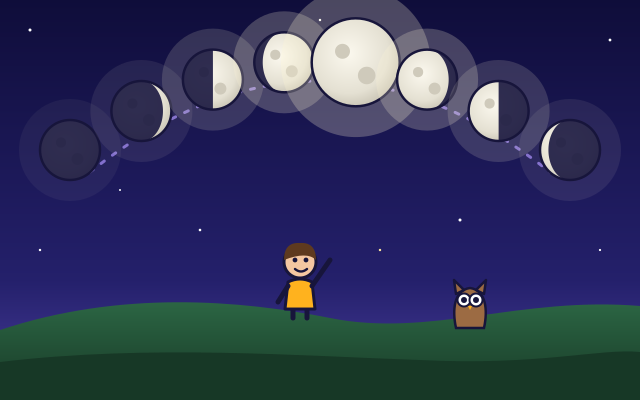
The interactive parts didn't load. The explanations below still work; try reloading the page.
Why does the Moon change shape?
- If you look at the Moon every night, its shape seems to change. First a thin crescent, then a half Moon, then a big round full Moon. How can that be?
- The Moon doesn't make its own light. Sunlight shines on it, so one half is always bright and the other half is dark, just like day and night on Earth.
- The Moon travels around Earth. Going from one full Moon to the next takes about 29 and a half days, which is where the word month comes from.
- Here is the secret. From Earth we only see the side of the Moon that faces us. As the Moon moves, more and more of its sunny half turns toward us.
- Some people think the dark part is Earth's shadow. But Earth's shadow points straight away from the Sun, and the Moon is almost never in it.
- The phases go in order: new Moon, crescent, first quarter, gibbous, full, then back down to new. Then it all starts again!
Eight Moons around Earth
Tap each Moon. The picture on the right shows how it looks from Earth.
- Sunlight. Sunlight comes from the Sun, far to the left. It always lights the half of the Moon that faces the Sun.
- Earth. We watch the Moon from Earth. Which part of the Moon we can see depends on where the Moon is in its orbit.
- New Moon. At new Moon the Moon is between Earth and the Sun. Its sunny side faces away from us, so it looks dark and is hidden in the Sun's glare.
- Waxing crescent. A few days later we see a thin sliver of the sunny half. Waxing means growing. Look for it in the west just after sunset.
- First quarter. A week after new Moon we see half of the Moon's face lit. It is called first quarter because the Moon is a quarter of the way around its orbit.
- Waxing gibbous. Gibbous means bulging. More than half of the face is lit, and it keeps growing night by night.
- Full Moon. At full Moon, the Moon is on the far side of Earth from the Sun. Its whole sunny half faces us, so it looks completely round.
- Waning gibbous. After full Moon, the lit part starts to shrink. Waning means getting smaller.
- Third quarter. Three weeks after new Moon we see a half Moon again, but now the other side is lit. You can often see it in the morning sky.
- Waning crescent. The last thin sliver before the next new Moon. Look for it in the east just before sunrise.
Two views of the Moon
Move the Moon around Earth. On the left, see its sunlit half from space. On the right, see what a kid on Earth sees. Can you make every phase?
Experiment: When the Moon is on the far side of Earth from the Sun, what shape do we see?
- Start with the Moon between Earth and the Sun (new Moon).
- Move it a quarter of the way around, then halfway around.
- Compare the space view with the ground view each time.
What we found: When the Moon is on the far side of Earth from the Sun, its whole sunny half faces us: a full Moon. When it is between us and the Sun, its sunny half faces away: a new Moon. In between we see crescents, half Moons and gibbous Moons.
Turn on JavaScript to try it yourself.
Phase match
Move the Moon to make each phase on the card, then press Match!
Where the phases come from
The Moon doesn't shine by itself. It is a big ball of rock, and we see it because sunlight bounces off it. The Sun always lights up one half of the Moon, the half facing the Sun, just as it lights up the daytime half of Earth.
The Moon travels around Earth about once a month. As it moves, we see different amounts of its sunny half. When the Moon is between Earth and the Sun, the sunny half faces away from us: that is a new Moon. When the Moon is on the far side of Earth, the whole sunny half faces us: a full Moon.
In between, we see part of the sunny half. A thin sliver is a crescent. Half of the face lit is a quarter Moon. More than half is a gibbous Moon. When the lit part is growing it is waxing, and when it is shrinking it is waning. The whole cycle takes about 29 and a half days.
The dark part of the Moon is not Earth's shadow. Earth's shadow points away from the Sun, and the Moon only passes through it during a lunar eclipse, which can only happen at full Moon.
Key words
- Phase
- The shape of the lit part of the Moon that we can see from Earth.
- Waxing and waning
- Waxing means the lit part is growing. Waning means it is shrinking.
- Crescent
- A phase when less than half of the Moon's face is lit, shaped like a thin curve.
- Gibbous
- A phase when more than half, but not all, of the Moon's face is lit.
- Synodic month
- The time from one full Moon to the next: about 29 and a half days.
Check your thinking
-
Where does the Moon's light come from?
Show the answer
Sunlight bouncing off it. The Moon reflects sunlight, like a mirror made of gray rock.
-
Where is the Moon during a full Moon?
Show the answer
On the far side of Earth from the Sun. Its whole sunlit half faces Earth, so we see a round, bright disc.
-
Is the dark part of a crescent Moon Earth's shadow?
Show the answer
No, it is the Moon's own night side. The dark part is the side of the Moon facing away from the Sun: the Moon's night.
-
How long is one full cycle of phases?
Show the answer
About 29 and a half days. From one new Moon to the next takes about 29.5 days.
-
The Moon's elongation is 60 degrees. About what fraction of its visible disc is lit?
Show the answer
About 25 percent. (1 − cos 60°) ÷ 2 = (1 − 0.5) ÷ 2 = 0.25.
-
From the Northern Hemisphere, a growing (waxing) Moon is lit on which side?
Show the answer
The right side. Waxing Moons are lit on the right as seen from the north. Remember: lit on the right, getting bright.
You're a Space & astronomy expert!
You watched, looked inside, tried it, solved the challenge and went deeper. Pick another question below, or switch the age at the top to see this topic another way.
More about space & astronomy
 #81
Space & astronomy
How do satellites stay in orbit?
Explore gravity and sideways motion in a simplified orbital simulation. Adjust a satellite's starting speed and height to compare its path.
#81
Space & astronomy
How do satellites stay in orbit?
Explore gravity and sideways motion in a simplified orbital simulation. Adjust a satellite's starting speed and height to compare its path.
 #82
Space & astronomy
How do solar and lunar eclipses happen?
Align the Sun, Earth, and Moon. Compare the shadows in solar and lunar eclipses and investigate why an eclipse does not happen every month.
#82
Space & astronomy
How do solar and lunar eclipses happen?
Align the Sun, Earth, and Moon. Compare the shadows in solar and lunar eclipses and investigate why an eclipse does not happen every month.
 #83
Space & astronomy
How does a space station support astronauts?
Explore air, water, food, power, exercise, and waste systems. Manage a small station and discover how astronauts live and work in orbit.
#83
Space & astronomy
How does a space station support astronauts?
Explore air, water, food, power, exercise, and waste systems. Manage a small station and discover how astronauts live and work in orbit.
 #471
Space & astronomy
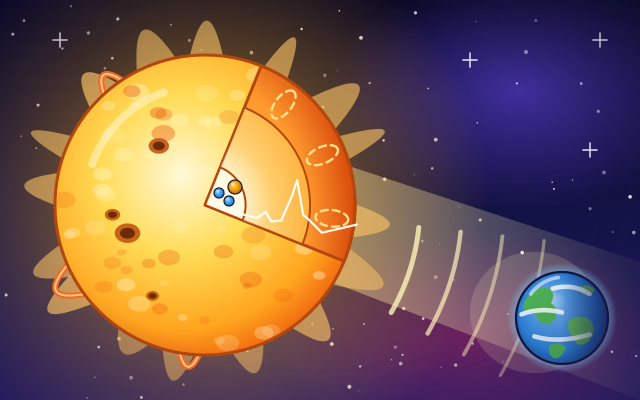
How does the Sun produce energy?
Explore a simplified fusion model and follow energy from the Sun toward Earth.
#471
Space & astronomy
How does the Sun produce energy?
Explore a simplified fusion model and follow energy from the Sun toward Earth.
Keep exploring
Games to play next
- Seasons and SkiesFrom days of the week to Earth's tilt: dress for the weather, read the sky and discover why seasons happen.
- Globe ExplorerSpin a real 3D globe, flip to the flat map, and find continents, oceans and countries.
- Science QuizzesOlly's Science Quiz Show: plants, animals, the body, weather, space and more, for every grade.
Guide for grown-ups
- How to start homeschooling: a step-by-step guide for familiesA guide for parents · 7 min read
Science games by grade
Science worksheets by grade
- Preschool Science Worksheets
- Pre-K Science Worksheets
- Kindergarten Science Worksheets
- 1st Grade Science Worksheets
- 2nd Grade Science Worksheets
- 3rd Grade Science Worksheets
- 4th Grade Science Worksheets
- 5th Grade Science Worksheets
- 6th Grade Science Worksheets
- 7th Grade Science Worksheets
- 8th Grade Science Worksheets