How do revolving doors help control airflow?
A revolving door is open to people but always closed to the wind. See how its wings trap just a small pocket of air.
The big idea: An ordinary door leaves a big hole in the wall whenever it is open, so cold air rushes in and warm air escapes. A revolving door's wings always touch its curved walls, so only one small pocket of air moves in with each person.
It's like passing things through a pet flap instead of opening the whole front door: something gets through, but the wind does not.
The interactive parts didn't load. The explanations below still work; try reloading the page.
Open to people, closed to wind
- It is a cold, windy day. Each time someone opens this ordinary door, a gust of cold air blows into the warm lobby. Brr!
- Seen from above, an open door is simply a hole in the wall. Cold air pushes in, and the warm air you paid to heat slips out.
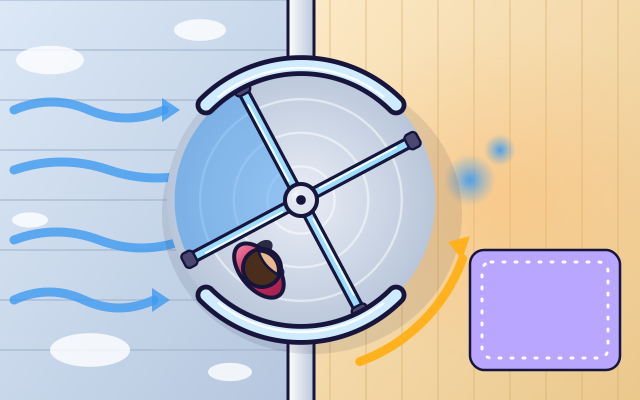
- A revolving door has four wings inside a round case. As it turns, at least two wings always touch the curved walls. There is never a clear path through.
- A person steps into one compartment and pushes. Only the air in that small compartment travels inside with them. The rest of the wind is left behind.
- Compare them. The swing door lets a big cloud of cold air in each time. The revolving door lets in only a small puff, so the lobby stays warm.
- In a tall building, warm air rises like smoke in a chimney and pulls cold air in at the bottom. Revolving doors stop that draft. A side door serves wheelchairs and strollers.
Look down on a revolving door
You are looking down from the ceiling. Tap each part to see it work.
- Wings. The four glass panels are called wings. You push one, and all four turn together like a pinwheel.
- Curved walls. Two curved walls stand on either side. The wings sweep along them. The gaps between the walls are where you walk in and out.
- Center shaft. The wings are fixed to a post in the middle called the shaft. It turns on bearings at the top and bottom.
- Brush seals. Soft brushes or rubber strips run along the edges of each wing. They brush the walls, floor and ceiling to close the small gaps.
- Compartment. The space between two wings is a compartment. It carries you, and one small pocket of air, from one side to the other.
- Speed control. A device above the door stops it from spinning too fast, even if someone pushes hard. That keeps everyone safe.
- Side door. Next to every revolving door is an ordinary wide door. People using wheelchairs, pushing strollers or carrying big loads use it.
Swing door or revolving door?
Send visitors through the swing door and through the revolving door. Watch the blue cold air and the lobby thermometer.
Experiment: Which door lets more cold air into the lobby each time someone comes in?
- Send one visitor through the swing door. Watch the blue air.
- Send one visitor through the revolving door.
- Compare the thermometer after each one.
What we found: The swing door lets a big gust of cold air in every time it opens, so the lobby cools quickly. The revolving door swaps only one small pocket of air, so the lobby stays warm.
Turn on JavaScript to try it yourself.
Everybody in, heat in too
Let every visitor in without letting the lobby drop below the cold line. Visitors on wheels need the side door.
Why revolving doors save heat
Buildings spend a lot of energy keeping the air inside comfortable: warm in winter and cool in summer. Every time an ordinary door opens, some of that air escapes and outdoor air takes its place. On a windy day you can feel it as a draft that sweeps across the lobby.
A revolving door solves the problem with a simple shape. Four wings turn inside a round case with two curved walls. However the wings are turned, at least two of them are touching the walls. So there is never an open path from outside to inside. Brushes along the edges of the wings close the last small gaps.
When you walk through, you ride in one compartment, the space between two wings. Only the air in that compartment comes in with you, and one compartment of indoor air goes out. That is far less than the gust that comes through an open swing door. Our comparison with a pet flap is not perfect, because a flap still opens a small hole for a moment, while a revolving door never opens at all.
Revolving doors are not right for everyone. They are too tight for wheelchairs, strollers and big suitcases, so there is always a wide ordinary door beside them. Revolving doors also turn at a safe, limited speed. Used together, the two doors keep a building comfortable and welcoming to all.
Key words
- Revolving door
- A door with wings that turn inside a round case, so it is never fully open.
- Wing
- One of the turning panels of a revolving door.
- Compartment
- The space between two wings that carries a person, and one pocket of air, through the door.
- Draft
- A stream of outdoor air blowing into a room.
- Stack effect
- Warm air rising inside a tall building and pulling cold air in at the bottom, as in a chimney.
- Air exchange
- Indoor air leaving a building and outdoor air taking its place.
Check your thinking
-
Which door lets in less cold air each time a person enters?
Show the answer
A revolving door. A revolving door only swaps the air in one small compartment.
-
Why is there never a clear path through a revolving door?
Show the answer
At least two wings always touch the curved walls. However the wings are turned, some of them are always against the walls, blocking the way.
-
Why is there an ordinary door next to a revolving door?
Show the answer
For wheelchairs, strollers and big loads. A revolving door's compartments are too tight for wheels and large loads.
-
On a very windy day, which door's draft gets much worse?
Show the answer
The swing door's. Wind can blow straight through an open swing door, but it cannot get past the wings of a revolving door.
-
A swing door stays open for 4 seconds. Air flows through its 2 square meter opening at 1 meter per second. About how much air is exchanged?
Show the answer
About 8 cubic meters. Volume is area times speed times time: 2 × 1 × 4 = 8 cubic meters, several compartments' worth.
You're a Buildings & city systems expert!
You watched, looked inside, tried it, solved the challenge and went deeper. Pick another question below, or switch the age at the top to see this topic another way.
More about buildings & city systems
 #199
Buildings & city systems
How do automatic fire sprinklers release water?
Warm a model sprinkler's heat-sensitive element and watch that individual sprinkler open.
#199
Buildings & city systems
How do automatic fire sprinklers release water?
Warm a model sprinkler's heat-sensitive element and watch that individual sprinkler open.
 #351
Buildings & city systems
How do escalators move their steps?
Look beneath the surface and follow linked steps circulating around the mechanism.
#351
Buildings & city systems
How do escalators move their steps?
Look beneath the surface and follow linked steps circulating around the mechanism.
 #352
Buildings & city systems
How does airport luggage reach the correct plane?
Scan baggage tags and guide bags through conveyors, sorting points, and loading areas.
#352
Buildings & city systems
How does airport luggage reach the correct plane?
Scan baggage tags and guide bags through conveyors, sorting points, and loading areas.
 #353
Buildings & city systems
How do shipping ports move containers?
Transfer containers between ships, storage yards, trains, and trucks.
#353
Buildings & city systems
How do shipping ports move containers?
Transfer containers between ships, storage yards, trains, and trucks.
Keep exploring
Games to play next
- Bridge LabBuild a bridge from beams, brace it with triangles, and stay on budget.
- Area ArchitectDesign rooms that hit the area and perimeter on the blueprint.
- Geometry Architect 3DCount, build and fold solids like a real architect.
Guide for grown-ups
- How to start homeschooling: a step-by-step guide for familiesA guide for parents · 7 min read
Science games by grade
Science worksheets by grade
- Preschool Science Worksheets
- Pre-K Science Worksheets
- Kindergarten Science Worksheets
- 1st Grade Science Worksheets
- 2nd Grade Science Worksheets
- 3rd Grade Science Worksheets
- 4th Grade Science Worksheets
- 5th Grade Science Worksheets
- 6th Grade Science Worksheets
- 7th Grade Science Worksheets
- 8th Grade Science Worksheets