How can clothing be waterproof and breathable?
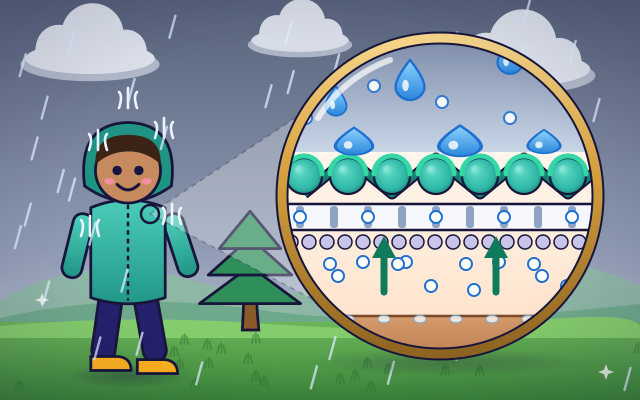
A rain jacket hides a layer with millions of tiny holes: too small for raindrops, but big enough for sweat vapor to escape.
The big idea: A raindrop is a huge crowd of water bits holding together. Sweat vapor is single bits flying alone. Holes of just the right size stop one and let the other through.
It's like a window screen: big bugs cannot get in, but the fresh air goes in and out as it likes.
The interactive parts didn't load. The explanations below still work; try reloading the page.
Rain out, sweat out
- Rain is pouring down, but the drops roll off this jacket. Walking fast makes you warm, and your skin makes sweat. If the sweat stays inside the jacket, you get wet anyway. So a good jacket has two jobs.
- The trick is that these are two kinds of water. A raindrop is liquid: a huge crowd of tiny water bits, all holding on to each other. Sweat dries into water vapor: the same bits, but each one flying alone.
- Here is plain cotton cloth, cut through. The threads love water. Raindrops soak into them and creep through the gaps, all the way to your skin. Cotton lets sweat out, but it lets rain in.
- A sheet of plastic has no holes at all. Rain cannot get in. But the vapor from your sweat cannot get out. It builds up, turns back into drops on the inside, and you feel wet and sticky.
- This thin layer is called a membrane. It is full of holes thousands of times smaller than a raindrop. Drops cannot squeeze in. But single bits of vapor are far smaller than the holes, so they drift straight through.
- A jacket is a sandwich. The outer fabric is tough and makes drops roll off. The membrane in the middle does the clever sorting. A soft lining protects it from your skin. Together they keep you dry from both sides.
Look inside rain-jacket fabric
This is jacket fabric cut through and made much bigger. Rain is above and your skin is below. Tap each part.
- Water-repellent finish. A very thin finish on the outer threads. Water does not cling to it, so raindrops pull into round beads and roll off instead of soaking in.
- Outer fabric. A strong woven fabric, often nylon or polyester. It takes the scrapes from backpacks, rocks and branches and protects the thin layer underneath.
- Membrane. A very thin sheet, thinner than a hair, stuck to the back of the outer fabric. It is full of tiny holes. This is the layer that keeps rain out and lets vapor through.
- Pore. One of the tiny holes in the membrane. It is thousands of times smaller than a raindrop, so drops stay out. But it is hundreds of times wider than a bit of water vapor.
- Lining. A soft inner layer. It feels nicer on your skin, and it keeps sweat, oil and rubbing away from the delicate membrane.
- Taped seam. Sewing pokes thousands of needle holes through the fabric, and each one is much bigger than a pore. A strip of waterproof tape is melted over every seam to seal them.
Test three fabrics
Pick a fabric. Tap the cloud for rain and the warm skin for sweat. Which fabric keeps rain out and lets sweat out?
Experiment: A plastic cape keeps out every drop of rain. Will you stay dry inside it on a long, fast walk?
- Choose the cotton shirt. Tap the cloud, then the warm skin.
- Do the same with the plastic cape and then with the rain jacket.
What we found: Cotton lets sweat out but lets rain in. Plastic keeps rain out but traps sweat, which turns back into water inside. Only the jacket's tiny holes sort the two: drops stay out and vapor escapes.
Turn on JavaScript to try it yourself.
Build a storm jacket
Choose the layers for a jacket, then test it on a rainy uphill hike. The hiker must stay dry from rain and from sweat.
Sorting drops from vapor
Staying dry in the rain sounds easy: wear something that water cannot get through, like a plastic bag. But try running in a plastic cape. After a few minutes you are wet anyway, from the inside. Your body cools itself by making sweat, and the sweat has nowhere to go.
The answer comes from looking at water very closely. Water is made of unimaginably tiny bits called molecules. In liquid water, the molecules cling to each other, so even a small raindrop is a crowd of more molecules than you could ever count. When sweat dries, the molecules let go of each other and float off into the air one by one. That is water vapor. You cannot see it.
A rain jacket has a very thin layer called a membrane, hidden between the outer fabric and the lining. The membrane is full of holes that are thousands of times smaller than a raindrop. A drop cannot break apart to squeeze through, so the rain stays outside. But each hole is still hundreds of times wider than a single molecule, so vapor passes through as if the membrane were hardly there.
The other layers help. The outer fabric has a finish that makes drops roll off. Without it the fabric soaks, and a sheet of water covers the holes. Tape seals the needle holes along the seams. And if you work very hard, you can still make sweat faster than any jacket can let it out. The fence comparison breaks down a little here: drops are not hard balls. They stay out because the membrane pushes water away, and the drop holds itself together.
Key words
- Membrane
- A very thin sheet that lets some things through and stops others.
- Water vapor
- Water as an invisible gas: single water molecules mixed into the air.
- Breathable
- Letting water vapor pass through, so sweat can escape.
- Surface tension
- The pull between water molecules that makes drops round, like a stretchy skin.
- Condense
- To turn from vapor back into liquid drops.
Check your thinking
-
Why can a raindrop not pass through the membrane?
Show the answer
The drop is thousands of times bigger than the holes. The water in a drop clings together, and the whole drop is far too big for the holes.
-
Why do you get wet inside a plastic cape when you run?
Show the answer
Your sweat vapor cannot escape, so it turns back into water. Plastic has no holes at all. The vapor builds up and condenses on the inside.
-
An old jacket no longer makes drops roll off. Its outer fabric gets soaked. What changes?
Show the answer
The wet fabric covers the tiny holes, so sweat cannot escape as well. The membrane still stops the rain, but a sheet of water on top blocks the way out for vapor.
-
In our model, what happens to the pressure a membrane can hold back if its pores are made twice as wide?
Show the answer
It halves. The entry pressure is 4γ·|cos θ| ÷ d, so it is inversely proportional to the pore diameter.
-
Why does any breathable jacket work poorly on a hot, humid day?
Show the answer
The air outside is nearly as humid as the air inside, so little vapor diffuses out. Diffusion is driven by the difference in vapor concentration. With little difference, there is little net flow.
You're a Everyday chemistry & materials expert!
You watched, looked inside, tried it, solved the challenge and went deeper. Pick another question below, or switch the age at the top to see this topic another way.
More about everyday chemistry & materials
 #414
Everyday chemistry & materials
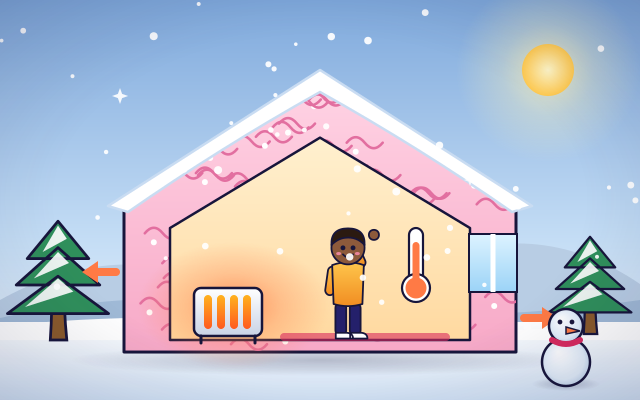
How does insulation slow heat loss?
Compare materials and trapped air around a model home or lunch container.
#414
Everyday chemistry & materials
How does insulation slow heat loss?
Compare materials and trapped air around a model home or lunch container.
 #415
Everyday chemistry & materials
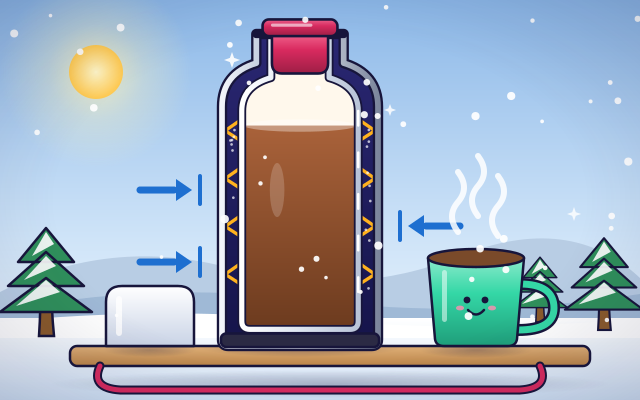
How does a vacuum flask keep drinks hot or cold?
Inspect the vacuum gap, reflective surfaces, and lid while tracking heat transfer.
#415
Everyday chemistry & materials
How does a vacuum flask keep drinks hot or cold?
Inspect the vacuum gap, reflective surfaces, and lid while tracking heat transfer.
 #416
Everyday chemistry & materials
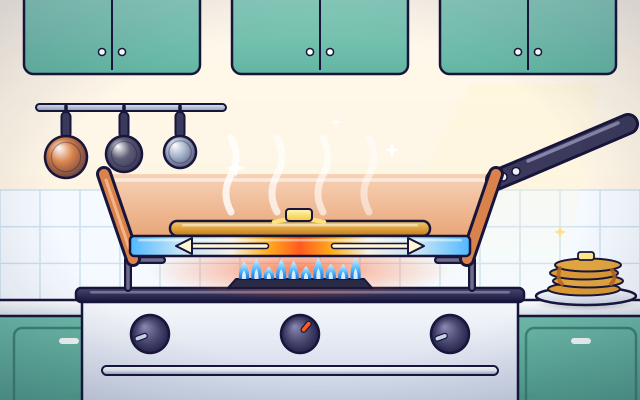
How do cooking pans transfer heat?
Compare metal types and watch heat spread from a burner through a pan.
#416
Everyday chemistry & materials
How do cooking pans transfer heat?
Compare metal types and watch heat spread from a burner through a pan.
 #417
Everyday chemistry & materials
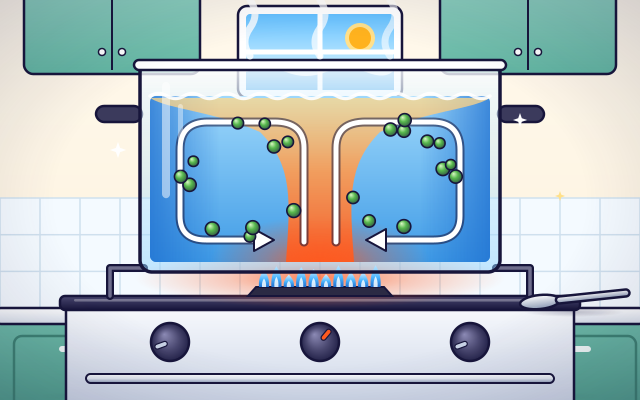
How does convection move heat through air and water?
Warm one region of a fluid and follow circulating currents.
#417
Everyday chemistry & materials
How does convection move heat through air and water?
Warm one region of a fluid and follow circulating currents.
Keep exploring
Games to play next
- Weather LabPredict the weather in a box, then run a fair test to find out why.
- Science QuizzesOlly's Science Quiz Show: plants, animals, the body, weather, space and more, for every grade.
- Ratio KitchenScale recipes, fill ratio tables and find the better buy.
Guide for grown-ups
- How to start homeschooling: a step-by-step guide for familiesA guide for parents · 7 min read
Science games by grade
Science worksheets by grade
- Preschool Science Worksheets
- Pre-K Science Worksheets
- Kindergarten Science Worksheets
- 1st Grade Science Worksheets
- 2nd Grade Science Worksheets
- 3rd Grade Science Worksheets
- 4th Grade Science Worksheets
- 5th Grade Science Worksheets
- 6th Grade Science Worksheets
- 7th Grade Science Worksheets
- 8th Grade Science Worksheets