How does our sense of smell work?
Smelly things give off tiny particles that float into your nose. They fit into special receptors, and your brain reads the pattern they make to tell you what you are smelling.
The big idea: A smell is made of particles too small to see. High inside your nose, each kind of particle fits only certain receptors, like a key in a lock. Every smell switches on its own set of receptors, and your brain recognizes the set.
It's like playing a chord on a piano: each smell presses its own set of keys at once, and your brain knows which chord it hears.
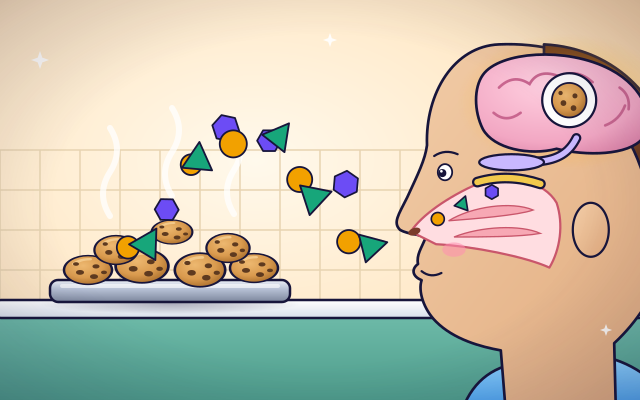
The interactive parts didn't load. The explanations below still work; try reloading the page.
How your sense of smell works
- Warm cookies have just come out of the oven. Sam is not even looking, but he knows at once. Something has travelled from the cookies to his nose. What is it?
- The cookies give off tiny particles, far too small to see. Warm things give off more of them. The particles drift through the air in every direction, and some drift toward Sam.
- When Sam breathes in, air carries the particles into his nose. A good sniff swirls them all the way up to a small patch at the very top, hidden behind the bridge of his nose.
- The patch is covered in millions of smell cells with receptors on them. A receptor works like a lock, and each kind of particle is a key that fits only some locks. When a key fits, the cell sends a signal.
- Cookie particles switch on one set of receptors. Lemon particles switch on a different set. Some receptors are shared, but the whole pattern is different for every smell.
- The signals travel along nerves to a smell bulb just above the nose, and on into the brain. The brain has seen this pattern before. It says: cookies! Smells can bring back memories, too.
Look inside the nose
We can see inside Sam's nose from the side. The magnifying glass shows the smell patch, much bigger. Tap every part.
- Nostril. The opening of the nose. Air, and the smell particles in it, come in here. Little hairs catch dust.
- Nose tunnel. A large space behind your nose, with curly shelves. It warms and wets the air, and swirls some of it up to the top.
- Smell patch. A small patch in the roof of the nose tunnel, about as big as a postage stamp. It holds millions of smell cells.
- Sticky layer. A thin layer of sticky liquid called mucus. Smell particles have to sink into it before they can reach the receptors.
- Receptors. The locks. Each kind of receptor fits only some kinds of particle. When one fits, the smell cell sends a signal.
- Smell bulb. A small part of the brain just above the nose. Signals from the smell cells arrive here and are sorted.
- Brain. The brain reads the pattern of signals and matches it to smells it has learned before. That is how you know it is cookies.
Sniff lab: which locks light up?
Choose a smell, drag it toward Sam's nose and press Sniff. Watch which receptors light up in the magnifying glass. Then try a different smell and compare the patterns.
Experiment: Lemon and orange smell different. Do they use completely different receptors?
- Sniff the lemon up close. Which receptors light up?
- Now sniff the orange. Which lights are the same? Which are different?
- Move a smell far away and sniff again. What changes?
What we found: Lemon and orange share two receptors and differ in one, and that one difference is enough for the brain to tell them apart. A smell is recognized by its whole pattern, not by a single receptor. Far away, fewer particles arrive, so the lights are dim and the brain is not sure.
Turn on JavaScript to try it yourself.
Smell detective: read the pattern
A mystery smell is under the lid. Its receptor pattern is on the top row. Tap a card to test-sniff that thing and see its pattern underneath. When the rows match, press That is it!
Keys, locks and patterns
Everything you can smell is giving off tiny particles into the air. A warm cookie, a flower, a wet dog and a pair of old socks are all losing particles too small to see. When you breathe in, the air carries some of them into your nose.
High up inside your nose, behind the bridge, is a small patch covered in a thin, sticky layer of mucus. Millions of smell cells live there. Each one has receptors that work like locks. A particle is like a key: it fits some locks and not others. When a key fits, the cell sends a tiny electrical signal toward your brain.
Here is the clever part. You have about 400 kinds of receptor, but you can tell apart far more smells than that. That works because a smell does not use just one kind of receptor. It switches on a whole set of them. Lemon switches on one set and orange a slightly different set. Your brain reads the whole pattern, like a chord of notes played together on a piano.
Smell helps you enjoy food, notice smoke and tell if milk has gone bad. When you have a cold, swelling and thick mucus stop the particles reaching the patch, so food seems dull. Our piano comparison is not perfect: a piano has 88 keys in a neat row, but your nose has millions of cells spread over the patch, and the brain has to learn each pattern by experience.
Key words
- Odor molecule
- A tiny particle given off by something smelly. It floats in the air.
- Receptor
- A tiny lock on a smell cell. Only certain particles fit it.
- Mucus
- The thin, sticky liquid that lines the inside of your nose.
- Olfactory bulb
- The smell bulb: the part of the brain, just above the nose, that receives smell signals first.
- Adaptation
- Getting used to a smell so that you stop noticing it.
Check your thinking
-
What travels from a cookie to your nose so that you can smell it?
Show the answer
Tiny particles from the cookie, floating in the air. Smelly things lose tiny particles into the air. Smell is your body detecting those particles.
-
You have about 400 kinds of receptor. How can you tell apart many more smells than that?
Show the answer
Each smell switches on its own combination of receptors. Combinations make far more patterns than there are receptors, just as a few piano keys can make many chords.
-
Why does food seem dull when you have a bad cold?
Show the answer
Swelling and thick mucus stop the particles reaching the smell patch. The receptors still work, but the particles cannot get to them.
-
You walk into a kitchen and smell soup strongly. Ten minutes later you hardly notice it. Why?
Show the answer
Your nose and brain get used to a smell that stays the same. Your smell system pays most attention to changes. A smell that stays the same fades into the background.
You're a Human body expert!
You watched, looked inside, tried it, solved the challenge and went deeper. Pick another question below, or switch the age at the top to see this topic another way.
More about human body
 #255
Human body
How do we taste food?
Explore taste buds and combine taste and smell signals into familiar flavors.
#255
Human body
How do we taste food?
Explore taste buds and combine taste and smell signals into familiar flavors.
 #256
Human body
How does the body keep its balance?
Combine information from inner-ear structures, vision, and body position while tilting a model head.
#256
Human body
How does the body keep its balance?
Combine information from inner-ear structures, vision, and body position while tilting a model head.
 #257
Human body
What happens while we sleep?
Move through sleep stages and compare brain activity, breathing, and movement.
#257
Human body
What happens while we sleep?
Move through sleep stages and compare brain activity, breathing, and movement.
 #258
Human body
How does the brain form memories?
Explore attention, repeated experiences, and changing connections in a simplified brain model.
#258
Human body
How does the brain form memories?
Explore attention, repeated experiences, and changing connections in a simplified brain model.
Keep exploring
Games to play next
- Body ExplorerTap, match and label your way around the amazing human body.
- Label LabPut the right labels on beautiful science diagrams, from bean plants to heart chambers.
- Science QuizzesOlly's Science Quiz Show: plants, animals, the body, weather, space and more, for every grade.
Guide for grown-ups
- How to start homeschooling: a step-by-step guide for familiesA guide for parents · 7 min read
Science games by grade
Science worksheets by grade
- Preschool Science Worksheets
- Pre-K Science Worksheets
- Kindergarten Science Worksheets
- 1st Grade Science Worksheets
- 2nd Grade Science Worksheets
- 3rd Grade Science Worksheets
- 4th Grade Science Worksheets
- 5th Grade Science Worksheets
- 6th Grade Science Worksheets
- 7th Grade Science Worksheets
- 8th Grade Science Worksheets