How do we taste food?
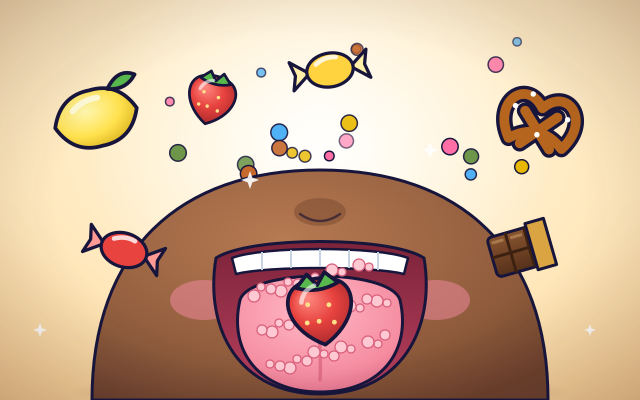
Your tongue has thousands of taste buds that sense five tastes: sweet, sour, salty, bitter and savory. Your nose adds the smell, and your brain mixes them into a flavor.
The big idea: The tongue can tell only five things: sweet, sour, salty, bitter and savory. The rest of a flavor, what makes strawberry different from banana, comes from smell. Your brain puts taste and smell together.
It's like a coloring book: your tongue draws the outline, sweet or sour or salty, and your nose colors in the picture. You need both to see what it is.
The interactive parts didn't load. The explanations below still work; try reloading the page.
How taste and smell make flavor
- Zoe pops a strawberry into her mouth. At once she knows: sweet, a tiny bit sour, and definitely strawberry. Two of her senses are working together. Let us find out how.
- Look closely at a tongue. It is covered in little bumps. Tucked into the sides of the bumps are taste buds, far too small to see. You have thousands of them.
- A taste bud looks like a tiny onion. Chewing mixes food with saliva, and tiny bits of food slip in through a hole in the top. There they touch the tips of the taste cells.
- Taste cells come in five kinds, one for each taste: sweet like sugar, sour like lemon, salty like pretzels, bitter like dark chocolate, and savory like soup. Each kind sends its own signal along a nerve.
- But the tongue cannot say which fruit it is. As Zoe chews, smell particles from the strawberry float up the back of her throat into her nose, to the smell patch at the top.
- The brain mixes the two messages. Sweet from the tongue plus strawberry from the nose makes strawberry flavor. If Zoe pinches her nose, the smell cannot get through, and she tastes only sweet.
Look inside the mouth and nose
We can see inside Zoe's mouth and nose. The magnifying glass shows one taste bud, much bigger. Tap every part.
- Tongue. A strong, bendy muscle. It moves food around your mouth, and its whole top surface can taste.
- Taste bud. A tiny bundle of taste cells, shaped like an onion and hidden in the side of a bump. You have thousands.
- Taste hole. The little opening at the top of a taste bud. Food bits dissolved in saliva get in through it.
- Taste cells. The cells that do the tasting. Each one senses one of the five tastes and sends a signal when its taste arrives.
- Taste nerve. Nerves carry the signals from the taste buds to the brain.
- Smell's back door. The back of your mouth joins the back of your nose. Smells from the food you are chewing float up this way.
- Smell patch. The smell patch at the top of the nose. It tells strawberry from banana, which the tongue cannot do.
- Brain. The brain joins the taste message and the smell message into one flavor, and remembers it for next time.
Flavor lab: tongue plus nose
Choose a food and drag it to Zoe's mouth. Watch what the tongue says and what the nose says. Then tap her nose to pinch it and try the two candies again.
Experiment: Zoe pinches her nose and eats a strawberry candy. What will she notice?
- Give Zoe the strawberry candy, then the banana candy. What does her tongue say each time? What does her nose say?
- Tap her nose to pinch it. Give her both candies again.
- Let go of her nose while the candy is still in her mouth.
What we found: With her nose pinched, both candies are just sweet, because the tongue sends the same message for both. Only the nose can tell strawberry from banana. Flavor needs taste and smell together.
Turn on JavaScript to try it yourself.
Flavor maker
Make each food Zoe is thinking of. Switch on the right tastes for her tongue, choose the right smell for her nose, then press Taste it. For 3 stars, make no mistakes.
Five tastes and a thousand flavors
Stick out your tongue and look in a mirror. Those little bumps are not taste buds, but the taste buds are hiding in them. Each taste bud is a tiny bundle of taste cells, shaped like an onion, with a small hole at the top. You have thousands of them, all over your tongue.
When you chew, your saliva dissolves some of the food. The dissolved bits slip into the taste buds and touch the taste cells. There are five kinds of taste cell, for five tastes: sweet, sour, salty, bitter and savory. Sweet tells you a food has sugar for energy. Bitter and very sour can be warnings that a food might be bad for you. Every part of your tongue can sense all five.
But five tastes are not enough to explain all the flavors you know. Strawberry candy and banana candy are both simply sweet to your tongue. The difference comes from smell. As you chew, smells from the food float up the back of your throat into your nose. Your brain mixes the taste message and the smell message into one flavor.
That is why food seems dull when you have a stuffy nose. The coloring book comparison is close but not perfect: flavor also depends on how food feels, how warm it is and even how it sounds when you crunch it. Your brain uses all of these clues at once.
Key words
- Taste bud
- A tiny cluster of taste cells in the tongue, with a small opening at the top.
- Saliva
- The watery liquid in your mouth. It dissolves food so that you can taste it.
- Umami
- The savory taste of foods like broth, cheese and tomatoes.
- Aroma
- The smell of a food.
- Flavor
- Taste and smell mixed together by your brain.
Check your thinking
-
What two senses does your brain mix together to make a flavor?
Show the answer
Taste and smell. The tongue gives the basic taste, and the nose gives the smell. Together they make the flavor.
-
With your nose pinched, why is it hard to tell a strawberry candy from a banana candy?
Show the answer
Both just taste sweet, and the smell that tells them apart is blocked. The tongue sends the same message, sweet, for both candies. Only the nose can tell which is which.
-
Which of these is NOT one of the five tastes your tongue can sense?
Show the answer
Strawberry. Strawberry is a flavor, made from sweet and a little sour on the tongue plus a smell in the nose. The five tastes are sweet, sour, salty, bitter and savory.
-
Why does very dry food on a very dry tongue have almost no taste at first?
Show the answer
Food has to dissolve in saliva before it can get into the taste buds. The dissolved bits slip into the tiny holes of the taste buds. That is one job of your saliva.
-
Where on the tongue can you taste sweet things?
Show the answer
Everywhere that has taste buds. Every part of the tongue with taste buds can sense all five tastes. The old tongue map is a myth.
You're a Human body expert!
You watched, looked inside, tried it, solved the challenge and went deeper. Pick another question below, or switch the age at the top to see this topic another way.
More about human body
 #256
Human body
How does the body keep its balance?
Combine information from inner-ear structures, vision, and body position while tilting a model head.
#256
Human body
How does the body keep its balance?
Combine information from inner-ear structures, vision, and body position while tilting a model head.
 #257
Human body
What happens while we sleep?
Move through sleep stages and compare brain activity, breathing, and movement.
#257
Human body
What happens while we sleep?
Move through sleep stages and compare brain activity, breathing, and movement.
 #258
Human body
How does the brain form memories?
Explore attention, repeated experiences, and changing connections in a simplified brain model.
#258
Human body
How does the brain form memories?
Explore attention, repeated experiences, and changing connections in a simplified brain model.
 #259
Human body
How do hormones guide growth?
Follow chemical messages from glands to tissues and explore their developmental roles.
#259
Human body
How do hormones guide growth?
Follow chemical messages from glands to tissues and explore their developmental roles.
Keep exploring
Games to play next
- Body ExplorerTap, match and label your way around the amazing human body.
- Label LabPut the right labels on beautiful science diagrams, from bean plants to heart chambers.
- Science QuizzesOlly's Science Quiz Show: plants, animals, the body, weather, space and more, for every grade.
Guide for grown-ups
- How to start homeschooling: a step-by-step guide for familiesA guide for parents · 7 min read
Science games by grade
Science worksheets by grade
- Preschool Science Worksheets
- Pre-K Science Worksheets
- Kindergarten Science Worksheets
- 1st Grade Science Worksheets
- 2nd Grade Science Worksheets
- 3rd Grade Science Worksheets
- 4th Grade Science Worksheets
- 5th Grade Science Worksheets
- 6th Grade Science Worksheets
- 7th Grade Science Worksheets
- 8th Grade Science Worksheets