
Animal
Japanese spider crab
The Japanese spider crab has the longest legs of any crab. With its legs stretched out, it is about as wide as a car is long! It walks slowly on the sea floor near Japan.
The Japanese spider crab is a gentle giant of the sea floor off Japan. Its body is only about the size of a large pizza, but its legs can stretch almost 4 meters from claw tip to claw tip, more than any other crab. It crawls slowly along the bottom, eating dead animals and plants.
Macrocheira kaempferi is the largest living arthropod by leg span: adults can measure nearly 4 meters between the tips of their claws, though the carapace is only about 37 centimeters long. It lives on the continental shelf and slope off Japan's Pacific coast, mostly at 150 to 300 meters, and scavenges the seabed. Catches have fallen sharply, and Japan bans fishing for it in the breeding season.
Photo: Teddy Yoshida, public domain, via Wikimedia Commons
Meet the Japanese spider crab
The Japanese spider crab is a giant crab with very long legs.
Its body is orange with white spots. It has ten legs, and two of them have claws. It lives deep in the sea near Japan.
The Japanese spider crab is the biggest crab in the world by leg span. Its round, bumpy body is only about 30 to 37 centimeters across, about the size of a large pizza. But its legs are enormous: on the largest crabs, they can stretch more than 3.5 meters, nearly 4 meters, from the tip of one claw to the other.
Its body and legs are reddish orange with white spots. It has ten legs. The front two end in claws and are called chelipeds; the other eight are walking legs. It can weigh up to about 20 kilograms.
Macrocheira kaempferi is the largest known living arthropod by size, though not by weight: Animal Diversity Web notes that the well-calcified carapace is only about 37 centimeters long, while adults can measure nearly 4 meters from the tip of one cheliped to the other. Nausicaá, France's national sea center, gives a leg span of more than 3.5 meters and a weight of up to 20 kilograms.
The pear-shaped carapace is covered in spiny and stubby tubercles and ranges from dark orange to light tan. It cannot change color. A rostrum of two slender spines juts out between the eyes. A notable growth pattern: the carapace stays about the same size through adulthood, while the walking legs and chelipeds keep lengthening as the crab ages.
Quick facts
- Group
- Invertebrate
- Length
- 3.5 to 4 m
- Weight
- 20 kg
Where it lives
Japanese spider crabs live in the sea near Japan.
They live deep down on the sandy, rocky sea floor. It is dark and cold there.
Japanese spider crabs live in the Pacific Ocean along the coast of Japan. They walk on sandy and rocky parts of the sea floor, usually 150 to 300 meters deep, where the water is cold and dark. Some have been found as deep as 600 meters.
Young crabs live in shallower, warmer water. As they grow up, they move deeper. Each year, from January to April, the adults climb up to shallower water, about 50 meters deep, to breed.
The species is mostly limited to the Pacific side of the Japanese islands of Honshu and Kyushu, usually between about 30 and 40 degrees north, and is found most often in Sagami, Suruga and Tosa bays and off the Kii Peninsula. One individual was recorded as far south as eastern Taiwan, which Animal Diversity Web considers most likely a one-time event.
Adults most often inhabit sandy and rocky bottoms of the continental shelf and slope at an average depth of 150 to 300 meters; in Suruga Bay at 300 meters the water is about 10 °C. Younger crabs live in shallower, warmer areas. During the breeding season, from January to April, adults move up to about 50 meters.
Its habitat

Where can you find this animal?
- Lives here naturally · Countries and seas named by a scientific source
- Sightings recorded · Records of wild sightings (GBIF)
Lives here naturally · Countries and seas named by a scientific source
Coastal Pacific waters of Japan, mostly off Honshu and Kyushu between about 30 and 40 degrees north (Sagami, Suruga and Tosa bays and the Kii Peninsula), at about 150 to 300 meters deep. The map shades the country whose waters it lives in.
Places: Japan.
Source: https://animaldiversity.org/accounts/Macrocheira_kaempferi/ · checked October 2026
Sightings recorded · Records of wild sightings (GBIF)
Counts of GBIF records of wild observations (human and machine) and preserved specimens. Records include introduced populations, vagrants, escaped or released animals and misidentifications, so a country with records is not necessarily part of the native range.
Wild sightings have been recorded in Japan, China, Estonia, Namibia, Taiwan, Pacific Ocean, Atlantic Ocean, Southern Ocean and 2 more places.
Source: gbif · checked October 2026
Range maps show where scientists say an animal lives, often country by country. An animal may live in only part of a country shown, and sightings records can include animals that wandered far from home.
What it eats
The spider crab looks for food on the sea floor.
It eats bits of dead fish and other animals that sink down. It eats seaweed too.
The Japanese spider crab is a scavenger. Instead of hunting, it crawls slowly along the sea floor, picking at dead animals and bits of plants that have sunk to the bottom. It eats both animal and plant food, so it is an omnivore.
Sometimes it does more than scavenge. It sometimes eats living seaweed, and now and then it catches small sea animals that are easy to grab.
This omnivorous scavenger rarely hunts. It crawls along the seabed picking at dead and decaying animal and plant matter, including food that falls from above. It occasionally eats living kelp and algae, and sometimes catches small marine invertebrates that are easy to take.
Nausicaá notes a possible link to climate change: warming oceans degrade seaweed beds, which could reduce the amount of food that falls to the seabed where these crabs live.
Did you know?
Spider crabs cannot swim. They walk!
Even with such long legs, Japanese spider crabs cannot swim. They walk slowly over the sea floor.
Despite its size, the species is strictly benthic: it roams the seafloor but cannot swim.
Long legs, bumpy armor
A spider crab wears a hard shell, like armor.
Its shell is bumpy and spiky. Its legs are long and thin. If it loses a leg, a new one can grow back!
A spider crab's hard outer shell is called an exoskeleton. The top part, over its body, is the carapace, which is covered in spiky bumps. Two thin spines stick out between its eyes.
Its long legs are strong enough to walk on but not very well attached. Scientists found that nearly three out of four of these crabs are missing at least one leg. Luckily, a spider crab can live with up to three walking legs missing, and lost legs can grow back when it molts, or sheds its shell.
The legs end in inwardly curving dactyls that help the crab climb and hook onto rock. In adult males the chelipeds are far longer than any walking leg, while females tend to have chelipeds shorter than their walking legs; females also have wider abdomens, used to carry eggs.
The long legs are poorly jointed to the body and often weak. One study reported that nearly three quarters of individuals are missing at least one limb, usually one of the first walking legs, lost to predators and nets. Crabs usually survive with up to three walking legs missing, and limbs regrow over successive molts. The antennae are greatly reduced and the eyestalks short and stubby.
From a tiny larva to a giant
A mother spider crab carries lots of tiny eggs.
The babies that hatch are tiny and look nothing like crabs. They drift and grow, and change shape, until they look like little crabs.
After mating in early spring, a female carries her eggs under her body, stirring the water with her back legs to give them oxygen. She can carry more than a million eggs, but only a few will survive to grow up.
The eggs hatch into tiny larvae that look nothing like crabs. They change shape several times over a couple of months before becoming little crabs. Young crabs live in shallower water and move deeper as they grow. Their bodies stop growing in adulthood, but their legs keep getting longer.
Mating takes place once a year, from about January to April, and fertilization is internal. A female may lay up to about 1.5 million eggs a season, each 0.63 to 0.85 millimeters across, and carries them during incubation, fanning them with her back legs. Hatching takes about 10 days, and there is no parental care afterward.
Development includes two zoeal stages, lasting 12 to 37 days in total, and one megalopa stage of about 30 days. The larvae do best at 15 to 18 °C and survive at 11 to 20 °C, warmer than many other decapods of the region. In laboratory conditions only about 75 percent survive the first zoeal stage, falling to about 33 percent by the megalopa. Longevity is poorly known; it is often reported, but not confirmed, that these crabs may live to 100 years.
A calm, slow giant
Spider crabs are calm and slow.
They cannot swim. They walk along the sea floor. Little spider crabs hide by sticking sponges and seaweed on their shells.
Japanese spider crabs are calm, slow-moving animals. They cannot swim, so they walk everywhere on the sea floor, spending much of the day looking for food. They usually live alone.
Young spider crabs have a clever disguise. They attach bits of sponge, seaweed and other things to their spiky shells so they blend in. Adults usually do not bother, because they are so big that few predators would try to eat them.
Animal Diversity Web describes the species as placid, spending much of its time searching for food. It roams the seafloor but cannot swim, and individuals usually scavenge alone with little communication, even when kept together in aquariums.
Many spider crabs decorate themselves by hooking sponges, kelp and other objects onto barbs on the rostrum and carapace. Juvenile Japanese spider crabs do this, but adults generally do not: their size deters most predators, and they live deep enough to meet few of them. Nausicaá notes that crabs are most vulnerable just after molting, before the new exoskeleton hardens.
Did you know?
A spider crab's body stops growing, but its legs keep growing.
Once a Japanese spider crab is grown up, its body stays the same size, but its legs keep getting longer.
The carapace stays about the same size through adulthood, while the walking legs and chelipeds lengthen considerably with age.
Protecting the giants
People in Japan catch and eat spider crabs.
Now people catch far fewer than they used to. In spring, when the crabs have babies, fishing for them is not allowed.
In Japan, spider crabs are caught and eaten as a special treat. Over the past few decades, the number of crabs caught has dropped a lot.
To help, Japan does not allow fishing for spider crabs during their breeding season, from January to April. Some scientists have suggested raising young crabs in hatcheries and releasing them into the sea.
There is not enough data to assess the species' conservation status formally, and it has no IUCN assessment. Animal Diversity Web reports that the catch has declined considerably over the past 40 years. Japanese law prohibits fishing for it during the breeding season, from about January to April, so that numbers can recover, and researchers have proposed restocking with juveniles cultured in fisheries.
The crabs are a delicacy in Japan, eaten raw and cooked. Climate change is an additional concern: Nausicaá notes that warmer oceans could reduce the number of larvae that survive to adulthood and degrade the seaweed beds that supply food to the seabed.
Did you know?
Young spider crabs wear sponges as a disguise.
Young spider crabs stick sponges and seaweed onto their shells to hide, but adults are too big to need a disguise.
Juveniles decorate with sponges and kelp hooked onto barbs; adults rarely do, as their size deters predators.
Amazing facts
-
A spider crab can live with some legs missing.
Nearly three out of four Japanese spider crabs are missing at least one leg, and they can manage with up to three walking legs gone.
One study found nearly three quarters of individuals missing a limb; lost legs regrow over successive molts.
-
Spider crabs cannot swim. They walk!
Even with such long legs, Japanese spider crabs cannot swim. They walk slowly over the sea floor.
Despite its size, the species is strictly benthic: it roams the seafloor but cannot swim.
-
Young spider crabs wear sponges as a disguise.
Young spider crabs stick sponges and seaweed onto their shells to hide, but adults are too big to need a disguise.
Juveniles decorate with sponges and kelp hooked onto barbs; adults rarely do, as their size deters predators.
-
A spider crab's body stops growing, but its legs keep growing.
Once a Japanese spider crab is grown up, its body stays the same size, but its legs keep getting longer.
The carapace stays about the same size through adulthood, while the walking legs and chelipeds lengthen considerably with age.
Words to know
- carapace
- the hard shell covering the top of a crab's body
- scavenger
- an animal that eats dead animals and plants it finds
- molt
- to shed an old outer shell or skin so the body can grow
- cheliped
- a crab leg that ends in a claw
- arthropod
- an animal with jointed legs and a hard outer skeleton, like insects, spiders and crabs
- larva
- the young stage of an animal that looks very different from the adult
Discovery challenge
-
What is special about this crab?
What makes the Japanese spider crab a record holder?
In what way is Macrocheira kaempferi the largest living arthropod?
- Its super long legs
- Its bright blue color
- It can fly
Show the answer
Its super long legs
Its legs are super long, almost 4 meters from claw to claw!
It has the biggest leg span of any crab, nearly 4 meters.
By leg span: nearly 4 meters between cheliped tips, though its carapace is only about 37 centimeters.
-
What does a spider crab eat?
How does the Japanese spider crab usually get its food?
What is the Japanese spider crab's main feeding strategy?
- It eats dead things on the sea floor
- It catches birds
- It eats only sand
Show the answer
It eats dead things on the sea floor
It finds dead animals and plants on the sea floor.
It is a scavenger that picks at dead animals and plants, and sometimes eats seaweed or small animals.
Omnivorous scavenging of dead and decaying matter, with occasional kelp, algae and small invertebrates.
-
Can a spider crab grow a new leg?
What happens when a Japanese spider crab loses a leg?
How do Japanese spider crabs replace lost limbs?
- It grows back when the crab molts
- It is gone forever
- Another crab gives it one
Show the answer
It grows back when the crab molts
Yes! A new leg grows when the crab sheds its shell.
Lost legs can grow back when the crab molts, and it can live with up to three walking legs missing.
Limbs regrow over successive molts; crabs usually survive with up to three walking legs missing.
-
Where do Japanese spider crabs live?
Where do Japanese spider crabs live?
Which describes the species' range?
- In the sea near Japan
- In rivers in Africa
- In the Arctic ice
Show the answer
In the sea near Japan
In the deep sea near Japan.
In the Pacific Ocean along Japan's coast, usually 150 to 300 meters deep.
Mostly the Pacific side of Honshu and Kyushu, 30 to 40 degrees north, on the shelf and slope.
Places where you might see it
Explore next
-
 Watch
3D
Animal
Giant isopod
The giant isopod is a deep-sea relative of the pill bugs and sowbugs you find under garden stones, but it can grow to about 50 centimeters long. It crawls over the dark sea floor of the western Atlantic, cleaning up dead fish, squid and other food that sinks from above.
-
 Watch
3D
Animal
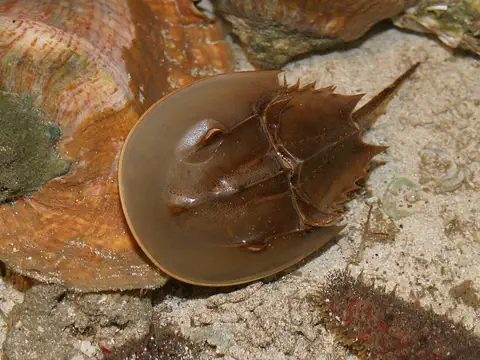
Atlantic horseshoe crab
The Atlantic horseshoe crab is a living fossil: its relatives have looked much the same for hundreds of millions of years. Despite its name, it is more closely related to spiders and scorpions than to crabs. Each spring, thousands crawl onto beaches to lay eggs, feeding hungry shorebirds, and its blue blood helps keep medicines safe.
-
 Watch
Animal
Giant Pacific octopus
The giant Pacific octopus is the largest octopus species in the world, living in cool waters of the North Pacific from Japan to Alaska and California. It hunts crabs and clams at night, changes color and skin texture at will, and can squeeze through a hole only a few centimeters wide.
-
 Watch
 Country
Japan
Japan is an island country in East Asia. Most of its land is steep mountains and forest, Mount Fuji is its tallest peak, and about 124 million people live there, many of them in big cities such as Tokyo.
-
 Watch
Animal
Coconut crab
The coconut crab, also called the robber crab, is the biggest crustacean that lives on land. It is a close relative of hermit crabs, lives on tropical islands in the Indian and Pacific Oceans, climbs trees, and can open coconuts with its powerful claws.
-
 Watch
Animal
American lobster
The American lobster is a big crustacean that lives on the rocky sea floor of the northwest Atlantic Ocean. It has two very different claws, one for crushing and one for tearing, and it must climb out of its hard shell again and again to grow.
-
 Watch
3D
Animal
Antarctic krill
Antarctic krill are small, shrimp-like crustaceans about 6 centimeters long that live in the icy Southern Ocean around Antarctica. They gather in enormous swarms, and almost all the bigger animals of the Antarctic, from penguins to blue whales, depend on them for food.
-
 Watch
Animal
Army ant
Army ants hunt together in giant swarms and never build a permanent nest. This page is about the best-studied kind, Eciton burchellii, of Central and South American forests. Each night of its traveling phase the colony moves, and the workers link their legs to build a living camp around their queen and young.
For parents & teachers
What children will learn
- Explain what makes the Japanese spider crab the largest living arthropod.
- Describe how crabs grow by molting and can regrow lost legs.
- Describe the crab's life cycle from egg through larval stages to adult.
- Explain how seasonal fishing rules help protect a species.
Recommended ages: 3 to 17 · About 15 minutes
Talk about it
- Why might a slow scavenger need few defenses as an adult?
- Why would young crabs need a disguise but adults not?
- How do fishing rules balance people's needs with the crabs' survival?
Try at home or in class
- Measure 3.7 meters across a room with string to see how wide a big spider crab's legs reach.
- Make a paper crab with ten legs: give two of them claws, and fold the legs to show their joints.
Key vocabulary: carapace, scavenger, molt, cheliped, arthropod, larva
Where these facts come from
- GBIF Backbone Taxonomy and GBIF Occurrence Search , Global Biodiversity Information Facility (CC0 1.0 (backbone); occurrence counts are facts derived from records under CC0, CC BY and CC BY-NC)
- Wikidata , Wikimedia Foundation (CC0 1.0)
- Macrocheira kaempferi (Japanese spider crab) , Animal Diversity Web, University of Michigan
- Japanese spider crab , Nausicaá, Centre National de la Mer
- Wikimedia Commons , Wikimedia Foundation (Per file: Public domain, CC0, CC BY or CC BY-SA only (credited on each page))
Checked, not yet human-reviewed. Last updated October 27, 2026. Spotted a mistake? Tell us.