Animal
Atlantic horseshoe crab
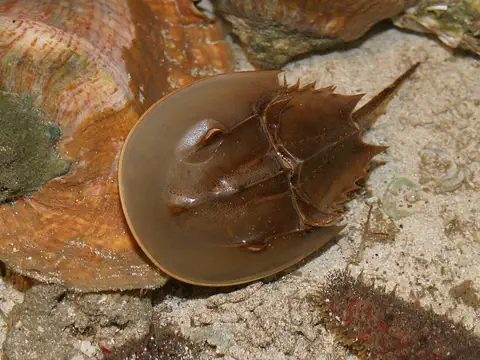
The horseshoe crab has a round shell shaped like a horse's shoe and a long, pointy tail. It is not really a crab! It comes to sandy beaches to lay its eggs.
The Atlantic horseshoe crab is a living fossil: its relatives have looked much the same for hundreds of millions of years. Despite its name, it is more closely related to spiders and scorpions than to crabs. Each spring, thousands crawl onto beaches to lay eggs, feeding hungry shorebirds, and its blue blood helps keep medicines safe.
Limulus polyphemus is the only horseshoe crab in North America, ranging from Maine to the Yucatán Peninsula. Massive spawning on beaches such as Delaware Bay supplies eggs to migrating shorebirds, while its blood yields Limulus amebocyte lysate (LAL), used to test injectable drugs and medical devices for bacterial toxins. The IUCN lists it as Vulnerable, and harvests are managed coast-wide.
Photo: © Hans Hillewaert, CC BY-SA 4.0, via Wikimedia Commons
Meet the horseshoe crab
The horseshoe crab has a smooth, round shell.
The front of its shell is shaped like a horse's shoe. It has a long, pointy tail. It is not really a crab. It is a cousin of spiders!
The Atlantic horseshoe crab gets its name from the front of its shell, which is shaped like a horse's shoe. It is olive green or brown on top and can grow up to about 60 centimeters long, tail included.
It is not a true crab at all. Horseshoe crabs belong to an ancient group of arthropods more closely related to spiders and scorpions. Their ancestors lived hundreds of millions of years ago and looked much like they do today, so people call them living fossils. It may look fierce, but it cannot bite or sting.
Limulus polyphemus is one of four living horseshoe crab species and the only one in North America; the other three live in Asia. The U.S. Fish and Wildlife Service describes horseshoe crabs as relatively unchanged in appearance for 350 million years, while Florida's Fish and Wildlife Conservation Commission (FWC) notes their ancestors were abundant 445 million years ago.
They are chelicerates, closer to spiders, scorpions and ticks than to true crabs: they have no antennae and no mandibles, but a pair of chelicerae that move food toward the mouth. Size varies along the coast; the largest mature females, on the Georgia coast, reach about 30 centimeters across the front shell, 60 centimeters long including the tail and about 4.8 kilograms, while males are 25 to 30 percent smaller.
Quick facts
- Group
- Invertebrate
- Length
- 60 cm
- Weight
- 4.8 kg
- Lifespan in the wild
- 20 years
Where it lives
Horseshoe crabs live in the sea along the coast.
They live near North America, from cold Maine to warm Mexico. In spring they come up onto sandy beaches.
Atlantic horseshoe crabs live along the Atlantic coast of North America, from Maine down to Florida, along the Gulf of Mexico coast to Louisiana, and around Mexico's Yucatán Peninsula.
They live in bays and shallow coastal waters. Young crabs stay on sandy and muddy flats near the beaches where they hatched, while older crabs move out to deeper water. In winter, some adults stay in estuaries and others travel out to the continental shelf.
The species ranges from the Gulf of Maine to Florida and along the Gulf of Mexico coast from Florida to Louisiana, with a separate population on Mexico's Yucatán Peninsula; it is considered absent from Texas to Tabasco, Mexico. Genetic studies divide it into regional population units: Gulf of Maine, Mid-Atlantic, Southeast, Florida Atlantic, northeastern Gulf and Yucatán.
Habitat needs change through life, from intertidal beaches and tidal flats for eggs and larvae to the edge of the continental shelf for adults. Adults overwinter in estuaries or on the shelf and return to beaches and estuaries in spring. USFWS calls the species an ecological generalist that tolerates a wide range of conditions.
Continent
Did you know?
Long ago, people used horseshoe crabs on farms.
From the 1850s to the 1920s, people caught 1.5 to 2 million horseshoe crabs a year to use as fertilizer and animal feed.
The fertilizer and livestock-feed harvest of 1.5 to 2 million crabs a year declined in the 1950s and ended in the 1960s.
Where can you find this animal?
- Lives here naturally · Countries and seas named by a scientific source
- Sightings recorded · Records of wild sightings (GBIF)
Lives here naturally · Countries and seas named by a scientific source
Coastal waters of the Atlantic from the Gulf of Maine to Florida, along the Gulf of Mexico coast from Florida to Louisiana, and around Mexico's Yucatán Peninsula; absent from Texas to Tabasco. The map shades whole countries; the crabs live only in coastal and shelf waters.
Places: United States and Mexico.
Source: https://www.fws.gov/species/atlantic-horseshoe-crab-limulus-polyphemus · checked October 2026
Sightings recorded · Records of wild sightings (GBIF)
Counts of GBIF records of wild observations (human and machine) and preserved specimens. Records include introduced populations, vagrants, escaped or released animals and misidentifications, so a country with records is not necessarily part of the native range.
Wild sightings have been recorded in United States, Mexico, Germany, Belgium, China, Denmark, Bahamas, Malaysia and 10 more places.
Source: gbif · checked October 2026
Range maps show where scientists say an animal lives, often country by country. An animal may live in only part of a country shown, and sightings records can include animals that wandered far from home.
What it eats
Horseshoe crabs eat small animals in the sand.
They like little clams and worms. They have no teeth, so they crush their food with their legs!
Horseshoe crabs are not picky eaters. They hunt small animals living in the sand and mud, such as little clams, crustaceans and worms, and they will also eat algae.
They have no jaws or teeth. Instead, they crush hard food between their legs before passing it to their mouth. Like birds, they have a gizzard, a muscly part of the gut that grinds food before it reaches the stomach.
Young and adult crabs spend much of their time on sandy tidal flats, feeding on invertebrates. Adults are important predators of small invertebrates living in the sediment, taking small clams, crustaceans and worms, plus other animals and algae.
Lacking mandibles, horseshoe crabs crush hard food between their legs before passing it to the mouth, and a gizzard grinds it further before it reaches the stomach, a feature FWC compares to birds.
Did you know?
A horseshoe crab climbs out of its old shell going forward.
True crabs back out of their old shells, but horseshoe crabs crawl forward out of theirs, leaving the empty shell behind.
Unlike true crabs, which back out of the old exoskeleton, horseshoe crabs push forward, leaving a split molt behind.
Ten eyes and a tail for flipping
A horseshoe crab has a hard shell in three parts.
It has ten eyes! Its long tail is not for stinging. It helps the crab flip over when a wave turns it upside down.
A horseshoe crab's body has three parts: the front shell, called the prosoma, the back shell, called the opisthosoma, and the spiky tail, called the telson. The tail is not a weapon. The crab uses it to push itself right side up if a wave flips it over.
Horseshoe crabs are very sensitive to light. They have ten eyes: two big compound eyes on top of the front shell, plus other light sensors, many of them along the tail.
The body has three regions: the horseshoe-shaped prosoma, the opisthosoma and the telson. The telson is used to right the animal when waves overturn it; it is not a weapon, and the crab neither bites nor stings, though spines line the edge of the shell.
FWC counts ten eyes: a pair of lateral compound eyes on the prosoma and additional photoreceptors elsewhere, mainly along the tail. Research on horseshoe crab compound eyes has advanced the understanding of human vision. The blood is copper-based, straw-colored, and turns blue when exposed to high concentrations of oxygen.
Beach babies
In spring, horseshoe crabs crawl up onto the beach at high tide.
The mother digs a nest in the sand and lays lots of tiny green eggs. Baby horseshoe crabs hatch a few weeks later.
In late spring and early summer, horseshoe crabs come ashore to spawn on calm, sandy beaches, especially at the high tides of the full and new moon. A smaller male holds on to the back of the female's shell with special claws, and she drags him up the beach.
The female half-buries herself and lays a cluster of about 4,000 tiny green eggs, then more clusters, sometimes 100,000 or more in a season. The larvae hatch in two to four weeks. As they grow, they molt, crawling forward out of the old shell and leaving it behind. A horseshoe crab can live 20 years or more.
Spawning peaks in late spring and early summer, at high tides around the full and new moons, and is greater at night and during full moons. Males clasp the female's shell in amplexus with modified claws, and satellite males gather around the pair; a female may have five or more males trying to fertilize her eggs. She buries clusters of about 4,000 eggs; USFWS gives 100,000 or more over several nights, while ASMFC estimates about 90,000 a year. In Florida, nesting can happen year-round.
Larvae hatch in two to four weeks, though some overwinter in the nest. They are planktonic briefly, settling within one to two weeks, then molt as they grow, pushing forward out of the old exoskeleton. Juveniles spend their first two years near shore. The species is long-lived, surviving more than 20 years, with high egg and larval mortality but low adult mortality.
A feast for shorebirds
Horseshoe crab eggs are a feast for birds.
Hungry shorebirds stop on beaches to eat the eggs. Then they fly north. You can help a crab that is stuck upside down.
When horseshoe crabs spawn, their eggs become a feast. Hundreds of thousands of migrating shorebirds, including the red knot, stop at beaches like those of Delaware Bay to eat the eggs and refuel before flying north. FWC compares the beaches to a gas station for birds.
Waves sometimes flip horseshoe crabs onto their backs, and some cannot turn over. With a grown-up, you can help by gently picking a crab up by both sides of its shell, never by the tail, and placing it back in the water.
Delaware Bay hosts the world's largest horseshoe crab spawning population and is the largest shorebird staging area on the Atlantic Flyway: an estimated 425,000 to one million migrating shorebirds stop there to refuel. Shorebirds such as the federally threatened red knot time their migrations to peak spawning.
Eggs also feed many fish, and adults are eaten by sea turtles, alligators, horse conchs and sharks. Many crabs die after being overturned by waves during spawning; FWC advises lifting them by both sides of the shell, never by the tail, which can injure them. Molted shells left on beaches are often mistaken for dead crabs.
Did you know?
Horseshoe crabs have a gizzard, like birds.
Horseshoe crabs have no teeth, so they crush food with their legs and grind it in a gizzard, just like a bird.
Without mandibles, food is crushed between the legs and ground in a gizzard before reaching the stomach.
Blue blood that keeps medicine safe
Horseshoe crabs have blue blood.
Doctors and scientists use a little of it to check that medicines are clean. That keeps people safe.
Horseshoe crab blood is copper-based and turns blue when it is exposed to lots of oxygen. It contains special cells, and a substance made from them, called LAL, clumps up when it touches tiny amounts of harmful bacterial toxins. Companies use LAL to check that vaccines, medicines and medical equipment are clean.
To get it, workers collect adult crabs, take some of their blood and return most of them alive to the water. Not all survive: some crabs die after the procedure, so the numbers are counted and managed.
Horseshoe crab blood contains large cells called amebocytes, from which Limulus amebocyte lysate (LAL) is made. LAL clots in the presence of bacterial toxins, so pharmaceutical companies use it to test the sterility of vaccines, drugs, prosthetics and other medical devices. FWC states that up to one third of a crab's blood can be removed without killing it.
Under the interstate management plan, most crabs bled by the biomedical industry must be released alive where they were caught, but a portion die. The Atlantic States Marine Fisheries Commission reports that in 2024, 1,073,329 horseshoe crabs were collected coast-wide solely for biomedical use, with an estimated 184,693 deaths. Biomedical use has increased since reporting began in 2004.
Did you know?
Horseshoe crabs have ten eyes.
Horseshoe crabs have ten eyes: two big compound eyes on the shell and more light sensors, many along the tail.
FWC counts ten eyes: paired lateral compound eyes plus photoreceptors, mainly along the telson.
Protecting horseshoe crabs
People catch horseshoe crabs for many reasons.
Now there are rules about how many can be caught. Some places are safe zones where they cannot be caught at all.
The IUCN Red List lists the Atlantic horseshoe crab as Vulnerable. People catch horseshoe crabs for fishing bait and for medicine, and many years ago they caught millions to use as fertilizer.
Since 1998, states along the Atlantic coast have worked together to manage them, with limits on how many can be caught. A large sanctuary at the mouth of Delaware Bay protects them, and in recent years only male crabs from Delaware Bay may be caught for bait.
The IUCN Red List lists Limulus polyphemus as Vulnerable. From the 1850s to the 1920s, 1.5 to 2 million were harvested each year for fertilizer and livestock feed; bait demand for the whelk fishery drove a harvest peak of nearly six million pounds in 1997.
The Atlantic States Marine Fisheries Commission's 1998 management plan and its addenda set state-by-state bait quotas and created the 1,500-square-mile Carl N. Shuster Jr. Horseshoe Crab Sanctuary off Delaware Bay. For Delaware Bay-origin crabs, an adaptive framework that accounts for red knots sets harvest; the limit for 2026 and 2027 is 500,000 males and zero females. The 2024 assessment update rated the coast-wide and Delaware Bay stocks good, but the New York region poor.
IUCN Red List
How is the atlantic horseshoe crab doing in the wild?
- Least Concern
- Near Threatened
- Vulnerable (this animal)
- Endangered
- Critically Endangered
- Extinct in the Wild
- Extinct
Vulnerable
At high risk of disappearing from the wild.
See the IUCN Red List assessment · The IUCN Red List of Threatened Species 2022.2
Amazing facts
-
Horseshoe crabs have ten eyes.
Horseshoe crabs have ten eyes: two big compound eyes on the shell and more light sensors, many along the tail.
FWC counts ten eyes: paired lateral compound eyes plus photoreceptors, mainly along the telson.
-
A horseshoe crab climbs out of its old shell going forward.
True crabs back out of their old shells, but horseshoe crabs crawl forward out of theirs, leaving the empty shell behind.
Unlike true crabs, which back out of the old exoskeleton, horseshoe crabs push forward, leaving a split molt behind.
-
Horseshoe crabs have a gizzard, like birds.
Horseshoe crabs have no teeth, so they crush food with their legs and grind it in a gizzard, just like a bird.
Without mandibles, food is crushed between the legs and ground in a gizzard before reaching the stomach.
-
Long ago, people used horseshoe crabs on farms.
From the 1850s to the 1920s, people caught 1.5 to 2 million horseshoe crabs a year to use as fertilizer and animal feed.
The fertilizer and livestock-feed harvest of 1.5 to 2 million crabs a year declined in the 1950s and ended in the 1960s.
Words to know
- living fossil
- a living animal that looks very much like its ancient relatives
- telson
- a horseshoe crab's long tail, used to flip itself over
- spawn
- to lay eggs, usually in water or on a beach
- LAL
- a substance made from horseshoe crab blood that shows if medicines have harmful bacterial toxins
- arthropod
- an animal with jointed legs and a hard outer skeleton, like insects, spiders and crabs
- molt
- to shed an old outer shell so the body can grow
Discovery challenge
-
Which animals are the horseshoe crab's closer cousins?
Horseshoe crabs are more closely related to which animals?
To which group is Limulus polyphemus more closely related?
- Spiders and scorpions
- Lobsters and shrimp
- Fish
Show the answer
Spiders and scorpions
Spiders and scorpions! It is not really a crab.
Despite the name, horseshoe crabs are closer to spiders and scorpions than to true crabs.
Chelicerates such as spiders, scorpions and ticks; horseshoe crabs lack antennae and mandibles.
-
What does a horseshoe crab use its tail for?
What is the horseshoe crab's long tail used for?
What is the function of the telson?
- Stinging
- Flipping back over
- Swimming very fast
Show the answer
Flipping back over
To flip back over when a wave turns it upside down.
It pushes itself right side up with its tail. It is not a stinger.
Righting the body after being overturned; it is not a weapon.
-
How do horseshoe crabs help people?
How does horseshoe crab blood help people?
What is Limulus amebocyte lysate used for?
- It checks that medicines are clean
- It makes paint
- It is used as fuel
Show the answer
It checks that medicines are clean
A bit of its blue blood helps check that medicines are clean.
LAL from its blood shows whether vaccines, medicines and equipment have bacterial toxins.
Testing drugs and medical devices for bacterial toxins: LAL clots on contact with them.
-
Who eats horseshoe crab eggs?
Which animals depend on horseshoe crab eggs during migration?
Which migratory bird, federally threatened, times its migration to horseshoe crab spawning?
- Shorebirds like the red knot
- Penguins
- Eagles
Show the answer
Shorebirds like the red knot
Shorebirds eat the eggs to get energy for flying.
Migrating shorebirds, like red knots, refuel on the eggs at Delaware Bay.
The red knot, among 425,000 to one million shorebirds staging at Delaware Bay.
Places where you might see it
-
 Watch
 Country
United States
The United States is a large country in North America made of 50 states, from icy Alaska to the warm islands of Hawaii. It has the Grand Canyon, the Mississippi River and Yellowstone, and about 342 million people live there.
-
 Watch
 Country
Mexico
Mexico is a large country in southern North America, between the Pacific Ocean and the Gulf of Mexico. It has smoking volcanoes, ancient cities built by the Maya and other peoples, and about 132 million people, many of them in and around Mexico City.
Explore next
-
 Watch
3D
Animal
Japanese spider crab
The Japanese spider crab is a gentle giant of the sea floor off Japan. Its body is only about the size of a large pizza, but its legs can stretch almost 4 meters from claw tip to claw tip, more than any other crab. It crawls slowly along the bottom, eating dead animals and plants.
-
 Watch
3D
Animal
Giant isopod
The giant isopod is a deep-sea relative of the pill bugs and sowbugs you find under garden stones, but it can grow to about 50 centimeters long. It crawls over the dark sea floor of the western Atlantic, cleaning up dead fish, squid and other food that sinks from above.
-
 Watch
Animal
Loggerhead sea turtle
The loggerhead sea turtle is named for its huge head and powerful jaws, which crush crabs, conchs and other hard-shelled animals. Babies hatch on sandy beaches, ride the open ocean for years and may cross an entire ocean before coming home to nest.
-
Watch
Country
United States
The United States is a large country in North America made of 50 states, from icy Alaska to the warm islands of Hawaii. It has the Grand Canyon, the Mississippi River and Yellowstone, and about 342 million people live there.
-
Watch
Country
Mexico
Mexico is a large country in southern North America, between the Pacific Ocean and the Gulf of Mexico. It has smoking volcanoes, ancient cities built by the Maya and other peoples, and about 132 million people, many of them in and around Mexico City.
-
 Watch
3D
Animal
Atlantic ghost crab
The Atlantic ghost crab is a sand-colored crab of beaches along the Atlantic coast of the Americas. It is so pale that it almost disappears on the sand, like a ghost. It digs deep burrows, comes out mostly at night, and runs very fast on its long legs.
-
 Watch
3D
Animal
Atlantic blue crab
The Atlantic blue crab is a swimming crab with bright blue claws and back legs shaped like paddles. It lives along the Atlantic coast of the Americas, especially in bays where rivers meet the sea, like the Chesapeake Bay. A mother crab carries up to two million eggs in a spongy orange mass under her body.
-
 Watch
3D
Animal
Chambered nautilus
The chambered nautilus is a relative of octopuses and squids that lives inside a coiled shell full of sealed rooms. It moves up and down along deep reef slopes by changing how much gas and water are in its shell, and it finds food mostly by smell.
For parents & teachers
What children will learn
- Explain why the horseshoe crab is called a living fossil and why it is not a true crab.
- Describe the horseshoe crab's life cycle and its link to shorebird migration.
- Explain how horseshoe crab blood is used to keep medicines safe, and its cost to the crabs.
- Describe how people manage a species used for bait, medicine and wildlife.
Recommended ages: 3 to 17 · About 15 minutes
Talk about it
- How do people decide how many horseshoe crabs can be taken when birds, fishers and medicine all depend on them?
- Why might spawning at the highest tides help horseshoe crab eggs?
- What should you do if you find a horseshoe crab stuck on its back?
Try at home or in class
- Draw a horseshoe crab and label the prosoma, opisthosoma and telson, then mark where its ten eyes are.
- Measure 60 centimeters on the floor with tape and compare it with your arm to see how big the largest females are.
Key vocabulary: living fossil, telson, spawn, LAL, arthropod, molt
Where these facts come from
- GBIF Backbone Taxonomy and GBIF Occurrence Search , Global Biodiversity Information Facility (CC0 1.0 (backbone); occurrence counts are facts derived from records under CC0, CC BY and CC BY-NC)
- Wikidata , Wikimedia Foundation (CC0 1.0)
- The IUCN Red List of Threatened Species , International Union for Conservation of Nature (IUCN terms of use (no redistribution of Red List data or range maps))
- Atlantic Horseshoe Crab (Limulus polyphemus) , U.S. Fish and Wildlife Service
- Horseshoe Crab , Atlantic States Marine Fisheries Commission
- Horseshoe Crab Facts , Florida Fish and Wildlife Conservation Commission
- Wikimedia Commons , Wikimedia Foundation (Per file: Public domain, CC0, CC BY or CC BY-SA only (credited on each page))
Checked, not yet human-reviewed. Last updated October 27, 2026. Spotted a mistake? Tell us.