
Animal
Antarctic krill
Antarctic krill are tiny, see-through sea animals that look like little shrimp. Huge swarms of them feed whales, seals, penguins and seabirds.
Antarctic krill are small, shrimp-like crustaceans about 6 centimeters long that live in the icy Southern Ocean around Antarctica. They gather in enormous swarms, and almost all the bigger animals of the Antarctic, from penguins to blue whales, depend on them for food.
Euphausia superba is one of the most abundant animal species on Earth, with an estimated 400 million tonnes in the Southern Ocean. It grazes on phytoplankton, forms swarms of up to 30,000 individuals per cubic meter, and can shrink and survive more than 200 days without food. Directly or indirectly, most large Antarctic animals depend on it.
Photo: Krill666.jpg: Uwe Kils I am willing to give the image in 1700 resolution to Wikipedia Uwe Kils, CC BY-SA 3.0, via Wikimedia Commons
Meet Antarctic krill
Antarctic krill are small sea animals.
They look like tiny see-through shrimp with big black eyes. They live in the cold sea around Antarctica. There are so many of them that they can turn the sea red!
Antarctic krill are crustaceans, the same group as shrimp, crabs and lobsters. A grown-up krill is about 6 centimeters long, about the length of your finger, and weighs a little over a gram.
Krill are almost see-through, but tiny red spots give their shells a red tinge, and you can often see their stomach glowing green from the tiny plants they have eaten. Krill may be small, but there are so many that scientists estimate their total weight at about 400 million tonnes.
The word krill covers about 86 species of crustaceans, called euphausiids, found in the open ocean. Five live in the Southern Ocean, and Euphausia superba is the dominant one. The Australian Antarctic Division calls it one of the most abundant and successful animal species on the planet, with an estimated 400 million tonnes in the Southern Ocean.
Adults are about 6 centimeters long and weigh over a gram. The body is mostly transparent, tinged red by small pigment spots, with large black eyes and a digestive system that often shows vivid green from the phytoplankton inside. At high density, swarms can color the sea reddish brown.
Quick facts
- Group
- Invertebrate
- Length
- 6 cm
- Lifespan in the wild
- 5 to 10 years
Where it lives
Krill live in the icy sea around Antarctica.
At night they swim up near the top of the sea. In winter, some find food under the sea ice.
Antarctic krill live in the Southern Ocean, the cold sea that circles Antarctica. They live south of the Antarctic Convergence, an ocean boundary that circles Antarctica.
Krill move up and down every day. At night they feed near the surface, and during the day they sink deeper. In winter, when food is scarce, some feed on tiny algae growing on the underside of the sea ice.
Antarctic krill is one of five krill species living in the Southern Ocean south of the Antarctic Convergence. It typically feeds near the surface at night and sinks deeper in the water column during the day.
Sea ice matters to its life. In winter, krill turn to algae growing on the underside of pack ice, detritus on the seafloor and other animals. The Australian Antarctic Division notes that the survival of young krill is affected by changes in climate, sea ice and ocean chemistry. The map shades the Southern Ocean as a whole; krill are patchy within it, gathered in swarms.
Its habitat

Where can you find this animal?
- Lives here naturally · Countries and seas named by a scientific source
- Sightings recorded · Records of wild sightings (GBIF)
Lives here naturally · Countries and seas named by a scientific source
The Southern Ocean around Antarctica, south of the Antarctic Convergence. Krill gather in patchy swarms, so they are not found evenly across the whole ocean shown.
Places: Southern Ocean.
Source: https://www.antarctica.gov.au/about-antarctica/animals/krill/ · checked October 2026
Sightings recorded · Records of wild sightings (GBIF)
Counts of GBIF records of wild observations (human and machine) and preserved specimens. Records include introduced populations, vagrants, escaped or released animals and misidentifications, so a country with records is not necessarily part of the native range.
Wild sightings have been recorded in Antarctica, Australia, Russia, Norway, Ukraine, Chile, Falkland Is., Colombia and 10 more places.
Source: gbif · checked October 2026
Range maps show where scientists say an animal lives, often country by country. An animal may live in only part of a country shown, and sightings records can include animals that wandered far from home.
What it eats
Krill eat tiny sea plants.
The plants are too small to see. When krill eat lots of them, their tummies look green!
Krill mostly eat phytoplankton: microscopic plants that float in the sunlit top layer of the ocean. That is why their stomachs often look green.
In winter, the sea is dark and phytoplankton are hard to find. Then krill eat algae from under the sea ice, bits of dead material from the sea floor and tiny animals. Amazingly, krill can survive up to 200 days without food, shrinking as they go.
The primary food is phytoplankton, microscopic algae suspended in the upper water column where there is enough light for growth. In winter, krill switch to ice algae on the underside of pack ice, detritus on the seafloor and other animals.
Their starvation tolerance is extraordinary: laboratory studies have shown Antarctic krill surviving more than 200 days without food. They do it by molting into smaller bodies, using their own body proteins as fuel, a strategy the Australian Antarctic Division calls downsizing.
Did you know?
A krill can get smaller when it is hungry.
When food runs out, krill can molt into a smaller body and use their own body as fuel.
Krill retain the ability to molt for life and can 'downsize', using body proteins as fuel during starvation.
A see-through body
You can almost see right through a krill.
It has big black eyes, long feelers and lots of little legs. Its tail helps it swim.
A krill's body is almost transparent, so you can see some of its insides, such as its green-colored stomach. It has two big black eyes, long antennae and many pairs of legs.
Like other crustaceans, krill wear their skeleton on the outside. To grow, a krill sheds its hard shell, a process called molting, and grows a new, bigger one. Krill can keep molting their whole lives.
The krill body is mostly transparent, with small red pigment spots and large black compound eyes. The digestive system is visible through the shell, often colored green by phytoplankton.
Like other crustaceans, krill grow by molting the exoskeleton, expanding the new one and growing into it. In most crustaceans molting slows with age and stops in adulthood, so size indicates age. Antarctic krill are the exception: they keep the ability to molt for life and use it to shrink as well as grow, which makes their age very hard to tell from size.
Down deep and back up
A krill mother lays lots of eggs near the top of the sea.
The eggs sink very deep and hatch. Then the babies swim all the way back up!
In summer, female krill lay several batches of thousands of eggs near the surface. The eggs sink for about seven days, down to around 1,000 meters deep, where they hatch.
The tiny larvae then start the long swim back up to the surface. They change shape many times over several months before they look like adults. Scientists estimate that krill live for 5 to 10 years.
Spawning happens in summer, when a female lays several broods; the Australian Antarctic Division gives up to 10,000 eggs at a time in one place and as many as 8,000 per brood in another, over a season that may last five months. The eggs sink for about seven days to around 1,000 meters, where they hatch into nauplius larvae, which then swim back toward the surface, changing form many times over several months.
Adults show an unusual cycle: at the end of summer they lose their sexual characteristics and, after a series of molts, resemble two-year-old juveniles; in spring they mature again before spawning. Lifespan is estimated at 5 to 10 years, but ageing krill is difficult.
Super swarms
Krill live in giant groups called swarms.
A swarm can have so many krill that the sea looks red. Whales, seals and penguins come to eat them.
Antarctic krill live in huge swarms. In the thickest part of a swarm, there can be up to 30,000 krill in a space the size of a big box, one cubic meter. Swarms are so large that they can turn the sea reddish brown.
Scientists are still learning how swarms work. Some swarms seem to be made only of young krill, and others only of females or only of males.
Swarm densities reach as high as 30,000 individuals per cubic meter, and swarms occur in larger patches. Their social structure is still being worked out; some swarms appear to consist entirely of juveniles, others of all females or all males.
Krill sit at the heart of the Southern Ocean food web. The British Antarctic Survey describes Antarctic krill as being at the base of the web, a food source for most of the larger animals in the region, and baleen whales such as blue and humpback whales filter krill from seawater using their baleen. Seals, seabirds, fish and squid also depend on them, directly or indirectly.
Did you know?
Scientists keep krill in a special aquarium in Australia.
The Australian Antarctic Division's krill aquarium is the only lab in the world where scientists can study the whole krill life cycle.
The Australian Antarctic Division's krill aquarium is the only research lab in the world able to study the entire Antarctic krill life cycle.
Krill in a changing ocean
There are still lots and lots of krill.
But the sea ice they need is changing. Countries work together to make sure people do not catch too many.
Antarctic krill are not endangered: the IUCN Red List lists them as Least Concern. But they face new challenges: changes in climate, sea ice and ocean chemistry affect how many young krill survive.
People also catch krill with fishing boats. Because so many Antarctic animals depend on krill, an international commission called CCAMLR sets limits on how much krill can be caught.
The IUCN Red List lists Euphausia superba as Least Concern. The Australian Antarctic Division notes that early survival is affected by changes in climate, sea ice and ocean chemistry, so krill are closely watched as the Southern Ocean changes.
A commercial fishery uses midwater and beam trawls at depths of 0 to 250 meters. It is managed by the Commission for the Conservation of Antarctic Marine Living Resources (CCAMLR), whose working group on ecosystem monitoring and scientific committee review it each year and whose conservation measures set catch limits; fishing is currently conducted only in Subareas 48.1 to 48.4 of the Atlantic sector.
IUCN Red List
How is the antarctic krill doing in the wild?
- Least Concern (this animal)
- Near Threatened
- Vulnerable
- Endangered
- Critically Endangered
- Extinct in the Wild
- Extinct
Least Concern
Not at risk of disappearing from the wild right now.
See the IUCN Red List assessment · The IUCN Red List of Threatened Species 2022.2
Amazing facts
-
A krill can get smaller when it is hungry.
When food runs out, krill can molt into a smaller body and use their own body as fuel.
Krill retain the ability to molt for life and can 'downsize', using body proteins as fuel during starvation.
-
Grown-up krill can turn back into young-looking krill in winter.
At the end of summer, adult krill lose their adult features and look like two-year-olds again, then grow up again in spring.
After a series of end-of-summer molts, adults resemble two-year-old juveniles with no sign of maturity, then mature again in spring.
-
So many krill can make the sea look red.
Krill swarms can be so thick that they color the sea reddish brown.
At high densities, swarms visibly tint the sea reddish brown.
-
Scientists keep krill in a special aquarium in Australia.
The Australian Antarctic Division's krill aquarium is the only lab in the world where scientists can study the whole krill life cycle.
The Australian Antarctic Division's krill aquarium is the only research lab in the world able to study the entire Antarctic krill life cycle.
Words to know
- crustacean
- an animal with a hard outer shell and jointed legs, like a crab, shrimp or krill
- phytoplankton
- tiny plant-like living things that float in sunlit water
- swarm
- a huge group of animals moving together
- molting
- shedding an old shell or skin and growing a new one
- food web
- all the ways the animals and plants in a place eat and are eaten
- baleen
- a bristly mesh some whales use to filter food from seawater
Discovery challenge
-
What do krill eat?
What is the main food of Antarctic krill?
What is the primary food of Euphausia superba?
- Tiny sea plants
- Penguins
- Sand
Show the answer
Tiny sea plants
They eat tiny sea plants, too small to see.
Phytoplankton: microscopic plants floating in the sunlit water.
Phytoplankton in the upper water column; ice algae, detritus and animals in winter.
-
Which big animal eats krill?
Which of these animals depends on krill for food?
Which baleen whale filters krill from seawater?
- Blue whale
- Camel
- Eagle
Show the answer
Blue whale
Blue whales eat lots and lots of krill.
Blue whales and humpbacks filter krill with their baleen; seals and penguins eat krill too.
Blue and humpback whales filter krill using baleen.
-
Where do krill eggs hatch?
What happens to krill eggs after they are laid?
Where do Antarctic krill eggs hatch?
- They sink deep and hatch
- They float up into the air
- They hatch on the ice
Show the answer
They sink deep and hatch
They sink very deep, then hatch.
They sink for about seven days, down to around 1,000 meters, and hatch there.
At around 1,000 meters after a seven-day sinking; nauplii then swim back up.
-
How do krill live through a hungry winter?
How can krill survive a long time without food?
Which adaptation lets krill survive more than 200 days of starvation?
- They shrink and use their own body as fuel
- They sleep inside icebergs
- They fly north
Show the answer
They shrink and use their own body as fuel
They get smaller and use their own body for energy.
They molt into smaller bodies and use their own body proteins as fuel.
Lifelong molting allows downsizing, using body proteins as fuel.
Experiments to try
Explore next
-
 Watch
Animal
Blue whale
The blue whale is the largest animal ever to live on Earth, bigger than any dinosaur. It is a baleen whale: instead of teeth it has bristly plates that strain huge mouthfuls of seawater to catch krill. Blue whales live in every ocean except the Arctic, and their deep calls are among the loudest sounds made by any animal.
-
 Watch
3D
Animal
Humpback whale
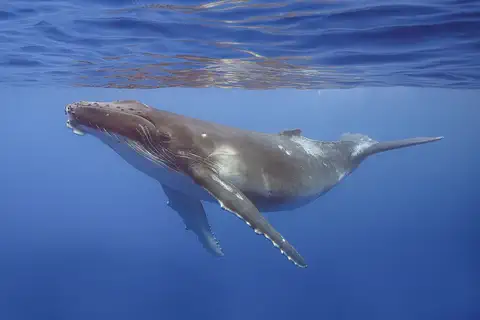
The humpback whale is a baleen whale famous for leaping out of the water, slapping its giant flippers and singing long, complex songs. It lives in every ocean and makes one of the longest journeys of any mammal, between cold feeding waters and warm waters where calves are born. Once hunted almost to extinction, it is now recovering.
-
 Watch
Animal
Adélie penguin
The Adélie penguin is a medium-sized penguin, about 70 centimeters tall, with a black back, a white front and a bright white ring around each eye. It breeds in summer on rocky, ice-free ground all around Antarctica, building nests of pebbles, and spends the winter far out at sea among the pack ice.
-
 Watch
Animal
Leopard seal
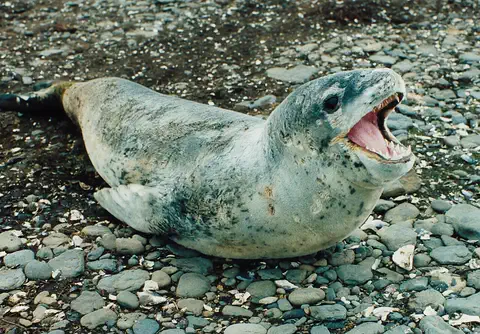
The leopard seal is a large, slender seal of the icy seas around Antarctica, named for the dark spots on its gray coat. It is a fast, powerful hunter with a big head and long teeth, and it eats everything from tiny krill to fish, penguins and young seals.
-
 Watch
3D
Animal
Bowhead whale
The bowhead whale is a giant baleen whale that spends its whole life in cold Arctic waters. Its enormous bow-shaped head can push through sea ice, its blubber is thicker than any other whale's, and some bowheads may live for more than 200 years.
-
 Watch
Animal
Chinstrap penguin
The chinstrap penguin is named for the thin black band that runs under its chin from ear to ear, like a helmet strap. It breeds in huge colonies on the Antarctic Peninsula and nearby islands, raises two chicks each summer and dives for krill close to shore.
-
 Watch
3D
Animal
Tardigrade
Tardigrades, or water bears, are tiny eight-legged animals about a millimeter long or less. They live in damp moss, soil, fresh water and the sea all over the world, and they can survive drying out completely by curling into a little barrel called a tun.
-
 Watch
Animal
Emperor penguin
The emperor penguin is the largest penguin in the world. It lives around Antarctica, and it is the only animal that breeds during the dark, freezing Antarctic winter. Fathers keep the egg warm on their feet for about two months, huddled together against the storms.
For parents & teachers
What children will learn
- Explain why Antarctic krill are central to the Southern Ocean food web.
- Describe the krill life cycle, including the deep sinking of eggs.
- Explain how krill survive winter by shrinking.
- Describe how international agreements manage a fishery.
Recommended ages: 3 to 17 · About 15 minutes
Talk about it
- What might happen to whales and penguins if there were far fewer krill?
- Why would an animal shrinking be a smart way to survive a hungry winter?
- Why do many countries need to agree on how much krill can be caught?
Try at home or in class
- Draw a food web for the Antarctic with krill in the middle and arrows to whales, seals, penguins, fish and squid.
- Measure 6 centimeters on your finger with a ruler to see how big one krill is.
Key vocabulary: crustacean, phytoplankton, swarm, molting, food web, baleen
Where these facts come from
- GBIF Backbone Taxonomy and GBIF Occurrence Search , Global Biodiversity Information Facility (CC0 1.0 (backbone); occurrence counts are facts derived from records under CC0, CC BY and CC BY-NC)
- Wikidata , Wikimedia Foundation (CC0 1.0)
- The IUCN Red List of Threatened Species , International Union for Conservation of Nature (IUCN terms of use (no redistribution of Red List data or range maps))
- Krill , Australian Antarctic Division
- Krill fisheries , Commission for the Conservation of Antarctic Marine Living Resources (CCAMLR)
- Antarctic wildlife , British Antarctic Survey
- Wikimedia Commons , Wikimedia Foundation (Per file: Public domain, CC0, CC BY or CC BY-SA only (credited on each page))
Checked, not yet human-reviewed. Last updated October 27, 2026. Spotted a mistake? Tell us.