
Animal
Kori bustard
The kori bustard is a very big bird that walks across the grasslands of Africa. It is one of the heaviest birds that can fly. Males puff up their necks to show off.
The kori bustard is a huge, long-legged bird of open grassland and savanna in eastern and southern Africa. It is one of the world's heaviest flying birds, but it spends its life on the ground and flies only when it really has to. In the breeding season, males blow up their necks like balloons and fan their white feathers to attract females.
Ardeotis kori is a very large African bustard (family Otididae) of flat, arid, open country, with two subspecies in eastern and southern Africa. BirdLife International assessed it as Near Threatened (A2bcd+4bcd) for the IUCN Red List (assessed 10 December 2024, published 2025) because of suspected moderately rapid declines from power-line collisions, hunting and habitat degradation.
Photo: Diego Delso, CC BY-SA 4.0, via Wikimedia Commons
Meet the kori bustard
The kori bustard is a very big bird with long legs.
Its back is buff and gray with fine dark lines. It walks much more than it flies.
The kori bustard is a huge bird with long legs and a long neck. Its upper feathers are buff and gray, finely barred with black, which helps it blend in with the dry grass. Males are more brightly colored than females, and much bigger.
A male weighs about 11 to 19 kilograms, and a female roughly half as much. The Smithsonian's National Zoo says the kori bustard is one of the world's heaviest flying birds, yet it lives on the ground and does not like to fly unless it is in serious danger.
Ardeotis kori is a bustard (family Otididae). The Smithsonian's National Zoo describes buff and gray upperparts finely barred with black that help it blend in, underparts that may be pale buff, white or black, three short, broad front toes adapted for running, and males more brightly colored than females. It gives males 11 to 19 kilograms, females roughly half that size, and a standing height of about 1.5 meters, and calls it one of the world's heaviest flying birds, reluctant to fly unless in serious danger.
The IUCN describes it as a huge African bustard with two recognized subspecies, and lists it as diurnal (Mmassy et al. 2022).
Quick facts
- Group
- Bird
- Height
- 1.5 m
- Weight
- 11 to 19 kg
Dry, open country
Kori bustards live on wide, open grassland in Africa.
They like dry places where they can see far.
Kori bustards live in flat, dry, mostly open country: grassland, bushland, thorny scrub and savanna. They also use wheat fields and firebreaks. In Kenya, some move into woodland in the dry season.
They live in two separate areas: one in eastern Africa, from South Sudan, Ethiopia and Somalia south to Tanzania, and one in southern Africa, from southern Angola, Namibia, Zambia, Zimbabwe and Botswana south to South Africa.
The IUCN describes an extremely large but disjunct range in sub-Saharan Africa, from South Sudan, Ethiopia and Somalia south to Tanzania, and from southern Angola, Namibia, south-west Zambia, Zimbabwe and Botswana south to South Africa, with an occupied area estimated at 3,420,000 square kilometers (Senyatso et al. 2013). Habitats are flat, arid, mostly open grassland, karoo, bushveld, thornveld, scrubland and savanna, as well as wheat fields and firebreaks; elevations run from sea level to 2,490 meters.
Several small outposts are suspected to have died out, in southern Somalia, south-west Uganda, Eswatini and KwaZulu-Natal, and a specimen once credited to Sudan proved to be a different bustard. The Smithsonian's National Zoo describes wide, open grasslands and lightly wooded savanna.
Continent
Its habitats


Where can you find this animal?
- Lives here naturally · Countries and seas named by a scientific source
- Sightings recorded · Records of wild sightings (GBIF)
Lives here naturally · Countries and seas named by a scientific source
Flat, dry, open grassland, bushland and savanna in two separate areas: eastern Africa from South Sudan, Ethiopia and Somalia to Tanzania, and southern Africa from southern Angola and Namibia to South Africa. Kori bustards live in only parts of the countries shown, and only a few remain in some of them. The IUCN lists them as possibly extinct in Eswatini, which is not shaded.
Places: Angola, Botswana, Ethiopia, Kenya, Mozambique, Namibia, Somalia, South Africa and 5 more places.
Source: iucn-red-list · checked October 2026
Sightings recorded · Records of wild sightings (GBIF)
Counts of GBIF records of wild observations (human and machine) and preserved specimens. Records include introduced populations, vagrants, escaped or released animals and misidentifications, so a country with records is not necessarily part of the native range.
Wild sightings have been recorded in South Africa, Kenya, Namibia, Tanzania, Botswana, Ethiopia, Zimbabwe, Mozambique and 9 more places.
Source: gbif · checked October 2026
Range maps show where scientists say an animal lives, often country by country. An animal may live in only part of a country shown, and sightings records can include animals that wandered far from home.
A bustard that eats lots of meat
Kori bustards eat insects, lizards, mice and seeds.
The chicks eat lots of insects.
Kori bustards eat both plants and animals, but they eat more meat than other bustards. Insects make up a big part of their food, especially for chicks. They also catch small mammals, lizards and snakes, and eat seeds, berries and roots. They have even been seen eating dead animals.
Kori bustards drink in an unusual way. Most birds scoop up water, but kori bustards suck it up.
The IUCN gives a wide-ranging diet of insects, reptiles, small rodents, birds, carrion, seeds, berries and roots (del Hoyo et al. 1996). The Smithsonian's National Zoo calls the species omnivorous but more carnivorous than other bustards, with insects forming a large part of the diet, especially for chicks, plus small mammals, lizards, snakes, seeds, berries and carrion.
The Zoo also notes that kori bustards are among the few birds that drink using a sucking motion rather than scooping.
Did you know?
Some kori bustards travel a long way.
Some kori bustards wander up to 130 kilometers from place to place.
Local nomadic movements of up to 130 kilometers are known (IUCN).
Built for walking
A kori bustard has three toes on each foot.
Its short, wide toes are good for running.
A kori bustard has only three toes on each foot, all pointing forward. They are short and broad, which makes them good for running across open ground.
A male can blow up his throat so his neck swells to as much as four times its usual size. He uses this balloon neck, along with his white feathers, when he displays to females.
The Smithsonian's National Zoo describes three short, broad front toes well adapted for running. In display the male inflates his esophagus to as much as four times its normal size, cocks his tail to reveal as much of the white undertail feathering as possible, and may droop his wings until the tips of the primaries touch the ground.
The IUCN notes that it may be sedentary in parts of its range, with local nomadic movements of up to 130 kilometers known, and that in Kenya at least birds may move into woodland in the dry season.
One or two eggs on the ground
The mother lays one or two eggs on the ground.
She looks after the chicks by herself.
The female makes a shallow scrape on the ground and lays one or two eggs, pale olive with brown blotches. She keeps them warm for 23 to 24 days, and the father does not help at all.
The chicks hatch fully developed. They can fly at about five weeks old, but they stay with their mother long after that. Kori bustards are at least about two years old before they can breed.
The Smithsonian's National Zoo describes a clutch of one or two pale olive eggs blotched with brown in a shallow scrape made by the female; incubation of 23 to 24 days; precocial chicks that remain with the female well after fledging at about five weeks; sexual maturity at about 2 years at the earliest; and males that mate with more than one female and take no part in incubation or rearing.
The IUCN gives a generation length of 11.9 years. The Zoo first bred the species in October 1997, the third zoo in the United States to do so.
Balloon necks on the hilltops
Male kori bustards show off on low hills.
They puff up their necks and fan out white feathers.
In the breeding season, males often gather in loose groups on low hilltops to display. A displaying male blows up his neck, cocks his tail to show its white feathers and droops his wings until they touch the ground. When he courts a female, he bows to her with his neck puffed up and snaps his bill, and he may make a low booming sound.
A male mates with more than one female. Kori bustards are active by day.
The Smithsonian's National Zoo describes males gathering in loose, lek-like formations on low hilltops; displays with the esophagus inflated, tail cocked and wings drooped; direct courtship in which the male bows to the female with neck inflated and bill snapping, sometimes with a low-pitched booming sound; and brief mating, after which the male resumes displaying for another female.
The IUCN lists the species as diurnal and as sedentary in parts of its range, with local nomadic movements of up to 130 kilometers.
Did you know?
Kori bustards suck up water when they drink.
Kori bustards are one of the few kinds of birds that drink by sucking up water instead of scooping it.
The Smithsonian's National Zoo notes that they are among the few birds that drink with a sucking motion rather than scooping.
Near threatened: power lines and hunting
There are fewer kori bustards than before.
They can fly into power lines. People are working to keep them safe.
The kori bustard is listed as near threatened. Its numbers are thought to be falling fairly fast in much of its range. Flying into power lines is a major danger, especially in South Africa and Namibia. Hunting, trade, fences and bushes spreading over open grassland are other problems.
No one knows exactly how many there are. A rough guess is 20,000 to 50,000 birds, with the most in Namibia. Kori bustards are thought to have disappeared from Eswatini.
BirdLife International assessed Ardeotis kori as Near Threatened (A2bcd+4bcd) for the IUCN Red List (assessed 10 December 2024, published 2025), suspecting moderately rapid declines. The global population is unquantified; national estimates covering about half the range sum to 14,000 to 30,100, and a tentative band of 20,000 to 50,000 individuals is used, with the largest estimate in Namibia (5,000 to 10,000). It became extinct in Eswatini in the 1950s.
The IUCN names collisions with high-voltage power lines as a major threat in the Karoo of South Africa and in Namibia, growing as transmission lines spread; planned wind farms in Kenya; fences around new settlements; hunting and trade; and bush encroachment in Namibia and Botswana. A large experiment with power-line markers in the eastern Karoo found no reduction in collisions. The Smithsonian's National Zoo reports range contractions since 1970 of more than 20% in East Africa and close to 10% in southern Africa.
IUCN Red List
How is the kori bustard doing in the wild?
- Least Concern
- Near Threatened (this animal)
- Vulnerable
- Endangered
- Critically Endangered
- Extinct in the Wild
- Extinct
Near Threatened
Not at risk yet, but it could be soon.
Amazing facts
-
Kori bustards suck up water when they drink.
Kori bustards are one of the few kinds of birds that drink by sucking up water instead of scooping it.
The Smithsonian's National Zoo notes that they are among the few birds that drink with a sucking motion rather than scooping.
-
A male's neck can swell up like a balloon.
A displaying male can blow up his neck to as much as four times its usual size.
In display the male inflates his esophagus to up to four times its normal size (Smithsonian's National Zoo).
-
Kori bustards can fly, but they would rather walk.
Even though it can fly, a kori bustard lives on the ground and flies only when it is in serious danger.
It is reluctant to fly unless in serious danger (Smithsonian's National Zoo).
-
Some kori bustards travel a long way.
Some kori bustards wander up to 130 kilometers from place to place.
Local nomadic movements of up to 130 kilometers are known (IUCN).
Words to know
- savanna
- a warm grassland with scattered trees and bushes
- lek
- a place where males gather to show off to females
- esophagus
- the tube that carries food from the mouth to the stomach
- carrion
- the meat of an animal that has already died
- bush encroachment
- when bushes spread over open grassland and fill it in
- near threatened
- close to being at risk of dying out in the wild
Discovery challenge
-
What does a kori bustard do most of the time?
How does a kori bustard usually get around?
How does the kori bustard mostly move about?
- It walks on the ground
- It swims in rivers
- It climbs trees
Show the answer
It walks on the ground
It walks!
It lives on the ground and flies only when it is in serious danger.
Ground-living; reluctant to fly unless in serious danger (Smithsonian's National Zoo).
-
How many eggs does a kori bustard lay?
How many eggs are in a kori bustard's clutch?
What is the kori bustard's clutch size?
- One or two
- About ten
- More than twenty
Show the answer
One or two
Just one or two!
Only one or two eggs, laid in a scrape on the ground.
One or two (Smithsonian's National Zoo).
-
What does a male puff up to show off?
What does a displaying male kori bustard inflate?
Which structure does the male inflate in display?
- His neck
- His tail
- His feet
Show the answer
His neck
His neck!
He blows up his neck to as much as four times its usual size.
His esophagus, up to four times its normal size (Smithsonian's National Zoo).
-
What is a big danger for kori bustards?
What is a major danger to kori bustards in South Africa and Namibia?
Which threat does the IUCN call major in the Karoo and Namibia?
- Flying into power lines
- Too much snow
- Sharks
Show the answer
Flying into power lines
Power lines!
Flying into power lines is a major danger there.
Collisions with high-voltage power lines (IUCN).
Places where you might see it
-
 Watch
 Country
Namibia
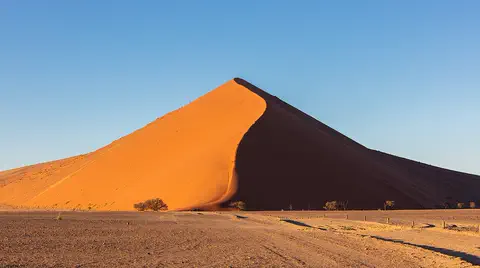
Namibia lies on the southwestern coast of Africa. The Namib, a desert of huge dunes kept alive by sea fog, runs along its coast, a high plateau with farms and wildlife fills its middle, and the dry Kalahari lies to the east. Namibia became independent in 1990.
-
 Watch
 Country
Kenya
Kenya is a country in East Africa, crossed by the equator. It has the snow-capped Mount Kenya, the deep Great Rift Valley, Lake Victoria and a long Indian Ocean coast, and about 54 million people live there, many of them speaking Swahili.
-
 Watch
 Country
Tanzania
Tanzania is a country in East Africa, just south of the Equator, on the Indian Ocean. It has Mount Kilimanjaro, Africa's highest mountain, deep lakes in the East African Rift, and the Serengeti, where huge herds of wildebeest travel each year.
Explore next
-
 Watch
Animal
Great bustard
The great bustard is a very large, heavy bird of open grassland and farmland, from Spain and Portugal across Europe and Asia to Mongolia and China. Males can weigh several times as much as females. In spring, males turn their feathers inside out into a puff of white to impress females. Great bustards are now endangered.
-
 Watch
Animal
Secretarybird
The secretarybird is a bird of prey that hunts on foot. It strides across the African savanna on the longest legs of any raptor, walking 20 to 30 kilometers a day, and stamps on grasshoppers, mice, lizards and even snakes with lightning-fast kicks.
-
 Watch
3D
Animal
Common ostrich
The common ostrich is the tallest and heaviest bird alive. It cannot fly, but it is the fastest runner on two legs, sprinting at about 70 kilometers an hour across the savannas and deserts of Africa. It also lays the biggest egg of any living animal.
-
 Watch
Animal
Helmeted guineafowl
The helmeted guineafowl is a chicken-sized bird of open country across much of Africa. Its gray feathers are covered in neat white spots, and its bare blue and red head carries a bony helmet called a casque. Guineafowl walk long distances in flocks, eating seeds, bulbs and insects, and fly up into trees to sleep at night.
-
Watch
Country
Namibia
Namibia lies on the southwestern coast of Africa. The Namib, a desert of huge dunes kept alive by sea fog, runs along its coast, a high plateau with farms and wildlife fills its middle, and the dry Kalahari lies to the east. Namibia became independent in 1990.
-
Watch
Country
Kenya
Kenya is a country in East Africa, crossed by the equator. It has the snow-capped Mount Kenya, the deep Great Rift Valley, Lake Victoria and a long Indian Ocean coast, and about 54 million people live there, many of them speaking Swahili.
-
Watch
Country
Tanzania
Tanzania is a country in East Africa, just south of the Equator, on the Indian Ocean. It has Mount Kilimanjaro, Africa's highest mountain, deep lakes in the East African Rift, and the Serengeti, where huge herds of wildebeest travel each year.
-
 Watch
Animal
Southern carmine bee-eater
The southern carmine bee-eater is a slim, bright pinkish-red bird with a greenish-blue crown, a dark mask and two long tail streamers. It lives in the savannas of southern and eastern Africa, catching flying insects in the air. In spring, huge colonies of up to a thousand pairs dig nest tunnels side by side in sandy riverbanks.
For parents & teachers
What children will learn
- Locate the two parts of Africa where kori bustards live.
- Describe how a male kori bustard displays to females.
- Explain why a bird that can fly might spend almost all its time walking.
- Discuss how power lines affect large birds and how planning can help.
Recommended ages: 3 to 17 · About 15 minutes
Talk about it
- Why might a very heavy bird avoid flying unless it has to?
- Why could a bird that lays only one or two eggs recover slowly from losses?
- Where should new power lines go so that birds stay safe?
Try at home or in class
- Height check: mark 1.5 meters on a wall with tape and compare it with family members. Who is taller than a kori bustard?
- Drinking test: try to drink water through a straw (sucking) and from a spoon tipped up (scooping). Which way does a kori bustard drink?
Key vocabulary: savanna, lek, esophagus, carrion, bush encroachment, near threatened
Where these facts come from
- GBIF Backbone Taxonomy and GBIF Occurrence Search , Global Biodiversity Information Facility (CC0 1.0 (backbone); occurrence counts are facts derived from records under CC0, CC BY and CC BY-NC)
- Wikidata , Wikimedia Foundation (CC0 1.0)
- The IUCN Red List of Threatened Species , International Union for Conservation of Nature (IUCN terms of use (no redistribution of Red List data or range maps))
- Ardeotis kori (BirdLife International, assessed 10 December 2024, published 2025) , IUCN Red List of Threatened Species
- Ardeotis kori: range, population, ecology, threats and conservation text , IUCN Red List of Threatened Species
- Ardeotis kori: IUCN Red List global assessment record (BirdLife International 2025), IUCN checklist on GBIF , GBIF
- Kori bustard , Smithsonian's National Zoo and Conservation Biology Institute
- File:Avutarda kori (Ardeotis kori), zona de conservación de Ngorongoro, Tanzania, 2024-05-27, DD 38.jpg (Diego Delso) , Wikimedia Commons
- Wikimedia Commons , Wikimedia Foundation (Per file: Public domain, CC0, CC BY or CC BY-SA only (credited on each page))
Checked, not yet human-reviewed. Last updated November 1, 2026. Spotted a mistake? Tell us.