
Animal
Olive baboon
The olive baboon is a big monkey with greenish-gray fur. It lives in big groups called troops. Babies ride on their mothers' backs.
The olive baboon is a large monkey of Africa named for its olive-gray fur. It lives in big troops on savannas, in grasslands and even in rainforests, eating almost anything from grass and roots to fruit and insects. It is the most widespread of all baboons.
Papio anubis, the most broadly distributed baboon, is native to 26 countries of equatorial Africa (IUCN). An adaptable omnivore living in multi-male, multi-female troops with complex social relationships, it is listed as Least Concern (IUCN, 2020), though crop-raiding brings conflict with farmers.
Photo: Charles J. Sharp, CC BY-SA 4.0, via Wikimedia Commons
Meet the olive baboon
The olive baboon is a big monkey.
Its fur looks gray and green. It has a long, dog-like face and a long tail.
The olive baboon is a big, strong monkey with a long, dog-like muzzle and a dark gray face. From far away its fur looks olive green, but up close each hair has black and yellow-brown rings.
Males are much bigger than females: about 24 kilograms compared with about 15. Males also have a big mane of longer fur on their head and shoulders, and large canine teeth. Look at the tail: the first part sticks up, then the rest flops down, so it looks broken!
Papio anubis is strongly sexually dimorphic. Wild males average about 24 kilograms and females about 14.7 (Primate Info Net); ADW gives average head-and-body lengths of 76 centimeters for males and 60 for females, plus tails of 56 and 48. Males carry a mane over the front of the body and large canines.
The olive-gray color comes from hairs banded with one or two pairs of black and yellow-brown rings. The face and the skin around the sitting pads (ischial callosities) are dark gray to black. The first quarter of the tail is held erect and the rest hangs, giving a "broken" look. Newborns are black and turn olive-gray by about six months.
Quick facts
- Group
- Mammal
- Length
- 60 to 76 cm
- Weight
- 14.7 to 24 kg
Where it lives
Olive baboons live in Africa.
They live on grassy plains and in forests. At night they sleep up in trees or on cliffs.
Olive baboons live in 26 countries across the middle of Africa, from Guinea and Mali in the west to Ethiopia, Somalia, Kenya and Tanzania in the east. No other baboon has such a big range.
They are often called savanna monkeys, but they live in many places: open grassland, woodland, rainforest and even near desert. They find food on the ground, in trees and under the ground. At night, a troop sleeps together in tall trees or on cliffs.
The IUCN assessment (Wallis 2020) lists 26 range countries, from Guinea, Sierra Leone, Mali and Mauritania east to Sudan, South Sudan, Ethiopia, Eritrea and Somalia, and south to Uganda, Kenya, Tanzania, Rwanda, Burundi and the two Congos, at 360 to 2,500 meters; isolated populations occur in the Sahara (ADW). Olive baboons interbreed with hamadryas baboons in Ethiopia's Awash Valley and with yellow baboons in Kenya and Tanzania, and overlap with Guinea baboons in the far west.
Habitats range from desert edge to montane forest, including grassland near woodland, gallery forest, moist evergreen forest and farmland. Home ranges vary enormously, from about 0.75 to 1.1 square kilometers in Ethiopia's Bole Valley to 43.8 square kilometers on Kenya's Laikipia Plateau, largely because group size differs.
Continent
Its habitats


Where can you find this animal?
- Lives here naturally · Countries and seas named by a scientific source
- Sightings recorded · Records of wild sightings (GBIF)
Lives here naturally · Countries and seas named by a scientific source
Savannas, grasslands, woodlands and forests across equatorial Africa, from Guinea and Mali to Ethiopia, Somalia and Tanzania, with isolated groups in the Sahara. Baboons live in only part of many countries shown.
Places: Guinea, Mali, Mauritania, Sierra Leone, Côte d'Ivoire, Burkina Faso, Ghana, Togo and 18 more places.
Source: iucn-red-list · checked October 2026
Sightings recorded · Records of wild sightings (GBIF)
Counts of GBIF records of wild observations (human and machine) and preserved specimens. Records include introduced populations, vagrants, escaped or released animals and misidentifications, so a country with records is not necessarily part of the native range.
Wild sightings have been recorded in Kenya, Benin, Tanzania, Uganda, Ethiopia, Ghana, Rwanda, DR Congo and 24 more places.
Source: gbif · checked October 2026
Range maps show where scientists say an animal lives, often country by country. An animal may live in only part of a country shown, and sightings records can include animals that wandered far from home.
What it eats
Olive baboons eat lots of different foods.
They eat grass, fruit, seeds and roots. They also eat bugs and eggs.
Olive baboons are omnivores that eat a huge variety of foods: fruit, seeds, flowers, grass, roots and tubers, tree gum, insects, eggs and sometimes small animals.
When the dry season comes and fruit and young leaves run out, baboons dig up roots and tubers. They can even live on grass for long periods. This is one reason they can survive in so many places. Near farms, some troops raid crops, which upsets farmers.
The diet includes fruits, tree gums, insects, eggs, seeds, flowers, grass, rhizomes, corms, roots, tubers and small vertebrates (Animal Diversity Web). Baboons can subsist on grasses for long periods, which lets them exploit dry habitats.
Food supply tracks rainfall: fruit, young leaves and flowers are plentiful late in the rains, and as the dry season advances baboons switch to underground foods (Primate Info Net). Where people farm, troops raid crops and garbage; crop-raiding males average about 27 kilograms, heavier than naturally foraging males, and grow up faster.
Did you know?
Some young baboons in Nigeria swim and dive for fun!
Young olive baboons at one river in Nigeria have been seen swimming and diving from trees, apparently for play.
Juveniles at a Nigerian river have been seen swimming with faces submerged and diving from overhanging trees, presumably as play.
A strong body
Baboons walk on all four legs.
They have strong hands for picking food. Males have big, sharp teeth.
Baboons spend a lot of time on the ground, walking on all fours. Their hands are good at picking up seeds and digging for roots. A long muzzle holds strong teeth, and males have very large canines.
Olive baboons have bare, tough sitting pads on their bottoms, so they can sit comfortably for a long time on rocks and branches. Their faces are dark and hairless, with close-set eyes.
Olive baboons are largely terrestrial quadrupeds that forage on the ground, in trees and below ground. The male skull has heavy bony ridges beside the nose, a prominent brow bar, a sagittal crest and large molars; the first lower premolar acts as a hone that sharpens the upper canine (Animal Diversity Web).
Both sexes have dark facial skin and ischial callosities. ADW notes that the bare area of the rump is smaller than in some related baboons and that the flat top of the head distinguishes this species from others with a crest.
Growing up
A baby baboon has black fur.
At first it holds on under its mother's belly. Later it rides on her back.
Olive baboons can have babies at any time of year. After about six months, a mother has one baby with black fur. It clings to her and drinks her milk, and later rides on her back. By about six months old its fur turns olive-gray.
Babies usually stop drinking milk at about 14 months old. Baboons are ready to have their own babies at four to six years old, but males keep growing until they are about 10.
Breeding is not seasonal. Gestation is about 180 days and produces a single infant (Animal Diversity Web; Primate Info Net). Weaning typically occurs at about 420 days, and the interbirth interval at Gilgil, Kenya, averages about two years (760 days), shorter for high-ranking females.
Both sexes reach sexual maturity at four to six years, but in the wild males do not reach full size until about 10. Nutrition matters: in crop-raiding populations, growth and puberty come earlier. Adult males often groom and protect infants of their female friends, which can deter predators such as chimpanzees at Gombe, Tanzania.
Life in the troop
Baboons live in big family groups called troops.
They groom each other's fur. Big males bark "wahoo" to warn of danger.
Olive baboons live in troops of about 15 to 150, with several adult males, many females and their young. The females stay in the troop they were born in all their lives, but young males leave to join another troop.
Baboons have friendships! Some males and females spend time together, groom each other and share food, and the male helps protect her babies. Baboons talk with barks, grunts, faces and touches. Big males give a loud "wahoo" bark when they see a lion or leopard.
Troops of about 15 to 150 contain several adult males, numerous females and young (Primate Info Net). Females are philopatric and form lifelong matrilineal bonds; males transfer after puberty, at six to nine years, and may move several more times. Males compete in a dominance hierarchy, but coalitions between older males and long-term "friendships" with particular females also shape mating.
Communication is visual, vocal and tactile. Adult males give a two-phase bark, the "wahoo", toward feline predators or rival males (Animal Diversity Web). Troops travel, forage and sleep together, so the availability of safe sleeping trees or cliffs limits their movements.
Did you know?
Baby baboons are born with black fur.
Baby olive baboons are black and turn olive-gray by about six months old.
The natal coat is black and is replaced by olive-gray fur by about six months.
Baboons and farmers
There are lots of olive baboons.
But some take food from farms. People are finding ways to share the land.
The olive baboon is listed as Least Concern: it is common across a huge area. But as more land becomes farms, troops raid crops, and some farmers trap or poison baboons.
People have tried scaring baboons away with recorded alarm calls, guard dogs and bad-tasting chemicals, but clever baboons soon learn to ignore them. In Kenya, more than 130 baboons were moved by 1984 to places far from farms, to keep both baboons and farmers safe.
The IUCN assessed Papio anubis as Least Concern in 2020. Primate Info Net describes habitat loss and growing conflict where human populations expand: troops become crop pests, and farmers poison, trap and shoot them. Deterrents such as alarm-call playback, chemical repellents and guard dogs work only briefly because baboons learn to avoid them.
Translocation has reduced persecution: at Gilgil, Kenya, more than 130 baboons had been trapped and moved by 1984. Disease is another risk: a 1982 tuberculosis outbreak in a Kenyan troop came from eating infected beef at a slaughterhouse dump.
IUCN Red List
How is the olive baboon doing in the wild?
- Least Concern (this animal)
- Near Threatened
- Vulnerable
- Endangered
- Critically Endangered
- Extinct in the Wild
- Extinct
Least Concern
Not at risk of disappearing from the wild right now.
See the IUCN Red List assessment · The IUCN Red List of Threatened Species 2022.2
Amazing facts
-
A baboon's tail looks like it is broken. But it is not!
An olive baboon holds the first part of its tail up and lets the rest hang down, so it looks broken.
The first quarter of the tail is held erect and the rest hangs limp, a distinctive "broken" carriage.
-
Baby baboons are born with black fur.
Baby olive baboons are black and turn olive-gray by about six months old.
The natal coat is black and is replaced by olive-gray fur by about six months.
-
Some young baboons in Nigeria swim and dive for fun!
Young olive baboons at one river in Nigeria have been seen swimming and diving from trees, apparently for play.
Juveniles at a Nigerian river have been seen swimming with faces submerged and diving from overhanging trees, presumably as play.
-
Boy and girl baboons can be friends.
Male and female baboons form friendships: they groom each other, share food and he protects her babies.
Long-term male-female friendships involve grooming, food sharing and male protection of the female's infants.
Words to know
- troop
- a group of monkeys that live together
- omnivore
- an animal that eats both plants and animals
- groom
- to clean another animal's fur, often to show friendship
- muzzle
- the nose and mouth part of an animal's face
- savanna
- a warm grassland with scattered trees
Discovery challenge
-
What is a group of baboons called?
What do we call a group of olive baboons?
What is the social group of olive baboons called?
- A troop
- A herd
- A flock
Show the answer
A troop
A group of baboons is a troop.
A troop, with about 15 to 150 baboons.
A troop: a multi-male, multi-female group of about 15 to 150.
-
Why is it called an olive baboon?
How did the olive baboon get its name?
What produces the olive baboon's characteristic color?
- Its fur looks olive green-gray
- It eats only olives
- It lives in olive trees
Show the answer
Its fur looks olive green-gray
Its fur looks greenish gray, like olives.
Its fur looks olive-gray from far away.
Hairs banded with black and yellow-brown rings give an olive-gray overall color.
-
Which baboons leave the troop when they grow up?
Which olive baboons leave the troop they were born in?
Which sex disperses from the natal troop in olive baboons?
- Young males
- Young females
- Nobody ever leaves
Show the answer
Young males
Young males leave. Females stay.
Young males leave after they grow up; females stay all their lives.
Males transfer after puberty, at six to nine years; females are philopatric.
-
What does an olive baboon eat?
Which best describes an olive baboon's diet?
Why can olive baboons survive in such varied habitats?
- Almost anything, plants and small animals
- Only meat
- Only bananas
Show the answer
Almost anything, plants and small animals
They eat lots of foods: grass, fruit, roots and bugs.
Almost anything: fruit, seeds, grass, roots, insects, eggs and small animals.
A flexible omnivorous diet, including subsisting on grass and underground foods in dry seasons.
Places where you might see it
-
 Watch
 Country
Kenya
Kenya is a country in East Africa, crossed by the equator. It has the snow-capped Mount Kenya, the deep Great Rift Valley, Lake Victoria and a long Indian Ocean coast, and about 54 million people live there, many of them speaking Swahili.
-
 Watch
 Country
Uganda
Uganda is a landlocked country in East Africa, on the shores of Lake Victoria, Africa's largest freshwater lake. The Victoria Nile flows out of the lake here, snowy mountains rise in the west, and its forests are home to mountain gorillas and chimpanzees. About 51.4 million people lived there in 2025.
Explore next
-
 Watch
Animal
Mandrill
The mandrill is the largest and most colorful of the Old World monkeys. Grown-up males have red noses, blue-ridged cheeks and a golden beard. Mandrills roam the rainforests of west-central Africa in huge, noisy groups called hordes.
-
Watch
Country
Kenya
Kenya is a country in East Africa, crossed by the equator. It has the snow-capped Mount Kenya, the deep Great Rift Valley, Lake Victoria and a long Indian Ocean coast, and about 54 million people live there, many of them speaking Swahili.
-
Watch
Country
Uganda
Uganda is a landlocked country in East Africa, on the shores of Lake Victoria, Africa's largest freshwater lake. The Victoria Nile flows out of the lake here, snowy mountains rise in the west, and its forests are home to mountain gorillas and chimpanzees. About 51.4 million people lived there in 2025.
-
 Watch
3D
Animal
Leopard
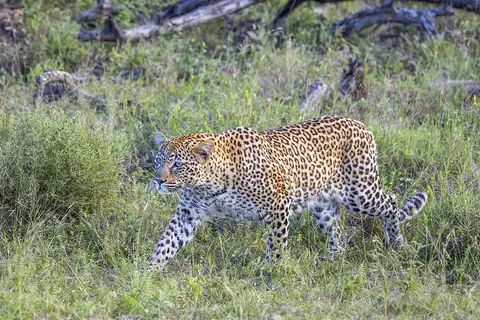
The leopard is a strong, spotted big cat and the best climber of them all. It can carry its food high up into a tree, away from lions and hyenas. Leopards live in more kinds of places than any other big cat, from deserts to rainforests, across Africa and Asia.
-
 Watch
Animal
Aardvark
The aardvark is a shy night digger of African savannas. It sniffs out ant and termite nests, rips them open with its spade-like claws and laps up the insects with a sticky tongue about 30 centimeters long. Its name means 'earth pig' in Afrikaans.
-
 Watch
Animal
African buffalo
The African buffalo is a huge, cow-like grazer with heavy, curving horns. It lives in herds that can number in the thousands, and a herd will rush to protect a calf in danger. It lives across much of Africa south of the Sahara, from open savannas to rainforests.
-
 Watch
Animal
African forest elephant
The African forest elephant is a separate species from the bigger bush elephant. It lives in the rainforests of central and western Africa, eats lots of fruit and spreads the seeds of forest trees in its dung. It is Critically Endangered.
-
 Watch
3D
Animal
African wild dog
The African wild dog, or painted dog, has a patchy coat unlike any other dog's, big round ears and only four toes on its front feet. It lives in close packs that hunt together, share food and care for the pups. It is endangered: the IUCN estimated in 2025 that only about 1,676 adults are left in the wild.
For parents & teachers
What children will learn
- Describe how olive baboons live together in troops.
- Explain how a flexible diet helps an animal live in many habitats.
- Locate the olive baboon's range across Africa.
- Discuss conflict between wildlife and farmers, and ways to reduce it.
Recommended ages: 3 to 17 · About 15 minutes
Talk about it
- Why might it help a baboon to have friends in its troop?
- If baboons raid a farmer's crops, what fair solutions can you think of?
- Why do you think young males, but not females, leave their troop?
Try at home or in class
- Make a list of everything you ate yesterday, then sort it into plant and animal foods: are you an omnivore like a baboon?
- Find Guinea, Mali, Ethiopia and Tanzania on a map of Africa and trace the olive baboon's range.
Key vocabulary: troop, omnivore, groom, muzzle, savanna
Where these facts come from
- GBIF Backbone Taxonomy and GBIF Occurrence Search , Global Biodiversity Information Facility (CC0 1.0 (backbone); occurrence counts are facts derived from records under CC0, CC BY and CC BY-NC)
- The IUCN Red List of Threatened Species , International Union for Conservation of Nature (IUCN terms of use (no redistribution of Red List data or range maps))
- Papio anubis (Olive Baboon), Wallis 2020, global assessment , IUCN Red List of Threatened Species
- Papio anubis (olive baboon) , Animal Diversity Web, University of Michigan
- Olive baboon (Papio anubis) factsheet , Primate Info Net, Wisconsin National Primate Research Center
- Papio anubis: IUCN Red List global assessment record (Wallis 2020), IUCN checklist on GBIF , GBIF
- Wikidata , Wikimedia Foundation (CC0 1.0)
- Wikimedia Commons , Wikimedia Foundation (Per file: Public domain, CC0, CC BY or CC BY-SA only (credited on each page))
Checked, not yet human-reviewed. Last updated November 1, 2026. Spotted a mistake? Tell us.