
Animal
African wild dog
The African wild dog has a coat of black, brown and white patches. It lives in a big family called a pack. The whole pack shares food and looks after the puppies.
The African wild dog, or painted dog, has a patchy coat unlike any other dog's, big round ears and only four toes on its front feet. It lives in close packs that hunt together, share food and care for the pups. It is endangered: the IUCN estimated in 2025 that only about 1,676 adults are left in the wild.
Lycaon pictus is a highly social canid of sub-Saharan Africa. Packs hunt cooperatively and raise one dominant pair's large litters together. The IUCN's 2025 assessment lists it as Endangered, with about 1,676 mature individuals and a range that has shrunk to 13 countries.
Photo: Michael Gäbler, CC BY 3.0, via Wikimedia Commons
Meet the African wild dog
The African wild dog has patchy fur.
It looks a bit like someone painted it with black, brown and white. It has big round ears and long legs. Every wild dog has its own pattern.
The African wild dog is also called the painted dog, because its short coat is splashed with black, brown, yellow and white. Every dog's pattern is different. Its scientific name, Lycaon pictus, means 'painted wolf'.
It has long legs, a lanky body and big, rounded ears. Unlike other members of the dog family, it has only four toes on each front foot. People often think it is a kind of hyena, but it is not: hyenas belong to a different family. Wild dogs are true members of the dog family.
Lycaon pictus is a canid, in the same family as wolves, jackals, foxes and domestic dogs, though it is often mistaken for a hyena, which belongs to a separate family, Hyaenidae. Fossils suggest its lineage split from other canids about three million years ago. Britannica notes that it differs from other canids in having four toes on each foot, while San Diego Zoo Wildlife Alliance specifies four toes on the front feet instead of five.
Britannica gives a head-and-body length of 76 to 102 centimeters, a 31- to 41-centimeter tail and a shoulder height of about 60 centimeters. San Diego Zoo gives weights of 18 to 34 kilograms. The blotched coat is unique to each individual.
Quick facts
- Group
- Mammal
- Length
- 76 to 102 cm
- Height
- up to 60 cm
- Weight
- 18 to 34 kg
- Top speed
- up to 60 km/h
Where it lives
African wild dogs live in Africa.
They run across grassy plains and open woodlands. They used to live in many more places than they do today.
African wild dogs live in parts of Africa south of the Sahara Desert, on open plains, savannas and woodlands, and sometimes in thicker bush and forest. They are not found in rainforests.
Long ago they lived across most of these lands. Today they are gone from many countries and live in only 13, such as Botswana, Tanzania, Zambia and Zimbabwe. A pack needs a huge area to roam: between about 200 and 2,000 square kilometers.
The IUCN's 2025 assessment lists the species as extant in 13 countries: Angola, Botswana, the Central African Republic, Ethiopia, Kenya, Mozambique, Namibia, Senegal, South Africa, South Sudan, Tanzania, Zambia and Zimbabwe. It is listed as extinct in 22 countries, possibly extinct in Algeria and Mali, and of uncertain presence in Chad and Guinea.
Animal Diversity Web lists grassland, savanna, open woodland and semi-desert to mountain areas, and says they are not found in jungle; San Diego Zoo adds that they can also thrive in thicker bush and forest. They are non-territorial, and San Diego Zoo describes them as constant wanderers that rarely stay in one place more than a day or two. San Diego Zoo notes that a pack needs about 207 to 2,070 square kilometers, more than most African national parks provide.
Continent
Its habitat

Where can you find this animal?
- Used to live here · Countries and seas named by a scientific source
- Lives here naturally · Countries and seas named by a scientific source
- Sightings recorded · Records of wild sightings (GBIF)
Used to live here · Countries and seas named by a scientific source
The 22 countries where the IUCN lists the African wild dog as extinct. It is also listed as possibly extinct in Algeria and Mali, which are not shaded.
Places: Benin, Burkina Faso, Burundi, Cameroon, DR Congo, Côte d'Ivoire, Egypt, Eritrea and 14 more places.
Source: iucn-red-list · checked October 2026
Lives here naturally · Countries and seas named by a scientific source
Savannas, grasslands and open woodlands in scattered parts of sub-Saharan Africa. Wild dogs live in only part of each country shown.
Places: Angola, Botswana, Central African Rep., Ethiopia, Kenya, Mozambique, Namibia, Senegal and 5 more places.
Source: iucn-red-list · checked October 2026
Sightings recorded · Records of wild sightings (GBIF)
Counts of GBIF records of wild observations (human and machine) and preserved specimens. Records include introduced populations, vagrants, escaped or released animals and misidentifications, so a country with records is not necessarily part of the native range.
Wild sightings have been recorded in South Africa, Botswana, Kenya, Zambia, Tanzania, United States, Zimbabwe, Namibia and 19 more places.
Source: gbif · checked October 2026
Range maps show where scientists say an animal lives, often country by country. An animal may live in only part of a country shown, and sightings records can include animals that wandered far from home.
What it eats
African wild dogs eat meat.
The pack hunts together, mostly in the early morning and the evening. They chase small antelopes and share the food.
African wild dogs hunt as a team, usually twice a day at dawn and dusk. They mostly catch antelopes such as impalas, Thomson's gazelles and puku, and sometimes old, sick or injured wildebeest and zebras.
Instead of hiding and pouncing, they take turns running after their prey until it tires. They can run at up to 60 kilometers an hour for nearly 5 kilometers. This teamwork works well: San Diego Zoo reports that wild dogs catch their prey 70 to 90 percent of the time. Lions and hyenas may try to take their food, so wild dogs eat quickly.
Packs hunt cooperatively, usually at dawn and dusk, targeting mammals about twice their own weight: impala, Thomson's gazelle, puku and bush duiker, and weakened wildebeest and zebra. Rather than ambush, they run prey down in relays, relying on endurance; San Diego Zoo cites speeds of up to 60 kilometers per hour over about 4.8 kilometers.
It reports success rates of 70 to 90 percent, compared with 30 to 40 percent for lions, and suggests the dogs' disruptive coloring makes a pack look larger and confuses prey. Because lions, spotted hyenas and vultures compete for kills, the dogs feed quickly. Food is shared: adults regurgitate meat for pups and for injured or ill pack members.
Did you know?
A wild dog will look for a lost puppy for days.
An adult wild dog has been recorded searching for days for a lost pup, calling and listening for an answer.
San Diego Zoo reports adults searching for days for a lost pup or juvenile, using a special call and listening for a reply.
Built for long chases
Wild dogs have long legs for running far.
Their big round ears hear very well. Big ears also help them stay cool in hot weather.
A wild dog's long legs and lanky body give it both speed and endurance, so it can keep running long after its prey tires. Its large, rounded ears give it excellent hearing and help it lose heat in the hot African climate.
Wild dogs also use their ears to talk: a pack mate can move its big ears to show which way to go. Its coat of blotches is unique, like a fingerprint: no two dogs have the same pattern.
Long limbs and a lanky frame suit endurance hunting rather than ambush. The large, rounded ears serve hearing and heat loss, and are also used for signaling direction within the pack. Britannica describes a broad, flat head and short muzzle.
The reduced number of toes, four on each front foot rather than the five of most canids, sets the genus apart. The short, sparse coat is irregularly blotched with yellow, black and white, and each individual's pattern is distinct; Animal Diversity Web compares this to the stripes of zebras.
Growing up in the pack
Baby wild dogs are called pups.
A mother can have lots of pups at once. The whole pack brings them food and keeps them safe.
Usually only the leading pair in a pack has pups. After a pregnancy of about ten weeks, the mother has her pups in a den, often an old aardvark, warthog or hyena burrow. A litter is big: San Diego Zoo gives 10 to 12 pups on average, and up to 21, more than any other kind of dog.
While she cares for them, other pack members bring her food and guard the den. From about four weeks old, the pups are fed meat that the adults bring back up from their stomachs. When the pups are old enough to follow, the adults let them eat first.
One dominant pair usually breeds, and pairs tend to stay together for life; subordinates are generally kept from breeding. Gestation is about ten weeks, and pups are usually born between March and July. Litter size estimates vary: Animal Diversity Web gives 2 to 20, Britannica an average of about six, and San Diego Zoo an average of 10 to 12 with up to 21, the largest of any canid.
Dens are often old aardvark, warthog or hyena burrows. Helpers, usually adult males, guard the den and feed the mother. Pups receive regurgitated solid food from about four weeks, are weaned at about eight weeks and use the den until up to 16 weeks. At kills, the adults stand back and keep watch while pups feed. Females mature at 12 to 18 months but breed later.
A close-knit pack
A wild dog pack is a family.
In the morning, they greet each other with happy chirps and play. Then they go hunting together. A lost dog calls with a hoo sound.
African wild dogs live in packs, usually of about 5 to 20 dogs. Each day starts with a noisy greeting: the dogs chirp and twitter like a flock of birds, run side by side, lick each other's mouths and play before the hunt.
Wild dogs do not howl like wolves. Instead they make high squeaks and a bell-like 'hoo' call, used when a dog gets separated. In most social mammals, young males leave home, but in wild dogs it is the young females that leave, at about three years old, to join new packs.
Packs average about 5 to 20 dogs (Animal Diversity Web gives 7 to 15 today, with past packs of up to 100), led by a dominant pair, with separate hierarchies for males and females. Pack life is strongly cooperative: food sharing, den guarding and care of injured members are central, and San Diego Zoo describes packs as gentler than wolf packs, with members getting along well most of the time.
Morning greeting ceremonies with twittering calls, mouth-licking and play precede hunts. Calls include high-pitched squeaks and the 'hoo' contact call of a separated dog; wild dogs do not howl. Unusually among social mammals, females disperse, sometimes as groups of sisters, at around two and a half to three years, while males usually stay, so packs often contain more males than females.

Saving the painted dog
There are not many African wild dogs left.
People are working to protect them. They need big wild places where they can run and hunt.
The African wild dog is endangered. The IUCN's 2025 assessment estimates only about 1,676 adults in the wild, and their numbers are still falling. In the past, people killed many wild dogs as pests, and they have disappeared from more than 20 countries.
Today the biggest problems are losing their wild land to farms and towns, being killed by farmers when they take livestock, and diseases such as rabies and distemper caught from pet dogs. Community-led conservation programs help too, such as one in Kenya, supported by San Diego Zoo Wildlife Alliance, that looks after wildlife and people's livelihoods together.
The IUCN's 2025 assessment lists Lycaon pictus as Endangered (criterion C2b) with about 1,676 mature individuals and a decreasing trend. Colonial-era bounty programs treated wild dogs as pests; San Diego Zoo reports that up to 5,000 were killed in Zambia between 1945 and 1949 alone.
Present threats include habitat loss and fragmentation, persecution by livestock farmers outside protected areas, and epidemics of rabies, canine distemper and parvovirus spread by domestic dogs. Because packs range so widely, most national parks are too small for even one pack, and the IUCN estimates that only 31 to 40 percent of the population lives in protected areas. Landscapes shared with people therefore matter; San Diego Zoo Wildlife Alliance supports one community-led program in Kenya.
IUCN Red List
How is the african wild dog doing in the wild?
- Least Concern
- Near Threatened
- Vulnerable
- Endangered (this animal)
- Critically Endangered
- Extinct in the Wild
- Extinct
Endangered
At very high risk of disappearing from the wild.
See the IUCN Red List assessment · The IUCN Red List of Threatened Species 2022.2
Amazing facts
-
Wild dogs do not howl. They chirp and squeak.
Unlike wolves, African wild dogs do not howl. They chirp, squeak and make a bell-like 'hoo' call when one gets lost.
African wild dogs lack the howl of wolves; their repertoire includes twittering, high-pitched squeaks and the 'hoo' contact call.
-
When pups are hungry, the grown-up dogs let them eat first.
When the pups are old enough to join a hunt, the adults step back and keep watch while the pups eat first.
At kills with pups present, adults let the young feed first and watch for other predators.
-
A wild dog will look for a lost puppy for days.
An adult wild dog has been recorded searching for days for a lost pup, calling and listening for an answer.
San Diego Zoo reports adults searching for days for a lost pup or juvenile, using a special call and listening for a reply.
-
Wild dogs have four toes on their front feet.
Most dogs have five toes on their front feet, but African wild dogs have only four.
The four-toed front foot distinguishes Lycaon from other canids, which have five.
Words to know
- pack
- a family group of wild dogs that live and hunt together
- regurgitate
- to bring food back up from the stomach to feed others
- endurance
- being able to keep going for a long time
- den
- a hidden home, often underground, where pups are born
- endangered
- at risk of disappearing from the wild
- canid
- a member of the dog family
Discovery challenge
-
Which family does the wild dog belong to?
Which family does the African wild dog belong to?
To which family does Lycaon pictus belong?
- The hyena family
- The dog family
- The cat family
Show the answer
The dog family
No! It belongs to the dog family, not the hyena family.
It is a true member of the dog family, with wolves and foxes. Hyenas are a separate family.
Canidae; hyenas form a separate family, Hyaenidae.
-
How many toes are on a wild dog's front foot?
How many toes does an African wild dog have on each front foot?
How many toes are on each front foot of Lycaon pictus?
- Three
- Four
- Five
Show the answer
Four
Wild dogs have four toes on each front foot.
Four, while most other dogs have five.
Four, a trait that distinguishes it from other canids.
-
Who looks after wild dog pups?
Who helps raise African wild dog pups?
How is pup care organized in an African wild dog pack?
- Only the mother
- The whole pack
- Nobody
Show the answer
The whole pack
The whole pack brings food and keeps the pups safe.
Pack members bring food, guard the den and feed the pups.
Cooperatively: helpers guard the den, feed the mother and regurgitate food for pups.
-
How do wild dogs catch food?
How do African wild dogs usually hunt?
Which hunting method do African wild dogs mainly use?
- Alone, hiding in trees
- As a team, taking turns to chase
- By digging for roots
Show the answer
As a team, taking turns to chase
They hunt as a team.
They work together and take turns chasing prey until it tires.
Cooperative relay chases that rely on endurance rather than ambush.
Places where you might see it
-
 Watch
 Country
Botswana
Botswana is a landlocked country in the middle of southern Africa. Deep Kalahari sand covers most of it, but in the north the Okavango River spreads into a huge green delta full of wildlife. Botswana became independent in 1966 and has grown more prosperous, helped by diamonds.
-
 Watch
 Country
Kenya
Kenya is a country in East Africa, crossed by the equator. It has the snow-capped Mount Kenya, the deep Great Rift Valley, Lake Victoria and a long Indian Ocean coast, and about 54 million people live there, many of them speaking Swahili.
-
 Watch
 Country
Mozambique
Mozambique stretches along the Indian Ocean coast of southeastern Africa. The great Zambezi River cuts through its middle, its beaches face the island of Madagascar, and parks like Gorongosa are home to elephants and lions. About 35.6 million people lived there in 2025, and Portuguese is the official language.
-
Watch
Natural wonder
Okavango Delta
The Okavango Delta, in northwestern Botswana, is a huge wetland in the middle of a dry land. The Okavango River flows in from Angola, spreads out into channels, lagoons and grassy plains, and then soaks away into the sands of the Kalahari instead of reaching the sea. Its flood arrives in the dry season, drawing elephants, buffalo, zebras and many other animals.
Explore next
-
 Watch
3D
Animal
Gray wolf
The gray wolf is the largest member of the dog family and the wild ancestor of pet dogs. Wolves live in family packs that hunt big animals like elk and moose together, and their howls can carry about 10 kilometers. After being wiped out in many places, wolves are coming back in parts of North America and Europe.
-
 Watch
3D
Animal
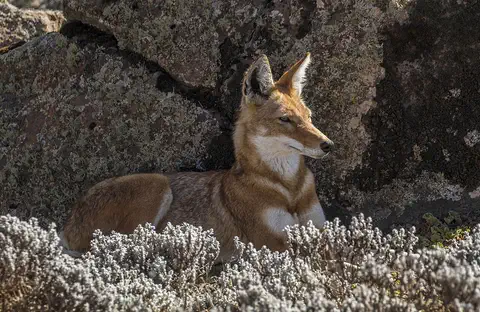
Ethiopian wolf
The Ethiopian wolf is a slender red wolf that lives only in the high mountains of Ethiopia. Wolf families share a territory, but each wolf hunts alone for rats and mole-rats. It is one of the rarest wild dogs on Earth.
-
 Watch
3D
Animal
Spotted hyena
The spotted hyena is the largest of the hyenas and a skilled hunter of the African savanna. Many people think hyenas only eat leftovers, but in East and Southern Africa they catch most of their own food. They live in big clans led by females, and they whoop, groan and 'giggle' to talk.
-
Watch
Country
Botswana
Botswana is a landlocked country in the middle of southern Africa. Deep Kalahari sand covers most of it, but in the north the Okavango River spreads into a huge green delta full of wildlife. Botswana became independent in 1966 and has grown more prosperous, helped by diamonds.
-
Watch
Country
Kenya
Kenya is a country in East Africa, crossed by the equator. It has the snow-capped Mount Kenya, the deep Great Rift Valley, Lake Victoria and a long Indian Ocean coast, and about 54 million people live there, many of them speaking Swahili.
-
 Watch
Animal
Impala
The impala is a slender, reddish-brown antelope of the savannas of eastern and southern Africa. It can both graze on grass and browse on leaves, lives in herds, and when startled the whole herd bursts into spectacular leaps. Only males have the long, curving horns.
-
Watch
Country
Mozambique
Mozambique stretches along the Indian Ocean coast of southeastern Africa. The great Zambezi River cuts through its middle, its beaches face the island of Madagascar, and parks like Gorongosa are home to elephants and lions. About 35.6 million people lived there in 2025, and Portuguese is the official language.
-
 Watch
Animal
Common warthog
Common warthogs are tough wild pigs of the African savanna. They kneel down to eat short grass, sleep in old aardvark burrows and run with their tails held straight up like little flags. The bumps on their faces are thick pads of skin.
For parents & teachers
What children will learn
- Describe the African wild dog's features and how they help it hunt and communicate.
- Explain how a pack cooperates to hunt, share food and raise pups.
- Correct the common confusion between wild dogs and hyenas.
- Understand why the species is endangered and what helps it.
Recommended ages: 3 to 17 · About 15 minutes
Talk about it
- Why might sharing food help the whole pack survive?
- Why do wild dogs need more space than most national parks have?
- How could an illness in pet dogs end up harming wild dogs?
Try at home or in class
- Play a relay chase game: one runner versus a team who take turns, and talk about why the team wins.
- Design your own painted dog coat on paper; compare with friends to see that no two are the same.
Key vocabulary: pack, regurgitate, endurance, den, endangered, canid
Where these facts come from
- The IUCN Red List of Threatened Species , International Union for Conservation of Nature (IUCN terms of use (no redistribution of Red List data or range maps))
- GBIF Backbone Taxonomy and GBIF Occurrence Search , Global Biodiversity Information Facility (CC0 1.0 (backbone); occurrence counts are facts derived from records under CC0, CC BY and CC BY-NC)
- Lycaon pictus (African Wild Dog), 2025 assessment , IUCN Red List of Threatened Species
- Painted Dog (African Hunting Dog) , San Diego Zoo Wildlife Alliance
- African wild dog , Encyclopaedia Britannica
- Lycaon pictus , Animal Diversity Web, University of Michigan Museum of Zoology
- Wikidata , Wikimedia Foundation (CC0 1.0)
- Wikimedia Commons , Wikimedia Foundation (Per file: Public domain, CC0, CC BY or CC BY-SA only (credited on each page))
Checked, not yet human-reviewed. Last updated October 24, 2026. Spotted a mistake? Tell us.