Animal
Leopard
The leopard is a spotted cat that loves to climb trees. It rests on branches in the day. It hunts at night.
The leopard is a strong, spotted big cat and the best climber of them all. It can carry its food high up into a tree, away from lions and hyenas. Leopards live in more kinds of places than any other big cat, from deserts to rainforests, across Africa and Asia.
Panthera pardus is the smallest and most widespread of the large cats, a solitary, mostly nocturnal ambush predator that eats almost anything it can overpower and caches kills in trees. It has lost up to three quarters of its range since 1750 and is listed as Vulnerable by the IUCN.
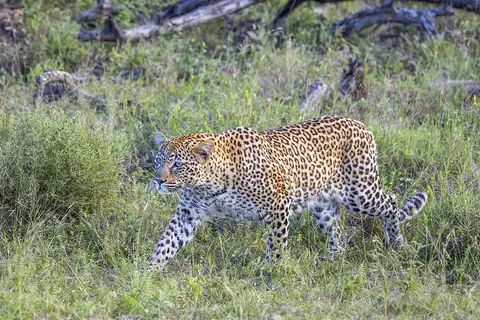
Photo: Charles J. Sharp, CC BY-SA 4.0, via Wikimedia Commons
Meet the leopard
The leopard is a big cat with lots of spots.
Its spots look like little flowers. Leopards are very strong. They are super climbers.
The leopard is a big cat with a golden coat covered in dark spots. Most of the spots are grouped in rings called rosettes, which look a bit like flowers. A grown leopard weighs about 21 to 75 kilograms, males more than females, and stands about 60 to 70 centimeters tall at the shoulder.
It looks a lot like a jaguar, but there is an easy way to tell them apart: a jaguar's rosettes have a dot in the middle, and a leopard's do not. Some leopards are black all over, with spots that are hard to see. People call them black panthers.
Panthera pardus is closely related to the lion, tiger and jaguar. San Diego Zoo Wildlife Alliance calls it the smallest of the large cats and the most widespread. San Diego Zoo Wildlife Alliance gives adult weights of 21 to 60 kilograms for females and 36 to 75 for males, and Britannica a shoulder height of 60 to 70 centimeters and a tail of about 90 centimeters.
The dark spots are mostly arranged in rosettes without the central spot of a jaguar's, and their size and spacing vary a great deal. A melanistic (black) form, the so-called black panther, is more common in Asia than elsewhere. Britannica counts nine recognized subspecies, some of which, such as the Amur and Arabian leopards, have declined to critical levels.
Quick facts
- Group
- Mammal
- Height
- 0.6 to 0.7 m
- Weight
- 21 to 75 kg
- Top speed
- up to 58 km/h
- Lifespan in the wild
- 10 to 12 years
Where it lives
Leopards live in Africa and Asia.
They live in many kinds of places. Some live in forests. Some live on grassy plains. Some live high in the mountains.
Leopards can live almost anywhere: high mountains, deserts, grassy savannas, rocky hills and thick rainforests. They live across much of Africa south of the Sahara and in parts of Asia, from Turkey and Iran to India, Sri Lanka, China and the Russian Far East.
Even so, they have lost a lot of their old home. Long ago they lived in many more places in North Africa, the Middle East and Asia.
No other big cat matches the leopard's range of habitats, from rainforest and savanna to desert, scrub and high mountains. In 1750 its range covered nearly all of sub-Saharan Africa, parts of North and Northeast Africa, and Asia from Asia Minor through Central Asia and India to China and Manchuria; Britannica reports that by 2019 the species had lost up to 75 percent of that range.
The IUCN Red List (2023 assessment) lists leopards as extant in about sixty countries across Africa and Asia, but many Asian and North African populations are small and isolated, and the species is extinct in countries such as Morocco, Algeria, Jordan, Syria and Singapore. The map shades countries where leopards live today; it does not mean they live everywhere inside each one.
Continents
Its habitats


Where can you find this animal?
- Lives here naturally · Countries and seas named by a scientific source
- Sightings recorded · Records of wild sightings (GBIF)
Lives here naturally · Countries and seas named by a scientific source
Forests, savannas, mountains, scrub and desert edges across much of Africa south of the Sahara and in scattered parts of Asia. In many Asian and North African countries only small, isolated populations remain, and in Indonesia leopards live only on Java.
Places: Afghanistan, Angola, Armenia, Bangladesh, Benin, Bhutan, Botswana, Burkina Faso and 47 more places.
Source: iucn-red-list · checked October 2026
Sightings recorded · Records of wild sightings (GBIF)
Counts of GBIF records of wild observations (human and machine) and preserved specimens. Records include introduced populations, vagrants, escaped or released animals and misidentifications, so a country with records is not necessarily part of the native range.
Wild sightings have been recorded in South Africa, India, Tanzania, Kenya, Zambia, Botswana, Sri Lanka, Namibia and 77 more places.
Source: gbif · checked October 2026
Range maps show where scientists say an animal lives, often country by country. An animal may live in only part of a country shown, and sightings records can include animals that wandered far from home.
What it eats
Leopards eat meat.
They catch antelopes, monkeys, birds and even fish. A leopard hides its food up in a tree. Then no one else can take it.
Leopards eat almost any animal they can catch, from rodents, snakes and birds to monkeys, baboons, warthogs and antelopes. Mostly they hunt small and medium-sized antelopes and deer.
A leopard does not chase prey for long. It creeps close, often on its belly, or drops from a tree, then pounces and catches its prey by the throat. Afterward it may drag the meal up a tree, out of reach of lions and hyenas, so it can come back and eat in peace.
The leopard is a dietary generalist: Britannica and San Diego Zoo Wildlife Alliance list prey from rodents, amphibians, fish, snakes and large birds to monkeys, baboons, porcupines, warthogs and antelopes up to the size of waterbuck, though small and medium-sized antelopes and deer are usual. This flexibility is a big reason the species can live in so many habitats.
Leopards stalk and pounce rather than chase, varying their approach unpredictably, and kill with a bite to the throat. Their strength is remarkable: San Diego Zoo Wildlife Alliance describes leopards climbing about 15 meters with a kill heavier than themselves, and one dragging a 100-kilogram young giraffe into cover. Caching kills in trees protects them from lions and hyenas.
Did you know?
A leopard can carry its dinner up a tree.
Leopards can climb about 15 meters up a tree while carrying a kill heavier than themselves.
Leopards have been seen hauling prey heavier than their own body weight about 15 meters up trees, and one dragged a 100-kilogram young giraffe into cover.
A climber's body
A leopard has strong legs and sharp claws for climbing.
Its long tail helps it balance on branches. Its spots help it hide in grass and trees.
Leopards are the best climbers of all the big cats. Strong legs and sharp claws that pull in and out help them grip tree bark, and a long tail helps them balance on thin branches.
They are great athletes on the ground too. A leopard can run at up to 58 kilometers per hour for a short burst, leap 6 meters forward in one bound and jump 3 meters straight up. Unlike most cats, leopards also like water and are good swimmers.
Of the large cats, the leopard is the most arboreal. A long tail acts as a counterbalance on narrow branches, and powerful forelimbs and retractable claws let it haul prey up trunks. Rosettes break up the body outline in dappled light and grass, camouflage that suits an ambush hunter.
San Diego Zoo Wildlife Alliance reports bursts of up to 58 kilometers per hour, horizontal leaps of 6 meters and vertical jumps of 3 meters. Leopards take readily to water and swim well, although they are less aquatic than tigers. White spots on the tip of the tail and the backs of the ears help leopards find and signal to each other in tall grass.
Growing up
Baby leopards are called cubs.
A mother has two or three cubs. At first their eyes are closed. Soon they play stalk and pounce, just like kittens.
Leopards can have cubs at any time of year. After about three months, the mother gives birth to two to four cubs, usually three, in a hidden den. The cubs have little hair, and their eyes are sealed shut.
For the first few days the mother stays with them all the time. Later she has to leave them hidden, sometimes for several days, while she hunts. At about three months old the cubs start going out with her to learn to hunt, and they practice by playing stalk, pounce and chase.
There is no fixed breeding season. Males and females find each other by scent, and after a gestation of about three months (roughly 91 days) the female bears two to four cubs, usually three. Cubs are born with sparse fur and sealed eyes, and the mother stays with them continuously for the first days.
Because she hunts alone, she must later leave the cubs hidden, sometimes for several days, which is a dangerous time for them. From about three months they accompany her to learn hunting, and play-stalking builds their skills. Animal Diversity Web gives a wild lifespan of about 10 to 12 years, and over 20 years in human care.

A secret life at night
Leopards like to be alone.
In the hot day they rest in trees, bushes or caves. At night they wake up and hunt. Leopards rarely roar. They make a raspy bark.
Leopards live alone, and they are mostly nocturnal, which means they are active at night. During the heat of the day they rest in bushes, among rocks, in caves or stretched out on a tree branch.
Leopards share their homes with lions and hyenas in Africa and tigers in Asia, which can harm them. So leopards stay out of the way: they hunt at different times, often catch different prey, and rest in trees where they are hard to notice. Instead of roaring, leopards usually make a raspy bark.
Leopards are solitary and mainly nocturnal, though they sometimes bask in the sun. They avoid larger competitors, lions, spotted hyenas and African wild dogs in Africa and tigers in Asia, by hunting at different times, often on different prey, and resting in trees. Caching kills off the ground is part of the same strategy.
Communication is mostly by scent and sound. A male may follow a female's scent trail for days before mating. Leopards rarely roar; their typical call is a rasping bark. The white markings on the tail tip and the backs of the ears probably help individuals keep track of each other in tall grass.
Did you know?
Leopards bark instead of roaring.
Leopards rarely roar. Their usual call is a rough, raspy bark.
Leopards rarely roar; their typical call is a rasping bark.
Helping leopards
Leopards are good at living in many places.
But some kinds of leopards are now very rare. People are working to keep their forests and grasslands safe.
Leopards are Vulnerable. Even though they are good at living in many places, they have lost up to three quarters of the land where they used to live. Forests are cut down, the animals leopards hunt are disappearing, and some leopards are killed by poachers or by people protecting their farm animals.
Some kinds of leopards, like the Amur leopard of Russia and China and the Arabian leopard, are very rare. Parks, patrols and work with local communities help protect them.
The IUCN Red List assessed the leopard as Vulnerable in 2023, with a decreasing population. Britannica estimates a range loss of up to 75 percent since 1750, and San Diego Zoo Wildlife Alliance describes habitat loss to logging and building, poaching for skins and body parts, and conflict with people as key threats.
The picture differs sharply between populations. Britannica describes large remaining pockets in sub-Saharan Africa, Iran and the Himalayas, while several subspecies, including the Amur and Arabian leopards, are endangered or worse. Protecting connected habitat, prey and the livelihoods of people who live alongside leopards is central to their conservation.
IUCN Red List
How is the leopard doing in the wild?
- Least Concern
- Near Threatened
- Vulnerable (this animal)
- Endangered
- Critically Endangered
- Extinct in the Wild
- Extinct
Vulnerable
At high risk of disappearing from the wild.
See the IUCN Red List assessment · The IUCN Red List of Threatened Species 2022.2
Amazing facts
-
A leopard can carry its dinner up a tree.
Leopards can climb about 15 meters up a tree while carrying a kill heavier than themselves.
Leopards have been seen hauling prey heavier than their own body weight about 15 meters up trees, and one dragged a 100-kilogram young giraffe into cover.
-
A black panther is a black leopard.
A black panther is usually a leopard with black fur. Its spots are still there, just hard to see.
Melanistic leopards, known as black panthers, have a black ground color as well as black spots; this form is more common in Asia.
-
Leopards like to swim.
Unlike most cats, leopards like water and are strong swimmers.
Leopards take readily to water and swim well, although they are less aquatic than tigers.
-
Leopards bark instead of roaring.
Leopards rarely roar. Their usual call is a rough, raspy bark.
Leopards rarely roar; their typical call is a rasping bark.
Words to know
- rosette
- a ring of spots shaped a little like a flower
- nocturnal
- active at night and resting in the day
- arboreal
- living or spending a lot of time in trees
- ambush
- to hide and wait, then attack by surprise
- melanistic
- having much more dark color than usual, so an animal looks black
- solitary
- living alone rather than in a group
Discovery challenge
-
Where does a leopard keep its food?
Why does a leopard drag its food up a tree?
What is the main benefit of caching kills in trees?
- To keep it away from lions and hyenas
- To let it dry in the sun
- To share it with birds
Show the answer
To keep it away from lions and hyenas
Up in a tree! Then lions and hyenas can't take it.
Lions and hyenas can't easily reach food up in a tree, so the leopard can eat in peace.
Caching protects kills from larger competitors such as lions and spotted hyenas.
-
When do leopards hunt?
When are leopards most active?
When are leopards usually most active?
- At night
- Only at lunchtime
- Never
Show the answer
At night
Leopards rest in the day and hunt at night.
Leopards are nocturnal: they rest during the hot day and hunt at night.
Leopards are mainly nocturnal, though they sometimes bask in the sun by day.
-
What do leopard spots look like?
How can you tell a leopard from a jaguar?
Which feature separates a leopard's coat from a jaguar's?
- Leopard rosettes have no dot inside
- Leopards have stripes
- Leopards have no spots
Show the answer
Leopard rosettes have no dot inside
Leopard spots look like little flowers.
Jaguar rosettes have a dot in the middle; leopard rosettes don't.
Leopard rosettes lack the central spot typical of jaguar rosettes.
-
Is a black panther a kind of leopard?
What is a black panther?
What is a black panther, in the leopard's case?
- A leopard with black fur
- A black bird
- A kind of bear
Show the answer
A leopard with black fur
Yes! A black panther is a leopard with black fur.
A black panther is a leopard with black fur. Its spots are still there.
It is a melanistic leopard, a form more common in Asia.
Places where you might see it
-
 Watch
 Country
Armenia
Armenia is a small, landlocked country just south of the Caucasus mountains. Most of it is high mountains and plateaus, its tallest peak is Mount Aragats, and about 3.1 million people lived there in 2025.
-
 Watch
 Country
Somalia
Somalia is the easternmost country of Africa, on the Horn of Africa between the Gulf of Aden and the Indian Ocean. Most of it is flat, hot and dry, with thornbush savanna, and camels, goats, sheep and cattle are its greatest farm wealth. Its capital is Mogadishu.
-
 Watch
 Country
Benin
Benin is a narrow country in West Africa that stretches from the Atlantic coast up to the Niger River. Lagoons line its short coast, savanna covers the north, and the palaces of the old kingdom of Dahomey still stand at Abomey. About 15 million people live there.
-
 Watch
 Country
Iran
Iran is a country in southwestern Asia. A high, dry plateau fills its middle, with mountain ranges all around it, and about 92 million people (2025) live there. Long ago it was called Persia, and its capital today is Tehran.
Explore next
-
 Watch
3D
Animal
Jaguar
The jaguar is the largest cat in North and South America. It lives near rivers and swamps, swims well, and has such a powerful bite that it can crack a turtle's shell. Most jaguars live in the Amazon rainforest.
-
 Watch
Animal
Snow leopard
The snow leopard lives high in the mountains of Central Asia, where it is freezing cold and the ground is steep and rocky. Thick fur, huge furry paws and a tail almost as long as its body help it survive. It is so hard to spot that people call it the ghost cat of the mountains.
-
 Watch
Animal
Clouded leopard
The clouded leopard is a forest cat of mainland Southeast Asia and the Himalayan foothills. It is named for the cloud-shaped patches on its coat, and it is an amazing climber that can creep headfirst down a tree trunk. It is Vulnerable, and fewer of them are left each year.
-
 Watch
Animal
Impala
The impala is a slender, reddish-brown antelope of the savannas of eastern and southern Africa. It can both graze on grass and browse on leaves, lives in herds, and when startled the whole herd bursts into spectacular leaps. Only males have the long, curving horns.
-
 Watch
Animal
Pygmy hippopotamus
The pygmy hippopotamus is a small, shy relative of the common hippo. It lives alone in the swampy rainforests of West Africa, mostly in Liberia, rests in water by day and feeds on land at night. It is endangered, with fewer than 2,500 adults left.
-
Watch
Country
Armenia
Armenia is a small, landlocked country just south of the Caucasus mountains. Most of it is high mountains and plateaus, its tallest peak is Mount Aragats, and about 3.1 million people lived there in 2025.
-
 Watch
3D
Animal
Tiger
The tiger is a huge cat with orange fur and dark stripes that help it hide in tall grass and forest shadows. It lives alone, hunts deer and wild pigs, and loves to swim. Wild tigers live only in Asia, and they are endangered.
-
Watch
Country
Somalia
Somalia is the easternmost country of Africa, on the Horn of Africa between the Gulf of Aden and the Indian Ocean. Most of it is flat, hot and dry, with thornbush savanna, and camels, goats, sheep and cattle are its greatest farm wealth. Its capital is Mogadishu.
For parents & teachers
What children will learn
- Explain how a leopard's body helps it climb, hide and hunt.
- Describe why leopards store food in trees and hunt at night.
- Tell the difference between a leopard and a jaguar.
- Understand why leopards are Vulnerable even though they are adaptable.
Recommended ages: 3 to 17 · About 15 minutes
Talk about it
- Why might it help a leopard to be active when lions are resting?
- Leopards can live in deserts, mountains and rainforests. What might make an animal so adaptable?
- If an animal is widespread, can it still be in danger? Why?
Try at home or in class
- Draw a leopard rosette and a jaguar rosette side by side and spot the difference.
- Measure 6 meters outdoors to see how far a leopard can leap in one bound.
Key vocabulary: rosette, nocturnal, arboreal, ambush, melanistic, solitary
Where these facts come from
- The IUCN Red List of Threatened Species , International Union for Conservation of Nature (IUCN terms of use (no redistribution of Red List data or range maps))
- GBIF Backbone Taxonomy and GBIF Occurrence Search , Global Biodiversity Information Facility (CC0 1.0 (backbone); occurrence counts are facts derived from records under CC0, CC BY and CC BY-NC)
- Wikidata , Wikimedia Foundation (CC0 1.0)
- Panthera pardus (Leopard), 2023 assessment , IUCN Red List of Threatened Species
- Leopard , Encyclopaedia Britannica
- Leopard , San Diego Zoo Wildlife Alliance
- Panthera pardus (leopard) , Animal Diversity Web, University of Michigan Museum of Zoology
- Wikimedia Commons , Wikimedia Foundation (Per file: Public domain, CC0, CC BY or CC BY-SA only (credited on each page))
Checked, not yet human-reviewed. Last updated October 28, 2026. Spotted a mistake? Tell us.