
Animal
African buffalo
The African buffalo is a big, strong animal with curly horns. It lives in big herds in Africa and eats grass.
The African buffalo is a huge, cow-like grazer with heavy, curving horns. It lives in herds that can number in the thousands, and a herd will rush to protect a calf in danger. It lives across much of Africa south of the Sahara, from open savannas to rainforests.
Syncerus caffer is a large African bovid whose four subspecies range from the massive Cape buffalo of the eastern and southern savannas to the small, red forest buffalo of the rainforests. A social grazer living in herds of up to thousands, it is listed as Near Threatened, with about 400,000 mature individuals and a decreasing trend.
Photo: Paul M Rae, CC BY 2.5, via Wikimedia Commons
Meet the African buffalo
The African buffalo looks like a big, strong cow.
Most are dark gray or black. It has big horns that curve down and then up. It lives in a herd with lots of other buffaloes.
The African buffalo is a large, heavy animal that looks a bit like a cow. Adults are usually dark gray or black, and both males and females have horns that grow out from the head or curve down and then up.
There is only one species of buffalo in Africa, but it comes in four kinds, called subspecies. The biggest is the Cape buffalo of the savannas: a big male can weigh more than 835 kilograms. The smallest is the red forest buffalo, which lives in rainforests.
Syncerus caffer is the only buffalo of Africa, but the African Wildlife Foundation recognizes four subspecies: the forest buffalo, the West African savanna buffalo, the Central African buffalo and the southern savanna or Cape buffalo. Animal Diversity Web notes that the species has carried at least 92 scientific names, and some genetic studies support only two subspecies.
Size tracks grass. Cape buffalo males can exceed 835 kilograms and stand 1.4 to 1.6 meters at the shoulder, with horn spans up to 130 centimeters; forest buffalo stand about 105 centimeters and weigh roughly 250 to 320 kilograms. ADW links the largest form to the grassiest regions and the smallest to forests where grass is scarce. Color ranges from black to red.
Quick facts
- Group
- Mammal
- Height
- 1.4 to 1.6 m
- Weight
- 300 to 835 kg
- Lifespan in the wild
- up to 22 years
Where African buffaloes live
African buffaloes live in Africa.
They live in grassy plains, woods, forests and even mountains. They always stay near water.
African buffaloes live across much of Africa south of the Sahara Desert, in about 37 countries. They can live almost anywhere with plenty of grass and water: savannas, woodlands, swamps, mountain grasslands and even rainforests.
They are never found far from water and like to be within about a kilometer of it. There are far fewer places where they live than there used to be. In many areas they now live mostly in reserves, and human activity has broken up their homes into pieces.
The IUCN's 2019 assessment lists the African buffalo in 37 countries across sub-Saharan Africa, reintroduced in Eswatini, and extinct in Eritrea, Gambia and Lesotho. Subspecies divide the range: Cape buffalo in the east and south, forest buffalo in the rainforests of West and Central Africa, and the two savanna forms of West and Central Africa between them.
Animal Diversity Web describes a species able to use almost any habitat with permanent water and grass, from lowland rainforest and miombo woodland to montane grassland, at altitudes up to more than 4,000 meters, but rarely where rain falls below about 500 millimeters a year. Buffalo prefer to be within a kilometer of water and are found only within 20 kilometers of it. Many populations are now largely confined to reserves. Shading on the map is by country.
Continent
Its habitats


Where can you find this animal?
- Used to live here · Countries and seas named by a scientific source
- Lives here naturally · Countries and seas named by a scientific source
- Sightings recorded · Records of wild sightings (GBIF)
- Brought back by people · Countries and seas named by a scientific source
Used to live here · Countries and seas named by a scientific source
Eritrea, Gambia and Lesotho, where the IUCN lists the African buffalo as extinct.
Places: Eritrea, Gambia and Lesotho.
Source: iucn-red-list · checked October 2026
Lives here naturally · Countries and seas named by a scientific source
Savannas, woodlands, montane grasslands and rainforests across sub-Saharan Africa, always near water; many herds now live mainly in reserves. Buffalo live in only part of each country shown.
Places: Angola, Benin, Botswana, Burkina Faso, Burundi, Cameroon, Central African Rep., Chad and 29 more places.
Source: iucn-red-list · checked October 2026
Sightings recorded · Records of wild sightings (GBIF)
Counts of GBIF records of wild observations (human and machine) and preserved specimens. Records include introduced populations, vagrants, escaped or released animals and misidentifications, so a country with records is not necessarily part of the native range.
Wild sightings have been recorded in South Africa, Colombia, Kenya, Benin, Tanzania, Uganda, Botswana, Zambia and 37 more places.
Source: gbif · checked October 2026
Brought back by people · Countries and seas named by a scientific source
Eswatini, where African buffalo have been reintroduced.
Places: Eswatini.
Source: iucn-red-list · checked October 2026
Range maps show where scientists say an animal lives, often country by country. An animal may live in only part of a country shown, and sightings records can include animals that wandered far from home.
Grazing day and night
African buffaloes eat grass.
They eat a lot of it, often at night. Later they chew it again, just like cows.
African buffaloes are grazers. They eat mainly grass and spend much of their time feeding. Like cows, they are ruminants: after eating, they bring the grass back up and chew it again, called chewing the cud, to get more goodness out of it.
The African Wildlife Foundation says buffaloes seem to find it hard to control their body temperature, which is why they feed mostly at night. Without fresh green grass they quickly get weak, so food matters more than predators in deciding how many buffaloes there are.
African buffalo are bulk grazers that devote a large share of their time to feeding and, as ruminants, chew the cud to extract more nutrients. The African Wildlife Foundation notes that food supply, not predation, is the main regulator of their numbers: without fresh green feed they deteriorate rapidly.
AWF also links their mainly nocturnal feeding to difficulty in regulating body temperature, although Animal Diversity Web reports activity throughout the 24 hours, with rest periods in the early morning and late afternoon. Buffalo density follows rainfall, and in the dry season herds favor riverine habitat close to drinking water.
Did you know?
An older buffalo mom may look after a lost calf.
Older female buffaloes sometimes adopt calves that have lost their mothers.
Older "nanny" females may adopt orphaned calves, sometimes several at once.
Horns and a heavy body
A buffalo's horns are big and strong.
On a male, the horns meet on top of his head. Buffaloes have a very good sense of smell.
Both male and female buffaloes have horns. On a grown male, the bases of the horns grow thick and join together across the top of the head, making a hard shield called a boss. Females have thinner horns without a boss. Males also have a hump behind their thick necks.
The African Wildlife Foundation says buffaloes do not see or hear very well but have a well-developed sense of smell. Animal Diversity Web disagrees about eyesight: it says buffaloes can spot lions more than a kilometer away. Calves are often reddish-brown and get darker as they grow.
Horns are present in both sexes. In males of the larger subspecies, the horn bases thicken and fuse into a heavy boss, supported by a bony ridge above the eyes; female horns are slender and lack it, and forest buffalo males have little or no boss. Horn growth takes four years in females and five in males, and the boss loses its hair as it forms.
Males are larger, with a shoulder hump, a thick neck and sometimes a dewlap. The sources differ on the senses: the African Wildlife Foundation calls sight and hearing rather poor and smell well developed, while Animal Diversity Web describes keen eyesight, able to pick out lions over a kilometer away, used together with smell and hearing. Coats darken from the reddish-brown of calves to the dark brown or black of adult Cape buffalo, and older animals lose hair.
Growing up in the herd
A baby buffalo is called a calf.
It drinks its mother's milk for about a year. Its mother takes good care of it. Daughters stay in the herd when they grow up.
A mother buffalo carries her calf for about 340 days, nearly a year. Most calves are born in the rainy season, when there is plenty of fresh grass. A newborn is not very steady at first, so its mother stays with it while it gains strength, then they catch up with the herd.
Calves begin to graze at about two months and drink milk for up to a year. Females have their first calf at about four or five years old. Young females stay in the herd, but young males leave at about four.
Gestation averages about 340 days, and most births fall in the wet season. Newborns, about 40 kilograms on average in captivity, are less precocial than wildebeest calves; the mother stays behind with her calf, sometimes sheltering in thickets, until it can rejoin the herd. Calves start grazing at about two months, are typically weaned at 9 to 10 months and become independent at one to two years.
The bond between mother and calf is unusually intense and long-lasting, and males play no part in raising young. Older "nanny" females may adopt orphaned calves. Females usually first calve at four or five, males are mature at four to six, and wild buffalo can live up to about 22 years.

Safety in numbers
Buffaloes live in big herds.
If a calf is in danger, it calls out. Then the whole herd runs to help it! Old males often like to be alone.
African buffaloes live in herds of a few hundred, and in the Serengeti thousands may gather in the rainy season. Living in a big herd makes it harder for lions to pick out one buffalo. Most of the herd are females and their young.
Buffaloes are mostly quiet, but they grunt and bellow. If a calf is in danger, it bellows, and other buffaloes come running to defend it. Males often spend time in bachelor groups, and old bulls may live on their own.
Buffalo form large mixed herds of females, young and some males, and small bachelor herds. Animal Diversity Web reports Cape buffalo herds from about 20 in montane areas to over 1,500 in the Serengeti, while forest buffalo herds average about 12. Large herds often split and merge again. Bachelor groups tend to be of either young males or bulls over 12, and old bulls may live alone.
Group living is an anti-predator defense: a calf's distress call brings herd members galloping to defend it. Lion predation is the second most common cause of death after disease, and males are taken more often than females. Some populations migrate over 80 kilometers between seasonal ranges.
Did you know?
Some African buffaloes are red!
The small forest buffalo of the rainforests is usually red, not black.
Forest buffalo are typically red, and in western Uganda many savanna buffalo are also red or pale orange.
Sharing the land
There are still lots of African buffaloes.
But there are fewer than before. People work to keep space for buffaloes and for farms too.
The IUCN lists the African buffalo as Near Threatened. There are still about 400,000 adults, but their numbers are going down. Their homes are being broken into pieces by new development, and outside parks some people see them as dangerous crop raiders.
In the 1890s a cattle disease called rinderpest killed huge numbers of buffaloes. Today conservation groups help plan new building and farming so that people and wildlife can share the land.
The IUCN's 2019 assessment lists the African buffalo as Near Threatened, with 398,000 to 401,000 mature individuals and a decreasing trend. The African Wildlife Foundation names habitat fragmentation from unsustainable development as a threat; outside parks they are seen as crop pests, and in East Africa buffalo raid crops, break fences and can pass bovine diseases to livestock, creating conflict.
The great rinderpest epidemic of the 1890s, with pleuropneumonia, killed up to 95 percent of buffalo and livestock in places, and many local populations were wiped out. Today groups such as AWF work with governments on land-use planning and with farming communities on sustainable agriculture, so that growth and wildlife can be balanced.
IUCN Red List
How is the african buffalo doing in the wild?
- Least Concern
- Near Threatened (this animal)
- Vulnerable
- Endangered
- Critically Endangered
- Extinct in the Wild
- Extinct
Near Threatened
Not at risk yet, but it could be soon.
See the IUCN Red List assessment · The IUCN Red List of Threatened Species 2022.2
Amazing facts
-
Some African buffaloes are red!
The small forest buffalo of the rainforests is usually red, not black.
Forest buffalo are typically red, and in western Uganda many savanna buffalo are also red or pale orange.
-
A buffalo herd can have thousands of buffaloes.
In the Serengeti, buffalo herds of more than 1,500 have been seen.
Cape buffalo herds range from about 20 in montane areas to over 1,500 in the Serengeti.
-
An older buffalo mom may look after a lost calf.
Older female buffaloes sometimes adopt calves that have lost their mothers.
Older "nanny" females may adopt orphaned calves, sometimes several at once.
-
Buffaloes chew their food twice, like cows.
Like cows, buffaloes chew their cud: they bring food back up and chew it again.
As ruminants, buffalo regurgitate and re-chew their food to extract more nutrients.
Words to know
- herd
- a large group of animals that live and move together
- boss
- the hard shield where a male buffalo's horns join on his head
- ruminant
- an animal that brings up its food and chews it again
- subspecies
- a group within a species that looks a bit different and lives in its own area
- grazer
- an animal that eats mostly grass
- near threatened
- close to becoming at risk of disappearing from the wild
Discovery challenge
-
What does a buffalo herd do when a calf is in danger?
What happens when a buffalo calf bellows in danger?
How does a buffalo herd respond to a calf's distress call?
- Everyone runs away
- Other buffaloes rush to protect it
- They all fall asleep
Show the answer
Other buffaloes rush to protect it
The herd runs over to keep the calf safe.
Other buffaloes come galloping to defend the calf.
Herd members arrive at a gallop to defend it, part of the buffalo's group defense.
-
What do buffaloes eat?
What is the African buffalo's main food?
Which describes the African buffalo's diet?
- Meat
- Grass
- Fish
Show the answer
Grass
Buffaloes eat grass.
They are grazers that eat mostly grass and chew the cud like cows.
They are ruminant bulk grazers whose numbers are limited mainly by the supply of fresh grass.
-
Which buffaloes have a boss on their heads?
What is a buffalo's boss?
Which buffalo grow a fused horn boss?
- Grown-up males
- Newborn calves
- Only females
Show the answer
Grown-up males
Grown-up males have a boss, where their horns join.
The boss is the hard shield where a grown male's horns join on top of his head.
Adult males of the larger subspecies; female horns are slender, and forest buffalo males have little or no boss.
-
How long does a baby buffalo grow inside its mom?
About how long is a buffalo mother pregnant?
What is the African buffalo's average gestation period?
- About 340 days
- About 30 days
- About 5 years
Show the answer
About 340 days
About 340 days. That is almost a whole year!
About 340 days, nearly a year. Most calves are born in the rainy season.
About 340 days on average (Animal Diversity Web gives a range of 330 to 346), with most births in the wet season.
Places where you might see it
-
 Watch
 Country
Tanzania
Tanzania is a country in East Africa, just south of the Equator, on the Indian Ocean. It has Mount Kilimanjaro, Africa's highest mountain, deep lakes in the East African Rift, and the Serengeti, where huge herds of wildebeest travel each year.
-
 Watch
 Country
Burkina Faso
Burkina Faso is a landlocked country in West Africa, on a wide plateau of savanna that is grassy in the north and dotted with forest in the south. About 24 million people live there. Its name, chosen in 1984, means Land of Incorruptible People, and its capital is Ouagadougou.
-
 Watch
 Country
Togo
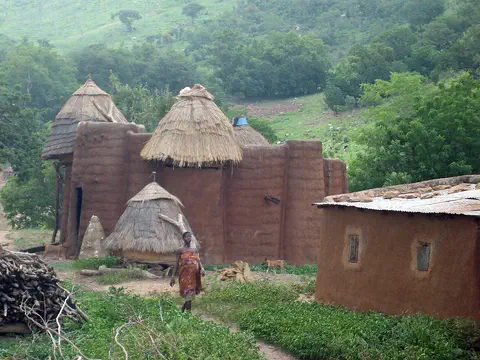
Togo is a small, narrow country in West Africa. It has only 51 kilometers of coast on the Gulf of Guinea but stretches about 515 kilometers inland, from beaches and lagoons to the Togo Mountains and northern savanna. About 8.6 million people lived there in 2025, and Lomé is the capital and main port.
Explore next
-
 Watch
3D
Animal
Cattle
Cattle are large farm animals that people tamed from wild oxen long ago. They eat grass and digest it with a stomach that has four parts. Farmers around the world keep cattle for milk, meat and leather, and in some places oxen still pull plows and carts.
-
 Watch
Animal
Blue wildebeest
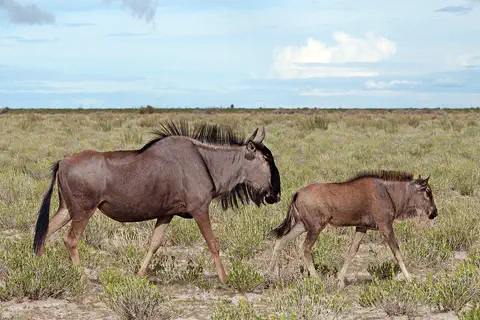
The blue wildebeest, or gnu, is a big antelope with a box-like head, curved horns, a mane and a beard. It grazes the savannas of eastern and southern Africa, and in the Serengeti huge herds travel in a giant circle every year following the rains.
-
Watch
Country
Tanzania
Tanzania is a country in East Africa, just south of the Equator, on the Indian Ocean. It has Mount Kilimanjaro, Africa's highest mountain, deep lakes in the East African Rift, and the Serengeti, where huge herds of wildebeest travel each year.
-
 Watch
3D
Animal
Lion
The lion is the only big cat that lives in a family group, called a pride. Lionesses hunt together, males guard the pride's land, and their roar can be heard about 8 kilometers away. Wild lions live in Africa, plus one small group in western India.
-
Watch
Country
Burkina Faso
Burkina Faso is a landlocked country in West Africa, on a wide plateau of savanna that is grassy in the north and dotted with forest in the south. About 24 million people live there. Its name, chosen in 1984, means Land of Incorruptible People, and its capital is Ouagadougou.
-
Watch
Country
Togo
Togo is a small, narrow country in West Africa. It has only 51 kilometers of coast on the Gulf of Guinea but stretches about 515 kilometers inland, from beaches and lagoons to the Togo Mountains and northern savanna. About 8.6 million people lived there in 2025, and Lomé is the capital and main port.
-
 Watch
3D
Animal
American bison
The American bison is the largest land animal in North America. Once tens of millions roamed the Great Plains, but by the 1890s fewer than a thousand were left. Careful protection, starting with a tiny herd in Yellowstone, brought bison back.
-
 Watch
Animal
Aardvark
The aardvark is a shy night digger of African savannas. It sniffs out ant and termite nests, rips them open with its spade-like claws and laps up the insects with a sticky tongue about 30 centimeters long. Its name means 'earth pig' in Afrikaans.
For parents & teachers
What children will learn
- Describe the African buffalo's body, including horns, boss and senses.
- Explain how living in a herd helps buffalo stay safe.
- Describe the buffalo's life cycle and the bond between mothers and calves.
- Understand why buffalo are Near Threatened and how land-use planning helps.
Recommended ages: 3 to 17 · About 15 minutes
Talk about it
- Why might living in a big group be safer than living alone?
- Why do you think the biggest buffaloes live where there is the most grass?
- How could farmers and buffaloes share land without conflict?
Try at home or in class
- Play a game where one person is a lion trying to tag a single 'buffalo' while the rest of the herd stays close together.
- Chew a cracker slowly and think about how a ruminant chews its food twice to get more from it.
Key vocabulary: herd, boss, ruminant, subspecies, grazer, near threatened
Where these facts come from
- The IUCN Red List of Threatened Species , International Union for Conservation of Nature (IUCN terms of use (no redistribution of Red List data or range maps))
- GBIF Backbone Taxonomy and GBIF Occurrence Search , Global Biodiversity Information Facility (CC0 1.0 (backbone); occurrence counts are facts derived from records under CC0, CC BY and CC BY-NC)
- African buffalo , African Wildlife Foundation
- Syncerus caffer (African buffalo) , Animal Diversity Web, University of Michigan
- Syncerus caffer (African Buffalo), 2019 assessment , IUCN Red List
- Wikidata , Wikimedia Foundation (CC0 1.0)
- Wikimedia Commons , Wikimedia Foundation (Per file: Public domain, CC0, CC BY or CC BY-SA only (credited on each page))
Checked, not yet human-reviewed. Last updated October 24, 2026. Spotted a mistake? Tell us.