
What If? Lab
What if migratory animals couldn’t reach their destinations?
Some animals take very long trips every year. They need safe places to stop and rest. What if their path was blocked? Let's see how people help with Olly!
Every year, birds, butterflies, deer and pronghorn travel huge distances between their summer and winter homes. Along the way they need stopover places to eat and rest, and clear paths across the land. Imagine those stops disappearing or those paths blocked by roads and fences, then meet the wildlife bridges and protected places that help animals travel.
Migratory species depend on a chain of habitats: breeding grounds, wintering grounds and the stopovers and corridors between them. Losing one link, such as a staging area or a passable corridor, can affect a whole population. Cases from red knots in Delaware Bay to pronghorn at Trappers Point, Wyoming, show both the risks and the fixes.
The big question
Every spring and fall, some animals go on very long trips. Birds fly, butterflies flutter and deer walk.
They need places to rest and eat on the way. What if those places were gone, or a road was in the way?
Migration is a regular journey animals make between places, often between summer and winter homes. Some of these journeys are astonishing: a shorebird called the red knot can fly more than 9,300 miles each spring.
No animal can make such a trip in one go without help from the land. They need stopover places to refuel and safe paths to follow. This thought experiment asks what would happen if migrating animals could not reach their destinations, and what people do about it.
A migratory population relies on several places in sequence: breeding range, nonbreeding range and the stopovers or corridors that connect them. Each must provide food, safety and passage at the right time of year.
This thought experiment removes links in that chain: a stopover site that disappears, or a corridor cut by roads and fences. Real monitoring of shorebirds, butterflies and big-game migrations lets us reason about the consequences and the conservation responses.
Explore the idea
Make a prediction
How can people help deer and pronghorn cross a busy road?
What did Wyoming build to help migrating pronghorn and deer cross a highway?
Which intervention cut wildlife–vehicle collisions at Trappers Point by more than 80 percent?
- Bridges and tunnels just for animals
- Taller fences with no gaps
- More traffic lights
-
Established fact
Monarch butterflies fly a long way each fall.
Migrating monarchs fly 50 to 100 miles a day and can take up to two months to reach Mexico.
Eastern monarchs travel 50–100 miles a day for up to two months to reach 11–12 overwintering areas in central Mexico (USDA Forest Service).
-
An idea scientists discuss
We imagine blocked trips using real animals and real places.
This lab imagines migrations cut off, using real cases; what would happen to a whole population depends on the species and the place.
Population-level consequences of lost links are inferred, not measured here; they vary by species, route and alternatives.
-
Established fact
Some red knot birds fly more than 9,000 miles each spring.
Some rufa red knots fly more than 9,300 miles from south to north every spring, and back again every autumn.
Some rufa red knots fly over 9,300 miles each spring and up to 19,000 miles a year, among the longest migrations known (USFWS).
-
Established fact
Red knots eat crab eggs at a big bay to get ready for their trip.
Delaware Bay is the last Atlantic stop for 50 to 80 percent of red knots each spring, because of its horseshoe crab eggs.
Delaware Bay provides the final Atlantic stopover for 50–80 percent of rufa red knots, which depend on horseshoe crab eggs for rapid weight gain (USFWS).
-
Established fact
Before a long flight, red knots get chubby with fat for fuel.
Before long flights, red knots store large amounts of fat as fuel, and some body parts shrink while their flight muscles grow.
Pre-departure red knots accumulate fat, shrink the gizzard, gut and liver, and enlarge pectoral muscles (USFWS).
-
An idea scientists discuss
Without their stop, the birds might arrive too tired.
Without their stopover food, red knots might arrive in the Arctic underweight, and fewer might raise chicks.
A failed staging area might reduce arrival condition and breeding success; the size of such an effect would need field data.
-
Established fact
Herds of pronghorn and deer have walked the same path for a very long time.
Giant herds of mule deer and pronghorn have traveled through Trappers Point, Wyoming, between their winter and summer ranges for thousands of years.
Trappers Point has funneled migrating mule deer and pronghorn between winter and summer ranges for millennia; the highway now forces them across (Pew).
-
Established fact
Busy roads are hard for animals to cross.
Across the United States, drivers hit an estimated 1 to 2 million animals each year.
A Federal Highway Administration report estimates 1–2 million animal–vehicle collisions a year in the U.S. (cited by Pew).
-
An idea scientists discuss
If animals could not cross, they might not reach their winter food.
If a herd could not get past a road, it might not reach its winter or summer food, even though both homes are still there.
A fully blocked corridor might strand a herd on one seasonal range; outcomes would depend on what that range can support.
-
Established fact
Animal bridges helped thousands of animals cross safely.
After Wyoming built crossings at Trappers Point, antelope and deer crossed more than 60,000 times in three years, and collisions fell by more than 80 percent.
Two overpasses and six underpasses (2012) led to more than 60,000 crossings in three years and over 80 percent fewer collisions (Wyoming Game and Fish).
-
Established fact
Mexico protects the forests where monarch butterflies spend the winter.
Mexico created the Monarch Butterfly Biosphere Reserve in 1986 to protect the forests where eastern monarchs spend the winter.
Recognizing the importance of oyamel forests, Mexico created the Monarch Butterfly Biosphere Reserve in 1986 (USDA Forest Service).
-
An idea scientists discuss
More animal bridges could help more animals travel.
Building more crossings in the right places, and protecting stopovers, could help many more migrations stay open.
Wider use of well-sited crossings and stopover protection could reconnect migrations; cost is one limit agencies cite, with an interstate overpass running up to $7 million.
Journeys that work
Monarch butterflies fly all the way to the mountains of Mexico for the winter. They have never been there before, but they find the way!
Pronghorn and mule deer walk between their summer and winter homes in Wyoming.
Eastern monarch butterflies fly south each fall to the same mountain forests in Mexico, traveling 50 to 100 miles a day for up to two months. The butterflies that make the trip have never been there before.
In western Wyoming, herds of pronghorn and mule deer have walked between their summer and winter ranges for thousands of years, squeezing through a narrow ridge called Trappers Point. And red knots stop in Delaware Bay each spring to feast on horseshoe crab eggs before flying on to the Arctic.
The eastern monarch overwinters in 11 to 12 mountain areas of central Mexico, in oyamel fir forests 2,400 to 3,600 meters up, from October to late March; migrants travel 50–100 miles a day for up to two months, and the generation that arrives has never been there before.
Rufa red knots fly up to 19,000 miles a year. Delaware Bay is the final Atlantic stopover for 50 to 80 percent of the population each spring. At Trappers Point, Wyoming, mule deer and pronghorn have used a sagebrush bottleneck between rivers for millennia.
When the path is blocked
Imagine a bird's favorite resting beach had no food. Or imagine a busy road across the deer's path.
The animals would have a much harder trip. That is why people work to keep their paths open.
Imagine the red knots' stopover had no horseshoe crab eggs. Red knots rely on those eggs to gain weight quickly before the last long flight, so they might arrive in the Arctic tired and underweight. That part is an idea, but the need for the eggs is a fact.
Now imagine the deer and pronghorn meeting a busy highway with fences. Before wildlife crossings were built at Trappers Point, antelope bunched up between the fence and the road, trying to crawl under and dart across. Many could not get through safely.
Red knots arriving in Delaware Bay depend on horseshoe crab eggs for remarkable rates of weight gain before departing for Arctic breeding grounds. A stopover without that food might leave birds unable to complete the journey in good condition: a reasoned idea, not a measured result here.
Roads and fences can sever corridors. At Trappers Point, biologist Hall Sawyer watched pronghorn bunch between fence and highway during migrations; about 85 vehicle–animal collisions a year once occurred there. Across the United States, drivers hit an estimated 1 to 2 million animals a year.
Why every stop matters
A long trip is like a long car ride. You need to stop for food and rest.
If one stop is missing, the whole trip gets harder.
Before a long flight, red knots store large amounts of fat as fuel, and their stomach and gut even shrink while their flight muscles grow. They have to refill at each stop. If a stop is missing, the next leg may be too long to manage.
For animals that walk, like pronghorn, a migration is a path across the land. One blocked section, like a fenced highway, can cut off the whole route, even if the summer and winter homes are fine.
Long-distance migrants budget energy across legs: red knots accumulate fat and reorganize organs before departure, shrinking the gizzard, gut and liver while enlarging flight muscles. Their success depends on predictable, high-quality food at staging sites, and they show moderate fidelity to particular flyways and stopovers.
Terrestrial migrants face a connectivity problem: a corridor is only as passable as its narrowest bottleneck. Removing one stopover or blocking one bottleneck can disconnect seasonal ranges that are otherwise intact.
Wildlife bridges and protected places
People build bridges just for animals! Deer and pronghorn walk over the road on a bridge covered with dirt and plants.
Mexico also protects the forests where monarch butterflies spend the winter.
In 2012, Wyoming finished two wildlife overpasses, six underpasses and about 12 miles of fencing at Trappers Point. The fences guide animals to the crossings, and the overpasses are covered with dirt and gravel. In the first three years, antelope and deer crossed more than 60,000 times, and collisions fell by more than 80 percent.
Protecting stopovers and wintering places helps too. Mexico created the Monarch Butterfly Biosphere Reserve in 1986 to protect the monarchs' winter forests.
Wyoming DOT's $11 million Trappers Point project (2012) combined two overpasses, six underpasses and some 12 miles of funnel fencing; the Wyoming Game and Fish Department reports more than 60,000 crossings in three years and collisions down by more than 80 percent. In Colorado, similar structures on Highway 9 cut collisions by almost 90 percent by the second winter. A four-lane interstate overpass can cost up to $7 million.
Habitat protection secures the other links: Mexico established the Monarch Butterfly Biosphere Reserve in 1986, and the U.S. Fish and Wildlife Service names Delaware Bay as a key staging area whose food supply red knots depend on.
Amazing facts
-
One monarch flew 265 miles in just one day!
The farthest a monarch butterfly has been recorded flying in one day is 265 miles.
The record single-day distance for a tracked monarch is 265 miles, against a typical 50–100 miles a day (USDA Forest Service).
-
Red knots are about the size of a robin.
The red knot is a robin-sized shorebird with wings about 20 inches across, yet it makes one of the longest migrations of any animal.
Rufa red knots have a 20-inch wingspan; their spring mass peaks near 7.2 oz (205 g) before departure, up from about 4.4 oz (125 g) in early winter.
-
Wildlife bridges are covered with dirt and plants.
The Trappers Point overpasses are made of concrete and steel covered with dirt and gravel, so animals walk over them as if they were part of the land.
The overpasses are concrete and rebar covered with soil and gravel; fences along the highway funnel the herds onto them.
Words to know
- migration
- a regular journey animals make between places, often between summer and winter homes
- stopover
- a place where migrating animals stop to rest and eat
- corridor
- a path of habitat that animals use to travel between places
- wildlife crossing
- a bridge or tunnel built so animals can safely cross a road
- overwinter
- to spend the winter in a place
Discovery challenge
-
What do red knots eat at Delaware Bay?
What food do red knots depend on at Delaware Bay?
Which food fuels rufa red knots' weight gain in Delaware Bay?
- Horseshoe crab eggs
- Berries
- Grass seeds
Show the answer
Horseshoe crab eggs
Tiny horseshoe crab eggs give them energy.
Horseshoe crab eggs, which help them gain weight fast before the flight to the Arctic.
Horseshoe crab eggs, supporting remarkable rates of mass gain.
-
What helps deer and pronghorn cross a busy road?
What did Wyoming build at Trappers Point to help migrating animals?
Which combination was built at Trappers Point in 2012?
- Animal bridges, tunnels and guiding fences
- A new shopping mall
- A taller wall with no gaps
Show the answer
Animal bridges, tunnels and guiding fences
Bridges and tunnels just for animals.
Two overpasses, six underpasses and fences to guide animals to them.
Two overpasses, six underpasses and about 12 miles of funnel fencing.
-
Where do eastern monarch butterflies spend the winter?
Where do eastern North American monarchs spend the winter?
Where is the eastern monarch population's overwintering habitat?
- Mountain forests in Mexico
- The Arctic
- Deep in the ocean
Show the answer
Mountain forests in Mexico
In the mountains of Mexico.
In mountain forests in central Mexico, protected by a reserve since 1986.
Oyamel fir forests at 2,400–3,600 meters in central Mexico.
-
After the animal bridges were built, were there more or fewer crashes?
How did collisions change after Trappers Point's crossings were built?
By how much did wildlife–vehicle collisions fall at Trappers Point?
- Fewer: down more than 80 percent
- More: up 80 percent
- No change
Show the answer
Fewer: down more than 80 percent
Many fewer! The animals crossed safely.
Collisions fell by more than 80 percent, and animals crossed more than 60,000 times in three years.
By more than 80 percent, per Wyoming Game and Fish.
Experiments to try
- Watch What If? Lab What if an invasive species entered an ecosystem? An invasive species is a living thing that ends up somewhere it doesn't naturally live and causes harm there. In this thought experiment, follow two real stories from Australia: cane toads, brought to eat beetles in sugar cane fields in 1935, and rabbits, which probably spread mostly from 24 brought in 1859. Then find out how people try to keep ecosystems in balance.
- Watch What If? Lab What if forests became grasslands? Forests and grasslands are next-door neighbors in many places, and fire, grazing animals and rain decide where one ends and the other begins. Imagine a forest becoming a grassland: who would move in, what would happen to the soil, and where would all the carbon in the trees go?
- Watch What If? Lab What if sea turtles lost their way? Sea turtles cross oceans and return to the coast where they hatched, using Earth's magnetic field like a map. Baby turtles find the sea by heading for the brightest horizon. Imagine them losing their way: follow magnetic maps, bright beach lights, and how people help hatchlings.
- Watch What If? Lab What if animals did not hibernate? Winter brings two big problems for animals: less food and lots of cold. Bats, groundhogs, dormice and bears get through it by slowing their bodies right down. Imagine they couldn't, and follow what might change for finding food, saving energy and the famous winter sleepers.
Explore next
-
 Watch
Animal
Arctic tern
The Arctic tern is a small, graceful seabird with a black cap, a red bill and red legs. Every year it flies from its nesting grounds in the Arctic to the edge of the ice around Antarctica and back again. Scientists who tracked terns from Greenland and Iceland found that they flew an average of 70,900 kilometers in one year.
-
 Watch
3D
Animal
Monarch butterfly
The monarch butterfly is famous for its bright orange wings and its amazing journey. Each fall, monarchs from eastern North America fly up to 3,000 miles to mountain forests in Mexico, where they spend the winter clustered together on fir trees. Their caterpillars eat only milkweed, which makes them taste bad to predators.
-
 Watch
Animal
Blue wildebeest
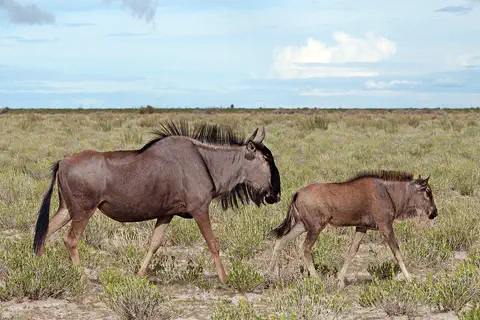
The blue wildebeest, or gnu, is a big antelope with a box-like head, curved horns, a mane and a beard. It grazes the savannas of eastern and southern Africa, and in the Serengeti huge herds travel in a giant circle every year following the rains.
- Watch What If? Lab What if an invasive species entered an ecosystem? An invasive species is a living thing that ends up somewhere it doesn't naturally live and causes harm there. In this thought experiment, follow two real stories from Australia: cane toads, brought to eat beetles in sugar cane fields in 1935, and rabbits, which probably spread mostly from 24 brought in 1859. Then find out how people try to keep ecosystems in balance.
- Watch What If? Lab What if forests became grasslands? Forests and grasslands are next-door neighbors in many places, and fire, grazing animals and rain decide where one ends and the other begins. Imagine a forest becoming a grassland: who would move in, what would happen to the soil, and where would all the carbon in the trees go?
-
 Watch
Natural wonder
Serengeti National Park
Serengeti National Park in northern Tanzania protects 14,763 square kilometers of grassy plains and woodlands. Each year more than a million wildebeest, with zebras and gazelles, travel a great loop across the Serengeti and into Kenya in search of grass and water, followed by lions and other predators.
- Watch What If? Lab What if sea turtles lost their way? Sea turtles cross oceans and return to the coast where they hatched, using Earth's magnetic field like a map. Baby turtles find the sea by heading for the brightest horizon. Imagine them losing their way: follow magnetic maps, bright beach lights, and how people help hatchlings.
- Watch What If? Lab What if animals did not hibernate? Winter brings two big problems for animals: less food and lots of cold. Bats, groundhogs, dormice and bears get through it by slowing their bodies right down. Imagine they couldn't, and follow what might change for finding food, saving energy and the famous winter sleepers.
For parents & teachers
What children will learn
- Migratory animals need stopovers and safe paths as well as summer and winter homes.
- Losing one stopover or blocking one path can make a whole journey harder.
- Wildlife crossings and fences that guide animals can greatly reduce collisions.
- Protecting habitats along a route keeps migrations going.
Recommended ages: 7 to 17 · About 15 minutes
Talk about it
- What would you need to pack for a very long trip? How is that like a bird storing fat?
- Why might fences be useful near a wildlife bridge?
- Which migrating animals pass through your area, and where might they rest?
Try at home or in class
- Make a 'migration map' on the floor with paper stepping stones. Remove one stone and see whether you can still cross; then add a 'bridge' to fix it.
- Plant native flowers or milkweed in a pot or garden, if suitable for your area, to give migrating butterflies a place to refuel.
Key vocabulary: migration, stopover, corridor, wildlife crossing, overwinter
Where these facts come from
- Rufa red knot (Calidris canutus rufa) , U.S. Fish and Wildlife Service
- Safe Passage , Wyoming Game and Fish Department
- Wildlife Crossings Can Protect Migrating Animals , The Pew Charitable Trusts
- Monarch Butterfly Migration and Overwintering , USDA Forest Service
Checked, not yet human-reviewed. Last updated October 23, 2026. Spotted a mistake? Tell us.