
Animal
Monarch butterfly
The monarch is a big orange and black butterfly. Its caterpillars eat only milkweed, and some monarchs fly all the way to Mexico for the winter.
The monarch butterfly is famous for its bright orange wings and its amazing journey. Each fall, monarchs from eastern North America fly up to 3,000 miles to mountain forests in Mexico, where they spend the winter clustered together on fir trees. Their caterpillars eat only milkweed, which makes them taste bad to predators.
Danaus plexippus is a milkweed specialist whose eastern North American population makes one of the longest known insect migrations, flying up to 3,000 miles to oyamel fir forests in central Mexico. The migrating generation lives six to nine months in reproductive diapause, while summer generations live two to five weeks. In December 2024 the US Fish and Wildlife Service proposed listing it as threatened.
Photo: Rhododendrites, CC BY-SA 4.0, via Wikimedia Commons
Meet the monarch
The monarch is a big butterfly with orange and black wings.
It has white dots around the edges. Monarchs drink sweet nectar from flowers. Some monarchs fly very, very far each year.
The monarch butterfly is one of the best-known butterflies in North America. Its wings are bright orange with black veins and a black border dotted with two rows of white spots. Its wings span about three to four inches, yet the whole butterfly weighs only about half a gram, less than a paperclip.
Monarchs are famous for migration. Every fall, huge numbers of them fly south to spend the winter in the same forests their ancestors used, even though none of them has ever been there before.
Danaus plexippus is a large milkweed butterfly in the family Nymphalidae. Adults are sexually dimorphic: males have narrower black wing veins and scent patches on the hindwings. Like other nymphalids, monarchs seem to have only four legs, because the two front legs are tiny and held against the thorax (Monarch Watch).
Its bright pattern is a warning. Caterpillars feed on milkweed and store toxins called cardenolides, which make monarchs distasteful or toxic to many predators. The eastern North American migration is, according to the US Fish and Wildlife Service, one of the longest known insect migrations in the world.
Quick facts
- Group
- Invertebrate
- Wingspan
- 7.6 to 10.2 cm
- Weight
- 0.5 g
- Lifespan in the wild
- 2 to 5 weeks
Where it lives
Monarchs live where milkweed plants grow.
Many live in Canada, the United States and Mexico. In winter, eastern monarchs gather in tall fir trees on mountains in Mexico.
Monarchs live in fields, meadows, roadsides, wetlands and gardens, anywhere milkweed and flowers grow. They are native to the Americas and have spread to places such as Australia, New Zealand, Pacific islands and the Iberian Peninsula in Europe.
Most monarchs live in North America. The Rocky Mountains split them into two migrating groups. Eastern monarchs spend the winter in oyamel fir forests high in the mountains of central Mexico. Western monarchs spend the winter in groves of trees along the coast of California and northern Baja California.
The US Fish and Wildlife Service describes the monarch as native to North and South America, with non-migratory populations established from Pacific islands to the western edge of Europe, including Australia, New Zealand and parts of the Iberian Peninsula. Most monarchs live and migrate in North America.
The eastern population covers upward of 70 percent of the North American range and overwinters in 11 to 12 mountain areas in the Mexican states of México and Michoacán, in oyamel fir forests at 2,400 to 3,600 meters (USDA Forest Service). The western population overwinters in hundreds of coastal groves in California and northern Baja California. Non-migratory monarchs stay year-round in parts of Florida, the Gulf Coast and California.
Continents
Its habitats


Where can you find this animal?
- Brought here by people · Countries and seas named by a scientific source
- Migration route · Countries and seas named by a scientific source
- Lives here naturally · Countries and seas named by a scientific source
- Sightings recorded · Records of wild sightings (GBIF)
Brought here by people · Countries and seas named by a scientific source
Monarchs have spread to places with milkweed and suitable temperatures, including Australia, New Zealand, Pacific islands and parts of the Iberian Peninsula. Many Pacific islands are too small to show on this map.
Places: Australia, New Zealand, Spain and Portugal.
Source: https://www.fws.gov/species/monarch-danaus-plexippus · checked October 2026
Migration route · Countries and seas named by a scientific source
The North American migration: eastern monarchs fly from Canada and the United States to oyamel fir forests in the Mexican states of México and Michoacán; western monarchs, west of the Rocky Mountains, fly to the coast of California and northern Baja California.
Places: Canada, United States and Mexico.
Source: https://www.fws.gov/species/monarch-danaus-plexippus · checked October 2026
Lives here naturally · Countries and seas named by a scientific source
Native to the Americas, where milkweed grows. Most monarchs live in North America; non-migratory monarchs also live in warmer areas year-round. This map shades whole continents, not every place monarchs breed.
Places: North America and South America.
Source: https://www.fws.gov/species/monarch-danaus-plexippus · checked October 2026
Sightings recorded · Records of wild sightings (GBIF)
Counts of GBIF records of wild observations (human and machine) and preserved specimens. Records include introduced populations, vagrants, escaped or released animals and misidentifications, so a country with records is not necessarily part of the native range.
Wild sightings have been recorded in United States, Canada, Mexico, Australia, Spain, New Zealand, Portugal, Colombia and 64 more places.
Source: gbif · checked October 2026
Range maps show where scientists say an animal lives, often country by country. An animal may live in only part of a country shown, and sightings records can include animals that wandered far from home.
Milkweed and nectar
Monarch caterpillars eat only milkweed leaves.
Grown-up monarchs drink nectar from many kinds of flowers. They sip it with a long tongue like a straw.
Monarch caterpillars can eat only one kind of plant: milkweed. That is why mother monarchs lay their eggs on milkweed. Milkweed contains toxins, and the caterpillars store them in their bodies, which makes both caterpillars and butterflies taste bad to many predators.
Adult monarchs drink nectar from many kinds of flowers. Their tongue, called a proboscis, works like a drinking straw and curls up when it is not in use. Migrating monarchs need lots of flowers along the way to fuel their long trip.
Milkweed is the only larval host. By feeding on it, larvae sequester cardenolides, which are poisonous to vertebrates and make monarchs distasteful (Monarch Watch); the orange-and-black pattern is aposematic, warning predators that eating them can be toxic (USFWS).
Adults feed on nectar from a wide range of flowers through the proboscis, which is coiled when not in use. Nectar is needed throughout the breeding season, migration and overwintering. In arid parts of western North America, USFWS notes that milkweed itself may be the principal nectar source and that nectar and milkweed are often concentrated along rivers and streams.
Did you know?
One monarch flew 265 miles in one day.
The longest single-day flight recorded for a tagged eastern monarch was 265 miles.
Tagging data suggest migrants average about 70 to 75 miles a day, with a record single-day flight of 265 miles (USFWS).
A butterfly up close
A monarch has two long feelers and big eyes.
It has four orange wings with black lines. Tiny scales cover the wings, like dust. It tastes with its feet!
A monarch's body has a head, a thorax and an abdomen. On the head are two huge compound eyes made of thousands of tiny parts, two antennae for smelling and a coiled tongue.
Four wings, two forewings and two hindwings, attach to the thorax. Black veins give the wings strength. Monarchs look as if they have only four legs, because the front pair is tiny and tucked against the body. Their feet even have taste sensors, which let them taste sweet liquids when they land.
Monarch Watch describes the adult head as bearing compound eyes of thousands of ommatidia, two scale-covered antennae and palpi that sense airborne molecules, and the straw-like proboscis. The thorax has three segments, each with a pair of legs; the second and third also carry the wings. Wing veins contain tracheae, nerves and space for hemolymph and give the wings strength.
The tarsi grip plants and carry sensors that taste sweet liquids. The forelegs are reduced and held against the thorax, a trait of nymphalids. Eastern migratory monarchs tend to have larger bodies, longer wings and redder coloration than non-migratory monarchs; USFWS reports that redder wings are associated with longer flight, though the mechanism is unknown.
Egg, caterpillar, chrysalis, butterfly
A monarch starts as a tiny egg on a milkweed leaf.
A striped caterpillar hatches and eats and eats. Then it hangs from a silk pad and becomes a green chrysalis. Out comes a butterfly!
Monarchs go through complete metamorphosis in four stages. A female lays single eggs on milkweed, about 100 to 300 in her life. Each egg hatches after about four days into a tiny caterpillar.
The caterpillar, striped black, yellow and white, eats its eggshell and then milkweed. It sheds its skin as it grows from less than 1 centimeter to about 5 centimeters. After about two weeks it hangs from a silk pad and becomes a green and gold chrysalis. One to two weeks later, an adult butterfly comes out. From egg to adult takes about 30 days.
Eggs hatch in two to five days (USFWS; about four days according to the USDA Forest Service). Larvae pass through five instars over about two weeks, growing from under 1 centimeter to about 5 centimeters; the stages between molts are called instars. A larva then spins a silk pad, splits its skin and hooks its cremaster, a spiny tip of the abdomen, into the pad to hang as a pupa.
The green and gold chrysalis lasts about one to two weeks before eclosion, the emergence of the adult. Monarch Watch puts the whole egg-to-adult cycle at about 30 days. A female lays roughly 100 to 300 eggs, usually one per plant, often under a leaf near the top.

The great migration
In fall, eastern monarchs fly south to Mexico.
The trip can take two months. In spring, they fly north again. Their babies and grandbabies keep going north.
Monarchs cannot survive cold northern winters, so each fall the last generation of the summer flies south. Eastern monarchs travel from Canada and the United States to Mexico, up to 3,000 miles, a trip that can take more than two months. They glide on air currents and travel only by day, gathering in trees at night.
In spring, the same butterflies start north and lay eggs on milkweed. Their children and grandchildren keep moving north through the summer, up to four generations. Then a brand-new generation flies south, to a place it has never seen.
In fall the migratory generation enters reproductive diapause and flies to overwintering sites. Eastern monarchs travel up to 3,000 miles from Canada through the US to Mexico; USFWS cites tagging data of about 70 to 75 miles a day, with a record of 265 miles in one day for a tagged eastern monarch. Several flyways merge into one in central Texas (USDA Forest Service). Western monarchs migrate about 300 to 1,000 miles to coastal California and northern Baja California.
Overwintering monarchs cluster, tens of thousands on a single tree. In spring they break diapause, mate and fly north; successive generations, up to four in a summer, continue the journey. Researchers think navigation combines cues such as the sun's position and Earth's magnetic field.
Did you know?
A monarch caterpillar eats its own eggshell first.
A newly hatched monarch caterpillar eats its eggshell before it starts on milkweed.
Larvae consume the chorion after hatching, then feed on the host plant (Monarch Watch).
Helping monarchs
There are fewer monarchs than there used to be.
Monarchs need milkweed and flowers. People can plant milkweed in gardens to help them.
Monarch numbers have fallen in recent years. The US Fish and Wildlife Service has proposed listing the monarch as a threatened species, which would protect it by law. The IUCN lists the migratory monarch as Vulnerable.
Monarchs need milkweed to lay eggs on, flowers for nectar along their migration and safe forests for the winter. Mexico protects key winter forests in the Monarch Butterfly Biosphere Reserve, created in 1986. Anyone with a yard or a school garden can help by planting native milkweed and flowers.
In December 2024 USFWS proposed listing the monarch as threatened under the Endangered Species Act, with a 4(d) rule and critical habitat; as of October 2026 the Monarch Joint Venture says it is not listed. In December 2023 the IUCN changed the migratory monarch from Endangered to Vulnerable after a petition; the Monarch Joint Venture explains that the change reflected IUCN's 10-year trend criteria, not an improvement in the population.
Conservation focuses on breeding, migration and overwintering habitat: milkweed and nectar plants, and the oyamel forests protected in Mexico's Monarch Butterfly Biosphere Reserve (1986). The species as a whole, including non-migratory populations, is listed as Least Concern globally by the IUCN (assessed 2021).
IUCN Red List
How is the monarch butterfly doing in the wild?
- Least Concern (this animal)
- Near Threatened
- Vulnerable
- Endangered
- Critically Endangered
- Extinct in the Wild
- Extinct
Least Concern
Not at risk of disappearing from the wild right now.
See the IUCN Red List assessment · The IUCN Red List of Threatened Species 2022.2
Amazing facts
-
Monarchs can taste with their feet.
Monarchs have taste sensors on their feet, so they can taste sweet liquids as soon as they land.
Receptors on the tarsi detect sweet liquids on contact (Monarch Watch).
-
The monarchs that fly to Mexico have never been there before.
The butterflies that fly south have never been to Mexico, yet they find the same mountain forests as their ancestors.
The migratory generation reaches overwintering sites used by its ancestors, apparently using several cues such as the sun and Earth's magnetic field.
-
One monarch flew 265 miles in one day.
The longest single-day flight recorded for a tagged eastern monarch was 265 miles.
Tagging data suggest migrants average about 70 to 75 miles a day, with a record single-day flight of 265 miles (USFWS).
-
A monarch caterpillar eats its own eggshell first.
A newly hatched monarch caterpillar eats its eggshell before it starts on milkweed.
Larvae consume the chorion after hatching, then feed on the host plant (Monarch Watch).
Words to know
- migration
- a long journey animals make each year between two places
- metamorphosis
- a big change in body shape as an animal grows up
- chrysalis
- the hard case a caterpillar makes while it turns into a butterfly
- caterpillar
- the young, wormlike stage of a butterfly or moth
- proboscis
- a butterfly's long tongue that works like a straw
- diapause
- a resting time when an animal stops growing or breeding
- milkweed
- a plant with milky sap that monarch caterpillars eat
Discovery challenge
-
What do monarch caterpillars eat?
Which is the only plant monarch caterpillars can eat?
What is the monarch's only larval host plant?
- Milkweed
- Grass
- Oak leaves
Show the answer
Milkweed
Monarch caterpillars eat only milkweed.
Milkweed is the only food monarch caterpillars can eat, so females lay their eggs on it.
Milkweed is the sole larval host; larvae sequester its cardenolides for defense.
-
Where do eastern monarchs go in winter?
Where do eastern North American monarchs spend the winter?
Where is the eastern population's overwintering habitat?
- Forests in the mountains of Mexico
- The Arctic
- Deep caves in Canada
Show the answer
Forests in the mountains of Mexico
They fly to fir forests on mountains in Mexico.
They spend the winter in oyamel fir forests high in the mountains of central Mexico.
Oyamel fir forests at 2,400 to 3,600 meters in México and Michoacán.
-
What comes after the caterpillar?
Which stage comes between the caterpillar and the butterfly?
What is the pupal stage of a monarch called?
- Egg
- Chrysalis
- Tadpole
Show the answer
Chrysalis
The caterpillar makes a chrysalis. Then the butterfly comes out.
The caterpillar becomes a green and gold chrysalis, and a butterfly emerges one to two weeks later.
The pupa, or chrysalis, hangs by its cremaster for one to two weeks before eclosion.
-
Why are monarchs so bright orange?
What do a monarch's bright orange and black colors tell predators?
What is the function of the monarch's coloration?
- To warn that they taste bad
- To keep warm
- To hide in the snow
Show the answer
To warn that they taste bad
Bright colors tell birds that monarchs taste bad.
The colors warn predators that monarchs carry toxins from milkweed.
Aposematic coloration advertises sequestered cardenolides.
Places where you might see it
-
 Watch
 Country
Mexico
Mexico is a large country in southern North America, between the Pacific Ocean and the Gulf of Mexico. It has smoking volcanoes, ancient cities built by the Maya and other peoples, and about 132 million people, many of them in and around Mexico City.
-
 Watch
 Country
United States
The United States is a large country in North America made of 50 states, from icy Alaska to the warm islands of Hawaii. It has the Grand Canyon, the Mississippi River and Yellowstone, and about 342 million people live there.
-
 Watch
 Country
Canada
Canada is the second-largest country in the world, stretching across the north of North America from the Atlantic to the Pacific and up into the Arctic. It has the Rocky Mountains, thousands of islands and about 42 million people, who speak English, French and many other languages.
Experiments to try
- Watch Try it What If? Lab What if bees disappeared? Many fruits and vegetables only grow well when bees and other animals carry pollen between their flowers. In our model farm, turn the pollinators down to zero and watch which harvests shrink, which hardly change, and why wheat, rice and corn don't mind. Then meet the people helping pollinators.
- Watch What If? Lab What if migratory animals couldn’t reach their destinations? Every year, birds, butterflies, deer and pronghorn travel huge distances between their summer and winter homes. Along the way they need stopover places to eat and rest, and clear paths across the land. Imagine those stops disappearing or those paths blocked by roads and fences, then meet the wildlife bridges and protected places that help animals travel.
- Watch What If? Lab What if a caterpillar never became a butterfly? A caterpillar is an eating machine. Inside its chrysalis it rebuilds its whole body into a butterfly that can fly, find a mate and lay eggs. Imagine a caterpillar that never changed: what would it miss, and what would happen to the next generation?
Explore next
-
Watch
Country
Mexico
Mexico is a large country in southern North America, between the Pacific Ocean and the Gulf of Mexico. It has smoking volcanoes, ancient cities built by the Maya and other peoples, and about 132 million people, many of them in and around Mexico City.
-
Watch
Country
United States
The United States is a large country in North America made of 50 states, from icy Alaska to the warm islands of Hawaii. It has the Grand Canyon, the Mississippi River and Yellowstone, and about 342 million people live there.
-
Watch
Country
Canada
Canada is the second-largest country in the world, stretching across the north of North America from the Atlantic to the Pacific and up into the Arctic. It has the Rocky Mountains, thousands of islands and about 42 million people, who speak English, French and many other languages.
-
 Watch
3D
Animal
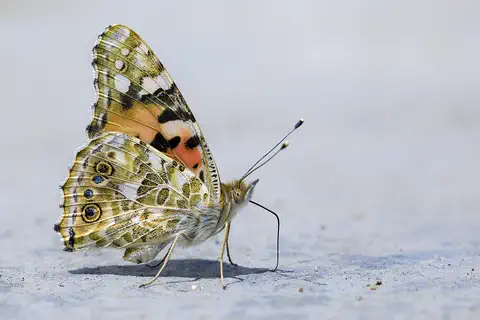
Painted lady
The painted lady is one of the most widespread butterflies in the world. Its orange and black wings carry it on huge journeys: each year, families of painted ladies fly between Africa and northern Europe, one generation after another.
-
 Watch
3D
Animal
Eastern tiger swallowtail
The eastern tiger swallowtail is a large butterfly of eastern North America. Males are yellow with black tiger stripes, while many females are dark, which helps them look like a bad-tasting butterfly. Its caterpillars disguise themselves as bird droppings, then turn green with big fake eyes.
-
 Watch
3D
Animal
Western honey bee
The western honey bee lives in big families called colonies, with one queen and many workers. Workers collect nectar and pollen from flowers, turn nectar into honey, and tell each other where food is by dancing. As they travel, they pollinate many plants, including crops people eat.
-
 Watch
3D
Animal
Old World swallowtail
The Old World swallowtail is a large butterfly with yellow wings, black veins, blue spots and a red eyespot near the long tails on its hindwings. It lives across Europe and Asia and in northern North America. Its green and black caterpillar has a hidden orange fork that pops out when it is bothered.
-
 Watch
Animal
Common blue morpho
The common blue morpho is a large butterfly of the forests of Mexico, Central America and South America. The tops of its wings flash bright blue, but the undersides are brown with big eyespots, which camouflage it when it lands with its wings closed. Adults sip juice from rotting fruit instead of nectar.
For parents & teachers
What children will learn
- Name the four stages of monarch metamorphosis and their timing.
- Explain why monarch caterpillars depend on milkweed.
- Describe the eastern and western North American migrations.
- Identify ways people can help monarchs.
Recommended ages: 3 to 17 · About 15 minutes
Talk about it
- How might a butterfly find a forest it has never visited?
- Why does it matter that monarch caterpillars eat only one kind of plant?
- What could your school or family plant to help monarchs?
Try at home or in class
- Draw the four life stages in a circle and label each with its time: 2 to 5 days, about 2 weeks, 1 to 2 weeks, 2 to 5 weeks.
- On a paper map, trace the eastern monarchs' route from southern Canada to central Mexico and estimate the distance with the map scale.
Key vocabulary: migration, metamorphosis, chrysalis, caterpillar, proboscis, diapause, milkweed
Where these facts come from
- GBIF Backbone Taxonomy and GBIF Occurrence Search , Global Biodiversity Information Facility (CC0 1.0 (backbone); occurrence counts are facts derived from records under CC0, CC BY and CC BY-NC)
- Monarch (Danaus plexippus) , U.S. Fish and Wildlife Service
- Monarch Butterfly Biology , U.S. Forest Service
- Monarch Butterfly Migration and Overwintering , USDA Forest Service
- Monarch biology: anatomy and life cycle , Monarch Watch, University of Kansas
- IUCN changes migratory monarch status from endangered to vulnerable , Monarch Joint Venture
- Are monarchs endangered? , Monarch Joint Venture
- Danaus plexippus (global assessment) , IUCN Red List of Threatened Species
- Danaus plexippus ssp. plexippus, migratory monarch (amended 2023 assessment) , IUCN Red List of Threatened Species
- Wikidata , Wikimedia Foundation (CC0 1.0)
- The IUCN Red List of Threatened Species , International Union for Conservation of Nature (IUCN terms of use (no redistribution of Red List data or range maps))
- Wikimedia Commons , Wikimedia Foundation (Per file: Public domain, CC0, CC BY or CC BY-SA only (credited on each page))
Checked, not yet human-reviewed. Last updated October 24, 2026. Spotted a mistake? Tell us.