
Natural wonder Africa
Serengeti National Park
Serengeti National Park is a huge grassy park in Tanzania, in Africa. More than a million wildebeest, and many zebras, walk across it every year. Lions, elephants and giraffes live there too.
Serengeti National Park in northern Tanzania protects 14,763 square kilometers of grassy plains and woodlands. Each year more than a million wildebeest, with zebras and gazelles, travel a great loop across the Serengeti and into Kenya in search of grass and water, followed by lions and other predators.
Serengeti National Park, a World Heritage Site since 1981, covers 1,476,300 ha of savanna at the heart of the Serengeti-Mara ecosystem. Its short-grass plains, on soils of volcanic ash, feed what UNESCO calls the largest remaining unaltered animal migration in the world: about 1.35 million western white-bearded wildebeest in Tanzania National Parks' 2024 guideline (UNESCO's statement of value, adopted in 2012, gives about 2 million), on a 1,000 km circuit through Tanzania and Kenya.
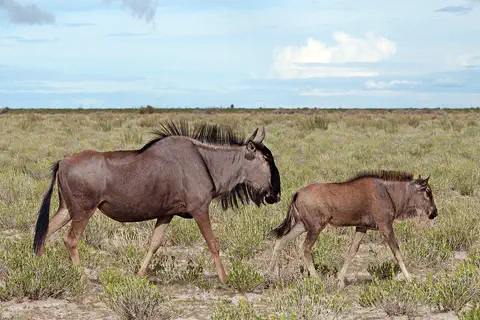
Photo: Bjørn Christian Tørrissen, CC BY-SA 3.0, via Wikimedia Commons
Discover the Serengeti
The Serengeti is a giant park in Tanzania, in Africa.
It has wide grassy plains, trees and rocky hills. The plains go on and on. Lots and lots of wild animals live here.
Serengeti National Park is in northern Tanzania, in East Africa. It covers 14,763 square kilometers, mostly savanna: wide grasslands with scattered trees. UNESCO describes its 'endless plains' of short grass dotted with rocky outcrops called kopjes, with rivers and woodlands in between.
The park is famous for the great migration. Every year huge herds of wildebeest, zebras and gazelles move around the Serengeti and into Kenya in search of fresh grass and water, and predators follow them. Tanzania National Parks, which runs the park, gives about 1.35 million wildebeest in its 2024 guideline; UNESCO's 2012 statement about the park gives about 2 million. The Serengeti became a World Heritage Site in 1981.
UNESCO lists Serengeti National Park at 1,476,300 ha, inscribed in 1981 under criteria (vii) and (x). It sits at the heart of a larger Serengeti ecosystem, defined by the area the migration covers: Ngorongoro Conservation Area to the south-east, Maswa Game Reserve to the south, Grumeti and Ikorongo Game Reserves, Loliondo Game Controlled Area, and Kenya's Maasai Mara National Reserve to the north. UNESCO says no barriers hamper the migration within this intact ecosystem.
UNESCO's statement of the park's value describes about 25,000 km² of treeless short grasslands, dotted with rocky outcrops (kopjes) and interspersed with rivers and woodlands, and calls the migration the largest remaining unaltered animal migration in the world. Under Tanzania's National Parks Ordinance of 1959, Tanzania National Parks (TANAPA) manages the site; its Mara River guideline (revised June 2024) gives about 1.35 million western white-bearded wildebeest, while UNESCO's statement of value, adopted by the World Heritage Committee in 2012, gives about 2 million.
- Area
- 1,476,300 ha (14,763 km²)
- World Heritage Site
- since 1981
- Managed by
- Tanzania National Parks (TANAPA)
- Migrating wildebeest
- about 1.35 million (TANAPA, 2024)
Plains made rich by volcanoes
Next to the Serengeti are old volcanoes and craters.
Long ago, ash from volcanoes fell on the plains. The ash made the soil good for grass. Short grass full of goodness grows there for the animals.
The Serengeti's short-grass plains lie beside the Ngorongoro highlands, a land of volcanoes and craters on the edge of the Great Rift Valley. Tanzania National Parks explains that volcanic ash fell on these plains thousands of years ago. Grasses growing in the shallow soil take up calcium, sodium, nitrogen and phosphorus from it, which makes them very nutritious.
UNESCO says the park's volcanic soils, together with the migration itself, make it one of the most productive ecosystems on Earth. UNESCO adds that rainfall, temperature, landforms, rocks and soils change from place to place, giving the park many habitats; Tanzania National Parks lists open grasslands, riverside forests, swamps, woodlands and kopjes.
UNESCO attributes the Serengeti's richness to a remarkable spatial and temporal gradient in rainfall, temperature, topography, geology, soils and drainage, which produces a wide variety of aquatic and terrestrial habitats, and to the combination of volcanic soils with the ecological impact of the migration, making it one of the most productive ecosystems on Earth.
The volcanic setting lies just to the south-east. UNESCO's Ngorongoro listing places the Ngorongoro, Olmoti and Empakaai craters in the eastern Rift Valley, whose volcanism dates back to the late Mesozoic or early Tertiary. Tanzania National Parks' 2024 guideline says the short-grass plains between Naabi gate and the Ngorongoro highlands, where wildebeest prefer to calve, are highly nutritious because of volcanic ash that fell thousands of years ago; the grasses take up calcium, sodium, nitrogen and phosphorus from the shallow soil, valuable for pregnant and nursing cows. The rocky kopjes that UNESCO describes rise above these plains.
Who lives on the plains
Wildebeest, zebras and gazelles eat the grass.
Lions, leopards, cheetahs and hyenas live here too. So do elephants, giraffes and buffalo. More than 500 kinds of birds fly over the plains.
The Serengeti is full of grazers: animals that eat grass. UNESCO's 2012 statement about the park lists about 2 million wildebeest, 900,000 Thomson's gazelles and 300,000 zebras, plus buffalo, giraffes, elephants, hippos and black rhinos. Alongside the grazers live predators: lions, leopards, cheetahs, spotted hyenas and African wild dogs.
There are also more than 500 kinds of birds, and UNESCO says the park has the highest ostrich population in Tanzania. Tanzania National Parks adds snakes, crocodiles and frogs in the riverside areas. Tanzania National Parks calls the wildebeest a keystone species: their grazing opens up pasture for other animals, and their dung feeds the plants and about 100 kinds of dung beetles.
UNESCO's statement of value (adopted 2012) lists 2 million wildebeest, 900,000 Thomson's gazelles and 300,000 zebras as the dominant herds, with 7,000 eland, 27,000 topi, 18,000 hartebeest, 70,000 buffalo, 4,000 giraffes, 2,700 elephants, 500 hippos and 200 black rhinos, and major predators including 4,000 lions, 1,000 leopards, 225 cheetahs, 3,500 spotted hyenas and 300 wild dogs; it calls the park home to one of the largest and most diverse large predator-prey interactions worldwide. Tanzania National Parks' own site (2026) gives more than 3,000 lions. UNESCO names black rhino, elephant, wild dog and cheetah as globally threatened, and counts over 500 bird species, five endemic to Tanzania.
Tanzania National Parks' 2024 guideline calls the wildebeest a keystone species: eating over 1.7 million tons of grass a year, the herds open pasture for zebra, hartebeest and gazelles, and the migration deposits about 3,500 tons of dung a day, food for the vegetation and for about 100 species of dung beetles.

The great migration
Every year, the wildebeest go on a long walk.
They walk to find fresh grass and water. Early in the year, many babies are born. The babies can walk very soon after they are born!
The migration is a giant loop. UNESCO describes over a million wildebeest, plus hundreds of thousands of other grazers, traveling about 1,000 kilometers each year through Tanzania and Kenya in search of grass and water.
In January and February the herds gather on the short-grass plains near the Ngorongoro highlands to have their calves. Tanzania National Parks says more than 250,000 calves are born each year, most of them in a few weeks starting in mid-February, and a calf can walk within 3 to 7 minutes of birth. In the dry season the herds rely on the Mara River in the north, the only river there that can supply them with water then.
UNESCO describes over one million wildebeest and hundreds of thousands of other ungulates on a 1,000 km annual circular trek spanning Kenya and Tanzania, in search of pasture and water. Tanzania National Parks' 2024 Mara River guideline gives the scale of one year: about 1.35 million wildebeest eating about 4,800 tons of grass a day; over 250,000 calves, four-fifths of them born within a few weeks from mid-February on the short-grass plains (8,000 to 12,000 births a day); calves mobile within 3 to 7 minutes; and about 300,000 females conceiving in less than a month during the rut.
The guideline describes the whole Serengeti-Mara-Ngorongoro ecosystem as relying on the annual migration of about 1.6 million wildebeest and zebras, and the Mara River as the only water source in the Serengeti able to sustain the migration in the dry season. TANAPA advises June to October, the dry season, for watching the migration and January to February for the calving season.
Visiting safely
Many visitors watch the animals from cars.
At the big river, everyone stays inside the car. Never feed the animals. Always do what your guide and the park rangers say.
Tanzania National Parks asks visitors to always travel with a guide or tour operator, follow the rangers' instructions and never wander off alone. Visitors stay in the areas set aside for them, never feed wild animals and keep to the speed limits. Bring plenty of water, wear clothes in neutral colors and use insect repellent.
At the Mara River crossings, vehicles must park in marked spots, stay still and keep their distance, and everyone stays inside the vehicle, so the animals can cross freely. Park staff also fight poaching with patrols and can close areas, for example to protect black rhinos while they breed.
TANAPA's visitor guide requires certified guides and asks visitors to stay in designated areas, avoid feeding wildlife, keep to speed limits and fly no drones without special permission; for safety it advises traveling with a guide or tour operator, carrying plenty of water, following ranger instructions, not wandering alone, wearing neutral colors and using insect repellent. Park gates close at 6 p.m. Its 2024 Mara River guideline adds that vehicles must use designated, signposted crossing points with set distances and maximum numbers, stay stationary when herds gather, never block animals, and keep visitors inside except in emergencies. Management may close areas to protect breeding black rhinos, to let heavily used crossing points recover, or in very wet conditions.
UNESCO lists poaching, tourism pressure, wildfires and limited monitoring capacity as major management concerns, and warns that the Mara, the park's only perennial river, faces cross-boundary threats. The TANAPA guideline also names disease, drought, habitat loss, fences on migratory routes in Kenya, illegal livestock incursions and growing demand for bushmeat. TANAPA credits anti-poaching patrols and sustainable tourism for keeping the wildlife thriving.
Amazing facts
-
Baby wildebeest can walk just minutes after they are born.
A wildebeest calf can move within 3 to 7 minutes of being born, and soon keeps up with the herd.
Tanzania National Parks' 2024 guideline says calves are mobile within 3 to 7 minutes and keep up with the herd soon after.
-
The wildebeest eat a giant amount of grass every day.
The Serengeti's wildebeest eat about 4,800 tons of grass every day.
About 1.35 million wildebeest eat roughly 4,800 tons of grass a day and over 1.7 million tons a year, TANAPA reports.
-
Lots of beetles live on wildebeest dung.
The migrating herds leave about 3,500 tons of dung each day, food for plants and for about 100 kinds of dung beetles.
TANAPA estimates the migration deposits 3,500 tons of dung a day, nourishing vegetation and about 100 species of dung beetles.
-
Lots of ostriches live in the Serengeti.
The Serengeti has the biggest ostrich population in Tanzania, and probably in all of Africa, UNESCO says.
UNESCO calls the park's ostrich population the highest in Tanzania and probably Africa, making it globally important.
Words to know
- savanna
- a warm grassland with scattered trees
- migration
- a regular journey animals make from one place to another and back
- grazer
- an animal that feeds mainly on grass
- predator
- an animal that hunts other animals for food
- kopje
- a small rocky hill rising from flat grassland
- keystone species
- a living thing that shapes its whole ecosystem, so many others depend on it
Discovery challenge
-
Which country is the Serengeti in?
In which country is Serengeti National Park?
Serengeti National Park is managed by the national parks authority of which country?
- Tanzania
- Egypt
- Morocco
Show the answer
Tanzania
The Serengeti is in Tanzania, in East Africa.
Serengeti National Park is in northern Tanzania, next to Kenya.
Tanzania National Parks (TANAPA) manages the park under the National Parks Ordinance of 1959.
-
Which animals go on the biggest walk in the Serengeti?
Which animal makes up most of the Serengeti's great migration?
Which species dominates the Serengeti migration, numbering about 1.35 million in TANAPA's 2024 guideline?
- Elephants
- Wildebeest
- Hippos
Show the answer
Wildebeest
Wildebeest! Zebras and gazelles go too.
More than a million wildebeest lead the migration, with zebras and gazelles.
About 1.35 million western white-bearded wildebeest, with zebras, make up the bulk of the roughly 1.6 million migrants.
-
What fell on the plains long ago and made the grass good?
What makes the soil of the short-grass plains so rich?
According to Tanzania National Parks, why are the short-grass plains so nutritious for calving wildebeest?
- Snow from mountains
- Sand from the sea
- Ash from volcanoes
Show the answer
Ash from volcanoes
Ash from volcanoes! It made the soil rich.
Volcanic ash fell on the plains thousands of years ago, and the grass takes up its minerals.
Volcanic ash that fell thousands of years ago lets the grasses take up calcium, sodium, nitrogen and phosphorus from the shallow soil.
-
When are most baby wildebeest born?
When are most Serengeti wildebeest calves born?
In what period are about four-fifths of the Serengeti's wildebeest calves born?
- In a few weeks from mid-February
- All through the year, a few at a time
- In December only
Show the answer
In a few weeks from mid-February
Most are born early in the year, starting in February.
Most of the more than 250,000 calves are born within a few weeks from mid-February.
Four-fifths are born in a short calving period of a few weeks from mid-February, 8,000 to 12,000 a day.
-
Where do visitors stay when the animals cross the big river?
At the Mara River crossings, where must visitors stay?
What does TANAPA's Mara River guideline require of visitors during a crossing?
- Out on the grass next to the herd
- Inside the vehicle, parked in the marked spot
- On the riverbank having a picnic
Show the answer
Inside the vehicle, parked in the marked spot
Inside the car, parked in its marked spot, so the animals can pass.
Vehicles park in marked spots and stay still, and everyone stays inside so the animals can cross freely.
Vehicles stay stationary at designated points within set distances, never block animals, and visitors remain inside except in emergencies; picnics on the banks are banned.
Nearby places
-
 Watch
Natural wonder
Ngorongoro Conservation Area
The Ngorongoro Conservation Area in northern Tanzania holds the Ngorongoro Crater, a giant bowl about 16 to 20 kilometers across, left when an ancient volcano collapsed about 2.5 million years ago. Around 25,000 large animals live in and around the crater. The area also protects Olduvai Gorge and Laetoli, where scientists have found important evidence of how humans evolved.
-
 Watch
Natural wonder
Lake Victoria
Lake Victoria is the largest lake in Africa, and Britannica says only Lake Superior, in North America, is a bigger freshwater lake. It is shared by Kenya, Tanzania and Uganda. The lake is wide but shallow, its only outlet is the Nile, and it is home to hundreds of kinds of colorful fish called cichlids.
-
 Watch
City
Nairobi
Nairobi, the capital of Kenya, sits high in the highlands of East Africa. It began in the late 1890s as a railway camp beside a Maasai water hole called Enkare Nairobi, "Cold Water." Today it is one of the biggest cities in tropical Africa, with Nairobi National Park, full of wild animals, at its edge.
-
 Watch
Natural wonder
Great Rift Valley
The Great Rift Valley is a huge valley that runs through East Africa, where the continent is slowly being stretched and pulled apart. Long, steep cliffs line its sides, its floor holds lakes full of flamingos, and giant volcanoes such as Kilimanjaro and Mount Kenya rose beside it. Scientists think a new ocean may one day open here.
-
 Watch
Natural wonder
Mount Kilimanjaro
Mount Kilimanjaro, in northeastern Tanzania, is what UNESCO calls the highest mountain in Africa: its top is 5,895 meters high. It is a huge volcanic mountain standing alone above the plains, and as you climb it you pass through farms, forest, moorland and high alpine desert to its icy top.
-
 Watch
Natural wonder
Mount Kenya
Mount Kenya is the second highest mountain in Africa, 5,199 meters tall, standing just south of the Equator in central Kenya. It is an old volcano that stopped erupting millions of years ago and has been carved by glaciers into sharp rocky peaks. Its slopes climb through farms, forests, bamboo and strange giant plants up to small, shrinking glaciers.
-
 Watch
Natural wonder
Mount Nyiragongo
Mount Nyiragongo is a steep volcano in the Virunga Mountains of the Democratic Republic of the Congo, near the border with Rwanda and just north of Lake Kivu. It is 3,470 meters high, and its deep summit crater often holds a lake of bubbling lava. Its lava is very runny, and eruptions in 1977, 2002 and 2021 sent lava flowing down its sides toward the city of Goma.
-
 Watch
Natural wonder
Virunga National Park
Virunga National Park, in the east of the Democratic Republic of the Congo, was founded in 1925; the park describes itself as Africa's first national park. It stretches from active volcanoes in the south to the snowy Rwenzori Mountains in the north. About one third of the world's mountain gorillas live in its forests, along with elephants, hippos, chimpanzees and hundreds of kinds of birds.
Experiments to try
Explore next
-
Watch
 Country
Tanzania
Tanzania is a country in East Africa, just south of the Equator, on the Indian Ocean. It has Mount Kilimanjaro, Africa's highest mountain, deep lakes in the East African Rift, and the Serengeti, where huge herds of wildebeest travel each year.
-
Watch
 Country
Kenya
Kenya is a country in East Africa, crossed by the equator. It has the snow-capped Mount Kenya, the deep Great Rift Valley, Lake Victoria and a long Indian Ocean coast, and about 54 million people live there, many of them speaking Swahili.
-
Watch
Natural wonder
Ngorongoro Conservation Area
The Ngorongoro Conservation Area in northern Tanzania holds the Ngorongoro Crater, a giant bowl about 16 to 20 kilometers across, left when an ancient volcano collapsed about 2.5 million years ago. Around 25,000 large animals live in and around the crater. The area also protects Olduvai Gorge and Laetoli, where scientists have found important evidence of how humans evolved.
-
Watch
Animal
Blue wildebeest
The blue wildebeest, or gnu, is a big antelope with a box-like head, curved horns, a mane and a beard. It grazes the savannas of eastern and southern Africa, and in the Serengeti huge herds travel in a giant circle every year following the rains.
-
 Watch
Animal
Plains zebra
Plains zebras are striped members of the horse family that graze on the grasslands of eastern and southern Africa. They live in close family groups, travel long distances to find fresh grass and water, and every zebra's stripes are different.
-
 Watch
3D
Animal
Lion
The lion is the only big cat that lives in a family group, called a pride. Lionesses hunt together, males guard the pride's land, and their roar can be heard about 8 kilometers away. Wild lions live in Africa, plus one small group in western India.
-
 Watch
3D
Animal
Cheetah
The cheetah is the fastest land animal. It can go from standing still to 72 kilometers per hour in about two and a half seconds, and its top speed is around 100 kilometers per hour, as fast as a car on a highway. Cheetahs live mostly in Africa, with a very small group in Iran.
-
 Watch
3D
Animal
Spotted hyena
The spotted hyena is the largest of the hyenas and a skilled hunter of the African savanna. Many people think hyenas only eat leftovers, but in East and Southern Africa they catch most of their own food. They live in big clans led by females, and they whoop, groan and 'giggle' to talk.
For parents & teachers
What children will learn
- Locate Serengeti National Park in northern Tanzania and its links to Ngorongoro and Kenya's Maasai Mara.
- Explain how volcanic soils and rainfall shape the plains and the migration.
- Describe the yearly migration cycle, from calving to the dry season.
- Name Tanzania National Parks' safety rules and the threats UNESCO and TANAPA describe.
Recommended ages: 3 to 17 · About 15 minutes
Talk about it
- Why might so many predators live in a place with so many grazing animals?
- The herds cross into Kenya. Why does it matter that the whole ecosystem is protected, not just one park?
- Why do you think the rules ask visitors to stay inside their vehicles at river crossings?
Try at home or in class
- Sprinkle a little plant food on one pot of grass seed and not on another; water both the same and compare how they grow over two weeks.
- Draw a map of the Serengeti with arrows for the herds' year: calving near Ngorongoro early in the year, the Mara River in the north in the dry season.
Key vocabulary: savanna, migration, grazer, predator, kopje, keystone species
Where these facts come from
- Wikidata , Wikimedia Foundation (CC0 1.0)
- Serengeti National Park , UNESCO World Heritage Centre
- Ngorongoro Conservation Area , UNESCO World Heritage Centre
- Decision 36 COM 8E: Adoption of retrospective Statements of Outstanding Universal Value , UNESCO World Heritage Committee
- Serengeti National Park , Tanzania National Parks (TANAPA)
- Wildlife & Habitats: Serengeti National Park , Tanzania National Parks (TANAPA)
- Visitor Guide: Serengeti National Park , Tanzania National Parks (TANAPA)
- Mara River Migration Crossings Guideline (revised June 2024) , Serengeti National Park management, Tanzania National Parks
- UNESCO World Heritage List , UNESCO World Heritage Centre (Linked as a reference; site facts come from Wikidata)
- Wikimedia Commons , Wikimedia Foundation (Per file (public domain, CC0, CC BY or CC BY-SA); see each media record)
Checked, not yet human-reviewed. Last updated October 24, 2026. Spotted a mistake? Tell us.