
What If? Lab
What if sea turtles lost their way?
Baby sea turtles crawl to the sea at night. Grown-up turtles swim across whole oceans and come back. How do they find their way? Let's find out with Olly!
Sea turtles cross oceans and return to the coast where they hatched, using Earth's magnetic field like a map. Baby turtles find the sea by heading for the brightest horizon. Imagine them losing their way: follow magnetic maps, bright beach lights, and how people help hatchlings.
Loggerheads appear to imprint on the magnetic signature of their natal beach and can learn magnetic signatures linked to food, using map and compass senses that seem to work by different mechanisms. Hatchlings orient toward the brightest horizon, so artificial beach lighting can disorient them; wildlife agencies publish lighting guidance to help.
The big question
Sea turtles swim far, far away across the ocean. Years later, they come back to the same part of the coast.
How do they find their way? What if they got lost?
Sea turtles are amazing navigators. NOAA says loggerhead turtles spend years in the open ocean and migrate hundreds to thousands of miles, yet females usually return to nest in the general area where they hatched decades earlier.
How do they do it, and what could make them lose their way? In this thought experiment you can follow three paths: the magnetic map inside a turtle's head, the bright lights that confuse baby turtles, and how people help hatchlings reach the sea.
Natal homing in sea turtles has puzzled scientists for decades: adults migrate thousands of miles yet nest near their birthplace. NOAA notes that Pacific loggerheads hatched in Japan and Australia cross the ocean to feed off Baja California, Peru and Chile, nearly 8,000 miles away, then return.
This thought experiment asks what turtles rely on and what happens when those cues fail. It follows two navigation systems, geomagnetic cues for adults and juveniles, and light cues for hatchlings on the beach, and the human role in each.
Explore the idea
Make a prediction
At night, which way do baby sea turtles crawl?
When hatchlings leave the nest at night, what do they crawl toward?
What visual cue do hatchlings use to find the sea on an undeveloped beach?
- The brightest horizon, usually over the sea
- The darkest place, under the dunes
- Wherever the wind blows
-
Established fact
Mother turtles come back to lay eggs near where they hatched.
Female loggerheads usually return to nest in the general area where they hatched, decades earlier.
Female loggerheads return every 2 to 3 years to breed in the general area where they hatched decades earlier (NOAA).
-
Established fact
No one knows exactly how turtles feel magnetism.
Scientists still have not found the part of a turtle's body that senses magnetism.
No magnetic receptor has been identified in turtles; the mechanism remains unknown (Goforth, UNC 2025).
-
An idea scientists discuss
If turtles lost their way, fewer babies might hatch on the right beaches.
If turtles could not navigate, mothers might nest on unsuitable beaches and young turtles might not find food.
Navigation failure might reduce nesting success and foraging; natal homing is thought to steer females to beaches with the rare mix of features eggs need.
-
Established fact
Some baby loggerheads swim across a whole ocean.
Loggerheads that hatch in Japan and Australia have been tracked crossing the Pacific to feed near Mexico, Peru and Chile, nearly 8,000 miles away, before returning.
Satellite tracking shows Pacific loggerheads hatched in Japan and Australia migrating nearly 8,000 miles to feed off Baja California, Peru and Chile, then returning to natal beaches (NOAA).
-
Established fact
Turtles seem to remember the magnetic feel of the beach where they hatched.
A study of 19 years of Florida nesting found that turtle nests shifted along the coast as Earth's magnetic field shifted, evidence that turtles find home by its magnetic signature.
Nest density increased where magnetic signatures of adjacent beaches converged and decreased where they diverged, over 19 years of Florida loggerhead nesting (Brothers and Lohmann, 2015).
-
Established fact
Turtles did a happy dance when they felt the magnetic feel of a feeding place.
In a 2025 study, young loggerheads learned the magnetic signatures of places where they were fed, and did a 'turtle dance' when they felt them again.
Loggerheads conditioned to food-linked magnetic fields showed 'turtle dancing'; radiofrequency fields disrupted compass orientation but not map learning, suggesting two mechanisms (Goforth et al., Nature 2025).
-
An idea scientists discuss
A turtle with a muddled magnetic sense might get lost.
If a turtle's magnetic sense stopped working, it might not find its feeding places or the beach where it hatched, though it might use other clues too.
Loss of magnetic map or compass information might impair homing and foraging; turtles may also use other cues, so the real effect is uncertain.
-
Established fact
Baby turtles crawl toward the brightest part of the sky.
Hatchlings move away from the dark shapes of dunes and plants toward the brightest horizon. Where there are artificial lights, they often crawl toward land instead of the sea.
Hatchlings orient away from the darkest landward silhouette toward the brightest horizon; artificial lighting disorients them so they often crawl landward (NOAA).
-
Established fact
Turtles that crawl the wrong way get tired and may not reach the sea.
Hatchlings that crawl the wrong way use up energy they need to swim out to floating seaweed as far as 60 miles offshore.
Disorientation increases mortality: hatchlings face predators and drying out and exhaust energy needed to reach seaweed rafts up to 60 miles offshore (South Carolina DNR).
-
Established fact
Amber, orange or red lights are better for baby turtles.
Florida's wildlife agency recommends turning off unneeded lights, shielding the rest, and using amber, orange or red lights near nesting beaches.
Florida Fish and Wildlife Conservation Commission guidance: long-wavelength lamps (560 nm or greater), shielded and directed away from the beach, and vegetation buffers between lights and sand.
-
Established fact
Lots of volunteers help protect turtle nests.
In South Carolina, more than 1,100 volunteers help protect sea turtle nests along the coast.
South Carolina DNR trains and supports more than 1,100 coastal volunteers who protect nests and document strandings.
-
An idea scientists discuss
Dark beaches might help many more baby turtles reach the sea.
If more beaches used turtle-friendly lighting, many more hatchlings might reach the sea safely.
Wider adoption of wildlife lighting might reduce disorientation events, which South Carolina DNR warns could rise as coastal development grows.
A turtle's long journey
Baby loggerhead turtles hatch from eggs in the sand. They crawl to the sea at night.
They swim out to the open ocean. Many years later, the grown-up mothers come back to lay eggs.
A loggerhead's life begins in a nest of about 100 eggs, buried in a sandy beach. After about two months in the warm sand, the eggs hatch, and the tiny hatchlings dig out and head for the sea, usually at night.
NOAA says loggerhead hatchlings and young turtles spend their first 7 to 15 years in the open ocean. Later they feed nearer the coast, and females mature at about 35 years old. Every 2 to 3 years they migrate to breed near where they hatched.
Each loggerhead nest holds about 100 eggs; incubation takes about two months, and sand temperature determines sex, warmer producing females (NOAA). Hatchlings and juveniles spend 7 to 15 years in the open ocean before moving to nearshore foraging areas for a decade or more.
Females mature at about 35, live up to 80 years or more, and every 2 to 3 years migrate to breed in the general area where they hatched, laying three to five nests a season. In South Carolina, the state Department of Natural Resources describes nests of about 120 eggs that hatch roughly sixty days later.
When turtles get lost
At night, baby turtles crawl toward the brightest part of the sky. Over the sea, that is the way to go.
But bright lights near the beach can trick them. Then they crawl the wrong way.
Turtles could lose their way in two ways. Out at sea, they rely on Earth's magnetic field. If that sense were confused, a turtle might not find its feeding grounds or its nesting beach.
On the beach, hatchlings crawl away from the dark shapes of dunes and plants and toward the brightest horizon, which is normally over the ocean. NOAA says that where there are artificial lights, hatchlings often crawl toward land instead. They tire themselves out and are more likely not to make it to the sea.
At sea, turtles appear to use a magnetic map (position) and a magnetic compass (direction). Disrupting them would be expected to impair homing and foraging, though turtles also use other cues.
On beaches the failure is observed, not hypothetical. NOAA describes hatchlings orienting away from the darkest landward silhouette toward the brightest horizon; artificial lighting disorients them so they often crawl landward. The South Carolina Department of Natural Resources reports that disorientation increases mortality, exposing hatchlings to predators and drying out and wasting energy they need to swim offshore.
How turtles find their way
Every place on Earth has its own magnetic feel, a bit like an invisible address. Turtles can sense it!
They seem to remember the address of the beach where they hatched.
Earth's magnetic field is slightly different from place to place. Scientists at the University of North Carolina found evidence that baby turtles remember the magnetic signature of their home beach, then use it to find their way back as adults.
In a 2025 study, young loggerheads even learned the magnetic signature of places where they were fed. When they felt it again, they did a 'turtle dance', flapping their flippers and spinning. How turtles sense magnetism is still a mystery: no one has found the sense organ.
Brothers and Lohmann (2015) analyzed 19 years of loggerhead nesting on Florida's east coast. Where shifts in Earth's field brought the magnetic signatures of adjacent beach locations closer together, nests packed into a shorter stretch of coast; where signatures diverged, nests spread out, evidence for geomagnetic imprinting.
Goforth and colleagues (Nature, 2025) conditioned loggerheads to fields matching ocean locations; radiofrequency fields disrupted their compass sense but not their map sense, suggesting two mechanisms. UNC's 2015 account suggests tiny magnetic particles in turtles' brains are most likely involved, but no receptor has been identified.
Helping turtles find the sea
People can help baby turtles. Turn off lights near the beach at night. Fill in holes in the sand.
Volunteers watch over turtle nests too.
People can make a real difference on nesting beaches. The Florida Fish and Wildlife Conservation Commission suggests turning off lights that can be seen from the beach, shielding lights so they point down and away, using amber, orange or red lights, and planting native plants between lights and the beach.
The South Carolina Department of Natural Resources asks beach visitors not to shine lights on nesting turtles, to fill in holes dug in the sand, and to take beach chairs away at the end of the day. More than 1,100 volunteers help protect nests along South Carolina's coast.
Florida's wildlife lighting guidance specifies long-wavelength light (560 nanometers or greater: amber, orange or red), shielded, low-mounted fixtures aimed down and away from the beach, removal of unnecessary or decorative lighting, and vegetation buffers. South Carolina adds beach etiquette: no lights or flash photography near nesting females, filled holes and cleared furniture.
These measures target the lighting problem observed on nesting beaches. South Carolina DNR warns that disorientation events may rise as coastal development grows, and that turtle-friendly fixtures and bulbs can reverse the trend.
Amazing facts
-
The warmth of the sand decides if baby turtles are boys or girls.
For loggerheads, the temperature of the sand decides whether a hatchling is male or female: cooler sand makes males and warmer sand makes females.
Loggerhead sex is temperature-dependent: cooler incubation produces males and warmer produces females (NOAA).
-
Loggerheads can live for 80 years or more.
Loggerhead turtles can live 80 years or more, and females are about 35 years old before they lay their first eggs.
Loggerheads can live 80 years or more and females mature at about 35 (NOAA).
-
Some turtles travel up to 10,000 miles.
Sea turtles return to the same feeding sites again and again, despite traveling up to 10,000 miles across the planet.
UNC notes sea turtles return repeatedly to the same feeding sites despite traveling up to 10,000 miles, which motivated the 2025 magnetic-learning study.
Words to know
- hatchling
- a baby animal that has just come out of its egg
- navigate
- to find your way from one place to another
- magnetic field
- the invisible pattern of magnetic force around Earth
- magnetic signature
- the particular strength and angle of Earth's magnetic field at one place
- natal beach
- the beach where an animal hatched
- disorientation
- getting confused about which way to go
Discovery challenge
-
At night, which way do baby turtles crawl?
On a natural beach at night, what do hatchlings crawl toward?
What visual cue guides hatchlings seaward on an unlit beach?
- The brightest horizon, over the sea
- The darkest dunes
- The nearest tree
Show the answer
The brightest horizon, over the sea
They crawl toward the brightest sky, over the sea.
The brightest horizon, which is normally over the open ocean.
The brightest horizon, away from the dark landward silhouette (NOAA).
-
What can trick baby turtles into crawling the wrong way?
What can make hatchlings crawl toward land instead of the sea?
What is the main documented cause of hatchling disorientation on developed beaches?
- Bright artificial lights
- Soft sand
- The sound of waves
Show the answer
Bright artificial lights
Bright lights from houses and streets.
Artificial lights that are brighter than the sea's horizon.
Artificial beachfront lighting brighter than the ocean horizon.
-
What invisible map do sea turtles use?
What do adult sea turtles seem to use to find the beach where they hatched?
What did Brothers and Lohmann's 2015 study provide evidence for?
- Earth's magnetic field
- The smell of sand
- Road signs
Show the answer
Earth's magnetic field
Earth's magnetic field, like an invisible address.
The magnetic signature of their home beach, which they seem to remember from when they hatched.
Geomagnetic imprinting: nesting density tracked shifts in beach magnetic signatures over 19 years.
-
Which lights are better near turtle beaches?
Which kind of lighting does Florida's wildlife agency recommend near nesting beaches?
What wavelength rule does Florida's sea turtle lighting guidance set?
- Shielded amber, orange or red lights
- Bright white floodlights
- Flashing blue lights
Show the answer
Shielded amber, orange or red lights
Amber, orange or red lights, pointed down.
Shielded amber, orange or red lights pointed down and away from the beach.
Long-wavelength light, 560 nm or greater (amber, orange or red), shielded and low.
Experiments to try
- Watch What If? Lab What if waves had no wind? Most ocean waves are made by wind blowing over the water. So what if the wind stopped everywhere? New waves would stop forming, but swells from earlier storms could keep rolling in for a while. And the tide would still come in and go out, because tides are made by the pull of the Moon and the Sun, not by wind.
- Watch What If? Lab What if the sea were as clear as glass? Sunlight fades as it goes deeper into the sea, and below about 200 meters there is hardly any. Tiny drifting plants and bits of mud also change how green, blue or murky the water looks. Imagine the sea perfectly clear, then follow how deep light would go, what it would mean for seaweed forests, and what gives the sea its colors.
- Watch What If? Lab What if migratory animals couldn’t reach their destinations? Every year, birds, butterflies, deer and pronghorn travel huge distances between their summer and winter homes. Along the way they need stopover places to eat and rest, and clear paths across the land. Imagine those stops disappearing or those paths blocked by roads and fences, then meet the wildlife bridges and protected places that help animals travel.
- Watch What If? Lab What if Earth had no magnetic field? Deep inside Earth, swirling melted iron makes a magnetic field all around our planet. It turns compass needles, helps sea turtles find their way and shields our air from the solar wind. Imagine it gone, compare Earth with Mars, and find out why scientists are calm about Earth's changing field.
Explore next
-
 Watch
Animal
Loggerhead sea turtle
The loggerhead sea turtle is named for its huge head and powerful jaws, which crush crabs, conchs and other hard-shelled animals. Babies hatch on sandy beaches, ride the open ocean for years and may cross an entire ocean before coming home to nest.
-
 Watch
Animal
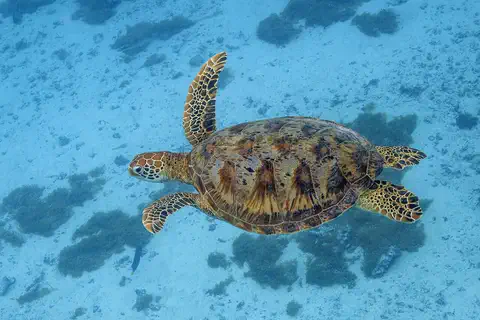
Green sea turtle
The green sea turtle is the largest sea turtle with a hard shell. It lives in warm seas around the world and, unlike other sea turtles, grown-ups eat mostly seagrass and algae. Females swim hundreds or even thousands of kilometers to lay their eggs on the beaches where they hatched long ago.
- Watch What If? Lab What if waves had no wind? Most ocean waves are made by wind blowing over the water. So what if the wind stopped everywhere? New waves would stop forming, but swells from earlier storms could keep rolling in for a while. And the tide would still come in and go out, because tides are made by the pull of the Moon and the Sun, not by wind.
- Watch What If? Lab What if the sea were as clear as glass? Sunlight fades as it goes deeper into the sea, and below about 200 meters there is hardly any. Tiny drifting plants and bits of mud also change how green, blue or murky the water looks. Imagine the sea perfectly clear, then follow how deep light would go, what it would mean for seaweed forests, and what gives the sea its colors.
- Watch What If? Lab What if migratory animals couldn’t reach their destinations? Every year, birds, butterflies, deer and pronghorn travel huge distances between their summer and winter homes. Along the way they need stopover places to eat and rest, and clear paths across the land. Imagine those stops disappearing or those paths blocked by roads and fences, then meet the wildlife bridges and protected places that help animals travel.
- Watch What If? Lab What if Earth had no magnetic field? Deep inside Earth, swirling melted iron makes a magnetic field all around our planet. It turns compass needles, helps sea turtles find their way and shields our air from the solar wind. Imagine it gone, compare Earth with Mars, and find out why scientists are calm about Earth's changing field.
- Watch Try it What If? Lab What if a coast were made of hard rock? Waves wear coasts away, but not every coast wears at the same speed. In our model, a bare sandy island facing ordinary waves keeps about 72 percent of its land after 50 model years. Make the same island of hard rock and it keeps about 99 percent. That is why hard rock is often left sticking out to sea as headlands.
- Watch Try it What If? Lab What if all the sea ice melted? Sea ice floats, so it is already pushing aside about as much water as it will make when it melts, like an ice cube in a glass. In our model, melting all the Arctic's springtime sea ice raises the sea by only about 2 millimeters. The same ice melting on land would raise it about 7 centimeters.
For parents & teachers
What children will learn
- Hatchling sea turtles find the sea by crawling toward the brightest horizon.
- Artificial lights can disorient hatchlings, and turtle-friendly lighting reduces the problem.
- Sea turtles appear to use Earth's magnetic field as a map to find their natal beaches and feeding areas.
- How turtles sense magnetism is still unknown, a real open question in science.
Recommended ages: 7 to 17 · About 15 minutes
Talk about it
- Why might a turtle return to the beach where it hatched rather than any beach?
- What could your family do on a beach trip to help sea turtles?
- How could scientists test whether an animal can sense magnetism?
Try at home or in class
- In a dark room, place a small toy 'turtle' and shine a dim light on one wall and a brighter flashlight on another. Which way would a hatchling go? Now turn off the bright one.
- Use a compass to find north in your home and at a park. Imagine that every place had its own slightly different compass reading, like a turtle's magnetic map.
Key vocabulary: hatchling, navigate, magnetic field, magnetic signature, natal beach, disorientation
Where these facts come from
- Loggerhead Turtle , NOAA Fisheries
- Lights Out for Loggerheads (2014) , South Carolina Department of Natural Resources
- Sea Turtle Lighting Guidelines , Florida Fish and Wildlife Conservation Commission
- For sea turtles, there's no place like magnetic home (2015) , University of North Carolina at Chapel Hill, College of Arts and Sciences
- Dancing turtles unlock scientific discovery (2025) , University of North Carolina at Chapel Hill
Checked, not yet human-reviewed. Last updated October 26, 2026. Spotted a mistake? Tell us.