Animal
Blue wildebeest
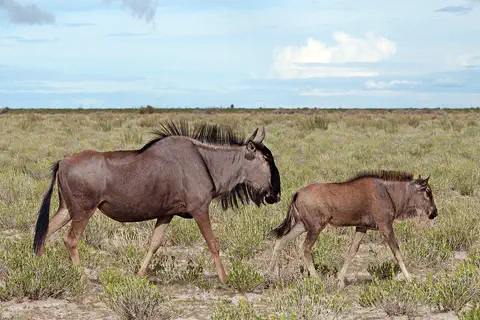
The blue wildebeest is a big antelope with a beard and curved horns. Huge herds walk a long way to find fresh grass.
The blue wildebeest, or gnu, is a big antelope with a box-like head, curved horns, a mane and a beard. It grazes the savannas of eastern and southern Africa, and in the Serengeti huge herds travel in a giant circle every year following the rains.
Connochaetes taurinus, the blue or common wildebeest, is a grazing antelope of eastern and southern African savannas. Its races include the white-bearded wildebeest whose Serengeti-Mara population makes one of Africa's best-known migrations. Calving is highly synchronized, and the IUCN lists the species as Least Concern.
Photo: Charles J. Sharp, CC BY-SA 4.0, via Wikimedia Commons
Meet the blue wildebeest
The blue wildebeest is a big antelope.
It has a big head, curved horns, a long mane and a beard. Its front is big and strong, and its back legs are thin.
The blue wildebeest is also called the gnu. It is a member of the antelope family, with a large, box-like head and curving horns that both males and females have. Its front end is big and heavy, while its back end is slim, with skinny legs.
Its coat is gray, sometimes bluish gray, and it has dark stripes on its neck and shoulders, a black mane and a beard. In some kinds the beard is black, and in others it is white.
Connochaetes taurinus is one of two wildebeest species; Animal Diversity Web describes it as the smaller and lighter of the two. Adults stand about 1.15 to 1.45 meters at the shoulder and weigh about 118 to 270 kilograms; males are larger and darker than females.
The coat ranges from slate or bluish gray to brownish gray, with dark vertical bands on the neck and forequarters. Both sexes have unridged horns that curve out and then up, longer and thicker in males. The mane and long tail are black. The African Wildlife Foundation describes several races: the western white-bearded wildebeest, which forms the great Serengeti-Mara herds of Kenya and Tanzania, the eastern white-bearded wildebeest east of the Gregory Rift, and the brindled or blue race south of the Zambezi River.
Quick facts
- Group
- Mammal
- Length
- 1.7 to 2.4 m
- Height
- 1.15 to 1.45 m
- Weight
- 118 to 270 kg
- Lifespan in the wild
- up to 20 years
Where wildebeest live
Blue wildebeest live in Africa.
They live on wide, grassy plains with a few trees. They always need water to drink.
Blue wildebeest live in eastern and southern Africa, from Kenya and Tanzania down to South Africa and west to Namibia. They like open plains and savannas with acacia trees, where the grass grows back quickly.
Wildebeest must drink often, so they never stray too far from water. When grass and water run out, herds travel to find more, sometimes hundreds of kilometers. They have disappeared from Malawi.
The IUCN's 2016 assessment lists the species as resident in Angola, Botswana, Eswatini, Mozambique, Namibia, South Africa, Tanzania, Zambia and Zimbabwe, and extinct in Malawi. That country list leaves out Kenya, but the same assessment's range description places two subspecies there: the western white-bearded wildebeest of the Serengeti-Mara ecosystem in southern Kenya and the eastern white-bearded wildebeest north to central Kenya. The African Wildlife Foundation and Animal Diversity Web (range "from Kenya to eastern Namibia") agree, so Kenya is shown.
Wildebeest prefer acacia savannas and plains with fast-regrowing grasses and moderate soil moisture, up to about 2,500 meters. As obligate drinkers they need regular water, and many populations use separate wet-season and dry-season ranges, which Animal Diversity Web reports can be up to 120 kilometers apart. Map shading is by country.
Continent
Its habitats


Where can you find this animal?
- Used to live here · Countries and seas named by a scientific source
- Lives here naturally · Countries and seas named by a scientific source
- Sightings recorded · Records of wild sightings (GBIF)
Used to live here · Countries and seas named by a scientific source
Malawi, where the IUCN lists the blue wildebeest as extinct.
Places: Malawi.
Source: iucn-red-list · checked October 2026
Lives here naturally · Countries and seas named by a scientific source
Savannas and grassy plains of eastern and southern Africa, from southern Kenya and Tanzania to South Africa and Namibia. Kenya is named in the IUCN assessment's range description (southern and central Kenya, the Mara and Kajiado) although its country list leaves it out. Wildebeest live in only part of each country shown.
Places: Angola, Botswana, Eswatini, Mozambique, Namibia, South Africa, Kenya, Tanzania and 2 more places.
Source: iucn-red-list · checked October 2026
Sightings recorded · Records of wild sightings (GBIF)
Counts of GBIF records of wild observations (human and machine) and preserved specimens. Records include introduced populations, vagrants, escaped or released animals and misidentifications, so a country with records is not necessarily part of the native range.
Wild sightings have been recorded in South Africa, Tanzania, Kenya, Namibia, Angola, Botswana, Zimbabwe, Zambia and 14 more places.
Source: gbif · checked October 2026
Range maps show where scientists say an animal lives, often country by country. An animal may live in only part of a country shown, and sightings records can include animals that wandered far from home.
Following the green grass
Wildebeest eat grass.
They eat in the day and on moonlit nights. When the grass runs out, they walk far away to find more.
Blue wildebeest are grazers. They mainly eat fast-growing grasses on the savannas and plains. When grass is scarce, they may nibble leaves from shrubs and trees. They graze in the daytime and on moonlit nights.
Because they need fresh grass and water, wildebeest are always on the move. In the Serengeti, huge herds follow the rains in a great loop each year, walking 800 to 1,610 kilometers.
Wildebeest are grazers specializing in the rapidly growing grasses of savannas and plains, feeding by day and on moonlit nights and turning to shrub and tree leaves when grass is sparse. As obligate drinkers, they need water often.
These needs drive their movements. When food runs short, migratory herds of thousands travel hundreds of kilometers. The Serengeti population moves in an annual circuit of 800 to 1,610 kilometers that begins after calving early in the year; by the end of the dry season the herds have nearly exhausted the grazing and return to the Serengeti plains as the rains begin. Many animals, especially calves, are injured or lost along the way.

Head, horns and beard
A wildebeest has a big head and curved horns.
It has a long, dark mane and a beard. Its long, black tail looks like a horse's tail.
A wildebeest's head is large and broad, with a wide muzzle for grazing. Both males and females have horns that curve out to the sides and then up, a bit like a cow's. Males' horns are thicker.
A dark mane runs from the horns over the neck to the shoulders, and a flowing beard hangs under the throat. The long, black tail looks like a horse's. Glands on the face and feet leave scents that help wildebeest keep track of each other.
Wildebeest are bovids with broad shoulders, a broad muzzle and smooth, parenthesis-shaped horns; in males the horns can reach about 83 centimeters along the curve, and in females 30 to 40 centimeters. The convex face is covered with bristly black hair, and a slight hump rises over the shoulders.
The black mane runs from the horns to the shoulders, and both sexes have a beard, black in most races and white in the white-bearded races. Preorbital glands near the eyes and pedal glands in the feet produce scents used in social contact; Animal Diversity Web notes that pedal gland scents allow herds to follow one another during migrations.
Thousands of babies at once
A baby wildebeest is called a calf.
It can stand up just a few minutes after it is born. Lots of calves are born at the same time.
A mother wildebeest carries her calf for about eight months. Most calves in a herd are born in the same two to three weeks: about 80 out of every 100 mothers give birth then. With so many calves at once, predators cannot catch them all.
A newborn calf weighs about 19 kilograms and can stand within minutes. It stays close beside its mother, and they recognize each other by smell. Calves are tawny brown at first and start to get their gray coat at about two months.
Gestation averages about eight months (7 to 9). Births are highly synchronized: the African Wildlife Foundation reports that about 80 percent of females calve within the same two- to three-week period, swamping predators so that more calves survive their first weeks.
Calves weigh about 19 kilograms and can stand within minutes; Animal Diversity Web gives about 6 minutes, Ultimate Ungulate about 15. Mother and calf imprint on each other by scent, which lets them reunite when separated in moving herds. Young become independent and join peer groups at about eight months. Females can breed at about 16 months, though first breeding averages 28 months, and wild wildebeest live about 20 years on average.
Herds, bulls and bellows
Wildebeest live in herds.
Moms and calves stay together. Dad wildebeest guard their own patch of land and call out loudly.
Blue wildebeest live in herds. A small herd is often about eight females and their calves, while a territorial bull wanders among them. When the herds migrate, many groups join together into huge crowds.
In the mating season, bulls guard small territories and call to females with humming, bellowing and croaking sounds. A bull's bellow can be heard up to 2 kilometers away. Wildebeest also rub their faces on each other for social contact.
Wildebeest are gregarious and territorial. Settled herds typically comprise about eight females and their calves, with territorial bulls moving among them; when moving, herds dissolve into loose aggregations. Males become territorial at four to five years, holding territories averaging about 1.5 square kilometers.
The three-week rut follows the rainy season and often begins at a full moon, with bulls calling in groups and sparring for access to females. Bellows carry up to 2 kilometers. The main predators are lions, cheetahs, spotted hyenas and African wild dogs, and Animal Diversity Web notes that individuals in larger herds are taken more often than those in smaller ones.
Did you know?
Wildebeest are also called gnus.
Another name for the wildebeest is the gnu.
Wildebeest are also called gnus, and the blue wildebeest is also known as the brindled gnu.
Keeping the herds moving
There are lots of wildebeest.
But they need open land to travel. People are working to keep their paths open.
The IUCN lists the blue wildebeest as Least Concern, and its numbers are stable. In some areas they are still widespread and plentiful.
But wildebeest need room to travel. Fences put up for farms can block their paths and split their land into pieces. The loss of water sources and poaching are dangers too. Conservation groups work with governments and farmers to plan the land so that herds can keep moving.
The IUCN lists Connochaetes taurinus as Least Concern with a stable trend (2016 assessment), although it is extinct in Malawi. The African Wildlife Foundation names habitat fragmentation, especially land fenced off for agriculture, the spread of farming, the reduction of water sources and poaching as threats.
Migratory populations are especially sensitive: their wet- and dry-season ranges may lie up to 120 kilometers apart. The IUCN assessment describes fences that blocked migrations and denied wildebeest water during droughts, causing mass deaths, as at Lake Xau in Botswana in 1980. AWF works with governments on land-use planning and with communities on sustainable agriculture, aiming to balance development with the space wildebeest need.
IUCN Red List
How is the blue wildebeest doing in the wild?
- Least Concern (this animal)
- Near Threatened
- Vulnerable
- Endangered
- Critically Endangered
- Extinct in the Wild
- Extinct
Least Concern
Not at risk of disappearing from the wild right now.
See the IUCN Red List assessment · The IUCN Red List of Threatened Species 2022.2
Amazing facts
-
A wildebeest calf can stand up minutes after it is born.
A newborn wildebeest can stand up within minutes, and soon it follows its mother.
Calves stand within minutes of birth: about 6 minutes according to Animal Diversity Web.
-
Wildebeest are also called gnus.
Another name for the wildebeest is the gnu.
Wildebeest are also called gnus, and the blue wildebeest is also known as the brindled gnu.
-
A wildebeest's call can be heard far away.
A male wildebeest's bellow can be heard up to 2 kilometers away.
Bull bellows carry up to 2 kilometers; at the start of the rut, bellowing males gather in groups called leks.
-
Wildebeest leave smells with their feet.
Scent glands in wildebeest feet help herds follow each other during migrations.
Pedal gland secretions let herds follow one another during migrations.
Words to know
- migration
- a long journey animals make, often with the seasons
- grazer
- an animal that eats mostly grass
- herd
- a large group of animals that live and move together
- antelope
- a hoofed, horned, plant-eating animal such as a wildebeest or an impala
- territory
- an area an animal guards and keeps others out of
Discovery challenge
-
Why do wildebeest walk so far?
Why do Serengeti wildebeest travel so far every year?
What drives the Serengeti wildebeest's annual circuit?
- To find fresh grass and water
- To find snow
- To build nests
Show the answer
To find fresh grass and water
They walk to find fresh grass and water.
They follow the rains to find fresh grass and water, walking 800 to 1,610 kilometers a year.
The search for fresh grazing and water as the seasons change; herds return to the Serengeti plains as the rains begin.
-
When are most wildebeest babies born?
When are most wildebeest calves in a herd born?
What is distinctive about wildebeest calving?
- All in the same few weeks
- One each month all year
- Only on snowy days
Show the answer
All in the same few weeks
Most babies are born in the same few weeks.
About 80 out of every 100 mothers give birth in the same two to three weeks, so predators cannot catch them all.
It is highly synchronized: about 80 percent of females calve within two to three weeks, swamping predators.
-
Do wildebeest moms have horns?
Which wildebeest have horns?
Which statement about wildebeest horns is true?
- Only males
- Only calves
- Both males and females
Show the answer
Both males and females
Yes! Moms and dads both have horns.
Both males and females have horns; males' horns are thicker.
Both sexes have unridged horns, which are longer and thicker in males.
-
What do wildebeest eat?
What is the wildebeest's main food?
Which describes the wildebeest's diet?
- Insects
- Grass
- Fish
Show the answer
Grass
Wildebeest eat grass.
They are grazers that eat mostly fast-growing grasses.
They graze rapidly growing grasses by day and on moonlit nights, taking shrub leaves when grass is sparse.
Places where you might see it
-
 Watch
 Country
Tanzania
Tanzania is a country in East Africa, just south of the Equator, on the Indian Ocean. It has Mount Kilimanjaro, Africa's highest mountain, deep lakes in the East African Rift, and the Serengeti, where huge herds of wildebeest travel each year.
-
 Watch
Natural wonder
Ngorongoro Conservation Area
The Ngorongoro Conservation Area in northern Tanzania holds the Ngorongoro Crater, a giant bowl about 16 to 20 kilometers across, left when an ancient volcano collapsed about 2.5 million years ago. Around 25,000 large animals live in and around the crater. The area also protects Olduvai Gorge and Laetoli, where scientists have found important evidence of how humans evolved.
-
Watch
Natural wonder
Serengeti National Park
Serengeti National Park in northern Tanzania protects 14,763 square kilometers of grassy plains and woodlands. Each year more than a million wildebeest, with zebras and gazelles, travel a great loop across the Serengeti and into Kenya in search of grass and water, followed by lions and other predators.
Experiments to try
Explore next
-
 Watch
Animal
Plains zebra
Plains zebras are striped members of the horse family that graze on the grasslands of eastern and southern Africa. They live in close family groups, travel long distances to find fresh grass and water, and every zebra's stripes are different.
-
 Watch
Animal
African buffalo
The African buffalo is a huge, cow-like grazer with heavy, curving horns. It lives in herds that can number in the thousands, and a herd will rush to protect a calf in danger. It lives across much of Africa south of the Sahara, from open savannas to rainforests.
-
Watch
Country
Tanzania
Tanzania is a country in East Africa, just south of the Equator, on the Indian Ocean. It has Mount Kilimanjaro, Africa's highest mountain, deep lakes in the East African Rift, and the Serengeti, where huge herds of wildebeest travel each year.
-
 Watch
3D
Animal
Lion
The lion is the only big cat that lives in a family group, called a pride. Lionesses hunt together, males guard the pride's land, and their roar can be heard about 8 kilometers away. Wild lions live in Africa, plus one small group in western India.
-
 Watch
Animal
Impala
The impala is a slender, reddish-brown antelope of the savannas of eastern and southern Africa. It can both graze on grass and browse on leaves, lives in herds, and when startled the whole herd bursts into spectacular leaps. Only males have the long, curving horns.
-
Watch
Natural wonder
Ngorongoro Conservation Area
The Ngorongoro Conservation Area in northern Tanzania holds the Ngorongoro Crater, a giant bowl about 16 to 20 kilometers across, left when an ancient volcano collapsed about 2.5 million years ago. Around 25,000 large animals live in and around the crater. The area also protects Olduvai Gorge and Laetoli, where scientists have found important evidence of how humans evolved.
-
Watch
Natural wonder
Serengeti National Park
Serengeti National Park in northern Tanzania protects 14,763 square kilometers of grassy plains and woodlands. Each year more than a million wildebeest, with zebras and gazelles, travel a great loop across the Serengeti and into Kenya in search of grass and water, followed by lions and other predators.
- Watch What If? Lab What if migratory animals couldn’t reach their destinations? Every year, birds, butterflies, deer and pronghorn travel huge distances between their summer and winter homes. Along the way they need stopover places to eat and rest, and clear paths across the land. Imagine those stops disappearing or those paths blocked by roads and fences, then meet the wildlife bridges and protected places that help animals travel.
For parents & teachers
What children will learn
- Describe the blue wildebeest's body, including horns, mane and beard.
- Explain why wildebeest migrate and how the Serengeti migration follows the rains.
- Explain how giving birth at the same time helps calves survive.
- Understand why open, connected land matters even for a common animal.
Recommended ages: 3 to 17 · About 15 minutes
Talk about it
- Why might it help calves survive if they are all born at once?
- What could happen to migrating wildebeest if a long fence were built across their path?
- How do you think a calf finds its mother in a herd of thousands?
Try at home or in class
- Draw a map of a loop journey and mark where the rains, the grass and the water might be in each season.
- Measure 1.4 meters up a wall to see how tall a wildebeest is at the shoulder.
Key vocabulary: migration, grazer, herd, antelope, territory
Where these facts come from
- The IUCN Red List of Threatened Species , International Union for Conservation of Nature (IUCN terms of use (no redistribution of Red List data or range maps))
- GBIF Backbone Taxonomy and GBIF Occurrence Search , Global Biodiversity Information Facility (CC0 1.0 (backbone); occurrence counts are facts derived from records under CC0, CC BY and CC BY-NC)
- Wildebeest , African Wildlife Foundation
- Connochaetes taurinus (blue wildebeest) , Animal Diversity Web, University of Michigan
- Connochaetes taurinus (Brindled gnu, Blue wildebeest) , Ultimate Ungulate
- Connochaetes taurinus (Common Wildebeest), 2016 assessment , IUCN Red List
- Connochaetes taurinus, 2016 assessment (errata 2020): full text with range description , IUCN Red List
- Wikidata , Wikimedia Foundation (CC0 1.0)
- Wikimedia Commons , Wikimedia Foundation (Per file: Public domain, CC0, CC BY or CC BY-SA only (credited on each page))
Checked, not yet human-reviewed. Last updated October 24, 2026. Spotted a mistake? Tell us.