
What If? Lab
What if orcas left the Southern Ocean?
Orcas are the top hunters of the cold sea near Antarctica. What if they swam away? Let's see who else changes in Olly's lab!
Orcas are apex predators: they eat at the top of the food web. Take them out of our model's Southern Ocean food web and the seals, penguins and fish they eat could become more common, which then changes the food of others. Explore the knock-on effects, and the real orcas that make long trips north.
Removing an apex predator can release its prey and pass effects down the web: a trophic cascade. In a rule-based model of the Southern Ocean, removing the orca marks three prey species as possibly more common, krill as possibly fewer and two krill-eaters as short of food. Real cascades depend on much the model omits.
The big question
Orcas are big black-and-white whales. They live in every ocean.
Near Antarctica, orcas catch seals, penguins and fish. What if all the orcas swam away?
Orcas, also called killer whales, live in every ocean on Earth. NOAA says they are most abundant in cold waters, such as the seas around Antarctica. They are apex predators: they eat at the top of the food web.
So what if every orca left the Southern Ocean around Antarctica? Would anything else notice? In this lab you can take the orca out of a model food web and follow what could happen next.
Killer whales occur in all oceans and are most abundant in cold waters such as those around Antarctica (NOAA). As apex predators, their effect on an ecosystem runs downward through the animals they eat. Researchers studying Antarctic killer whales note that their predation may be a major force structuring marine communities.
This lab asks what a food web model predicts if that top level is removed entirely. It is a qualitative experiment: the model shows which species could be affected and in which direction, not by how much.
Try the experiment
Make a prediction
Olly takes the orcas away. What could happen to the seals and penguins they hunt?
The orca is taken out of the model's Southern Ocean web. What could happen to the seals, penguins and fish it hunts?
With the orca removed, how does the model's top-down rule mark the orca's prey?
- They could become more common
- They could disappear
- Nothing would change for them
| Control | In our world | What if… | Range |
|---|---|---|---|
| Food web · Which food web to explore. This lab uses the Southern Ocean around Antarctica. | 0 | — | 0–1 |
| Take out of the ocean · The animal or plant that disappears from the Southern Ocean web. Choose the orca for this lab, then try the leopard seal to compare. You can also tap one in the picture. | 0 | 8 | 0–8 |
-
Established fact
Orcas are top hunters at the top of the food web.
Orcas are apex predators that eat at the top of the food web, and they are most abundant in cold waters such as those around Antarctica.
Killer whales are apex predators, most abundant in cold waters such as Antarctica's; their diets are shaped largely by the learned hunting culture of each ecotype (NOAA).
-
What the model shows
In the model, without orcas, seals, penguins and fish could become more common.
In the model, removing the orca could make silverfish, Adélie penguins and crabeater seals more common, krill fewer, and leave blue whales and leopard seals with less food.
Model (Southern Ocean, orca removed): affected 6, more common 3, fewer 1 (krill), less food 2 (blue whale, leopard seal), gone 0; qualitative only.
-
Established fact
Some Antarctic orcas swim all the way to warm water and back.
Satellite tags showed some Antarctic orcas swimming to warm waters off Uruguay and Brazil and back; one round trip was almost 9,400 kilometers in 42 days.
Five of 12 tagged type B killer whales moved to subtropical waters (30–37° S) off Uruguay and Brazil; one made a non-stop round trip of almost 9,400 km in 42 days (Durban and Pitman, 2011).
-
An idea scientists discuss
Without orcas, the whole sea near Antarctica might change.
Scientists think orcas' hunting may help shape which animals live in Antarctic waters, so losing them might change the food web in ways that are hard to predict.
Predation by killer whales may be a major force structuring Antarctic marine communities (Durban and Pitman, citing earlier work); the size and speed of any real cascade are unknown and beyond this model.
The web today
In the cold sea, tiny plants called phytoplankton feed the krill.
Krill feed fish, penguins, seals and whales. Orcas eat seals, penguins and fish.
The Australian Antarctic Division says the Southern Ocean food web begins with tiny plant-like phytoplankton that use sunlight. They feed Antarctic krill, small shrimp-like animals, and nearly everything else eats krill: fish, penguins, some seals and great whales.
Our model web has eight members. Krill eat phytoplankton. Silverfish, crabeater seals and blue whales eat krill. Adélie penguins eat krill and fish. Leopard seals eat krill, penguins and fish. At the top, orcas eat crabeater seals, penguins and fish.
The model's Southern Ocean web has eight nodes in four rows: phytoplankton; Antarctic krill; silverfish, Adélie penguin, crabeater seal and blue whale; and the leopard seal and orca. Each link is present or absent, and all of a species' foods count equally.
This matches the outline the Australian Antarctic Division gives: phytoplankton feed krill, krill feed fish, squid, seabirds, penguins, some seals and baleen whales, and predators such as leopard seals and killer whales eat penguins and other seals. The real web has hundreds of species of plankton, birds and fish.
Take out the orcas
Now Olly takes the orcas out of the web.
The seals, penguins and fish have one less hunter. There could be more of them!
Take the orca out of the model and nothing is left without food, because orcas are at the top. Instead, the change flows downward. The silverfish, Adélie penguins and crabeater seals lose a hunter, so they could become more common.
All three eat krill, so with more of them eating, krill could become fewer. And then the blue whale and leopard seal, which also eat krill, could find less food. In all, six of the other seven species are affected.
With the orca removed, the model's bottom-up rule finds nothing starved: no species depended on orcas for food. The top-down rule marks the orca's three prey (silverfish, Adélie penguin, crabeater seal) as possibly more common. Their shared food, krill, is marked as possibly fewer, and the blue whale and leopard seal, whose foods include krill, as possibly finding less food.
Readouts: affected 6, more 3, fewer 1, less food 2, gone 0. Only phytoplankton is untouched, because the model follows top-down effects just one level.
Why one hunter matters
Every animal in a food web is joined to others. Take one away, and others feel it.
When a hunter goes, the animals it ate can grow in number. Then they eat more of their own food.
A food web is a set of links between who eats whom. When a hunter disappears, the animals it ate are no longer being caught, so their numbers could grow. More of them means more mouths eating their food. This chain of knock-on effects is called a trophic cascade.
Our model is simple. It only says who could be affected, never how many animals or how fast. Real orcas and leopard seals eat many foods the model leaves out, and real animals can switch foods.
Top-down control: a predator limits its prey, which in turn limits what the prey eat. Removing the predator can release the prey and shift pressure to the next level, a trophic cascade. The model applies this as rules: release the removed species' prey, mark their foods as eaten more, and flag species whose foods are reduced.
Limits from its documentation: it is qualitative, gives no population numbers, follows top-down effects only one level, ignores competition, disease, weather and people, and real predators often switch prey. Note too that the model's orca does not eat leopard seals, although the Australian Antarctic Division names the killer whale as the leopard seal's only natural predator.
Orcas on the move
Some orcas from Antarctica really do take long trips. They swim to warm water and come back!
Scientists followed them with special tags.
Real Antarctic orcas do sometimes leave, for a while. NOAA scientists Durban and Pitman put satellite tags on 12 orcas hunting near the Antarctic Peninsula. Six of them swam fast and straight away from Antarctica, and five reached warm waters off Uruguay and Brazil.
One orca made a round trip of almost 9,400 kilometers in just 42 days. The scientists found no sign that the trips were for feeding or for having calves. They suggest the warm water might let the orcas renew their skin without losing too much body heat.
Durban and Pitman (NOAA Southwest Fisheries Science Center, Biology Letters, 2011) tagged 12 type B killer whales, predators of ice seals and penguins, near the Antarctic Peninsula. Six made fast (over 12 km/h), direct movements away from Antarctic waters; five reached subtropical waters at 30–37° S off Uruguay and Brazil, in water from −1.9 °C to 24.2 °C. One whale completed a non-stop round trip of almost 9,400 km in 42 days.
With no sign of calving or prolonged feeding, the authors suggest periodic maintenance migrations allowing skin regeneration without high heat loss: a hypothesis. A real, lasting departure of all orcas has never been observed, so its effects remain an idea.
Amazing facts
-
Orcas talk with clicks, whistles and calls.
Orcas communicate with clicks, whistles and pulsed calls, and each population has its own calls that young orcas learn.
Killer whale pulsed calls are unique among populations, learned and culturally transmitted, and act as family badges (NOAA).
-
There are about 50,000 orcas in the world.
NOAA estimates there are around 50,000 killer whales in the world's oceans.
NOAA estimates a global population of around 50,000 killer whales, with about 2,500 in the eastern North Pacific.
-
Leopard seals have special teeth for catching krill.
Leopard seals hunt penguins and fish, but they also have unusual teeth for straining krill out of the water.
Like crabeater seals, leopard seals have unusual teeth for straining krill, alongside a diet of penguins, fish, squid and seal pups (Australian Antarctic Division).
-
Some orcas swim very fast on long trips.
Antarctic orcas heading north traveled at more than 12 kilometers an hour, fast and straight.
Tagged type B killer whales moved away from Antarctica at more than 12 km/h (6.5 knots), traveling slower only in the warmest waters (Durban and Pitman, 2011).
Words to know
- apex predator
- a hunter that eats at the top of a food web
- food web
- all the links between who eats whom in a place
- trophic cascade
- a chain of knock-on effects that spreads through a food web
- krill
- small shrimp-like animals that many ocean animals eat
- migration
- a long journey that animals make and then return from
- satellite tag
- a small device that sends an animal's position to scientists through satellites
Discovery challenge
-
Without orcas, which animals could grow in number?
In the model, which animals could become more common when the orca is removed?
Which species does the model release when the orca is removed?
- Silverfish, Adélie penguins and crabeater seals
- Blue whales and leopard seals
- Only the phytoplankton
Show the answer
Silverfish, Adélie penguins and crabeater seals
The fish, penguins and seals the orcas used to catch.
The orca's prey: silverfish, Adélie penguins and crabeater seals.
Its three prey species, by the one-level top-down rule.
-
Why could there be fewer krill?
In the model, why could krill become fewer when orcas leave?
What mechanism marks krill as 'fewer' in the orca-removal run?
- More fish, penguins and seals eat them
- Orcas used to look after the krill
- The water gets colder
Show the answer
More fish, penguins and seals eat them
More animals are eating them.
The released fish, penguins and seals all eat krill, so krill are eaten more.
The released prey all feed on krill, so krill are flagged as eaten more.
-
Who is the only animal that hunts leopard seals?
According to the Australian Antarctic Division, what is the leopard seal's only natural predator?
Which predator link does the Australian Antarctic Division describe that the model omits?
- The orca
- The blue whale
- Antarctic krill
Show the answer
The orca
The orca.
The orca. Our model leaves this link out.
Orca predation on leopard seals: the killer whale is its only natural predator.
-
Where did some Antarctic orcas swim to?
In the satellite-tag study, where did some Antarctic orcas travel?
Where did tagged type B killer whales travel in Durban and Pitman's study?
- Warm waters off Uruguay and Brazil
- The Arctic Ocean
- Up a river
Show the answer
Warm waters off Uruguay and Brazil
To warm water near South America, and back again!
To warm waters off Uruguay and Brazil, and then back to Antarctica.
Subtropical waters at 30–37° S off Uruguay and Brazil, in round trips of up to almost 9,400 km.
Experiments to try
- Watch Try it What If? Lab What if an ocean food web changed? Antarctic krill are small shrimp-like animals, but they feed a huge number of bigger ones. Take krill out of our model's Southern Ocean food web and all seven other species are affected: every animal in it loses all its food, from silverfish to orcas.
- Watch Try it What If? Lab What if insects vanished? Insects eat plants, and birds, mice and bears eat insects. In our forest food web, take the insects out and see who could go hungry and who could change. Then find out why scientists are counting insects carefully, and how people help them.
- Watch Try it What If? Lab What if wolves returned to a park? For nearly 70 years, Yellowstone National Park had no wolf packs. In 1995, people brought wolves back. Start with a model park that has no wolves, put the wolves back into its food web, and see what changes for the elk, the willows and the animals that need them. Then find out what scientists in the real park are still working out.
- Watch What If? Lab What if warmer seas changed ocean life? When seawater gets too warm, corals can lose the tiny algae that feed them and turn white. Fish and shellfish move toward cooler water, and a long ocean heatwave can leave whole food webs short of food. Explore what scientists have seen, and what they still study about storms.
- Watch What If? Lab What if sharks disappeared? Sharks catch and eat other sea animals, and just having them around changes where those animals go. Follow what scientists have found in Australia's Shark Bay seagrass meadows and on coral reefs, where the evidence is still debated, and how some shark populations are recovering.
Explore next
-
 Watch
3D
Animal
Orca
The orca, also called the killer whale, is the largest member of the dolphin family and the ocean's top predator. Orcas live in every ocean, in close family groups called pods, made up of orcas related through their mothers. Each group has its own favorite foods, hunting tricks and even its own calls, which young orcas learn from their families.
-
 Watch
Animal
Leopard seal
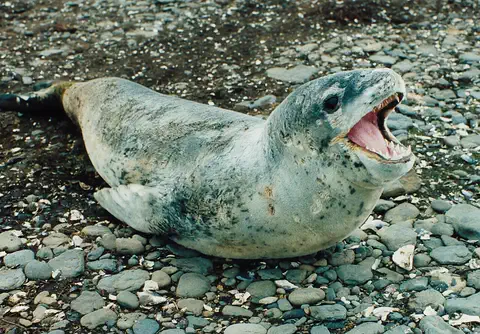
The leopard seal is a large, slender seal of the icy seas around Antarctica, named for the dark spots on its gray coat. It is a fast, powerful hunter with a big head and long teeth, and it eats everything from tiny krill to fish, penguins and young seals.
- Watch Try it What If? Lab What if an ocean food web changed? Antarctic krill are small shrimp-like animals, but they feed a huge number of bigger ones. Take krill out of our model's Southern Ocean food web and all seven other species are affected: every animal in it loses all its food, from silverfish to orcas.
- Watch Try it What If? Lab What if insects vanished? Insects eat plants, and birds, mice and bears eat insects. In our forest food web, take the insects out and see who could go hungry and who could change. Then find out why scientists are counting insects carefully, and how people help them.
- Watch Try it What If? Lab What if wolves returned to a park? For nearly 70 years, Yellowstone National Park had no wolf packs. In 1995, people brought wolves back. Start with a model park that has no wolves, put the wolves back into its food web, and see what changes for the elk, the willows and the animals that need them. Then find out what scientists in the real park are still working out.
- Watch What If? Lab What if warmer seas changed ocean life? When seawater gets too warm, corals can lose the tiny algae that feed them and turn white. Fish and shellfish move toward cooler water, and a long ocean heatwave can leave whole food webs short of food. Explore what scientists have seen, and what they still study about storms.
- Watch What If? Lab What if sharks disappeared? Sharks catch and eat other sea animals, and just having them around changes where those animals go. Follow what scientists have found in Australia's Shark Bay seagrass meadows and on coral reefs, where the evidence is still debated, and how some shark populations are recovering.
- Watch Try it What If? Lab What if a coast were made of hard rock? Waves wear coasts away, but not every coast wears at the same speed. In our model, a bare sandy island facing ordinary waves keeps about 72 percent of its land after 50 model years. Make the same island of hard rock and it keeps about 99 percent. That is why hard rock is often left sticking out to sea as headlands.
For parents & teachers
What children will learn
- A food web shows who eats whom, and a change to one species can affect many others.
- Removing a top predator can let its prey increase, which puts more pressure on the prey's food (a trophic cascade).
- Models leave things out: this one shows who could be affected, not how many or how fast.
- Real Antarctic orcas make long journeys to warm water and back, which scientists study with satellite tags.
Recommended ages: 9 to 17 · About 15 minutes
Talk about it
- Why does removing a top predator affect animals it never eats, such as blue whales?
- The model's orcas do not hunt leopard seals, but real ones do. How might that change the result?
- Why might scientists want to know where orcas travel?
Try at home or in class
- Draw the Southern Ocean food web on paper with arrows from food to eater. Cover the orca with a coin and trace which arrows lead away from it.
- Build a web with string: each person holds a card for one species, and a string joins food to eater. When one person lets go, who feels the tug?
Key vocabulary: apex predator, food web, trophic cascade, krill, migration, satellite tag
Where these facts come from
- Killer Whale , NOAA Fisheries
- Antarctic killer whales make rapid, round-trip movements to subtropical waters: evidence for physiological maintenance migrations? (Durban and Pitman, Biology Letters 2011) , The Royal Society, via PubMed Central
- Antarctic food web , Australian Antarctic Division
- Leopard seal , Australian Antarctic Division
Checked, not yet human-reviewed. Last updated October 27, 2026. Spotted a mistake? Tell us.