
What If? Lab
What if insects vanished?
Insects are tiny, but they are food for birds, mice and even bears. What if there were no insects in Olly's forest? Let's look at the food web!
Insects eat plants, and birds, mice and bears eat insects. In our forest food web, take the insects out and see who could go hungry and who could change. Then find out why scientists are counting insects carefully, and how people help them.
Insects sit at the nexus of many trophic links: plant eaters, prey, pollinators and decomposers. A rule-based food-web model shows the first knock-on effects of removing them from a Yellowstone-style forest, while research on insect declines shows what is known, and what is still uncertain, in the real world.
The big question
Look closely in a forest. Beetles, ants, caterpillars and moths are everywhere!
Many animals eat insects. What if all the insects were gone? Who would miss them?
Insects are small animals all around us: beetles, ants, bees, butterflies, moths and many more. They nibble leaves, and in turn they are food for many birds and other animals.
A food web shows who eats whom. If one kind of living thing disappears, the animals that ate it lose food, and the living things it ate lose a hunter. This lab asks: what if the insects vanished from a forest food web? This is a pretend experiment. Insects have not vanished, but scientists want to know how they are doing.
Insects connect many links in terrestrial food webs. They consume plants, are eaten by birds, mammals and other insects, pollinate fruits, vegetables and nuts, control pests and weeds, and break down leaves, wood and dung.
This lab removes insects from a simplified forest web to trace the immediate knock-on effects, the start of what ecologists call a trophic cascade. It is a thought experiment carried out with a model; real insect populations are declining in many places, but they have not vanished.
Try the experiment
Make a prediction
Olly takes the insects out of the forest. Which animals will have less to eat?
The insects are taken out of the forest food web. Which animals could find less food?
Removing insects from the forest web, which consumers does the model mark as finding less food?
- The mouse, the songbird and the bear
- The wolf and the elk
- No animals at all
| Control | In our world | What if… | Range |
|---|---|---|---|
| Food web · Which food web to explore. This lab uses the forest, modeled on Yellowstone. | 1 | — | 0–1 |
| Take out of the forest · The living thing that disappears from the forest web. Choose 'insects' for this lab, or try others. You can also tap one in the picture. | 0 | 4 | 0–13 |
-
What the model shows
In the model, with no insects, mice, songbirds and bears have less food.
In the model, removing insects means the deer mouse, songbird and grizzly bear could find less food, but none loses all its food.
With insects removed, the model marks 3 consumers as finding less food, 3 plant groups as possibly more common, and none as disappearing: 6 species affected.
-
Established fact
Most land birds feed insects to their babies.
96 percent of North American land birds feed their young on insects; one chickadee family needs at least 7,000 caterpillars.
96 percent of North American land birds feed nestlings insects, and a chickadee clutch needs at least 7,000 caterpillars to fledge (Clemson Extension, citing Doug Tallamy).
-
Established fact
In many places there are fewer insects than before.
Scientists report insects declining in many places, often by about 1 to 2 percent a year, but the data are patchy and some insects are increasing.
Reported annual declines in insect abundance frequently fall around 1 to 2 percent, with large variation and major data gaps, especially in the tropics (Wagner et al. 2021).
-
An idea scientists discuss
Without insects, many flowers might not make seeds.
The model only follows who eats whom. Scientists explain that insects also pollinate plants and break down dead leaves, so a world without insects would likely change far more than the model shows.
Losing insects would also remove pollination, pest control and decomposition; the model's 'plants could become more common' ignores these and could be the opposite of what would happen.
A forest full of insects
In Olly's forest, insects eat leaves and berries.
Mice, songbirds and bears eat the insects. Everyone has food!
Our model forest is based on Yellowstone, in the United States. Grasses, willows and aspens, and berry bushes are at the bottom. Insects eat all three. Deer mice, songbirds and grizzly bears eat insects, along with other foods.
Higher up, owls and coyotes eat mice and hares, and wolves eat elk. With nothing removed, every animal in the web keeps its food. There are 13 kinds of living things in this simple web; a real forest has many thousands.
The model's forest web has 13 nodes modeled on Yellowstone: three plant groups; insects, deer mouse, snowshoe hare, elk and beaver as plant eaters (the mouse also eats insects); and songbird, great horned owl, coyote, gray wolf and grizzly bear above them. Insects eat grasses, willow and aspen, and berry bushes, and are eaten by the deer mouse, songbird and grizzly bear.
Links are either present or absent, and all of a species' foods count equally. With nothing removed, the model reports zero species affected.
Take the insects out
In our pretend forest, Olly takes the insects away.
Now the mice, the songbirds and the bears have less to eat. They still find other food, like berries. The plants have fewer leaf nibblers.
Remove the insects in the model and the effects spread out in waves. First, grasses, willows and berry bushes could become more common, because the insects that ate them are gone.
Next, the deer mouse, the songbird and the grizzly bear could find less food, because insects were on their menu. None of them loses all its food, so none disappears in the model. In all, 6 of the 12 remaining species are affected.
With insects removed, the model's bottom-up rule finds no consumer left without food, so none could disappear. The deer mouse, songbird and grizzly bear each lose one food and could find less food. The top-down rule marks all three plant groups as possibly more common, since they lost a consumer. That is 6 species affected.
For comparison, removing the deer mouse affects 10 species and removing the gray wolf affects 8, through the wolf, elk and willow cascade. The model's numbers are counts of species that could change, never population sizes.
Why it happens
Animals that eat insects lose some of their food. Plants that insects ate lose a nibbler.
That is how a food web works: when one part changes, others change too.
Every link in a food web is a meal. Take away the insects and every animal that ate them loses part of its food. The plants that insects ate are nibbled less.
The model is very simple. It shows who could be affected, not how many animals or how fast. It counts only who eats whom, so it leaves out insects' other jobs, like carrying pollen and breaking down dead leaves. Real animals can also switch to other foods.
The model applies five qualitative rules: remove the species; consumers with no food left could disappear (iterated); species that lost a hunter could become more common (one level); their foods could become fewer; species that lost some food could find less food.
Its limits matter here. It ignores insects as pollinators and decomposers, so its 'plants could become more common' result is a feeding-link artifact: plants that depend on insect pollination could suffer instead. It ignores diet switching, competition, disease and weather, follows top-down effects only one level, and gives no population numbers.
Counting and helping insects
Insects have not vanished. But in some places, there are fewer than before.
Scientists are counting them. People help insects by planting flowers and native plants and by using fewer bug sprays.
Insects really do feed birds: 96 percent of North American land birds feed their young on insects, and one chickadee family needs at least 7,000 caterpillars to raise its chicks.
Scientists have found insects declining in many places, often by about 1 to 2 percent a year, because of land clearing, farming, climate change, pollution, introduced species, pesticides and light at night. But they also say the data are patchy, and some insects are increasing. People help by growing insect-friendly plants instead of lawns, using fewer pesticides, and joining community science counts.
A 2021 PNAS special feature introduced by Wagner and colleagues reports that annual declines in insect abundance frequently fall around 1 to 2 percent, with much variation in time, space and lineage. Named stressors include land-use change, agriculture, climate change, nitrification, pollution and introduced species, plus insecticides, herbicides, urbanization and light pollution; their relative importance and interactions remain uncertain. Long-term data are meager from the tropics, and some taxa, such as Arctic arthropods and some temperate moths, have increased.
The stakes for food webs are real: Clemson Extension notes that 96 percent of North American land birds feed their young insects. Responses include pollinator policies, reduced pesticide use, community science and individual actions.
Amazing facts
-
One chickadee family needs thousands of caterpillars!
To raise one family of chicks, a pair of chickadees needs at least 7,000 caterpillars.
Entomologist Doug Tallamy estimates that a single chickadee clutch requires at least 7,000 caterpillars to fledge.
-
There are many more kinds of moths than butterflies.
For every butterfly species you might see in the daytime, there are about 19 species of moths flying at night.
Moth researcher David Wagner notes roughly 19 moth species for every butterfly species; moths are declining in parts of Europe and Central America but increasing in some temperate areas.
-
Insect numbers go up and down a lot from year to year.
Insect numbers can swing hugely from one year to the next, so scientists need many years of counts to see a slow decline.
Spotting a 1 to 2 percent annual decline against swings of two to three orders of magnitude often takes decades of census data.
Words to know
- insect
- a small animal such as a beetle, ant, bee, moth or butterfly
- food web
- a picture of who eats whom in a place, with many linked food chains
- trophic cascade
- a chain of changes that spreads through a food web when one species is added or removed
- decomposer
- a living thing that breaks down dead plants and animals
- community science
- research in which ordinary people help scientists collect data, such as counting insects
Discovery challenge
-
In Olly's forest, which animal eats insects?
In the model forest, which of these animals eats insects?
Which of these is linked to insects as a consumer in the model's forest web?
- The songbird
- The elk
- The beaver
Show the answer
The songbird
The songbird eats insects.
The songbird eats insects and berries; elk and beavers eat plants.
The songbird (with the deer mouse and grizzly bear); elk and beaver are herbivores in the web.
-
With no insects, do any animals in the model lose all their food?
In the model, how many species could disappear when insects are removed?
How many consumers does the bottom-up rule mark as 'could disappear' when insects are removed?
- None
- All of them
- Only the wolf
Show the answer
None
None. They all still have other food.
None: the mouse, songbird and bear all have other foods, so they find less food but don't lose it all.
Zero: every consumer of insects retains at least one other food.
-
What do most land birds feed their babies?
What do 96 percent of North American land birds feed their young?
Most North American land birds provision nestlings with…
- Insects
- Seeds only
- Fish
Show the answer
Insects
Insects, like caterpillars.
Insects. A chickadee family needs at least 7,000 caterpillars.
…insects: 96 percent of species, according to Clemson Extension.
-
Which job of insects does our model leave out?
Which important job of insects does the model leave out?
Which insect ecosystem service is missing from the model's feeding links?
- Carrying pollen to flowers
- Being food for birds
- Eating leaves
Show the answer
Carrying pollen to flowers
Insects carry pollen, but the model only shows who eats whom.
Pollination. The model shows only feeding links, so it misses insects' pollen carrying.
Pollination (and decomposition); the model encodes only trophic links.
Experiments to try
- Watch Try it What If? Lab What if bees disappeared? Many fruits and vegetables only grow well when bees and other animals carry pollen between their flowers. In our model farm, turn the pollinators down to zero and watch which harvests shrink, which hardly change, and why wheat, rice and corn don't mind. Then meet the people helping pollinators.
- Watch Try it What If? Lab What if wolves returned to a park? For nearly 70 years, Yellowstone National Park had no wolf packs. In 1995, people brought wolves back. Start with a model park that has no wolves, put the wolves back into its food web, and see what changes for the elk, the willows and the animals that need them. Then find out what scientists in the real park are still working out.
- Watch Try it What If? Lab What if beavers built no dams? Beavers eat willow and aspen, and they also build dams that turn streams into ponds. Take the beaver out of our forest food web and the model finds only one change. Then find out why scientists call beavers nature's engineers, and what a food web leaves out.
- Watch Try it What If? Lab What if orcas left the Southern Ocean? Orcas are apex predators: they eat at the top of the food web. Take them out of our model's Southern Ocean food web and the seals, penguins and fish they eat could become more common, which then changes the food of others. Explore the knock-on effects, and the real orcas that make long trips north.
- Watch What If? Lab What if there were no spiders? Spiders around the world catch an estimated 400 to 800 million tons of prey every year, mostly insects. They also spin some of the toughest materials in nature. Imagine a world with no spiders: what would happen to all those insects, and what would we lose?
- Watch What If? Lab What if mosquitoes disappeared? Nobody enjoys an itchy mosquito bite. But mosquitoes are also food for fish, dragonflies, birds and bats, and some even pollinate flowers. Some kinds can also carry germs that make people sick. Imagine every mosquito gone: what would we gain, what might we lose, and why aren't scientists sure?
Explore next
-
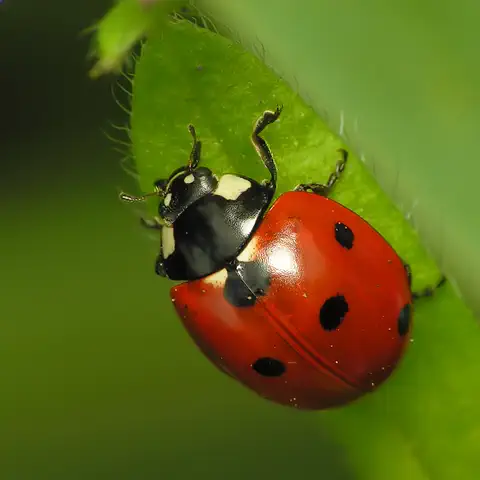 Watch
3D
Animal
Seven-spot ladybird
The seven-spot ladybird, or ladybug, is a domed red beetle with seven black spots. Both the young and the adults hunt aphids, small insects that suck plant juices, so gardeners and farmers are glad to see them. Its bright colors warn predators that it tastes horrible.
- Watch Try it What If? Lab What if bees disappeared? Many fruits and vegetables only grow well when bees and other animals carry pollen between their flowers. In our model farm, turn the pollinators down to zero and watch which harvests shrink, which hardly change, and why wheat, rice and corn don't mind. Then meet the people helping pollinators.
- Watch Try it What If? Lab What if wolves returned to a park? For nearly 70 years, Yellowstone National Park had no wolf packs. In 1995, people brought wolves back. Start with a model park that has no wolves, put the wolves back into its food web, and see what changes for the elk, the willows and the animals that need them. Then find out what scientists in the real park are still working out.
- Watch Try it What If? Lab What if beavers built no dams? Beavers eat willow and aspen, and they also build dams that turn streams into ponds. Take the beaver out of our forest food web and the model finds only one change. Then find out why scientists call beavers nature's engineers, and what a food web leaves out.
- Watch Try it What If? Lab What if orcas left the Southern Ocean? Orcas are apex predators: they eat at the top of the food web. Take them out of our model's Southern Ocean food web and the seals, penguins and fish they eat could become more common, which then changes the food of others. Explore the knock-on effects, and the real orcas that make long trips north.
- Watch What If? Lab What if there were no spiders? Spiders around the world catch an estimated 400 to 800 million tons of prey every year, mostly insects. They also spin some of the toughest materials in nature. Imagine a world with no spiders: what would happen to all those insects, and what would we lose?
- Watch What If? Lab What if mosquitoes disappeared? Nobody enjoys an itchy mosquito bite. But mosquitoes are also food for fish, dragonflies, birds and bats, and some even pollinate flowers. Some kinds can also carry germs that make people sick. Imagine every mosquito gone: what would we gain, what might we lose, and why aren't scientists sure?
- Watch Try it What If? Lab What if an ocean food web changed? Antarctic krill are small shrimp-like animals, but they feed a huge number of bigger ones. Take krill out of our model's Southern Ocean food web and all seven other species are affected: every animal in it loses all its food, from silverfish to orcas.
For parents & teachers
What children will learn
- Insects link plants to many animals in food webs.
- Removing one species can affect others through food-web links, but a simple model shows only part of the story.
- Insects are declining in many places, though the evidence is uneven and some insects are increasing.
- People can help insects with insect-friendly plants, fewer pesticides and community science.
Recommended ages: 7 to 17 · About 15 minutes
Talk about it
- Which animals near your home might eat insects?
- Why might the model say plants do better without insects, when in real life they might do worse?
- Why is it hard for scientists to know exactly how insects are doing?
Try at home or in class
- Lay a white sheet under a bush and gently shake a branch. Count the insects that drop, then let them go.
- Draw a food web of your backyard or a park, with arrows from each food to the animal that eats it, then cross out the insects and see which arrows disappear.
Key vocabulary: insect, food web, trophic cascade, decomposer, community science
Where these facts come from
- Insect decline in the Anthropocene: Death by a thousand cuts (Wagner et al., PNAS 2021) , PubMed Central (US National Library of Medicine)
- Death by 1,000 cuts: Are major insect losses imperiling life on Earth? , Mongabay
- Caterpillars for the Birds , Clemson Cooperative Extension, Home & Garden Information Center
Checked, not yet human-reviewed. Last updated October 23, 2026. Spotted a mistake? Tell us.