Animal
Leopard seal
The leopard seal is a big, spotty seal that lives near Antarctica. It has a huge mouth and swims fast to catch its food.
The leopard seal is a large, slender seal of the icy seas around Antarctica, named for the dark spots on its gray coat. It is a fast, powerful hunter with a big head and long teeth, and it eats everything from tiny krill to fish, penguins and young seals.
Hydrurga leptonyx is a solitary, wide-ranging true seal of the Antarctic pack ice and a top predator of the Southern Ocean. Females are larger than males. Its unusual teeth let it both strain krill and seize large prey, and the IUCN lists it as Least Concern (assessed 2025).
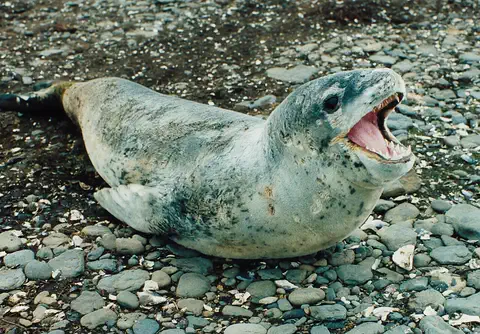
Photo: Papa Lima Whiskey (uploader), CC BY-SA 3.0, via Wikimedia Commons
Meet the leopard seal
The leopard seal is a big seal with dark spots.
Its spots made people think of a leopard. It has a long body, a big head and a very wide mouth.
The leopard seal is named for the dark spots on its gray coat, a bit like a leopard's. It has a long, slender body built for speed, long front flippers and a large head with jaws that open very wide.
In leopard seals, the females are bigger than the males. A typical male is about 2.8 meters long and weighs about 320 kilograms, and a typical female about 3 meters and 370 kilograms. Large females can be over 3.5 meters long and weigh more than 500 kilograms.
Hydrurga leptonyx is a true seal (family Phocidae) named for its spotted coat: dark gray above, silvery gray below and dappled with dark and light spots. The Animal Diversity Web translates its scientific name as 'slender-clawed water-worker'.
The body is long and slender with long foreflippers, and the large head carries a long snout and jaws that open very widely. Females are larger than males: the Australian Antarctic Division gives typical males as 2.8 meters and 320 kilograms and females as 3.0 meters and 370 kilograms, with large females over 3.5 meters and 500 kilograms.
Quick facts
- Group
- Mammal
- Length
- 2.8 to 3.5 m
- Weight
- 320 to 500 kg
- Lifespan in the wild
- up to 30 years
Where it lives
Leopard seals live in the cold seas around Antarctica.
They rest on floating ice. Some swim north to islands far away.
Leopard seals live mostly in and around the pack ice that surrounds Antarctica. They spend much of their time in the water, where they are fast and agile, and haul out on the ice to rest and to give birth.
Some also live on islands north of Antarctica, such as Heard Island, and young leopard seals visit Macquarie Island in winter. They are great wanderers: leopard seals have been seen as far away as Tasmania, and one even turned up at Heron Island on Australia's Great Barrier Reef.
The species is circumpolar in the Antarctic pack ice. The IUCN's 2025 global assessment lists it as resident in Antarctica, southern Chile, Kerguelen, Heard and McDonald Islands and New Zealand's Antipodes Islands, with records of uncertain seasonality at Macquarie Island, the Falklands, Marion Island and South Georgia; vagrants reach Australia, South America and southern Africa.
Small numbers occupy sub-Antarctic islands year-round, with greater dispersal there in winter, when juveniles in particular arrive. The Australian Antarctic Division calls leopard seals perhaps the greatest wanderers of the Antarctic seals, with sightings in Tasmania and a northern record at subtropical Heron Island. Researchers are studying why their visits to Macquarie Island and Tasmania follow a cycle.
Continent

Where can you find this animal?
- Lives here naturally · Countries and seas named by a scientific source
- Sightings recorded · Records of wild sightings (GBIF)
Lives here naturally · Countries and seas named by a scientific source
The pack ice around Antarctica, plus sub-Antarctic islands such as Heard, Kerguelen, Macquarie and South Georgia and the far south of Chile. Wanderers sometimes reach Australia, New Zealand, South America and southern Africa; those countries are not shaded.
Places: Southern Ocean and Antarctica.
Source: iucn-red-list · checked October 2026
Sightings recorded · Records of wild sightings (GBIF)
Counts of GBIF records of wild observations (human and machine) and preserved specimens. Records include introduced populations, vagrants, escaped or released animals and misidentifications, so a country with records is not necessarily part of the native range.
Wild sightings have been recorded in Antarctica, Australia, New Zealand, Fr. Southern Lands, Chile, Falkland Is., Argentina, South Africa and 8 more places.
Source: gbif · checked October 2026
Range maps show where scientists say an animal lives, often country by country. An animal may live in only part of a country shown, and sightings records can include animals that wandered far from home.
An all-round hunter
Leopard seals eat many kinds of food.
They eat tiny krill, fish and squid. They also catch penguins and young seals.
Leopard seals eat almost anything they can catch. Their unusual back teeth have several sharp points, and like crabeater seals, leopard seals can use them to strain tiny krill out of the water. They also eat fish and squid.
They are also big hunters. Leopard seals catch penguins, usually in the water, and they eat the pups of other seals, such as crabeater, Weddell and fur seals. Each leopard seal seems to have its own favorite foods: some wait near penguin colonies, while others prefer young seals.
Leopard seals are generalist predators. Their complex, sharply pointed cheek teeth can strain krill, as in crabeater seals, and ADW describes krill as a primary food. They also take fish, squid and crustaceans, and large prey: penguins and the pups of crabeater, Weddell and southern fur seals.
Penguins are typically chased or seized in the water and shaken until they can be eaten. Diets are highly individual: some seals stay near penguin colonies, others specialize on crabeater seal pups, and some travel north to Heard Island to feed on penguins and seal pups there. One leopard seal caught near Sydney had eaten an adult platypus. As an apex predator, it sits near the top of the Antarctic food web.
Did you know?
Girl leopard seals are bigger than boys.
In leopard seals, the females are bigger than the males, and large females can weigh over 500 kilograms.
Females are the larger sex, reaching over 3.5 meters and 500 kilograms.
Built for speed and big bites
A leopard seal has a long, smooth body for fast swimming.
Its mouth opens very wide. It has long front teeth and bumpy back teeth.
A leopard seal's body is built for speed in the water. Its body is long and slender, and its front flippers are long, which makes it fast and agile when it swims. On the ice it moves much more clumsily.
Its head is large, and its jaws open very wide to show exceptionally long front teeth called canines. Its back teeth are complex, with sharp points, so it can grab big prey or strain krill.
A slender, streamlined body and long foreflippers make the leopard seal fast and agile in water, though it is much less agile on ice. The large head and long snout suit catching and handling prey.
The jaws open widely to reveal exceptionally long canines and unusually complex, sharply pointed molars; Britannica describes three-cusped cheek teeth. These lobodont teeth serve a dual function: seizing large animals and filtering krill. Coloration, dark gray dorsally and silvery below with spots, varies from back to belly. Britannica calls it an earless seal: like other true seals, it has no external ear flaps.
Pups on the ice
A leopard seal mom has one pup on the sea ice.
She feeds it milk for about four weeks. Then the pup is ready to grow up on its own.
Leopard seal mothers give birth to one pup on the sea ice, in late October or November. A newborn pup is about 1.2 meters long and can weigh more than 30 kilograms.
The mother feeds and guards her pup on the ice for about four weeks. After the pup is weaned, the adults mate again in December and early January. Mothers are six years old or more, and leopard seals have been recorded living up to 30 years in the wild.
Because leopard seals are solitary and live in the pack ice, little is known of their breeding biology, and much comes from captive animals. Females aged six or more give birth to a single pup on the ice in late October or November, after a gestation of about nine months; newborns average about 1.2 meters and may exceed 30 kilograms.
The mother alone nurses and protects the pup on an ice floe for about four weeks. Mating follows weaning, in December and early January, and is thought to take place in the water. Males become highly vocal in the breeding season, which is suspected to help attract mates. Recorded wild lifespans reach about 30 years.
A loner of the ice
Leopard seals like to be alone.
In the breeding season, males make lots of calls. Their only enemy in nature is the killer whale.
Leopard seals are loners. They live and hunt on their own, except when mothers are raising pups and when adults meet to mate. During the breeding season, males make lots of sounds, which scientists think help them attract females.
Leopard seals are top predators, near the top of the Antarctic food chain. Their only natural predator is the killer whale. Because they live alone in remote pack ice, scientists still have a lot to learn about them.
Leopard seals are solitary outside the mating and nursing periods; their density on and around the pack ice rises as the mating season approaches and when pups are born. Males vocalize just before and during mating, probably for mate attraction, though little else is known of their communication.
The killer whale is their only regular natural predator; a male elephant seal once killed a leopard seal at Heard Island, but this is thought to be rare. The Australian Antarctic Division studies their movements in the pack ice zone to learn more about this little-known species.
Did you know?
Each leopard seal has its own favorite food.
Some leopard seals hang around penguin colonies, while others prefer to hunt young seals.
Diets are highly individual: some specialize on penguins near colonies, others on crabeater seal pups.
A future on the ice
There are lots of leopard seals.
They need sea ice to rest and to have their babies. Scientists study the seals and the ice.
Leopard seals are not endangered. Scientists list them as Least Concern and estimate that there are tens of thousands of adults.
But leopard seals depend on the Antarctic pack ice, where they rest and have their pups. Scientists think that changes to their ice habitat as the climate changes could affect them. Other concerns include litter in the ocean, disease and disturbance by people. Scientists keep studying leopard seals to understand how they are doing.
The IUCN's 2026 global assessment (assessed in December 2025) lists Hydrurga leptonyx as Least Concern, with an estimated 25,000 to 79,000 mature individuals and an unknown trend; it notes threats including habitat shifting with climate change, fishing, recreational disturbance, disease, invasive species and garbage. ADW notes that a decline in Antarctic pack ice is likely to affect the species.
There is little direct interaction between people and leopard seals, which have no commercial importance. Because the species is solitary and lives in remote pack ice, much of its biology is still poorly known, and the Australian Antarctic Division continues to study its movements and its cyclic visits to Macquarie Island and Tasmania.
IUCN Red List
How is the leopard seal doing in the wild?
- Least Concern (this animal)
- Near Threatened
- Vulnerable
- Endangered
- Critically Endangered
- Extinct in the Wild
- Extinct
Least Concern
Not at risk of disappearing from the wild right now.
See the IUCN Red List assessment · The IUCN Red List of Threatened Species 2022.2
Amazing facts
-
Leopard seals can eat tiny krill and big penguins.
A leopard seal's back teeth work like a sieve for tiny krill, while its long front teeth catch big prey like penguins.
Lobodont cheek teeth filter krill, while the leopard seal also takes large prey such as penguins and seal pups.
-
One leopard seal swam all the way to a warm coral reef.
Leopard seals are great wanderers. One was even seen at Heron Island on Australia's Great Barrier Reef.
The Australian Antarctic Division cites a northern record from subtropical Heron Island, in the southern Great Barrier Reef.
-
Girl leopard seals are bigger than boys.
In leopard seals, the females are bigger than the males, and large females can weigh over 500 kilograms.
Females are the larger sex, reaching over 3.5 meters and 500 kilograms.
-
Each leopard seal has its own favorite food.
Some leopard seals hang around penguin colonies, while others prefer to hunt young seals.
Diets are highly individual: some specialize on penguins near colonies, others on crabeater seal pups.
Words to know
- pack ice
- large pieces of sea ice floating close together
- predator
- an animal that hunts other animals for food
- krill
- small shrimp-like animals that live in the ocean
- canine
- a long, pointed tooth near the front of the mouth
- pup
- a baby seal
- solitary
- living alone
Discovery challenge
-
Why is it called a leopard seal?
What gives the leopard seal its name?
Which feature is the leopard seal named for?
- Its spots
- Its loud roar
- Its long tail
Show the answer
Its spots
It has spots, like a leopard.
It is named for the dark spots on its gray coat.
Its black-spotted gray coat.
-
Where do leopard seals live?
Where do most leopard seals live?
Which habitat holds most of the leopard seal population?
- Around Antarctica
- In hot deserts
- In mountain lakes
Show the answer
Around Antarctica
They live in the icy sea around Antarctica.
Most live in and around the pack ice that surrounds Antarctica.
The circumpolar Antarctic pack ice, with smaller numbers on sub-Antarctic islands.
-
What can a leopard seal's back teeth do?
How do leopard seals catch tiny krill?
Leopard seals also catch large prey, but what do they use their sharply pointed cheek teeth for?
- Strain krill from the water like a sieve
- Chew grass
- Dig holes in the ice
Show the answer
Strain krill from the water like a sieve
They work like a sieve for tiny krill.
Their pointed back teeth can strain krill from the water.
Sharply pointed cheek teeth filter krill, while the seal also seizes large prey such as penguins.
-
Which animal hunts leopard seals?
What is the leopard seal's only natural predator?
Which species is the leopard seal's only regular natural predator?
- The killer whale
- The penguin
- The krill
Show the answer
The killer whale
Only killer whales hunt leopard seals.
The killer whale is its only natural predator.
The killer whale; an elephant seal kill at Heard Island is thought to be rare.
Experiments to try
Explore next
-
 Watch
Animal
Emperor penguin
The emperor penguin is the largest penguin in the world. It lives around Antarctica, and it is the only animal that breeds during the dark, freezing Antarctic winter. Fathers keep the egg warm on their feet for about two months, huddled together against the storms.
-
 Watch
3D
Animal
Antarctic krill
Antarctic krill are small, shrimp-like crustaceans about 6 centimeters long that live in the icy Southern Ocean around Antarctica. They gather in enormous swarms, and almost all the bigger animals of the Antarctic, from penguins to blue whales, depend on them for food.
-
 Watch
3D
Animal
Harbor seal
The harbor seal lives along the northern coasts of North America, Europe and Asia, and it is one of the most common marine mammals on the east and west coasts of the United States. It has spotted fur, a dog-like face and no ear flaps, and it wriggles like a caterpillar on land. Its pups can swim within minutes of being born.
-
 Watch
3D
Animal
Orca
The orca, also called the killer whale, is the largest member of the dolphin family and the ocean's top predator. Orcas live in every ocean, in close family groups called pods, made up of orcas related through their mothers. Each group has its own favorite foods, hunting tricks and even its own calls, which young orcas learn from their families.
-
 Watch
3D
Animal
King penguin
The king penguin is the second-largest penguin in the world. It lives in huge, noisy colonies on windy islands in the Southern Ocean and dives deep to catch lantern fish. Its babies grow a thick coat of brown fluff and take more than a year to raise.
- Watch Try it What If? Lab What if orcas left the Southern Ocean? Orcas are apex predators: they eat at the top of the food web. Take them out of our model's Southern Ocean food web and the seals, penguins and fish they eat could become more common, which then changes the food of others. Explore the knock-on effects, and the real orcas that make long trips north.
-
 Watch
Animal
Chinstrap penguin
The chinstrap penguin is named for the thin black band that runs under its chin from ear to ear, like a helmet strap. It breeds in huge colonies on the Antarctic Peninsula and nearby islands, raises two chicks each summer and dives for krill close to shore.
-
 Watch
Animal
Adélie penguin
The Adélie penguin is a medium-sized penguin, about 70 centimeters tall, with a black back, a white front and a bright white ring around each eye. It breeds in summer on rocky, ice-free ground all around Antarctica, building nests of pebbles, and spends the winter far out at sea among the pack ice.
For parents & teachers
What children will learn
- Describe how the leopard seal's body and teeth suit it for hunting.
- Explain how one predator can eat both tiny krill and large prey.
- Describe the leopard seal's life on and around Antarctic pack ice.
- Understand why sea ice matters for leopard seals.
Recommended ages: 3 to 17 · About 12 minutes
Talk about it
- Why might it help an animal to be able to eat many different foods?
- How might changes to sea ice affect animals that give birth on it?
- Why is it hard for scientists to study animals that live alone in remote places?
Try at home or in class
- Spread your fingers and scoop rice from a bowl of water to see how a row of points can strain food, a bit like a leopard seal's teeth.
- Measure 3.5 meters on the floor to see how long a large female leopard seal can be.
Key vocabulary: pack ice, predator, krill, canine, pup, solitary
Where these facts come from
- The IUCN Red List of Threatened Species , International Union for Conservation of Nature (IUCN terms of use (no redistribution of Red List data or range maps))
- GBIF Backbone Taxonomy and GBIF Occurrence Search , Global Biodiversity Information Facility (CC0 1.0 (backbone); occurrence counts are facts derived from records under CC0, CC BY and CC BY-NC)
- Leopard seal , Australian Antarctic Division
- Hydrurga leptonyx (leopard seal) , Animal Diversity Web, University of Michigan Museum of Zoology
- Leopard seal , Encyclopaedia Britannica
- Hydrurga leptonyx (Leopard Seal), 2026 global assessment , IUCN Red List of Threatened Species
- Wikidata , Wikimedia Foundation (CC0 1.0)
- Wikimedia Commons , Wikimedia Foundation (Per file: Public domain, CC0, CC BY or CC BY-SA only (credited on each page))
Checked, not yet human-reviewed. Last updated October 24, 2026. Spotted a mistake? Tell us.