
What If? Lab
What if sharks disappeared?
Sharks are big hunters of the sea. What if there were no sharks at all? Let's follow the story with Olly!
Sharks catch and eat other sea animals, and just having them around changes where those animals go. Follow what scientists have found in Australia's Shark Bay seagrass meadows and on coral reefs, where the evidence is still debated, and how some shark populations are recovering.
Large sharks can shape ecosystems through what they eat and through fear: prey change where and how they feed. Shark Bay research links tiger sharks to seagrass patterns via dugongs and green turtles; on reefs, evidence for shark-driven cascades is contested. Oceanic sharks and rays declined 71% since 1970 (Pacoureau et al. 2021).
The big question
Sharks live in oceans all over the world. Many sharks catch and eat other sea animals.
What if all the sharks were gone? Would the other sea animals notice?
There are many kinds of sharks, from small reef sharks to great white sharks. NOAA says the great white shark is an apex predator: it eats at the top of the food chain and plays an important part in the ocean.
So what would happen if sharks disappeared? Would their prey simply grow in number, or would other things change too? In this thought experiment you can follow real studies from seagrass meadows and coral reefs, and see where scientists agree and where they are still arguing.
Large sharks are often described as apex predators, and NOAA calls the white shark one, with an important ecological role. Predators can affect ecosystems two ways: by eating prey (consumptive effects) and by changing prey behavior through risk (non-consumptive effects).
This thought experiment follows field research rather than a model. It asks what the evidence says about losing sharks in two settings, a subtropical seagrass bay and remote coral reefs, and notes where conclusions are firm, suggestive or disputed.
Explore the idea
Make a prediction
When tiger sharks are near, what do dugongs and turtles do?
In Shark Bay, what do dugongs and green turtles do when tiger sharks are around?
How do Shark Bay's large grazers respond to the presence of tiger sharks?
- They graze in safer spots
- They stop eating for good
- They chase the sharks away
-
Established fact
When sharks are near, many sea animals change where they go.
Just having tiger sharks around changes where dugongs, turtles, dolphins and seabirds feed in Shark Bay.
Non-consumptive (risk) effects of tiger sharks alter habitat use of several Shark Bay species (FIU SBERP).
-
Established fact
Scientists do not all agree about sharks on coral reefs.
Studies of coral reefs disagree about how much sharks shape the fish and corals there.
Reef evidence is contested: atoll comparisons suggest mesopredator release with shark loss; a 2016 review finds coral-benefiting cascades weakly supported.
-
An idea scientists discuss
A sea without sharks might be different in surprising ways.
Losing sharks might change seagrass meadows and some reefs in ways that are hard to predict.
Losing sharks might reorganize some ecosystems through both predation and risk pathways; outcomes likely differ by place and are not precisely predictable.
-
Established fact
Great white sharks are top hunters in the sea.
The great white shark is an apex predator, at the top of the food chain, and plays an important part in the ocean.
NOAA describes the white shark as an apex predator with an important ecological role, made vulnerable by low productivity.
-
Established fact
There are far fewer ocean sharks than there used to be.
Since 1970, the number of ocean-roaming sharks and rays has fallen by 71 percent, mostly because of fishing.
Global abundance of oceanic sharks and rays fell 71% since 1970 with an 18-fold rise in relative fishing pressure (Pacoureau et al., Nature 2021).
-
Established fact
When tiger sharks are near, dugongs and turtles move to safer spots.
Dolphins, dugongs, sea turtles and cormorants in Shark Bay all change where they go when tiger sharks are around.
Shark Bay dolphins, dugongs, sea turtles and cormorants modify habitat use in the presence of tiger sharks, and dugongs change how they forage (FIU Shark Bay Ecosystem Research Project).
-
Established fact
Sharks seem to change the seagrass by changing where grazers eat.
Experiments with underwater fences suggest that tiger sharks affect seagrass by changing when, where and how green turtles and dugongs feed.
Exclosure results suggest tiger sharks influence seagrass through grazers, and possibly through a second pathway via dolphins, small fish and seagrass (FIU SBERP).
-
An idea scientists discuss
Without sharks, the seagrass might be eaten in new places.
The researchers think seagrass beds might be very different if tiger sharks were lost.
The Shark Bay team suggests seagrass beds might be very different without sharks; the size and direction of the change elsewhere are not known.
-
Established fact
Reefs with fewer sharks had more middle-sized hunting fish.
Fished reefs with fewer sharks had more mid-sized hunting fish and, after storms and bleaching, fewer plant-eating fish than protected reefs.
Fished Scott Reefs had about a third of the reef sharks of the protected Rowley Shoals, more mid-sized carnivores and, after disturbance, fewer herbivores (Ruppert et al., PLoS ONE 2013).
-
Established fact
Some scientists think reef sharks are not the very top hunters.
A 2016 review found that most reef sharks act as middle hunters alongside many reef fish, and that the evidence for sharks protecting corals is weak.
Roff et al. (Trends in Ecology and Evolution, 2016): most reef-associated sharks function as mesopredators; evidence for shark-driven cascades benefiting corals is weak and equivocal.
-
An idea scientists discuss
Without sharks, some reefs might have fewer plant-eating fish.
Without sharks, some reefs might end up with more mid-sized hunters and fewer plant-eating fish, which help corals recover after damage.
Shark loss might contribute to mesopredator release and fewer herbivores, which matter for coral recovery; given the debate, this is a possibility, not a settled outcome.
-
Established fact
Great white sharks take many years to grow up.
Male great white sharks mature at about 26 years old and females at about 33, which makes them slow to recover.
White sharks mature at about 26 (males) and 33 (females) years; NOAA cites this low productivity as a reason for their vulnerability.
-
Established fact
Some great white sharks are coming back.
Great white shark numbers in the northwest Atlantic have been increasing since rules to protect them began in the 1990s.
NOAA research indicates rising northwest Atlantic white shark abundance trends since protections in the 1990s, and the northeastern Pacific population appears to be increasing.
Sharks in the sea today
Sharks have been in trouble. People caught many of them.
Some kinds of sharks are now protected, and some are coming back.
Many sharks have become much rarer. A big study published in 2021 found that the number of ocean-roaming sharks and rays fell by 71 percent since 1970, mostly because fishing grew much heavier.
Many sharks grow slowly, which makes them vulnerable. NOAA says male great white sharks take about 26 years to grow up, and females about 33. But protection can help: NOAA reports that great white shark numbers in the northwest Atlantic have been rising since rules protecting them began in the 1990s.
Pacoureau and colleagues (Nature, 2021) combined 57 abundance time series for 18 oceanic shark and ray species and found a 71% decline in global abundance since 1970, driven by an 18-fold increase in relative fishing pressure; three-quarters of the 31 oceanic species are now threatened with extinction.
Low productivity makes many sharks vulnerable: NOAA lists the white shark's slow growth, with maturity at about 26 years for males and 33 for females. NOAA also reports rising abundance trends in the northwest Atlantic since protective regulations in the 1990s, and a northeastern Pacific population that appears to be increasing.
Imagine no sharks
Without sharks, turtles and dugongs might eat seagrass anywhere they like.
That could change the underwater meadows where they graze.
In Shark Bay, Australia, scientists found that when tiger sharks are around, dugongs and green turtles avoid the risky shallow middle of seagrass banks and graze near the edges instead. Their experiments suggest that this changes the seagrass itself.
So without tiger sharks, the grazers might feed everywhere, and the meadows might look very different. On coral reefs the story is less clear: one study linked fewer sharks to more mid-sized fish hunters and fewer plant-eating fish, but other scientists say the evidence that reef sharks protect corals is weak.
Two lines of evidence frame the question. In Shark Bay, the Shark Bay Ecosystem Research Project found that dugongs, green turtles, dolphins and cormorants shift habitat use when tiger sharks are present, and exclosure experiments suggest tiger sharks influence seagrass by changing when, where and how grazers feed.
On reefs, Ruppert and colleagues (2013) found reef sharks about three times as abundant on protected atolls as on fished ones, with more mid-sized carnivores and, after disturbance, fewer herbivores on the fished reefs: evidence consistent with mesopredator release. Roff and colleagues (2016) countered that most reef sharks act as mesopredators and that support for coral-benefiting cascades is weak and equivocal.
Why a hunter matters
Animals stay away from places where sharks hunt. So sharks change where other animals eat.
That can help plants and corals in some places.
A predator can change an ecosystem in two ways. It eats some animals, and it scares others into changing where they go. In Shark Bay, the fear of tiger sharks seems to matter a lot: grazers crowd into safer spots, leaving other parts of the meadow less grazed.
The chain can even reach animals sharks rarely eat. Dolphins in Shark Bay almost completely leave their best shallow feeding grounds when large tiger sharks arrive. Scientists call these chains of effects trophic cascades.
Risk effects can rival direct predation. When large tiger sharks (over 3.5 m) are present, Shark Bay dugongs and green turtles concentrate on bank edges; seagrass there has lower nutritional quality than in bank middles that grazers largely abandon. A second pathway runs through dolphins and cormorants that eat small seagrass-grazing fish, so tiger sharks may affect seagrass through both.
On reefs, many fish share the middle predator level with sharks, which may blunt any single species' effect. That is one reason scientists disagree, and why the outcome of losing sharks is uncertain rather than a single, predictable chain.
What scientists are learning
Scientists watch sharks, turtles and dugongs in Shark Bay, Australia. They learn how all the animals are linked.
They are still finding out what sharks do on coral reefs.
Researchers in Shark Bay built underwater fences that let fish in but kept dugongs and turtles out, then compared the seagrass inside and outside. They kept the experiment going for almost three years, cleaning the cages almost every week. Their results suggest that seagrass beds might be very different if the sharks were lost.
On coral reefs, scientists are still debating. That is how science works: different studies are compared until the evidence becomes clearer. Meanwhile, some shark populations, like great whites in the northwest Atlantic, have been increasing since they were protected.
The Shark Bay team maintained 2.5 × 3.0 m exclosures and paired controls for almost three years, then added fish-proof cages and transplanted seagrass to separate large and small grazers. They found fish to be important grazers in bank middles, and concluded that seagrass beds might be very different without sharks.
For reefs, the 2013 atoll comparison and the 2016 review reach different emphases; the authors' published exchange shows an active debate. Trends in some protected populations, such as northwest Atlantic white sharks, are rising, while the 2021 study found that oceanic sharks and rays overall declined by 71% since 1970.
Amazing facts
-
Great white sharks are a little bit warm-blooded.
Great white sharks can keep parts of their bodies warmer than the water around them.
The white shark is regionally endothermic, maintaining internal temperatures above ambient water, which lets it stay active in cooler seas (NOAA).
-
A baby great white shark is about 4 feet long.
A great white shark is born about 4 feet long and can grow to about 20 feet.
White sharks are born at about 4 ft and can reach about 20 ft and over 4,000 lb (NOAA).
-
Scientists cleaned their underwater cages almost every week.
In Shark Bay, scientists' seagrass cages needed cleaning almost every week, and storms and currents wrecked their first ones.
Shark Bay exclosures had to be cleaned almost weekly; early deep-water cages were destroyed by strong currents and shallow ones damaged by storms (FIU SBERP).
Words to know
- apex predator
- a hunter at the top of a food chain
- mesopredator
- a middle-sized hunter that is also hunted by bigger animals
- seagrass
- flowering plants that grow in meadows under shallow seawater
- grazer
- an animal that feeds on plants or seagrass
- trophic cascade
- a chain of effects passed down a food web
- exclosure
- a fence or cage that keeps certain animals out of an area so scientists can compare
Discovery challenge
-
When tiger sharks are near, where do dugongs and turtles eat?
In Shark Bay, what do dugongs and green turtles do when tiger sharks are around?
How do large grazers in Shark Bay respond to tiger shark presence?
- In safer spots, like the edges of seagrass banks
- Right in the middle of the risky shallows
- They stop eating forever
Show the answer
In safer spots, like the edges of seagrass banks
They eat in safer spots.
They graze near the safer edges of the seagrass banks.
They concentrate on bank edges, leaving bank middles lightly grazed.
-
Have ocean sharks become more or fewer since 1970?
By how much did ocean-roaming sharks and rays decline between 1970 and the 2021 study?
What decline in oceanic shark and ray abundance did Pacoureau et al. (2021) estimate since 1970?
- They fell by about 71 percent
- They doubled
- They stayed the same
Show the answer
They fell by about 71 percent
Fewer. There are far fewer now.
About 71 percent, mainly because of much heavier fishing.
71%, with an 18-fold rise in relative fishing pressure.
-
Do all scientists agree about sharks on coral reefs?
What do scientists say about sharks protecting coral reefs?
Which best describes the state of evidence for shark-driven cascades on coral reefs?
- They are still debating it
- They all agree sharks save every reef
- Sharks never live on reefs
Show the answer
They are still debating it
No. They are still finding out.
Some studies suggest an effect, but a 2016 review found the evidence weak.
Contested: suggestive atoll comparisons versus a review finding weak, equivocal support.
-
Do great white sharks grow up fast or slowly?
About how old are female great white sharks when they mature?
What age at maturity does NOAA give for female white sharks?
- About 33 years
- About 1 year
- About 5 years
Show the answer
About 33 years
Slowly! It takes many years.
About 33 years; males about 26.
About 33 years (males about 26), part of their low productivity.
Experiments to try
- Watch What If? Lab What if there were no ocean currents? Ocean currents are like rivers in the sea. They carry warm water away from the equator and cold water away from the poles, and some lift food-rich water up from the deep. Imagine them stopping: follow the Gulf Stream, warm and cold coasts, and the rich fishing waters fed by upwelling.
- Watch What If? Lab What if the sea were not salty? Rain and rivers wash tiny bits of salt out of rocks and carry them to the sea, where they build up. Imagine a sea with no salt: most sea creatures are built for salty water, sea ice would form differently, and deep ocean currents would lose one of their pushes.
- Watch Try it What If? Lab What if orcas left the Southern Ocean? Orcas are apex predators: they eat at the top of the food web. Take them out of our model's Southern Ocean food web and the seals, penguins and fish they eat could become more common, which then changes the food of others. Explore the knock-on effects, and the real orcas that make long trips north.
- Watch What If? Lab What if whales returned to every ocean? Hunting in the last century took away most of the world's great whales, and since a 1985 ban on commercial whaling many are growing in number again. Whale poop feeds the tiny drifting plants at the base of the ocean food web, and whale bodies carry carbon to the deep sea. Imagine whales back in every ocean and follow what they might do.
Explore next
-
 Watch
3D
Animal
Tiger shark
The tiger shark is one of the biggest sharks in the sea. Young tiger sharks have dark spots and stripes like a tiger, which fade as they grow. It eats an amazing range of food, and it travels long distances between warm and cooler seas.
-
 Watch
3D
Animal
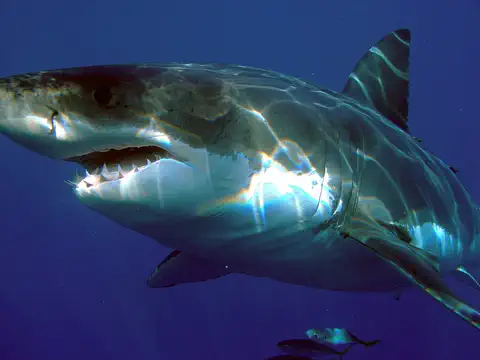
Great white shark
The great white shark is the largest of the mackerel sharks: a strong, torpedo-shaped fish with a gray back and a white belly. It hunts fish, seals and sea lions, and it is partly warm-blooded, which helps it stay active in cool water.
- Watch What If? Lab What if there were no ocean currents? Ocean currents are like rivers in the sea. They carry warm water away from the equator and cold water away from the poles, and some lift food-rich water up from the deep. Imagine them stopping: follow the Gulf Stream, warm and cold coasts, and the rich fishing waters fed by upwelling.
- Watch What If? Lab What if the sea were not salty? Rain and rivers wash tiny bits of salt out of rocks and carry them to the sea, where they build up. Imagine a sea with no salt: most sea creatures are built for salty water, sea ice would form differently, and deep ocean currents would lose one of their pushes.
- Watch Try it What If? Lab What if orcas left the Southern Ocean? Orcas are apex predators: they eat at the top of the food web. Take them out of our model's Southern Ocean food web and the seals, penguins and fish they eat could become more common, which then changes the food of others. Explore the knock-on effects, and the real orcas that make long trips north.
- Watch What If? Lab What if whales returned to every ocean? Hunting in the last century took away most of the world's great whales, and since a 1985 ban on commercial whaling many are growing in number again. Whale poop feeds the tiny drifting plants at the base of the ocean food web, and whale bodies carry carbon to the deep sea. Imagine whales back in every ocean and follow what they might do.
- Watch Try it What If? Lab What if a coast were made of hard rock? Waves wear coasts away, but not every coast wears at the same speed. In our model, a bare sandy island facing ordinary waves keeps about 72 percent of its land after 50 model years. Make the same island of hard rock and it keeps about 99 percent. That is why hard rock is often left sticking out to sea as headlands.
- Watch Try it What If? Lab What if all the sea ice melted? Sea ice floats, so it is already pushing aside about as much water as it will make when it melts, like an ice cube in a glass. In our model, melting all the Arctic's springtime sea ice raises the sea by only about 2 millimeters. The same ice melting on land would raise it about 7 centimeters.
For parents & teachers
What children will learn
- Predators affect ecosystems both by eating prey and by changing where prey feel safe to feed.
- In Shark Bay, Australia, tiger sharks appear to shape seagrass meadows through the behavior of grazers.
- Scientists still debate how much reef sharks shape coral reefs, which shows how science weighs evidence.
- Many ocean sharks have declined sharply, and some protected populations are increasing.
Recommended ages: 7 to 17 · About 15 minutes
Talk about it
- How can an animal change an ecosystem without eating anything?
- Why might the role of sharks be different in a seagrass bay and on a coral reef?
- Why do you think sharks take so long to recover when their numbers fall?
Try at home or in class
- Play 'safe zones': mark a 'risky' middle and 'safe' edges on a playground. Grazers collect paper 'seagrass' and can only be tagged in the middle. Afterwards, where was the most seagrass left?
- Draw two pictures of a seagrass meadow, one with tiger sharks around and one without, showing where dugongs and turtles might graze in each.
Key vocabulary: apex predator, mesopredator, seagrass, grazer, trophic cascade, exclosure
Where these facts come from
- White Shark , NOAA Fisheries
- Half a century of global decline in oceanic sharks and rays (Pacoureau et al., Nature 2021) , Nature
- Research Projects: Indirect Effects of Tiger Sharks , Shark Bay Ecosystem Research Project, Florida International University
- Caught in the Middle: Combined Impacts of Shark Removal and Coral Loss on the Fish Communities of Coral Reefs (Ruppert et al., 2013) , PLoS ONE
- The Ecological Role of Sharks on Coral Reefs (Roff et al., 2016) , Trends in Ecology and Evolution, via PubMed
Checked, not yet human-reviewed. Last updated October 26, 2026. Spotted a mistake? Tell us.
Picture credits
- Photo: Albert kok, CC BY-SA 3.0, via Wikimedia Commons · source · license
- Photo: P.Lindgren, CC BY-SA 3.0, via Wikimedia Commons · source · license
- Photo: Chris Chucholl, CC BY 4.0, via Wikimedia Commons · source · license
- Photo: Charles J. Sharp, CC BY-SA 4.0, via Wikimedia Commons · source · license
- Photo: Florida Keys National Marine Sanctuary Staff, public domain, via Wikimedia Commons · source
- Photo: Horizon Charters, CC BY-SA 4.0, via Wikimedia Commons · source · license