
City Europe
Bergen
Bergen is a city in Norway, between the sea and the mountains. It has old wooden houses by the harbor, and it rains a lot!
Bergen is Norway's second-largest city, on the west coast between a fjord and seven hills. It was founded in 1070 and became an important trading port: its old harbor district, Bryggen, is a UNESCO World Heritage Site. On 1 January 2026, 294,860 people lived in Bergen.
Bergen, founded in 1070 at the head of the Byfjord, was around 1300 the most important city in Scandinavia (Universalis) and from 1350 the seat of a Hanseatic Office that controlled the stockfish trade. Its wooden Bryggen district, rebuilt after the fire of 1702, has been on the World Heritage List since 1979. Statistics Norway: 294,860 people on 1 January 2026.
Photo: W. Bulach, CC BY-SA 4.0, via Wikimedia Commons
Discover Bergen
Bergen is a city in Norway. It sits by the sea, with hills and mountains all around.
Only Oslo has more people in Norway.
Bergen lies on the west coast of Norway, at the end of a fjord called the Byfjord, Universalis says. Like Rome, it is known as a city of seven hills: houses fill a narrow strip of flat land by the water and climb the slopes behind it. Its old name, Bjorgvin, means 'the meadow among the mountains'.
On 1 January 2026, 294,860 people lived in Bergen, according to Statistics Norway. Only Oslo, with 728,714, has more.
Statistics Norway (via City Population): Bergen municipality 207,922 (1 January 1986), 229,496 (2000), 267,950 (2013), 283,929 (2020) and 294,860 (1 January 2026), rank 2 after Oslo (728,714), ahead of Trondheim (218,460).
Universalis: as the etymology says (bjorgvin, the meadow in the middle of the mountains), Bergen, like Rome, is a city of seven hills; at the head of the Byfjord in a mountainous region of southwest Norway, it is packed onto a narrow platform surrounded by water and onto the hillsides that come down to the sea.
- Country
- Norway (second-largest city)
- People in Bergen (estimate, 1 January 2026)
- 294,860
- Setting
- at the head of the Byfjord, among seven hills
- Old name
- Bjorgvin, 'the meadow among the mountains'
A lake, a fountain and a mountain
Look at the fountain splashing in the lake! Behind the buildings is a big green mountain with a tall mast on top.
This photo was taken on 31 May 2016, looking across a lake in the center of Bergen. A fountain sprays on the right. Along the shore are lawns, trees and buildings, from a building with a red roof to modern office blocks.
Behind them rises a green mountain with a tall mast on its top. Bergen's old harbor district, Bryggen, with its rows of wooden houses by the harbor, is about 0.6 kilometers north of the city's center point on Wikidata.
Commons: '00 4400 View over the store Lungegårdsvann - Bergen (Norway)', 31 May 2016, own work by W. Bulach, CC BY-SA 4.0.
In the picture: a lake with a multi-jet fountain and gulls; a lawn and trees along the shore; a building with a red tiled roof; a glass-fronted tower block; a long white building at right; houses on a wooded slope at left with a yellow crane; a green mountain with a mast on its summit.
- Photo
- a lake in the city center with Bergen's buildings and a mountain behind, 31 May 2016
- Bryggen
- Hanseatic wharf buildings, about 0.6 km north of the city's Wikidata point; on the World Heritage List since 1979
- Fløibanen
- a funicular railway, opened 15 January 1918 (Wikidata)
A Hanseatic trading city
Long ago, ships came to Bergen to trade dried fish. The traders lived and worked in wooden houses by the harbor.
Bergen was founded in 1070 by Olaf Kyrre, Universalis says, and grew fast. Around 1300 it had about 6,000 people and was the most important city in Scandinavia.
In 1350 the Hanseatic League opened an office in Bergen, UNESCO says. Its German merchants controlled the trade in stockfish, dried fish from northern Norway. Their harbor district, Bryggen, burned many times and was rebuilt each time; its look today dates from the time after the fire of 1702.
Universalis: founded in 1070 by Olaf Kyrre, Bergen quickly became one of the country's main towns and, around 1300, with about 6,000 inhabitants, the most important city of Scandinavia; it became a Hanseatic trading post that dominated its economy until the 16th century, when the Dutch took over; its wealth rested on the fish of northern Norway, and until about 1830 it remained the country's most important city.
UNESCO (Bryggen, 59): established as a trade center by the 12th century; Hanseatic Office from 1350, controlling the stockfish trade through privileges granted by the Crown; Bryggen is the only one of the League's four overseas offices preserved; its appearance stems from the time after the 1702 fire; some 62 buildings remain, in rows of two- to three-story wooden 'gårds' along narrow passages. Inscribed 1979, criterion (iii).
- Founded
- 1070, by Olaf Kyrre
- Hanseatic Office
- from 1350; controlled the stockfish trade from northern Norway
- Bryggen today
- about 62 wooden buildings, rebuilt after the fire of 1702
Funicular, harbor and airport
In Bergen, a train pulled by a cable climbs a slope. Boats sail from the harbor.
Bergen is an important port for trade, fishing and passengers, Universalis says.
A funicular railway, Fløibanen, opened on 15 January 1918 according to Wikidata; its point is about 0.5 kilometers north-northeast of the city's center point. Bergen Airport lies about 12 kilometers south-southwest; it opened on 18 June 1954.
Universalis: an important port for trade, fishing and passengers.
Wikidata (from the city's point, Q26793): Lille Lungegårdsvannet (Q1777601), a lake, 0.36 km SE; Fløibanen (Q117767), a funicular railway, official opening 15 January 1918, 0.51 km NNE; Bryggen (Q153430) 0.56 km N; Fløyen (Q1420616), a mountain, 1.38 km ENE; Ulriken (Q386192), a mountain, 643 m, 3.87 km ESE; Bergen Airport (Q619980), official opening 18 June 1954, 12.43 km SSW.
- Fløibanen
- a funicular, about 0.5 km north-northeast of the city's Wikidata point, opened 15 January 1918 (Wikidata)
- Port
- a port for trade, fishing and passengers
- Bergen Airport
- about 12 km south-southwest of the city's Wikidata point; opened 18 June 1954 (Wikidata)
Mild, and very wet
It rains a lot in Bergen, in every month of the year. Winters are cool and summers are mild.
The World Meteorological Organization's averages for 1961 to 1990 show a mild but very wet city. Average daily highs go from 3.6 °C in January to 17.6 °C in July, and average lows stay near or above freezing even in winter.
About 2,250 millimeters of rain fall in a year, on about 235 days. September is the wettest month, with 283 millimeters, and even the driest, May, gets 106.
WMO World Weather Information Service, Bergen (60.38° N, 5.33° E), 1961–1990: mean daily maximum 3.6 °C (January) to 17.6 °C (July); mean daily minimum -0.5 °C (February) to 11.6 °C (August). Rainfall sums to 2,250 mm; September (283 mm), October (271 mm) and November (259 mm) are the wettest months and May (106 mm) the driest; 235 days a year with at least 0.1 mm.
The WMO table for Oslo, on the other side of Norway, has colder winters (January average low -6.8 °C).
- Average daily highs (WMO, 1961–1990)
- 3.6 °C (January) to 17.6 °C (July)
- Average daily lows (same normals)
- -0.5 °C (February) to 11.6 °C (August)
- Rain in a year (sum of the monthly normals)
- about 2,250 mm, on about 235 days
Ships, factories, music and books
A composer, Edvard Grieg, was born in Bergen. A composer writes music. Many visitors come to see the old wooden houses.
Bergen has many kinds of work, Universalis says: its port, factories that build ships and make chemicals, machines, cloth and food, and its role as a center of culture and tourism.
Fires have burned parts of the city many times, but many old places survive, such as Bergenhus. Bergen is the birthplace of the writer Ludvig Holberg and the composer Edvard Grieg.
Universalis: activities are many: an important port for trade, fishing and passengers; varied industries (shipbuilding, chemicals, electromechanics, textiles, canneries, food); a cultural and tourist center. Despite the fires that devastated the city many times, many remains of its history survive (Bergenhus). Bergen is the birthplace of the writer Ludvig Holberg and the composer Edvard Grieg. In 2008 it was, with 240,000 inhabitants, the country's second urban area.
- Industries
- shipbuilding, chemicals, electrical machinery, textiles, canneries, food
- Born in Bergen
- the writer Ludvig Holberg and the composer Edvard Grieg
- Old remains
- many survive despite repeated fires, such as Bergenhus
Bergen on the map
Find Norway on the globe, in the north of Europe. Bergen is on its west coast, by the sea.
Bergen lies at about 60.4° north, on the west coast of Norway, in Vestland county.
Measured from the city's center point on Wikidata, Bryggen is about 0.6 kilometers north, the mountain Fløyen about 1.4 kilometers east-northeast, the mountain Ulriken about 3.9 kilometers east-southeast, and Bergen Airport about 12 kilometers south-southwest.
Bergen lies at about 60.39° N and 5.32° E (Natural Earth point, close to the Wikidata point). From the Wikidata point (Q26793): Lille Lungegårdsvannet 0.36 km SE; Fløibanen 0.51 km NNE; Bryggen 0.56 km N; Fløyen 1.38 km ENE; Ulriken 3.87 km ESE; Bergen Airport 12.43 km SSW. The photo's recorded position is 1.11 km SE of the Natural Earth point.
City Population lists Bergen in Vestland (incl. Hordaland and Sogn og Fjordane).
- Latitude
- about 60.4° north
- Longitude
- about 5.3° east
- Region
- southwest Norway, Vestland county
Amazing facts
-
Bergen's old name means 'the meadow among the mountains'.
Bergen's old name, Bjorgvin, means 'the meadow among the mountains', Universalis says.
Universalis: bjorgvin, the meadow in the middle of the mountains.
-
Long ago, Bergen's traders sold dried fish called stockfish.
Hanseatic merchants in Bergen controlled the trade in stockfish, dried fish from northern Norway, UNESCO says.
UNESCO: the Hanseatic League gradually acquired Bryggen and controlled the stockfish trade from northern Norway through privileges granted by the Crown.
-
Even in May, the driest month, it rains a lot in Bergen.
In the WMO averages for 1961 to 1990, Bergen's driest month, May, still gets 106 millimeters.
WMO 1961–1990, Bergen: May 106 mm (driest), September 283 mm (wettest); 235 days a year with at least 0.1 mm.
-
The composer Edvard Grieg was born in Bergen.
Bergen is the birthplace of the composer Edvard Grieg and the writer Ludvig Holberg, Universalis says.
Universalis: Bergen is the birthplace of the writer Ludvig Holberg and the composer Edvard Grieg.
Words to know
- fjord
- a long, narrow arm of the sea between steep hills or cliffs
- Hanseatic League
- a group of trading towns, mostly German, that worked together in the Middle Ages
- stockfish
- fish dried in the open air without salt
- funicular
- a railway on a steep slope where cars are pulled up by a cable
- wharf
- a place by the water where ships load and unload
- gabled
- having a pointed, triangle-shaped wall at the end of the roof
Discovery challenge
-
Bergen is a city in which country?
Bergen is the second-largest city of which country?
Bergen, founded in 1070, is in which country?
- Norway
- Spain
- Egypt
Show the answer
Norway
Norway!
Norway.
Norway.
-
What did Bergen's old traders sell?
What did the Hanseatic merchants in Bergen trade?
Which product from northern Norway did the Hanseatic Office control?
- Dried fish (stockfish)
- Coffee
- Gold
Show the answer
Dried fish (stockfish)
Dried fish!
Stockfish, dried fish.
Stockfish from northern Norway.
-
What are the old houses at Bryggen made of?
What are Bryggen's old buildings mainly built of?
UNESCO says Bryggen's buildings, rebuilt after 1702, are made of what?
- Wood
- Ice
- Glass
Show the answer
Wood
Wood!
Wood.
Wood, in local building traditions.
-
Which month is the wettest in Bergen?
In the WMO averages, which month gets the most rain?
WMO 1961–1990: which month has the most rain, 283 mm?
- September
- May
- July
Show the answer
September
September!
September.
September (283 mm).
-
Which composer was born in Bergen?
Which composer was born in Bergen?
Universalis names which composer as born in Bergen?
- Edvard Grieg
- Ludwig van Beethoven
- Frédéric Chopin
Show the answer
Edvard Grieg
Edvard Grieg!
Edvard Grieg.
Edvard Grieg.
Nearby places
-
 Watch
Natural wonder
Sognefjord
The Sognefjord in western Norway is 205 kilometers long and 1,303 meters deep at its deepest point. Store norske leksikon, Norway's national encyclopedia, calls it Norway's longest and deepest fjord.
-
 Watch
Natural wonder
Geirangerfjord
Geirangerfjord is a fjord in western Norway: a long, deep, narrow arm of the sea between steep mountain walls, carved by glaciers in the Ice Age. It stretches 15 kilometers from Hellesylt to the village of Geiranger, with waterfalls pouring down its sides. Since 2005 it has been a UNESCO World Heritage Site together with Nærøyfjord.
-
 Watch
City
Oslo
Oslo, the capital of Norway, lies at the head of the Oslo Fjord. It was founded about 1050, burned down in 1624 and was rebuilt under a new name, Christiania, before taking back the name Oslo in 1925. About 729,000 people lived there in 2026.
-
 Watch
City
Gothenburg
Gothenburg is Sweden's second city, where the Göta älv river meets the Kattegat sea. About 613,278 people lived in the city at the end of 2025. Founded in 1621, it grew into Sweden's first port, and in the 1700s an East India Company was founded here.
-
 Watch
Landmark
Balmoral Castle
Balmoral Castle stands in Aberdeenshire, in the Scottish Highlands. Prince Albert bought the estate for Queen Victoria in 1852, and the castle was built from 1853 to 1856 to a design by the Aberdeen architect William Smith. It has been the Highland home of the royal family ever since, and in 2024 visitors could tour inside it for the first time.
-
 Watch
Landmark
Kronborg Castle
Kronborg Castle stands at Helsingør, in Denmark, where the strait between Denmark and Sweden is only 4 kilometers wide. King Frederik II built it from 1574 to 1585, and ships passing by paid a toll here for centuries. It is also known as Elsinore, the castle in Shakespeare's play Hamlet.
-
 Watch
City
Copenhagen
Copenhagen, the capital of Denmark, grew from a small harbor town into a royal city of palaces, canals and towers. Its name means "Merchants' Harbor." It has the Tivoli Gardens, opened in 1843, and the Little Mermaid statue, and about 673,000 people lived there in 2026.
-
 Watch
Landmark
Øresund Bridge
The Øresund Bridge links Denmark and Sweden across a strait called the Øresund. It is part of a 15.9-kilometer crossing: a bridge, an artificial island called Peberholm, and a tunnel under the sea. Cars drive on its upper deck and trains run on the lower deck. It opened on July 1, 2000.
Explore next
-
Watch
 Country
Norway
Norway stretches along the western side of the Scandinavian Peninsula, far into the Arctic. Deep, narrow inlets of the sea called fjords cut into its mountains, and about 5.6 million people live there, many of them near Oslo, the capital.
-
Watch
City
Oslo
Oslo, the capital of Norway, lies at the head of the Oslo Fjord. It was founded about 1050, burned down in 1624 and was rebuilt under a new name, Christiania, before taking back the name Oslo in 1925. About 729,000 people lived there in 2026.
-
Watch
City
Gothenburg
Gothenburg is Sweden's second city, where the Göta älv river meets the Kattegat sea. About 613,278 people lived in the city at the end of 2025. Founded in 1621, it grew into Sweden's first port, and in the 1700s an East India Company was founded here.
-
Watch
Natural wonder
Geirangerfjord
Geirangerfjord is a fjord in western Norway: a long, deep, narrow arm of the sea between steep mountain walls, carved by glaciers in the Ice Age. It stretches 15 kilometers from Hellesylt to the village of Geiranger, with waterfalls pouring down its sides. Since 2005 it has been a UNESCO World Heritage Site together with Nærøyfjord.
-
 Watch
City
Tromsø
Tromsø is a port town in northern Norway, built on the island of Tromsøya and linked to the mainland by a long bridge. Store norske leksikon says the town on the island had 40,979 people in 2021; an estimate for the start of 2026 gives the whole municipality 79,943.
-
 Watch
City
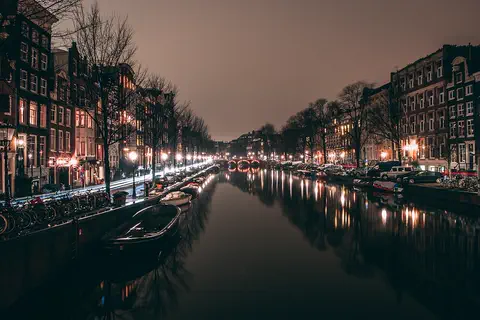
Amsterdam
Amsterdam is the capital of the Netherlands. It began as a fishing village beside a dam on the Amstel River, which gave the city its name. Today about 942,000 people live among its rings of canals, hundreds of bridges, houseboats and bicycles.
-
 Watch
City
Antwerp
Antwerp is a city in Belgium on the Scheldt river, and Universalis calls it the second port of continental Europe, after Rotterdam. Belgium's statistics office estimated 565,615 people in the city on 1 January 2026. In the 1500s it was one of Europe's great trading cities.
-
 Watch
City
Athens
Athens is the capital of Greece and one of the oldest cities in the world. Above it rises the Acropolis, a rocky hill crowned by the marble Parthenon, built about 2,500 years ago. Ancient Athens was home to early democracy, great thinkers and theater.
For parents & teachers
What children will learn
- Locate Bergen on Norway's west coast between a fjord and mountains.
- Explain how trade made a medieval port rich.
- Describe why wooden towns burned often and how Bryggen was rebuilt.
- Read a climate table for a very wet city.
Recommended ages: 3 to 17 · About 15 minutes
Talk about it
- Why might traders from far away want to live in one district together?
- How do you think people in Bergen get used to rain on most days?
- Why would a city build a railway up a steep mountain?
Try at home or in class
- Rain gauge: put a straight-sided jar outside for a week, measure the water and compare with Bergen's 2,250 mm a year.
- Wharf model: build a row of gabled houses from card along a 'harbor' of blue paper.
- Drying test: hang a slice of apple in a dry, airy place and see how drying changes it, as stockfish is dried.
Key vocabulary: fjord, Hanseatic League, stockfish, funicular, wharf, gabled
Where these facts come from
- Wikidata , Wikimedia Foundation (CC0 1.0)
- Natural Earth vector data , Natural Earth (NACIS) (Public domain)
- Bergen , Encyclopaedia Universalis
- Bryggen , UNESCO World Heritage Centre
- Norway: Major Municipalities , City Population (Thomas Brinkhoff), from Statistics Norway
- Bergen: climatological information , World Meteorological Organization, World Weather Information Service
- Oslo: climatological information , World Meteorological Organization, World Weather Information Service
- File:00 4400 View over the store Lungegårdsvann - Bergen (Norway).jpg (W. Bulach, 31 May 2016) , Wikimedia Commons
- Wikimedia Commons , Wikimedia Foundation (Per file (public domain, CC0, CC BY or CC BY-SA); see each media record)
Checked, not yet human-reviewed. Last updated November 1, 2026. Spotted a mistake? Tell us.