
City Europe
Oslo
Oslo is the capital city of Norway. It sits at the end of a long arm of the sea, with forests and ski hills close by.
Oslo, the capital of Norway, lies at the head of the Oslo Fjord. It was founded about 1050, burned down in 1624 and was rebuilt under a new name, Christiania, before taking back the name Oslo in 1925. About 729,000 people lived there in 2026.
Oslo, Norway's capital and largest city, lies at the head of the Oslo Fjord. Founded by Harald Hardraade about 1050, it became the royal seat in 1299, was rebuilt beneath Akershus fortress as Christiania after the fire of 1624 and regained its old name in 1925. Statistics Norway counted 729,437 residents in 2026.
Photo: Jørn Eriksson, CC BY 2.0, via Wikimedia Commons
Discover Oslo
Oslo is the capital city of Norway.
It sits where a long arm of the sea ends. Boats sail in and out of its harbor. At night, its buildings shine on the water.
Oslo is the capital and biggest city of Norway. It lies in the southeast of the country, at the head (the inner end) of the Oslo Fjord, a long arm of the sea.
Oslo is Norway's center for trade, banking and shipping, and its harbor is the biggest and busiest in the country. About 729,000 people lived in the city in 2026. At night, new buildings along the waterfront light up and shine in the calm water.
Oslo, the capital and largest city of Norway, lies at the head of the Oslo Fjord in the southeast of the country. It is the center of Norwegian trade, banking, industry and shipping, and the junction of the national road, rail and air networks; Oslo Harbor is the country's largest and busiest. Many oil and gas companies are based here, and in 2016 the city produced about 20 percent of Norway's GDP.
Statistics Norway counted 729,437 residents in the second quarter of 2026. Britannica notes some of the most rapid population growth of any European city in the early 2000s, driven by immigration and internal migration; in 2024, immigrants and their children made up 35 percent of the population.
- Country
- Norway (capital)
- People in the city (2026)
- about 729,000
- Founded
- about 1050
- Other names
- Christiania (1624–1925)
Famous places
Oslo has an opera house that looks like it slopes into the water.
You can walk right up onto its white roof! There is an old fortress by the harbor. A big park is full of statues by one famous sculptor.
The Oslo Opera House opened in 2008. Its sloping roof is a public square covered in white marble and granite, so visitors can stroll from the water's edge right up to the top. It stands on the edge of the fjord in the city's old docklands, where a new library and the Munch museum have also been built.
Akershus fortress, built around 1300, guards the harbor. In Frogner Park, in the west of the city, stand the sculptures of Gustav Vigeland. Up on the hill at Holmenkollen is a famous ski jump.
Akershus fortress went up around 1299, when Haakon V moved his residence from Bergen and made Oslo the capital; after the fire of 1624 the new town of Christiania was laid out beneath its walls. Frogner Park, in the west, displays the works of the modern sculptor Gustav Vigeland.
The Oslo Opera House, home of the Norwegian National Opera and Ballet, was designed by Snøhetta, completed in 2007 and officially opened in April 2008. Its wedge-shaped form, on the edge of the Oslofjord in the former docklands, slopes down at its western end so that the ground runs from the water's edge to the top of the roof, a public plaza clad in Norwegian granite and Carrara marble; inside, Baltic oak lines the auditorium. Dezeen credits it with starting a wave of buildings with publicly accessible roofs. The once largely derelict docklands at Bjørvika now also hold the Barcode office blocks, the Deichman Bjørvika library and the new Munch museum.
- Oslo Opera House
- opened April 2008
- Akershus fortress
- built around 1299
- Frogner Park
- sculptures by Gustav Vigeland
- Holmenkollen
- ski jump and ski museum
A city that moved and changed its name
Long ago, a king started the town of Oslo.
One day, a big fire burned the whole town. A new town was built nearby with a new name. Many years later, the city got its old name back.
King Harald Hardraade founded Oslo about 1050, on a site east of the Aker River. In 1299 King Haakon V moved his home here from Bergen, making Oslo the capital, and Akershus fortress was built.
In 1624 a fire destroyed the whole city. King Christian IV, who ruled Denmark and Norway together, built a new town farther west, beneath the fortress walls, and named it Christiania. It grew rich from trade and shipbuilding. Christiania became a capital again in 1814 and grew into Norway's largest city. In 1925 it took back its old name: Oslo.
Britannica calls Oslo's history one of shifting locations, statuses and names. Founded by Harald Hardraade about 1050 east of the Aker River, it became a bishopric in 1070 and the royal seat in 1299, when Haakon V moved from Bergen and Akershus fortress was built. The bubonic plague of 1349 killed half the population, and in 1397 Oslo lost its capital status when Norway joined the Kalmar Union with Denmark and Sweden.
After fire destroyed the city in 1624, Christian IV of Denmark-Norway laid out a new town farther west under Akershus and called it Christiania. It prospered on trade and shipbuilding, became a national capital again when Norway entered a personal union with Sweden in 1814, and overtook Bergen as Norway's largest city. The old name returned in 1925. German forces occupied the city from 1940 to 1945; in 1948 it completed the incorporation of the neighboring township of Aker. On July 22, 2011, a bomb attack damaged government buildings in the city center.
Getting around Oslo
Big ships sail into Oslo's harbor.
Trains and roads from all over Norway meet in the city. People can walk a long path beside the water.
Oslo Harbor is the largest and busiest harbor in Norway, with ships carrying goods and passengers in and out of the fjord. Norway's main roads, railways and air routes all come together in Oslo.
The old docklands by the fjord, once largely empty, have been rebuilt with offices, a library, a museum and the Opera House, whose sloping roof people can walk onto from the water's edge.
Oslo is the junction of Norway's road, rail and air networks and the base of its largest and busiest port, the hub of a city long tied to the sea through trade and shipbuilding. The redevelopment of the largely derelict former docklands at Bjørvika, begun with the Opera House, opened that stretch of the fjord's edge to the public.
After the city completed its absorption of the much larger township of Aker in 1948, satellite towns and residential areas grew up to the east and west of the center.
- Oslo Harbor
- Norway's largest and busiest
- Transport hub
- national road, rail and air networks meet here
- Bjørvika docklands
- rebuilt around the Opera House
Weather and seasons
Oslo has cold, snowy winters.
Even in the daytime, it is often below freezing. Summers are warm and pleasant. Autumn is the rainiest time.
Oslo has cold winters and warm summers. In January, days average about −2 °C and nights about −7 °C, so it often stays below freezing all day. In July, days average about 22 °C and nights about 12 °C.
About 763 millimeters of rain and snow falls in a year. The wettest months are August, September and October, and the driest is February.
World Meteorological Organization normals for 1961–1990 give mean daily maxima and minima of −1.8 °C and −6.8 °C in January and 21.5 °C and 12.2 °C in July; from December through February the average daytime high stays below 0 °C.
Monthly precipitation totals add up to about 763 mm, ranging from 36 mm in February to 90 mm in September, with 12 to 17 days of precipitation each month. Late summer and autumn (August to October) are the wettest season.
- January, average daily high and low
- about −2 °C and −7 °C
- July, average daily high and low
- about 22 °C and 12 °C
- Rain and snow in a year
- about 763 mm
Living in Oslo
People in Oslo love to ski in winter.
There is a giant ski jump on a hill. Families visit museums full of ships. One ship sailed to the icy ends of the Earth!
Oslo is great for winter sports, especially cross-country skiing. Every year, ski jumpers from many countries compete at Holmenkollen, where a ski museum has the oldest and largest collection of skis in the world.
On the Bygdøy peninsula, museums tell stories of the sea. The Fram Museum holds the Fram, a ship used on polar journeys by the explorers Fridtjof Nansen and Roald Amundsen. The Kon-Tiki Museum remembers Thor Heyerdahl's expedition in the Pacific. The painter Edvard Munch has his own museum.
Oslo holds Norway's leading cultural institutions: the National Theatre, the Norwegian Theatre, the Oslo Concert Hall, the Norwegian Opera and the National Museum of Art, Architecture and Design. At Bygdøy, the Norwegian Folk Museum, the Viking Ship Museum, the Fram Museum (with the Fram, the polar vessel of Fridtjof Nansen and Roald Amundsen), the Kon-Tiki Museum and the shipping museum reflect the city's maritime ties.
The Oslo region has 37 universities and research institutes; the University of Oslo's library is the country's main library, and its Aula, decorated with 11 paintings by Munch, hosts lectures, ceremonies and concerts. Natural advantages for cross-country skiing and the annual Holmenkollen ski-jump competitions make the city a winter-sports center.
- Universities and research institutes in the region
- 37
- Munch paintings in the university's Aula
- 11
- Ski museum
- world's oldest and largest collection of skis
Oslo on the map
Find Oslo on the globe.
Look for Norway, a long country in the north of Europe. Oslo is in the south, where a long arm of the sea ends.
Oslo is in southeastern Norway, at the inner end of the Oslo Fjord. A fjord is a long, narrow arm of the sea.
The fjord opens to the south into the Skagerrak, the sea between Norway and Denmark. Sweden lies to the east of Oslo.
Oslo lies at about 59.9° N and 10.7° E, at the head of the Oslo Fjord in southeastern Norway. The medieval town stood east of the Aker River; Christiania was laid out farther west beneath Akershus after 1624.
The modern city spread over the former township of Aker, incorporated by 1948, with satellite towns to the east and west. The Bygdøy peninsula, home to many museums, juts into the fjord west of the center, and Holmenkollen rises on the hills to the northwest.
- Latitude
- about 59.9° north
- Longitude
- about 10.7° east
- Water
- head of the Oslo Fjord
Amazing facts
-
You are allowed to walk on the roof of Oslo's opera house.
The roof of the Oslo Opera House is a public square, covered in marble and granite, that anyone can walk on.
Residents were first invited to climb the Opera House roof in 2007, when the building was completed; it opened officially in April 2008.
-
For about 300 years, Oslo had a different name.
After the fire of 1624, the rebuilt city was called Christiania. It became Oslo again in 1925.
Christian IV named the town he rebuilt after the 1624 fire Christiania; the original name, Oslo, was restored in 1925.
-
Oslo has a museum full of skis.
The ski museum at Holmenkollen has the oldest and largest collection of skis in the world.
The Holmenkollen site houses a ski museum with the world's oldest and largest collection of skis.
-
A famous polar ship sits in an Oslo museum.
The Fram, a ship used by the polar explorers Fridtjof Nansen and Roald Amundsen, is kept in the Fram Museum.
The Fram Museum on Bygdøy contains the Fram, the polar exploration vessel used by Fridtjof Nansen and Roald Amundsen.
-
In winter, people slide down the Opera House roof on sleds.
In summer, skateboarders and sunbathers fill the Opera House roof. In icy winter months, it becomes a place for sledding.
The Opera House roof is used all year: by skateboarders, swimmers and sunbathers in summer, and as a sledding destination in the icy winter months.
Words to know
- capital
- the city where a country's government meets
- fjord
- a long, narrow arm of the sea between steep hills or cliffs
- fortress
- a large, strong building or group of buildings built for defense
- harbor
- a sheltered place on the coast where ships can stay safely
- peninsula
- land with water on three sides
- polar
- near the North Pole or the South Pole
- cross-country skiing
- skiing across mostly flat or rolling land instead of down steep slopes
Discovery challenge
-
Which country is Oslo the capital of?
Oslo is the capital of which country?
Since 1814, Oslo (then Christiania) has been the capital of which country?
- Norway
- Denmark
- Finland
Show the answer
Norway
Norway! A long country in the north.
Norway. Oslo is its capital and biggest city.
Norway, when it entered a personal union with Sweden in 1814.
-
What can you walk on in Oslo?
Which part of the Oslo Opera House are visitors invited to walk on?
Which part of Snøhetta's Opera House (2008), clad in white marble, is designed to be walked on?
- The roof
- The stage
- The orchestra pit
Show the answer
The roof
The roof! It slopes down like a hill.
The roof. Its sloping marble surface leads up to views over the fjord.
The roof, a sloping public plaza clad in Norwegian granite and Carrara marble.
-
What was Oslo called for about 300 years?
What was Oslo called after it was rebuilt in 1624?
What name did Christian IV give the town he rebuilt beneath Akershus after the fire of 1624?
- Christiania
- Bergen
- Copenhagen
Show the answer
Christiania
Christiania! Later it got its old name back.
Christiania. It became Oslo again in 1925.
Christiania, which became Oslo again in 1925.
-
What winter sport is Oslo famous for?
What happens every year at Holmenkollen, in Oslo?
Which annual competitions bring athletes from the leading ski nations to Holmenkollen?
- Ski jumping
- Ice fishing
- Sled-dog racing
Show the answer
Ski jumping
Ski jumping! Skiers fly off a giant jump.
Ski jumping. There is also a ski museum there.
The Holmenkollen ski-jump competitions.
-
What is the Fram?
The Fram, kept in an Oslo museum, is a famous what?
What was the Fram, used by Fridtjof Nansen and Roald Amundsen?
- A ship
- A castle
- A mountain
Show the answer
A ship
A ship that went to icy places!
A ship used for polar exploration.
A polar exploration vessel, now in the Fram Museum on Bygdøy.
Nearby places
-
 Watch
City
Stockholm
Stockholm, the capital of Sweden, is built on islands and the mainland where Lake Mälaren meets an arm of the Baltic Sea. First mentioned as a town in 1252, it has a medieval Old Town, a royal palace, a 17th-century warship you can visit and subway stations full of art. About 985,000 people lived there in 2022.
-
 Watch
City
Copenhagen
Copenhagen, the capital of Denmark, grew from a small harbor town into a royal city of palaces, canals and towers. Its name means "Merchants' Harbor." It has the Tivoli Gardens, opened in 1843, and the Little Mermaid statue, and about 673,000 people lived there in 2026.
-
 Watch
City
Hamburg
Hamburg, in northern Germany, is the country's second-biggest city and one of Europe's largest ports. It grew from a castle built about 825 into a rich trading city on the Elbe River, with canals, a big lake and brick warehouses. About 1.9 million people lived there in 2025.
-
 Watch
City
Tallinn
Tallinn, the capital of Estonia, lies on a bay of the Gulf of Finland. Its walled Old Town, with towers, church spires and a town hall finished in 1404, is, says UNESCO, an exceptionally complete and well-preserved medieval trading town, and today the city is also known for its technology companies.
-
 Watch
City
Helsinki
Helsinki is the capital of Finland, on a peninsula in the Gulf of Finland. Founded in 1550 and made the capital in 1812, it has white stone buildings, a sea fortress on islands, and the world's most northern metro. About 694,000 people lived there at the end of 2025.
-
 Watch
City
Berlin
Berlin, the capital of Germany, grew from two small trading towns on the Spree River. From 1961 to 1989 the Berlin Wall divided it. Today about 3.7 million people live there (2025), among lakes, forests, museums and the Brandenburg Gate.
-
Watch
Landmark
Brandenburg Gate
The Brandenburg Gate is a grand sandstone gateway in the center of Berlin, built from 1788 to 1791 with 12 columns and five passages. On top, a statue called the Quadriga shows a chariot pulled by four horses. From 1961 to 1989 the Berlin Wall shut it off, so the gate became a symbol first of a divided Germany and then of its reunification.
-
 Watch
City
Amsterdam
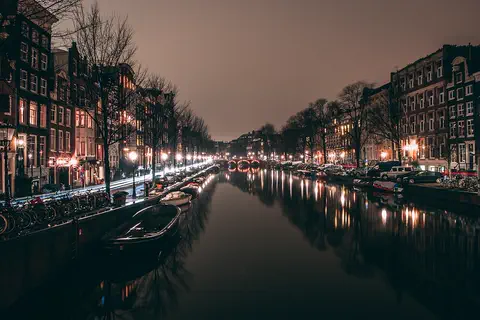
Amsterdam is the capital of the Netherlands. It began as a fishing village beside a dam on the Amstel River, which gave the city its name. Today about 942,000 people live among its rings of canals, hundreds of bridges, houseboats and bicycles.
Explore next
-
 Watch
 Country
Norway
Norway stretches along the western side of the Scandinavian Peninsula, far into the Arctic. Deep, narrow inlets of the sea called fjords cut into its mountains, and about 5.6 million people live there, many of them near Oslo, the capital.
-
 Watch
Life around the world
The polar night in Tromsø, Norway
Tromsø lies far north of the Arctic Circle. From about 26 November to 17 January the sun stays below the horizon all day, a time called mørketid in Norwegian, the dark time. Around midday there are still a few hours of twilight. People wear reflectors on dark roads, and a study found that people farther north in Norway tended to feel more positive about winter.
-
Watch
City
Copenhagen
Copenhagen, the capital of Denmark, grew from a small harbor town into a royal city of palaces, canals and towers. Its name means "Merchants' Harbor." It has the Tivoli Gardens, opened in 1843, and the Little Mermaid statue, and about 673,000 people lived there in 2026.
-
Watch
City
Stockholm
Stockholm, the capital of Sweden, is built on islands and the mainland where Lake Mälaren meets an arm of the Baltic Sea. First mentioned as a town in 1252, it has a medieval Old Town, a royal palace, a 17th-century warship you can visit and subway stations full of art. About 985,000 people lived there in 2022.
-
Watch
City
Helsinki
Helsinki is the capital of Finland, on a peninsula in the Gulf of Finland. Founded in 1550 and made the capital in 1812, it has white stone buildings, a sea fortress on islands, and the world's most northern metro. About 694,000 people lived there at the end of 2025.
-
 Watch
City
Dublin
Dublin, the capital of Ireland, sits where the River Liffey flows into Dublin Bay. Vikings built a town here in the 800s, and its name comes from a "black pool" in the river. Today it is famous for its writers, music, Georgian squares and Trinity College, home of the Book of Kells.
-
Watch
City
Amsterdam
Amsterdam is the capital of the Netherlands. It began as a fishing village beside a dam on the Amstel River, which gave the city its name. Today about 942,000 people live among its rings of canals, hundreds of bridges, houseboats and bicycles.
-
 Watch
City
Athens
Athens is the capital of Greece and one of the oldest cities in the world. Above it rises the Acropolis, a rocky hill crowned by the marble Parthenon, built about 2,500 years ago. Ancient Athens was home to early democracy, great thinkers and theater.
For parents & teachers
What children will learn
- Locate Oslo at the head of the Oslo Fjord in Norway.
- Explain how a fire led Oslo to move and change its name.
- Describe how the sea shaped Oslo's work, museums and buildings.
- Read average winter and summer temperatures and compare them with home.
Recommended ages: 3 to 17 · About 15 minutes
Talk about it
- Oslo was called Christiania for about 300 years. Why might a city choose to change its name back?
- The Opera House roof is made for walking on. What other buildings could people share in new ways?
- In January, Oslo's daytime average is below freezing. How would your day change if you lived there?
Try at home or in class
- Fold a piece of paper into a sloping 'roof' and test which toy figures can walk up it without slipping.
- Make a fjord in a baking tray with modeling clay hills and water, and float a paper boat to its head.
Key vocabulary: capital, fjord, fortress, harbor, peninsula, polar, cross-country skiing
Where these facts come from
- Wikidata , Wikimedia Foundation (CC0 1.0)
- Natural Earth vector data , Natural Earth (NACIS) (Public domain)
- Oslo , Encyclopaedia Britannica
- Oslo (kommunefakta) , Statistics Norway
- Snøhetta's Oslo Opera House , Dezeen
- Oslo: climatological information , World Meteorological Organization, World Weather Information Service
- Wikimedia Commons , Wikimedia Foundation (Per file (public domain, CC0, CC BY or CC BY-SA); see each media record)
Checked, not yet human-reviewed. Last updated October 27, 2026. Spotted a mistake? Tell us.