
City Europe
Copenhagen
Copenhagen is the capital city of Denmark. It sits beside the sea, with canals, palaces and a famous old fun park.
Copenhagen, the capital of Denmark, grew from a small harbor town into a royal city of palaces, canals and towers. Its name means "Merchants' Harbor." It has the Tivoli Gardens, opened in 1843, and the Little Mermaid statue, and about 673,000 people lived there in 2026.
Copenhagen, Denmark's capital, stands on the islands of Zealand and Amager at the southern end of the Øresund. Bishop Absalon fortified a herring-trading village here in 1167; by the 15th century it was the royal capital. About 672,666 people lived in the municipality in 2026, at the heart of an urban area that Britannica put at 1.35 million in 2022.
Photo: Pudelek, CC BY-SA 4.0, via Wikimedia Commons
Discover Copenhagen
Copenhagen is the capital city of Denmark.
It sits right beside the sea. Boats float in its canals. Red roofs and tall green towers fill the sky.
Copenhagen is the capital and biggest city of Denmark, a country in northern Europe. The city is built on two islands, Zealand and Amager, where a narrow strip of sea called the Øresund (The Sound) separates Denmark from Sweden.
Its Danish name, København, means "Merchants' Harbor," and trading ships have sailed in and out for more than 800 years. About 673,000 people lived in the city in 2026. From the tower of Christiansborg Palace you can look out over red roofs, green copper spires and canals.
Copenhagen is the capital and largest city of Denmark, spread across the islands of Zealand (Sjælland) and Amager at the southern end of The Sound (Øresund), the strait between Denmark and Sweden. Its Danish name, København, means "Merchants' Harbor," a reminder that the town grew rich on the Baltic herring trade.
Statistics Denmark counted 672,666 people in the municipality in 2026; Britannica's 2022 estimate put the wider urban area at 1,345,562. Postwar growth followed the "Five Finger Plan," which ran transport links out along corridors and kept green recreation areas within reach of neighborhoods. By 2000 the economy, once heavily industrial, was dominated by services, trade, finance and education.
- Country
- Denmark (capital)
- People in the city (2026)
- about 673,000
- Name means
- Merchants' Harbor
- Built on
- the islands of Zealand and Amager
Famous places
Tivoli is a very old fun park in the middle of the city.
It has rides, gardens and twinkling lights. By the water sits a small statue of a mermaid. She comes from a fairy tale.
Tivoli Gardens opened its gates on August 15, 1843. It still has a wooden roller coaster from 1914, one of the oldest in the world still running, and a lake made from part of the old city moat.
Out by the harbor, at Langelinie Pier, sits The Little Mermaid, a bronze statue from 1913 based on a story by Hans Christian Andersen. It has become a symbol of Denmark. Christiansborg Palace, on a little island in the center, is where Denmark's Parliament meets, and Rosenborg Castle, more than 400 years old, is now a museum of the royal family.
Christiansborg Palace occupies Slotsholmen ("Castle Islet"), on the site of the castle Bishop Absalon founded in 1167; since 1928 it has housed Parliament, the Supreme Court and the Foreign Office. Nearby are the Royal Library and its waterfront extension of steel and glass, the Black Diamond (1999). The building boom that began in the late 16th century produced the Børsen (Exchange), Holmens Church, Trinitatis Church with its Round Tower, and Rosenborg Castle, now the museum of the royal family.
Amalienborg palace, the University of Copenhagen (1479), the 17th-century citadel and the Church of Our Saviour in Christianshavn complete the historic core. Tivoli, founded by Georg Carstensen and opened in 1843, covers 8.3 hectares; its lake was created in 1887 from the former moat, and its Pantomime Theatre (1874) is its oldest standing building. Edvard Eriksen's Little Mermaid (1913) at Langelinie is a national symbol.
- Tivoli Gardens
- opened August 15, 1843
- The Little Mermaid
- bronze statue, 1913
- Christiansborg Palace
- home of Parliament since 1928
- University of Copenhagen
- founded 1479
From fishing village to royal capital
Long ago, a small village stood here by the sea.
A bishop built a castle and a wall around the town. Fishing boats and traders made it busy. Later, kings and queens made it their home.
A small village stood here more than 1,000 years ago. In 1167 Bishop Absalon built a castle on a tiny island off the shore and put walls and a moat around the town. Fishing for herring and selling it made the town grow fast.
By the 1400s, Danish kings lived here, and Copenhagen became the capital. Hard times came too: big fires in 1728 and 1795 burned many houses. In the 1800s the city became a home of writers and thinkers, including the storyteller Hans Christian Andersen. Its old walls were pulled down in 1856, and the city spread out.
A village existed on the site by the early 10th century. In 1167 Bishop Absalon of Roskilde built a castle on an islet and fortified the town with ramparts and a moat; the herring trade drove rapid growth. Copenhagen became Denmark's de facto capital in the 15th century, with 1416, when Erik VII took up residence, often given as the key date.
The Reformation brought civil war and a siege in 1535–36, after which the population rose from about 10,000 to some 42,000 by 1672. Trade, the royal court and the naval base fueled a building boom. Sweden besieged the city for two years during the wars of 1658–60; plague killed about a third of the people in 1711, fires struck in 1728 and 1795, and British forces fought the Danish fleet in 1801 and bombarded the city in 1807. The 19th century brought a cultural flowering (Kierkegaard, Andersen); the ramparts came down in 1856 and the population passed 450,000 by 1901. German forces occupied the city from 1940 to 1945.
Getting around Copenhagen
In Copenhagen, trains run under the ground with no driver at all!
Buses and trains carry people to work. A long bridge and tunnel go across the sea to Sweden.
Copenhagen's metro is fully automated: the trains run without drivers. Building began in the late 1990s, and the first line opened in 2002. Electric commuter trains called S-trains and a network of city buses carry people in from the suburbs.
In 2000 the Øresund Link opened. It is a tunnel and a bridge joined together, so cars and trains can cross the sea to Malmö in Sweden. It also serves Copenhagen Airport at Kastrup.
Arterial streets carry traffic toward the center and across the harbor bridges. Electric commuter railways (S-baner) and a bus network serve the metropolitan area; the last streetcars ran in 1972. Construction of a fully automated subway began in the late 1990s, and its first line opened in 2002.
The Øresund Link, a combined tunnel-and-bridge system opened in 2000, connects Copenhagen with Malmö, Sweden, and serves Copenhagen Airport at Kastrup. Britannica notes that it supports cooperation and regional growth on both sides of The Sound. Postwar planning under the Five Finger Plan built the transport corridors along which the suburbs grew.
- Metro
- fully automated, first line 2002
- Øresund Link to Sweden
- tunnel and bridge, opened 2000
- Commuter trains
- S-baner (electric)
- Last streetcars
- 1972
Weather and seasons
Winters in Copenhagen are cold and gray.
Summers are mild, not very hot. It rains a little on many days, all year round.
Copenhagen has cool summers and chilly winters. In January, days average about 2 °C and nights about −2 °C. In July, days average about 20 °C and nights about 13 °C, so even summer is mild.
Rain falls on 11 to 17 days in a typical month. About 525 millimeters falls in a whole year, and July and August are the wettest months.
World Meteorological Organization normals for 1961–1990 give mean daily maxima and minima of 2 °C and −2 °C in January and February, and 20 °C and 13 °C in July and August, a narrow range that reflects the surrounding sea.
Monthly totals add up to about 525 mm a year, from 24 mm in February to 57 mm in July, spread over 11 to 17 rain days each month. Precipitation is frequent rather than heavy: no month averages more than 60 mm.
- January, average daily high and low
- about 2 °C and −2 °C
- July, average daily high and low
- about 20 °C and 13 °C
- Rain and snow in a year
- about 525 mm
Living in Copenhagen
Families in Copenhagen visit parks, gardens and a zoo.
They ride the old roller coaster at Tivoli. They look at stars at a planetarium. Many like to read Hans Christian Andersen's fairy tales.
Hans Christian Andersen, who wrote fairy tales such as The Little Mermaid, lived and worked in Copenhagen in the 1800s, and the city still celebrates him. Families visit the Tivoli Gardens, the zoo in Frederiksberg Park, the botanical gardens and the Tycho Brahe Planetarium, named after a famous Danish astronomer.
The University of Copenhagen has taught students since 1479. Today most people in the city work in services, trade, finance and education. The Royal Theatre, built in 1874, stands on Kongens Nytorv, the King's New Square.
The city's heart is Rådhuspladsen (Town Hall Square), from which an old, crooked shopping street leads to Kongens Nytorv, laid out in the 17th century with the Royal Theatre (1874), the Thott Palace and Charlottenborg, now the Royal Academy of Fine Arts. The Ny Carlsberg Glyptotek holds a fine collection of traditional and modern art.
Besides the University of Copenhagen (1479), higher education includes the Technical University of Denmark (1829) and the Royal Danish Academy of Music (1867). The botanical gardens (1874) have an observatory with a statue of Tycho Brahe, and the Tycho Brahe Planetarium opened in 1989. In Christianshavn, Freetown Christiania, a community set up in 1971 in abandoned military buildings, has become one of the city's largest tourist attractions.
- Tycho Brahe Planetarium
- opened 1989
- Royal Theatre
- built 1874
- Tivoli roller coaster
- running since 1914
Copenhagen on the map
Find Copenhagen on the globe.
Look at the top of Europe for Denmark. Copenhagen is on its east side, by the sea. Sweden is just across the water.
Copenhagen is on the east coast of Denmark, in northern Europe. It sits on the island of Zealand and the smaller island of Amager, at the southern end of The Sound, the narrow sea between Denmark and Sweden.
The Swedish city of Malmö is just across the water, joined to Copenhagen by the Øresund Link.
Copenhagen lies at about 55.7° N and 12.6° E, on the islands of Zealand and Amager at the southern end of the Øresund, the strait linking the Kattegat with the Baltic Sea. Its harbor separates the old city from Christianshavn and Amager.
The historic core spreads out from Slotsholmen, where Absalon's castle stood, to Kongens Nytorv, Amalienborg and the citadel. The Five Finger Plan steered postwar growth along transport corridors radiating from the center, with green areas between them.
- Latitude
- about 55.7° north
- Longitude
- about 12.6° east
- Sea
- The Sound (Øresund)
Amazing facts
-
Copenhagen's name means Merchants' Harbor.
The Danish name København means "Merchants' Harbor," because the town grew up trading by the sea.
København means "Merchants' Harbor"; the name dates from around 1167, when the town grew rapidly on the Baltic herring trade.
-
Tivoli's wooden roller coaster is more than 100 years old.
Tivoli's wooden roller coaster opened in 1914 and is one of the oldest in the world still running.
Tivoli's present roller coaster, opened in 1914 as the Mountain Coaster, is one of the world's oldest wooden coasters still in operation.
-
Tivoli's lake was once part of a moat.
The lake in Tivoli Gardens was made in 1887 from part of the city's old moat.
Tivoli Lake was created in 1887 from the former city moat, a remnant of the ramparts that once ringed Copenhagen.
-
Denmark's Parliament meets in a palace on a small island.
Since 1928, Denmark's Parliament has met in Christiansborg Palace, on a little island in the middle of the city.
Christiansborg Palace on Slotsholmen, built on the site of Absalon's 1167 castle, has housed Parliament, the Supreme Court and the Foreign Office since 1928.
-
The Little Mermaid statue comes from a fairy tale.
The Little Mermaid statue, from 1913, is based on a story by Hans Christian Andersen and is a symbol of Denmark.
Edvard Eriksen's bronze Little Mermaid (1913) at Langelinie Pier, based on Andersen's tale, is a Danish national symbol and one of the city's most popular sights.
Words to know
- capital
- the city where a country's government meets
- harbor
- a sheltered place on the coast where ships can stay safely
- canal
- a waterway dug by people for boats
- ramparts
- thick earth or stone walls built around a town to protect it
- moat
- a deep ditch, often filled with water, around a castle or town
- strait
- a narrow strip of sea between two pieces of land
- automated
- run by machines and computers, with no person driving
Discovery challenge
-
What does the name Copenhagen mean?
The Danish name København means what?
What does the name København, given to the town around 1167, mean?
- Merchants' Harbor
- Snowy Hill
- King's Garden
Show the answer
Merchants' Harbor
Merchants' Harbor! Traders came by ship.
Merchants' Harbor. Trading ships made the town grow.
Merchants' Harbor, fitting a town that grew rich on the herring trade.
-
Which country is Copenhagen the capital of?
Copenhagen is the capital of which country?
Copenhagen has been the capital of which country since the 15th century?
- Denmark
- Norway
- Sweden
Show the answer
Denmark
Denmark! Sweden is just across the water.
Denmark. Sweden is across The Sound.
Denmark; 1416, when Erik VII settled there, is often given as the key date.
-
What is Tivoli?
Tivoli Gardens, opened in 1843, is what kind of place?
What did Georg Carstensen open in Copenhagen on August 15, 1843?
- An amusement park
- A train station
- A university
Show the answer
An amusement park
A fun park with rides and gardens!
An amusement park with gardens, music and an old wooden roller coaster.
Tivoli, an amusement park and garden of 8.3 hectares.
-
Who sits by the harbor in Copenhagen?
Which famous bronze statue sits at Langelinie Pier?
Which 1913 statue by Edvard Eriksen, based on an Andersen tale, is a Danish national symbol?
- The Little Mermaid
- A giant lion
- A sea captain
Show the answer
The Little Mermaid
The Little Mermaid, from a fairy tale!
The Little Mermaid, based on a story by Hans Christian Andersen.
The Little Mermaid, one of Copenhagen's most popular sights.
-
What is special about Copenhagen's underground trains?
What is unusual about Copenhagen's metro, which opened its first line in 2002?
Which feature distinguishes the Copenhagen metro, whose construction began in the late 1990s?
- They have no driver
- They float on water
- They are pulled by horses
Show the answer
They have no driver
No driver! The trains drive themselves.
It is fully automated, so the trains run without a driver.
It is fully automated.
Nearby places
-
 Watch
City
Hamburg
Hamburg, in northern Germany, is the country's second-biggest city and one of Europe's largest ports. It grew from a castle built about 825 into a rich trading city on the Elbe River, with canals, a big lake and brick warehouses. About 1.9 million people lived there in 2025.
-
 Watch
City
Berlin
Berlin, the capital of Germany, grew from two small trading towns on the Spree River. From 1961 to 1989 the Berlin Wall divided it. Today about 3.7 million people live there (2025), among lakes, forests, museums and the Brandenburg Gate.
-
Watch
Landmark
Brandenburg Gate
The Brandenburg Gate is a grand sandstone gateway in the center of Berlin, built from 1788 to 1791 with 12 columns and five passages. On top, a statue called the Quadriga shows a chariot pulled by four horses. From 1961 to 1989 the Berlin Wall shut it off, so the gate became a symbol first of a divided Germany and then of its reunification.
-
 Watch
City
Oslo
Oslo, the capital of Norway, lies at the head of the Oslo Fjord. It was founded about 1050, burned down in 1624 and was rebuilt under a new name, Christiania, before taking back the name Oslo in 1925. About 729,000 people lived there in 2026.
-
 Watch
City
Stockholm
Stockholm, the capital of Sweden, is built on islands and the mainland where Lake Mälaren meets an arm of the Baltic Sea. First mentioned as a town in 1252, it has a medieval Old Town, a royal palace, a 17th-century warship you can visit and subway stations full of art. About 985,000 people lived there in 2022.
-
 Watch
City
Amsterdam
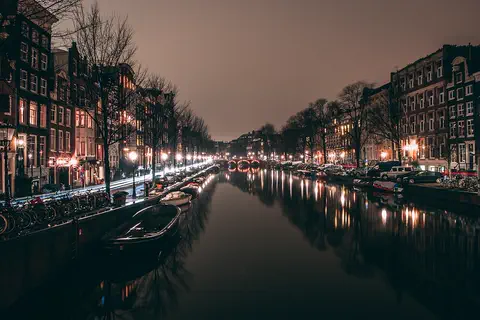
Amsterdam is the capital of the Netherlands. It began as a fishing village beside a dam on the Amstel River, which gave the city its name. Today about 942,000 people live among its rings of canals, hundreds of bridges, houseboats and bicycles.
-
 Watch
City
Prague
Prague, the capital of the Czech Republic, lies on the Vltava River in the heart of Europe. With Prague Castle on its hill, the 14th-century Charles Bridge and so many church towers that it is called the 'City of a Hundred Spires', its historic center is a UNESCO World Heritage Site. About 1.4 million people lived there in 2025.
-
 Watch
City
Warsaw
Warsaw is the capital of Poland, on the Vistula River. Much of the city was destroyed in World War II, and afterward its people rebuilt the Old Town so carefully that UNESCO made it a World Heritage Site. About 1.86 million people lived there in 2024.
Explore next
-
 Watch
 Country
Denmark
Denmark is a country in northern Europe made of the Jutland peninsula and more than 400 islands, with the sea almost all around. It is low and mostly flat, about 6 million people live there, and its capital, Copenhagen, is full of bicycles.
-
Watch
City
Oslo
Oslo, the capital of Norway, lies at the head of the Oslo Fjord. It was founded about 1050, burned down in 1624 and was rebuilt under a new name, Christiania, before taking back the name Oslo in 1925. About 729,000 people lived there in 2026.
-
Watch
City
Stockholm
Stockholm, the capital of Sweden, is built on islands and the mainland where Lake Mälaren meets an arm of the Baltic Sea. First mentioned as a town in 1252, it has a medieval Old Town, a royal palace, a 17th-century warship you can visit and subway stations full of art. About 985,000 people lived there in 2022.
-
 Watch
City
Helsinki
Helsinki is the capital of Finland, on a peninsula in the Gulf of Finland. Founded in 1550 and made the capital in 1812, it has white stone buildings, a sea fortress on islands, and the world's most northern metro. About 694,000 people lived there at the end of 2025.
-
 Watch
City
Dublin
Dublin, the capital of Ireland, sits where the River Liffey flows into Dublin Bay. Vikings built a town here in the 800s, and its name comes from a "black pool" in the river. Today it is famous for its writers, music, Georgian squares and Trinity College, home of the Book of Kells.
-
Watch
City
Amsterdam
Amsterdam is the capital of the Netherlands. It began as a fishing village beside a dam on the Amstel River, which gave the city its name. Today about 942,000 people live among its rings of canals, hundreds of bridges, houseboats and bicycles.
-
 Watch
City
Athens
Athens is the capital of Greece and one of the oldest cities in the world. Above it rises the Acropolis, a rocky hill crowned by the marble Parthenon, built about 2,500 years ago. Ancient Athens was home to early democracy, great thinkers and theater.
-
 Watch
City
Barcelona
Barcelona, the capital of Catalonia in northeastern Spain, lies on the Mediterranean between mountains and the sea. It is famous for the buildings of the architect Antoni Gaudí, including the Sagrada Família, a giant church begun in 1882. About 1.7 million people live in the city (2025).
For parents & teachers
What children will learn
- Locate Copenhagen on the Øresund between Denmark and Sweden.
- Explain how trade and a harbor helped a small village become a capital city.
- Name some of Copenhagen's palaces, parks and landmarks.
- Describe how a tunnel and bridge link two countries.
Recommended ages: 3 to 17 · About 15 minutes
Talk about it
- Copenhagen's name means Merchants' Harbor. Why do so many cities grow up beside harbors?
- Tivoli's lake was made from an old moat. What could your town do with a space it no longer needs?
- Would you like to ride a train with no driver? Why or why not?
Try at home or in class
- Read a Hans Christian Andersen fairy tale together, then draw the place where it happens.
- Make a 'tunnel and bridge' with a cardboard tube and a ruler across a tray of water, and send a toy car across.
Key vocabulary: capital, harbor, canal, ramparts, moat, strait, automated
Where these facts come from
- Wikidata , Wikimedia Foundation (CC0 1.0)
- Natural Earth vector data , Natural Earth (NACIS) (Public domain)
- Copenhagen , Encyclopaedia Britannica
- FOLK1AM: Population on the first day of the month , Statistics Denmark
- Tivoli's history , Tivoli Gardens
- Copenhagen: climatological information , World Meteorological Organization, World Weather Information Service
- Wikimedia Commons , Wikimedia Foundation (Per file (public domain, CC0, CC BY or CC BY-SA); see each media record)
Checked, not yet human-reviewed. Last updated October 27, 2026. Spotted a mistake? Tell us.