
 Country
Europe
Norway
Norway is a long country in the north of Europe. It has deep fjords, snowy mountains and reindeer.
Norway stretches along the western side of the Scandinavian Peninsula, far into the Arctic. Deep, narrow inlets of the sea called fjords cut into its mountains, and about 5.6 million people live there, many of them near Oslo, the capital.
Norway occupies the western half of the Scandinavian Peninsula, where Ice Age glaciers carved deep fjords into ancient rock of the Fennoscandian Shield. A warm ocean current keeps its coast milder than its latitude suggests, and its 5.64 million people (mid-2026) are concentrated in the south around Oslo and in coastal cities.
Photo: Diego Delso, CC BY-SA 4.0, via Wikimedia Commons
Discover Norway
Norway is a country in the far north of Europe.
It is long and thin. It has tall mountains and lots of sea. The sea goes deep into the land. The capital city is called Oslo.
Norway is a long, narrow country in northern Europe, on the western side of the Scandinavian Peninsula. About two-thirds of it is mountains, and its coast is cut by deep fjords. Some 50,000 islands lie off the coast.
The north of Norway reaches far beyond the Arctic Circle. About 5.6 million people live in Norway, and nearly half of them live in the far south, around the capital, Oslo.
Norway occupies the western half of the Scandinavian Peninsula. About two-thirds of the country is mountainous, its average elevation is about 500 m (compared with about 300 m for Europe as a whole), and some 50,000 islands lie off its deeply indented coast. Its area is about 385,000 square kilometers (Wikidata, from the Norwegian Mapping Authority's figures).
Statistics Norway counted 5,627,400 residents on 1 January 2026 and 5,636,904 at the end of the second quarter of 2026. Nearly half of the population lives in the region around Oslo, and Britannica puts the urban share at 83 percent (2023). Norway is a constitutional monarchy with one legislative house, the 169-member Storting.
Cities and famous places
Oslo is the biggest city in Norway.
It has a big, busy harbor. Bergen is a city between hills and the sea. Tromsø is a city far in the north. In summer the Sun shines there all night.
Oslo, the capital, is Norway's center for trade, banking and shipping, and its harbor is the country's largest and busiest. About 718,000 people lived in the city in 2024.
Bergen, on the west coast, was once an important trading town. Its old wharf, Bryggen, still has rows of wooden buildings. Far to the north, Tromsø lies on two islands just off the mainland, well above the Arctic Circle.
Oslo, with 717,710 people in 2024 (Wikidata), is the hub of Norway's trade, banking, industry and shipping, and home to the National Theatre and the Norwegian Opera. Britannica notes that the interior was always more sparsely settled, owing to extremes of climate and difficult terrain, and that the population is still concentrated in coastal cities such as Bergen and Trondheim.
Bryggen, Bergen's old wharf, recalls the town's importance in the Hanseatic League's trading empire from the 14th to the mid-16th century. Many fires, the last in 1955, have destroyed its wooden houses, but rebuilding followed old patterns and methods, and some 62 buildings remain; UNESCO inscribed it in 1979. Tromsø, at about 69.6° N on two islands just west of the mainland, is the capital of Nord-Norge, the northern region that lies mostly above the Arctic Circle; there the Sun stays visible all day and night from late May to late July.

Fjords, glaciers and a warm current
Norway has many fjords.
A fjord is a long arm of the sea between steep mountains. Waterfalls tumble down the cliffs. Long ago, giant rivers of ice made the fjords.
During the Ice Age, huge glaciers slid down Norway's valleys and scraped them deep and wide. When the ice melted, the sea flowed in, making fjords: long, narrow inlets with steep walls. In Geirangerfjord and Nærøyfjord, the rock walls rise up to 1,400 meters from the water, and waterfalls pour down them.
Norway is warmer than many places this far north because a warm ocean current, part of the Gulf Stream, flows along the coast and usually keeps the fjords from freezing. The west is mild and very rainy; the east has warm summers and cold winters. Jostedal Glacier is the largest ice field on mainland Europe.
Norway's bedrock, mostly granite and other heat- and pressure-formed rock of the Fennoscandian Shield, is one to two billion years old. During repeated glaciations of the last 2.6 million years, glaciers flowing down V-shaped river valleys carved the U-shaped, drowned fjords of the west coast. UNESCO inscribed Geirangerfjord and Nærøyfjord in 2005 as archetypal fjord landscapes, among the world's longest and deepest, with crystalline walls rising up to 1,400 m from the Norwegian Sea and reaching 500 m below sea level.
The Norwegian Current, the northeastern extension of the Gulf Stream, carries four to five million tons of tropical water per second into the surrounding seas. The west coast averages about 7 °C a year, far above the average for its latitude, and western Norway receives nearly 2,250 mm of precipitation, against less than 760 mm in the sheltered east. The Hardanger Plateau is Europe's largest mountain plateau, the Jostedal Glacier is continental Europe's largest ice field, and Galdhøpiggen (2,469 m) is the highest point.

Animals of Norway
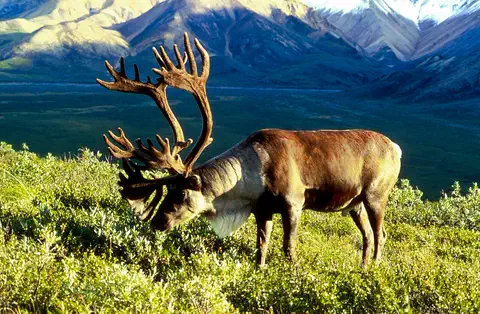
Reindeer live in Norway's mountains.
Moose walk in the big forests. Lots of seabirds nest on rocky islands. Far out in the Arctic, on Svalbard, polar bears hunt on the sea ice.
Reindeer, wolverines and lemmings live in Norway's mountains and the Arctic north. Moose are common in the large conifer forests, and red deer live along the west coast. Bears, wolves and lynx live in only a few areas now, mainly in the north. Salmon swim up at least 160 rivers.
On some small cliff islands, hundreds of thousands of seabirds nest together. Far north, on the Svalbard islands, polar bears hunt seals on the sea ice. A survey in 2004 estimated between 1,900 and 3,600 polar bears in the Barents Sea region.
Britannica lists reindeer, wolverines, lemmings and other Arctic animals throughout Norway, although in the south they live only in the mountains. Elk (moose) are common in the large coniferous forests and red deer are numerous on the west coast; bears, wolves and lynx, common 150 years ago, now survive only in a few areas, mainly in the north. Foxes, otters, martens, badgers and beavers are widespread, and salmon run in at least 160 rivers. Many bird species migrate as far as southern Africa, and cliff islands as far south as Ålesund can hold several hundred thousand nesting seabirds.
In the Svalbard archipelago, the Norwegian Polar Institute reports that polar bears are found mostly where there is sea ice, with the most important denning areas on Kongsøya, Svenskøya, Edgeøya, Nordaustlandet and Hopen. Their main prey there are ringed, bearded and harp seals. An August 2004 survey estimated 1,900 to 3,600 polar bears in the Barents Sea population, which dens in both Svalbard and Russia's Franz Josef Land; only pregnant females den in winter.

People, languages and food
About 5.6 million people live in Norway.
Most people speak Norwegian. In the north, some people speak Sámi too. Fish like salmon and cod are popular foods. Many people spend lots of time outdoors.
About 5.6 million people live in Norway. Norwegian is the main language, and it has two written forms, Bokmål and Nynorsk. Most schoolchildren learn mainly in Bokmål.
The Sámi are the first people known to have lived in Norway, and most of them live in the north. More than 15,000 people speak North Sámi as their first language. Fish dishes such as salmon and cod are popular, and on May 17, Constitution Day, many people wear colorful folk costumes called bunads.
Norwegian is a North Germanic language with two official written forms: Bokmål, the main school language for more than four-fifths of pupils and dominant around Oslo, and Nynorsk, widely used in the mountainous interior and on the west coast. Until about 1850 there was one written standard, strongly influenced by Danish during the 434-year union with Denmark.
Britannica's Sami article counts more than 53,000 Sámi in Norway in the late 2010s and early 2020s (its Norway article gives an older estimate of 30,000 to 40,000, about nine-tenths of them in Nord-Norge); they arrived at least 10,000 years ago. Once subject to widespread, even official, discrimination, they are now legally recognized as a distinct culture with a Sámi Parliament, and North Sámi, a Uralic language, is official in several municipalities. In the early 21st century growing immigration, including from Africa and the Middle East, made the population more diverse. Britannica describes salmon and cod dishes, sour-cream porridge and lefse among traditional foods, and folk costumes worn on Constitution Day, May 17.

A long history
People have lived in Norway for a very long time.
Long ago, people carved animals into rocks. Later, the Vikings sailed far across the sea. Today Norway has a king.
Thousands of years ago, people near Alta in the far north carved and painted thousands of pictures on rocks, showing scenes of life in the Far North long ago. Farmers who grew grain and kept cows and sheep settled in eastern Norway by about 3000 to 2500 BCE.
More than a thousand years ago, Viking sailors from Norway set up colonies in Iceland and Greenland and reached North America. Later, Norway was ruled together with Denmark, and then with Sweden. It became fully independent in 1905. In the 1970s Norway began producing oil and gas from under the sea.
The rock art of Alta, near the Arctic Circle, records a settlement from about 4200 to 500 BCE in thousands of carvings and paintings (World Heritage Site, 1985). Farming arrived in eastern Norway between 3000 and 2500 BCE, and the oldest known Norwegian runic inscription dates from the 3rd century CE. In the Viking era, Norse seafarers raided the British Isles and western Europe, founded colonies in Iceland and Greenland and explored the North American coast that Leif Eriksson called Vinland.
Weakened by plague in the late Middle Ages, Norway came under the dominance of Denmark, with which it was united for 434 years, and later of Sweden. On June 7, 1905, the Storting declared the union with Sweden dissolved, and modern Norway became a major shipping nation. From the 1970s offshore oil and natural gas became its main maritime industry, and in the 1990s Norway emerged as one of the world's leading petroleum exporters.

Norway on the map
Find Norway on the globe.
It is at the top of Europe. It is long and thin, like a spoon. Sweden is next door. Far to the north are the cold islands of Svalbard.
Norway runs along the western side of the Scandinavian Peninsula. Its only land borders are in the east, with Sweden, Finland and Russia. The Barents Sea lies to the north, the Norwegian Sea and the North Sea to the west, and the Skagerrak strait to the south.
Norway has four traditional regions. Northern Norway begins almost exactly halfway up the country, and most of it lies above the Arctic Circle. The Svalbard islands, part of Norway, lie far out in the Arctic Ocean.
With the Barents Sea to the north, the Norwegian and North seas to the west and the Skagerrak to the south, Norway has land borders only to the east, with Sweden, Finland and Russia. Mountain barriers divide the south into Østlandet (east), Vestlandet (west) and Trøndelag, while Nord-Norge begins near the country's midpoint and lies mostly above the Arctic Circle.
The Glåma, about 600 km long, runs south through eastern Norway, and Mjøsa, 80 km north of Oslo, is by far the largest of some 65,000 lakes. Svalbard lies between 74° and 81° N, about 930 km north of Tromsø; a treaty of February 9, 1920, granted Norway possession of the archipelago while giving mineral rights on an equal basis to other signatory countries.
- Islands off the coast
- some 50,000
- Share that is mountainous
- about two-thirds
- Longest river
- Glåma, about 600 km
- Svalbard
- 74° to 81° N, about 930 km north of Tromsø
Amazing facts
-
Norway has about 50,000 islands.
Some 50,000 islands lie off Norway's deeply cut coast.
Off Norway's much-indented coastline lie some 50,000 islands, and about two-thirds of the mainland is mountainous.
-
A warm sea current keeps Norway's fjords from freezing.
A warm current from the Gulf Stream usually keeps Norway's fjords from freezing, even far in the Arctic north.
The Norwegian Current carries four to five million tons of tropical water per second into Norway's seas and usually keeps even Finnmark's fjords ice-free.
-
Norwegian has two ways of writing.
Norwegian has two official written forms, Bokmål and Nynorsk.
Bokmål and Nynorsk have equal status; Bokmål is the main school language for more than four-fifths of pupils.
-
Polar bears on Svalbard mostly eat seals.
On Svalbard, polar bears mostly hunt ringed seals, bearded seals and harp seals.
In Svalbard the main prey of polar bears are ringed, bearded and harp seals, though they also take bird eggs and carrion.
-
Some fjord walls rise more than a kilometer above the water.
The walls of Geirangerfjord and Nærøyfjord rise up to 1,400 meters straight out of the sea.
The crystalline walls of Geirangerfjord and Nærøyfjord rise up to 1,400 m from the Norwegian Sea and extend 500 m below sea level.
Words to know
- fjord
- a long, narrow arm of the sea between steep cliffs, carved by a glacier
- glacier
- a huge, slow-moving mass of ice
- Arctic Circle
- an imaginary line around the far north of Earth; north of it, there are days when the Sun does not set or rise
- peninsula
- land with water on most sides, joined to a larger piece of land
- Sámi
- an Indigenous people of the far north of Norway, Sweden, Finland and Russia
- midnight sun
- the time in summer, far north or south, when the Sun can be seen all day and all night
Discovery challenge
-
What is a fjord?
What is a fjord?
Which best describes a fjord?
- A long arm of the sea between steep mountains
- A sandy desert
- A tall volcano
Show the answer
A long arm of the sea between steep mountains
A fjord is a long arm of the sea between mountains.
A fjord is a deep, narrow inlet of the sea in a valley carved by a glacier.
A fjord is a glacier-carved, U-shaped trough drowned by the sea, like Geirangerfjord.
-
What is the capital city of Norway?
Which city is the capital of Norway?
Which city, in Norway's far south, is the capital and its busiest port?
- Bergen
- Tromsø
- Oslo
Show the answer
Oslo
Oslo is the capital of Norway.
Oslo is the capital, in the south. Bergen is on the west coast and Tromsø is in the north.
Oslo is the capital and hub of trade and shipping; its harbor is Norway's largest and busiest.
-
What keeps Norway's coast warmer than you might think?
Why are Norway's fjords usually free of ice, even in the far north?
What keeps the Norwegian coast far warmer than the average for its latitude?
- A warm ocean current
- Hot volcanoes
- A big desert nearby
Show the answer
A warm ocean current
A warm current in the sea flows along the coast.
A warm current, part of the Gulf Stream, flows along the coast and keeps the fjords from freezing.
The Norwegian Current, an extension of the Gulf Stream, and the southerly air above it warm the coast, especially in winter.
-
Which big animal lives on Norway's Arctic islands, Svalbard?
Which large animal hunts seals on the sea ice around Svalbard?
Which animal's Barents Sea population was estimated at 1,900 to 3,600 in 2004?
- Camel
- Polar bear
- Giraffe
Show the answer
Polar bear
Polar bears live on Svalbard. They hunt seals on the ice.
Polar bears on Svalbard hunt ringed, bearded and harp seals on the sea ice.
The Norwegian Polar Institute reports 1,900 to 3,600 polar bears in the Barents Sea population (2004 survey).
-
Which people lived in Norway first, long ago?
Which people are the first known inhabitants of Norway?
Which people, who arrived at least 10,000 years ago, now have their own parliament in Norway?
- The Sámi
- The Romans
- The Maya
Show the answer
The Sámi
The Sámi lived in Norway first. Many live in the north.
The Sámi are Norway's first known people; most live in the north.
The Sámi arrived at least 10,000 years ago, are recognized as a distinct culture and have a Sámi Parliament.
Places to discover in Norway
-
Watch
City
Oslo
Oslo, the capital of Norway, lies at the head of the Oslo Fjord. It was founded about 1050, burned down in 1624 and was rebuilt under a new name, Christiania, before taking back the name Oslo in 1925. About 729,000 people lived there in 2026.
-
Watch
Natural wonder
Svalbard
Svalbard is a group of Arctic islands, part of Norway, far north of the Arctic Circle. Glaciers and snowfields cover nearly 60 percent of the land. Polar bears hunt seals on the sea ice, walruses rest on the beaches, and inside a mountain on Spitsbergen the world keeps a frozen store of seeds.
Animals of Norway
-
 Watch
Animal
Polar bear
The polar bear is a huge bear that lives on the frozen sea of the Arctic. Thick fur and a layer of fat keep it warm, its amazing nose finds seals under the snow, and it can swim for many hours. It needs sea ice to hunt, so a warming Arctic is a big problem for it.
-
 Watch
3D
Animal
Reindeer
Reindeer, called caribou in North America, are deer of the Arctic tundra and northern forests. They are the only deer in which females grow antlers too. Some herds walk thousands of kilometers a year, and people in northern Europe and Asia have herded reindeer for a very long time.
-
 Watch
3D
Animal
Atlantic cod
The Atlantic cod is a large, speckled fish of the cold North Atlantic. It has a whisker-like barbel on its chin and three fins along its back. For hundreds of years people have caught cod for food, so many that some cod populations crashed and are still being rebuilt today.
-
 Watch
Animal
Atlantic salmon
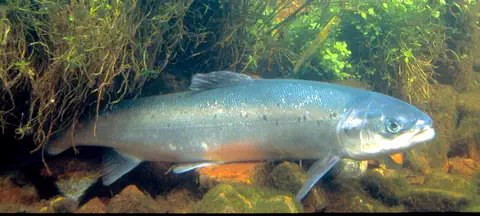
The Atlantic salmon hatches in a river, swims out to the North Atlantic Ocean to feed and grow, then returns to the very river where it was born to lay its eggs. Along the way it changes color and shape several times.
-
 Watch
3D
Animal
Atlantic puffin
The Atlantic puffin is a small seabird of the North Atlantic, often called the clown of the sea because of its huge, colorful bill. It spends most of its life far out on the ocean and comes ashore only in summer to nest in burrows on islands and cliff tops. Underwater, its small wings work like flippers.
-
 Watch
3D
Animal
Atlantic herring
The Atlantic herring is a small, silvery fish of the cold North Atlantic. Herring swim in enormous schools, eat tiny floating plankton, and lay their sticky eggs on the sea floor. Whales, seabirds and many fish depend on them for food, and people have fished for them for hundreds of years.
-
 Watch
3D
Animal
Atlantic mackerel
The Atlantic mackerel is a sleek, shiny fish of the North Atlantic Ocean, with a blue-green back covered in wavy black bars and a silvery white belly. Mackerel swim in large schools near the surface, eat tiny crustaceans and lay floating eggs. Many fish and sea mammals eat them, and so do people.
-
 Watch
Animal
Snowy owl
The snowy owl is a large white owl that nests on the Arctic tundra. Unlike most owls it hunts in daylight, and in the endless light of an Arctic summer it may hunt at any hour. Lemmings are its favorite food.
-
 Watch
3D
Animal
Stoat
The stoat is a small, slender hunter with a long body, short legs and a black-tipped tail. It lives across the northern parts of Europe, Asia and North America, and in snowy places some stoats turn white in winter.
-
 Watch
Animal
Common starfish
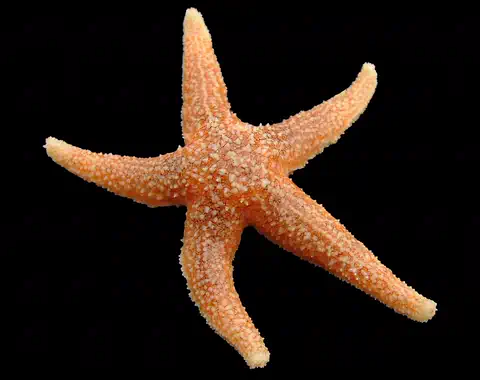
The common starfish is the most familiar starfish of the north-east Atlantic coasts. It has five arms, an eye spot at the tip of each one, and many tube feet. It can pull open a mussel shell and push its own stomach inside to eat.
-
 Watch
Animal
European herring gull
The European herring gull is a large, noisy gull of European coasts, with a pale gray back, pink legs and a yellow bill marked with a red spot. It eats almost anything, from crabs and fish to scraps people throw away, and many now nest on rooftops in towns. Even so, its numbers are falling in many places.
-
 Watch
Animal
Lion's mane jellyfish
The lion's mane jellyfish is one of the biggest jellyfish in the world. Its bell is usually 30 to 50 centimeters across, but in very cold seas it can grow to about 2 meters, and hundreds of long, hair-like tentacles trail beneath it to catch food.
Explore next
-
Watch
Natural wonder
Svalbard
Svalbard is a group of Arctic islands, part of Norway, far north of the Arctic Circle. Glaciers and snowfields cover nearly 60 percent of the land. Polar bears hunt seals on the sea ice, walruses rest on the beaches, and inside a mountain on Spitsbergen the world keeps a frozen store of seeds.
-
Watch
City
Oslo
Oslo, the capital of Norway, lies at the head of the Oslo Fjord. It was founded about 1050, burned down in 1624 and was rebuilt under a new name, Christiania, before taking back the name Oslo in 1925. About 729,000 people lived there in 2026.
-
Watch
Animal
Polar bear
The polar bear is a huge bear that lives on the frozen sea of the Arctic. Thick fur and a layer of fat keep it warm, its amazing nose finds seals under the snow, and it can swim for many hours. It needs sea ice to hunt, so a warming Arctic is a big problem for it.
-
Watch
3D
Animal
Reindeer
Reindeer, called caribou in North America, are deer of the Arctic tundra and northern forests. They are the only deer in which females grow antlers too. Some herds walk thousands of kilometers a year, and people in northern Europe and Asia have herded reindeer for a very long time.
-
Watch
3D
Animal
Atlantic cod
The Atlantic cod is a large, speckled fish of the cold North Atlantic. It has a whisker-like barbel on its chin and three fins along its back. For hundreds of years people have caught cod for food, so many that some cod populations crashed and are still being rebuilt today.
-
Watch
Animal
Atlantic salmon
The Atlantic salmon hatches in a river, swims out to the North Atlantic Ocean to feed and grow, then returns to the very river where it was born to lay its eggs. Along the way it changes color and shape several times.
-
Watch
Life around the world
The polar night in Tromsø, Norway
Tromsø lies far north of the Arctic Circle. From about 26 November to 17 January the sun stays below the horizon all day, a time called mørketid in Norwegian, the dark time. Around midday there are still a few hours of twilight. People wear reflectors on dark roads, and a study found that people farther north in Norway tended to feel more positive about winter.
-
Watch
3D
Animal
Atlantic puffin
The Atlantic puffin is a small seabird of the North Atlantic, often called the clown of the sea because of its huge, colorful bill. It spends most of its life far out on the ocean and comes ashore only in summer to nest in burrows on islands and cliff tops. Underwater, its small wings work like flippers.
For parents & teachers
What children will learn
- Locate Norway and Svalbard and describe how far north the country reaches.
- Explain how glaciers carved Norway's fjords and why a warm current keeps the coast mild.
- Name some of Norway's wildlife, from reindeer and moose to Svalbard's polar bears.
- Recognize the Sámi as Norway's first known people and outline Norway's path to independence in 1905.
Recommended ages: 3 to 17 · About 15 minutes
Talk about it
- In Tromsø the Sun can be seen all day and night from late May to late July. How might that change everyday life?
- Why do you think most people in Norway live near the coast?
- Norway has two written forms of its language. Why might people care about how a language is written?
Try at home or in class
- Make a fjord: shape a V-shaped valley in a tray of damp sand, drag an ice cube down it to widen it into a U, then pour in water.
- Put a bowl of cold water in a tray and run warm tap water around it; feel how a warm current changes the temperature nearby.
Key vocabulary: fjord, glacier, Arctic Circle, peninsula, Sámi, midnight sun
Where these facts come from
- Wikidata , Wikimedia Foundation (CC0 1.0)
- Natural Earth vector data , Natural Earth (NACIS) (Public domain)
- UNESCO World Heritage List , UNESCO World Heritage Centre (Linked as a reference; site facts come from Wikidata)
- Norway , Encyclopaedia Britannica
- Norway: Climate, plant and animal life, ethnic groups , Encyclopaedia Britannica
- Norway: Languages and religion , Encyclopaedia Britannica
- Norway: Daily life and social customs , Encyclopaedia Britannica
- Norway: Earliest peoples , Encyclopaedia Britannica
- Norway: The union conflict, 1859–1905 , Encyclopaedia Britannica
- Svalbard , Encyclopaedia Britannica
- Population (quarterly and 1 January 2026) , Statistics Norway (SSB)
- Polar bear , Norwegian Polar Institute
- West Norwegian Fjords – Geirangerfjord and Nærøyfjord , UNESCO World Heritage Centre
- Rock Art of Alta , UNESCO World Heritage Centre
- Bryggen , UNESCO World Heritage Centre
- Oslo , Encyclopaedia Britannica
- Tromsø , Encyclopaedia Britannica
- Jostedals Glacier , Encyclopaedia Britannica
- Galdhø Peak , Encyclopaedia Britannica
- Sami , Encyclopaedia Britannica
- PlayOwl region table, version 1 , PlayOwl (PlayOwl original data)
- flag-icons 7.5.0 , Panayiotis Lipiridis and contributors (MIT)
- Wikimedia Commons , Wikimedia Foundation (Per file (public domain, CC0, CC BY or CC BY-SA); see each media record)
Checked, not yet human-reviewed. Last updated October 24, 2026. Spotted a mistake? Tell us.
Picture credits
- Photo: Diego Delso, CC BY-SA 4.0, via Wikimedia Commons · source · license
- Photo: W. Bulach, CC BY-SA 4.0, via Wikimedia Commons · source · license
- Photo: Holger Uwe Schmitt, CC BY-SA 4.0, via Wikimedia Commons · source · license
- Photo: Per Harald Olsen – User Perhols on no.wikipedia, CC BY 2.5, via Wikimedia Commons · source · license
- Photo: Svein-Magne Tunli - tunliweb.no, CC BY-SA 4.0, via Wikimedia Commons · source · license
- Photo: Jørn Eriksson, CC BY 2.0, via Wikimedia Commons · source · license