
City Europe
Birmingham
Birmingham is a big city in the middle of England. Long ago its workshops made nails, jewelry and steam engines.
Birmingham is the second-biggest city in Britain after London, with an estimated 1,176,960 people in mid-2025. It sits in the middle of the country, where railways, motorways and canals meet, and it grew very fast in the Industrial Revolution as a city of makers.
Birmingham, Britain's second city, specialized from the 16th century in finished metal goods, then jewelry in the 18th century and steam engines in the 19th. It grew from 70,000 people in 1801 to a peak of 1,113,000 in 1951; by 1993 services gave most of its jobs.
Photo: JimmyGuano, CC BY-SA 4.0, via Wikimedia Commons
Discover Birmingham
Birmingham is a big city in England. It is right in the middle of the country.
More than a million people live there.
Birmingham is a city in the West Midlands of England. Britain's Office for National Statistics estimated that 1,176,960 people lived in Birmingham's local authority area on 30 June 2025.
Universalis calls Birmingham the second city of Britain, after London. Its central position makes it an important meeting point for railways, motorways and canal boats.
City Population's table of UK local authorities (ONS mid-year estimates) gives Birmingham Metropolitan Borough 1,029,200 people in 1981, 984,600 in 2001, 1,074,283 in 2011, 1,143,285 in 2021 and 1,176,960 on 30 June 2025; the West Midlands metropolitan county had 3,027,190 (2025). The Birmingham built-up area had 1,161,326 in mid-2024.
Universalis (Claude Moindrot): the city is the main town of the West Midlands county.
- Country
- United Kingdom (England, West Midlands)
- People in Birmingham (estimate, 30 June 2025)
- 1,176,960
- People in the West Midlands county (same date)
- 3,027,190
- Rank in Britain
- second city, after London
The skyline from Edgbaston
Look at the tall city buildings behind the green trees! One tower is shiny blue-green.
On the left, a tall pointed spire points up to the sky.
This view of Birmingham's skyline was taken from Edgbaston Cricket Ground on 9 June 2012. Tall blocks and towers rise behind a wide band of green trees, including a round, shiny blue-green tower in the middle and a thin tower with antennas on the left. A pointed red-brick spire and red roofs stand in front.
Edgbaston Cricket Ground opened in 1882 and holds 21,000 people, Wikidata says.
Commons: 'Birmingham-Skyline-from-Edgbaston-crop' (made 2 August 2014), a crop of the photographer's 'Birmingham Skyline from Edgbaston Cricket Ground', dated 9 June 2012, own work by JimmyGuano (the crop CC BY-SA 4.0; the original GFDL and CC BY-SA 3.0); in 'Skylines of Birmingham'.
Wikidata: Edgbaston Cricket Ground opened in 1882, capacity 21,000, 2.46 km south of Birmingham New Street station.
- Photo
- the skyline from Edgbaston Cricket Ground, 9 June 2012
- Edgbaston Cricket Ground
- opened 1882; 21,000 seats
- Library of Birmingham
- opened 3 September 2013
A city of makers
Long ago, people in Birmingham made nails and blades. Later they made jewelry and little trinkets, and then steam engines.
The town grew and grew into a huge city.
Universalis says Birmingham became a metalworking town as early as the 16th century, near the coal and iron of the Black Country. It left the heavy iron-making to its neighbors and made finished goods: first nails, blades and harnesses, then jewelry and small trinkets in the 18th century, and steam engines in the 19th.
The Industrial Revolution made it grow very fast: from 70,000 people in 1801 to 1,113,000 in 1951, its highest count.
Universalis: specialization in high-value finished products; in the 20th century, bicycles, cars, electronics, machine tools, electrical equipment and telephone equipment were added, giving Birmingham Britain's most varied industry.
City planning (a rebuilt center, the Bull Ring Centre, a ring road) then caused a slight fall in population. From the late 1970s an economic crisis cost many factory jobs; by 1993 services such as finance and tourism had 78% of jobs.
- Metalworking
- from the 16th century
- People in 1801
- 70,000
- Most people ever (1951)
- 1,113,000
Railways, roads and canals
Many trains, roads and canals meet in Birmingham. Planes fly from Birmingham Airport, east of the city center.
Universalis says Birmingham's central position in Britain makes it an important crossroads for railways, motorways and canal boats. Birmingham New Street railway station dates from 1854, Wikidata says. City planning later added a ring road around the center.
Birmingham Airport opened in 1939 and lies about 10.5 kilometers east-southeast of New Street station.
Universalis: an important rail, motorway and inland-waterway hub; city planning added a ring road.
Wikidata: Birmingham New Street railway station, opened 1854; Birmingham Airport (Bickenhill), opened 1939, 10.55 km ESE of New Street; Library of Birmingham 0.69 km WNW of New Street.
- Birmingham New Street station
- opened 1854 (Wikidata)
- Birmingham Airport
- opened 1939; about 10.5 km east-southeast of New Street
- Hub for
- railways, motorways and canal boats
Mild and often rainy
Birmingham has cool winters and mild summers. It rains a little in every month.
The World Meteorological Organization's averages for Birmingham (1981–2010) give July days an average high of about 21 °C, while February nights average about 1 °C.
About 805 millimeters of rain fall in a year, spread through all the months, on about 131 days. October is the wettest month, with about 83 millimeters.
WMO World Weather Information Service, Birmingham (1981–2010): average highs from 6.7 °C in January to 21.3 °C in July; average lows from 1.1 °C in February to 12.1 °C in July. Rainfall 805.0 mm on 131 days with at least 1 mm; February 51.4 mm is the driest month, October 82.7 mm the wettest.
Every month has at least 9 rain days in this table.
- July, average high (WMO, 1981–2010)
- 21.3 °C
- February, average low (same table)
- 1.1 °C
- Days with at least 1 mm of rain
- about 131 a year
Jewelry, cricket and books
Birmingham has a part of town called the Jewellery Quarter. It also has a library that opened in 2013 and a big cricket ground.
Jewelry has been made in Birmingham since the 18th century, Universalis says, and one area of the city is still called the Jewellery Quarter. The Library of Birmingham opened on 3 September 2013, Wikidata says.
By 1993 most jobs were in services, such as finance and tourism, but industry, turned to high technology, stayed part of the city's landscape. Its two universities work closely with industry.
Universalis: services (finance, tourism) reached 78% of jobs by 1993; industry, converted to high technology, has nonetheless stayed in Birmingham's landscape; two universities with close ties to industry.
Wikidata: Jewellery Quarter, area of Birmingham, 1.46 km NNW of New Street; Library of Birmingham, opened 2013-09-03.
- Jewellery Quarter
- an area of the city, about 1.5 km north-northwest of New Street
- Two universities
- with close links to industry
- Jobs in services (1993)
- 78%
Birmingham on the map
Find Great Britain on the globe. Birmingham is in the middle of England.
Birmingham lies at about 52.5° north, near the middle of Great Britain. Measured from New Street station, the Library of Birmingham is about 700 meters west-northwest, the Jewellery Quarter about 1.5 kilometers north-northwest and Edgbaston Cricket Ground about 2.5 kilometers south.
The airport is about 10.5 kilometers east-southeast.
Birmingham lies at about 52.48° N and 1.90° W. From Birmingham New Street station (Wikidata points): Library of Birmingham 0.69 km WNW, Jewellery Quarter 1.46 km NNW, Edgbaston Cricket Ground 2.46 km S, Birmingham Airport 10.55 km ESE.
Universalis: next to the Black Country coalfield, with its iron ore.
- Latitude
- about 52.5° north
- Longitude
- about 1.9° west
- Setting
- central Britain, next to the Black Country coalfield
Amazing facts
-
Birmingham made steam engines long ago!
Universalis says Birmingham made nails and blades, then jewelry in the 18th century and steam engines in the 19th.
Universalis: nails, blades and harnesses first; 18th-century jewelry and trinkets; 19th-century steam engines; 20th-century bicycles, cars and electronics.
-
Birmingham grew from a town into a city of more than a million people.
Birmingham had about 70,000 people in 1801 and 1,113,000 in 1951, its highest count, Universalis says.
Universalis: 70,000 in 1801, 1,113,000 in 1951 (the maximum), then a slight fall after big city-planning works.
-
One part of Birmingham is called the Jewellery Quarter!
Birmingham has made jewelry since the 18th century, and one area of the city is called the Jewellery Quarter.
Universalis dates jewelry-making to the 18th century; Wikidata lists the Jewellery Quarter as an area of Birmingham.
-
Birmingham has a big cricket ground called Edgbaston.
Edgbaston Cricket Ground opened in 1882 and holds about 21,000 people, Wikidata says.
Wikidata: Edgbaston Cricket Ground, opened 1882, capacity 21,000; the hero photo was taken from it.
Words to know
- Industrial Revolution
- the time, from the late 1700s, when machines and factories changed how things were made
- metalworking
- making things out of metal, such as nails, tools or engines
- steam engine
- a machine that uses the push of steam to make things move
- canal
- a waterway dug by people for boats to carry goods
- skyline
- the outline of a city's buildings against the sky
- services
- work that helps people instead of making things, such as banking, shops and tourism
Discovery challenge
-
Birmingham is a city in which country?
Birmingham is the second city of which country, after London?
Birmingham is the main town of the West Midlands county in which country?
- Ireland
- The United Kingdom
- Canada
Show the answer
The United Kingdom
The United Kingdom, in England!
The United Kingdom.
The United Kingdom (England).
-
What did Birmingham make in the 1800s?
Which machines did Birmingham make in the 19th century?
Universalis says which product became a Birmingham specialty in the 19th century?
- Steam engines
- Spaceships
- Smartphones
Show the answer
Steam engines
Steam engines!
Steam engines.
Steam engines.
-
What is one part of Birmingham called?
Which area of Birmingham lies about 1.5 kilometers north-northwest of New Street station?
Which Birmingham area does Wikidata place 1.46 km NNW of New Street station?
- The Jewellery Quarter
- The Gold Coast
- The Silver Lake
Show the answer
The Jewellery Quarter
The Jewellery Quarter!
The Jewellery Quarter.
The Jewellery Quarter.
-
About how many people lived in Birmingham in 1801?
Birmingham had how many people in 1801, before it grew to over a million?
Universalis gives Birmingham's population in 1801 as about how many?
- 70,000
- 7,000,000
- 700
Show the answer
70,000
About 70,000!
About 70,000.
70,000.
-
What sport is played at Edgbaston in Birmingham?
The photo of Birmingham was taken from Edgbaston. What kind of sports ground is it?
Wikidata lists Edgbaston (opened 1882, 21,000 seats) as which kind of ground?
- Cricket
- Ice hockey
- Skiing
Show the answer
Cricket
Cricket!
A cricket ground.
A cricket ground.
Nearby places
-
 Watch
City
Oxford
Oxford is a city in England, on the River Thames upstream from London. It is known above all for its university, which Universalis calls Britain's oldest. In mid-2024 about 166,034 people lived in the city, according to an official estimate.
-
 Watch
City
Cardiff
Cardiff is the capital of Wales, part of the United Kingdom. It grew fast in the 1800s as a port shipping coal: from fewer than 2,000 people in 1801 to 200,000 in 1901. The Office for National Statistics estimated 381,516 people in Cardiff in mid-2025.
-
 Watch
Landmark
Windsor Castle
Windsor Castle stands above the River Thames, west of London. William the Conqueror built the first castle here in the 1070s, and kings and queens have lived in it ever since. It is still a working royal home, and visitors can tour its grand rooms and chapel.
-
 Watch
Landmark
Stonehenge
Stonehenge is a prehistoric monument on Salisbury Plain in England. It began as a round earthwork about 5,000 years ago, and its stone circle went up about 2500 BC. Hundreds of people moved huge stones, some from Wales, and lined them up with the sun.
-
 Watch
Landmark
Kew Gardens
Kew Gardens, the Royal Botanic Gardens in south-west London, began as a small garden in 1759. Today it covers 132 hectares beside the River Thames, with huge glasshouses and enormous collections of plants. Scientists here have studied plants from around the world for more than 260 years.
-
 Watch
Landmark
British Museum
The British Museum in London was founded in 1753 and opened in 1759. It holds treasures from all over the world, like the Rosetta Stone, which helped people learn to read Egyptian hieroglyphs. Its grand building with columns was built from 1823 to 1847, and in 2025 it had more than 6.4 million visits.
-
 Watch
Landmark
Buckingham Palace
Buckingham Palace began as a big house built for the Duke of Buckingham. King George III bought it in 1761, and King George IV had the architect John Nash turn it into a palace. Since 1837 it has been the London home of Britain's kings and queens. It has 775 rooms.
-
 Watch
Landmark
Royal Opera House
The Royal Opera House stands in Covent Garden, in London. It is the third theater on its site: the first opened in 1732, and the building you see today opened in 1858. It is the home of The Royal Opera and The Royal Ballet.
Explore next
-
 Watch
 Country
United Kingdom
The United Kingdom, or UK, lies on islands off the northwest coast of Europe. It is made up of four parts, England, Scotland, Wales and Northern Ireland, and about 69.5 million people live there. Its capital is London.
-
 Watch
City
London
London, the capital of the United Kingdom, began as a Roman town almost 2,000 years ago. About 8.8 million people lived in Greater London in 2021. It has the Tower of London, Big Ben, Tower Bridge and the Tube, an underground railway that opened in 1863.
-
 Watch
City
Glasgow
Glasgow is a city in Scotland, on the River Clyde. It has had a university since 1451, and around 1900, Universalis says, Glasgow and Clydebank had the largest shipyards in the world. National Records of Scotland estimated 654,330 people in Glasgow City in mid-2025, more than in any other part of Scotland.
-
 Watch
City
Edinburgh
Edinburgh is the capital of Scotland, on the southern shore of the Firth of Forth. Its Old Town runs along a ridge from a castle on a volcanic rock, and its New Town, built from 1767, has straight streets and stone buildings. Scotland's statistics office estimated that 531,370 people lived in the City of Edinburgh in mid-2025.
-
Watch
City
Cardiff
Cardiff is the capital of Wales, part of the United Kingdom. It grew fast in the 1800s as a port shipping coal: from fewer than 2,000 people in 1801 to 200,000 in 1901. The Office for National Statistics estimated 381,516 people in Cardiff in mid-2025.
-
 Watch
City
Amsterdam
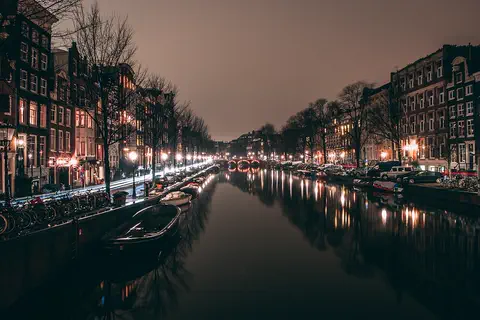
Amsterdam is the capital of the Netherlands. It began as a fishing village beside a dam on the Amstel River, which gave the city its name. Today about 942,000 people live among its rings of canals, hundreds of bridges, houseboats and bicycles.
-
 Watch
City
Antwerp
Antwerp is a city in Belgium on the Scheldt river, and Universalis calls it the second port of continental Europe, after Rotterdam. Belgium's statistics office estimated 565,615 people in the city on 1 January 2026. In the 1500s it was one of Europe's great trading cities.
-
 Watch
City
Athens
Athens is the capital of Greece and one of the oldest cities in the world. Above it rises the Acropolis, a rocky hill crowned by the marble Parthenon, built about 2,500 years ago. Ancient Athens was home to early democracy, great thinkers and theater.
For parents & teachers
What children will learn
- Locate Birmingham in the middle of England.
- Explain how being a crossroads of railways, roads and canals helps a city grow.
- Describe how a city's work can change from factories to services.
- Read a climate table and find the wettest and driest months.
Recommended ages: 3 to 17 · About 15 minutes
Talk about it
- Birmingham changed from making things to giving services. What jobs do people near you do?
- Birmingham made nails, jewelry and steam engines. Why might one city make so many different things?
- Canals once carried goods. Why might boats be a good way to move heavy loads?
Try at home or in class
- Population line: plot Birmingham's 1801, 1951 and 2025 numbers on a line graph.
- Canal boat: build a small boat from a carton and see how much weight it can carry in a tub of water.
- Rain chart: plot Birmingham's monthly rainfall and find the driest month.
Key vocabulary: Industrial Revolution, metalworking, steam engine, canal, skyline, services
Where these facts come from
- Wikidata , Wikimedia Foundation (CC0 1.0)
- Natural Earth vector data , Natural Earth (NACIS) (Public domain)
- United Kingdom: Counties and Districts , City Population (Thomas Brinkhoff), from the Office for National Statistics
- West Midlands (Region, United Kingdom): Built-up Areas , City Population (Thomas Brinkhoff), from the Office for National Statistics
- Birmingham, Royaume-Uni , Encyclopaedia Universalis (Claude Moindrot)
- Birmingham: climatological information , World Meteorological Organization, World Weather Information Service (United Kingdom)
- File:Birmingham-Skyline-from-Edgbaston-crop.jpg (JimmyGuano, a 2014 crop of a photo dated 9 June 2012) , Wikimedia Commons
- File:Birmingham Skyline from Edgbaston Cricket Ground.jpg (JimmyGuano, 9 June 2012; the original of the crop) , Wikimedia Commons
- Wikimedia Commons , Wikimedia Foundation (Per file (public domain, CC0, CC BY or CC BY-SA); see each media record)
Checked, not yet human-reviewed. Last updated November 1, 2026. Spotted a mistake? Tell us.