
City Europe
Oxford
Oxford is a city in England with a very old university. It has many towers and spires.
Oxford is a city in England, on the River Thames upstream from London. It is known above all for its university, which Universalis calls Britain's oldest. In mid-2024 about 166,034 people lived in the city, according to an official estimate.
Oxford lies on the Thames upstream of London, where the river cuts through a ridge of limestone. Schools of logic and theology grew there in the late 12th century and became a university with its own statutes in 1214; car making arrived in 1912. ONS estimate 30 June 2024: 166,034 (Oxford district).
Photo: Andrew Gray, CC BY-SA 3.0, via Wikimedia Commons
Discover Oxford
Oxford is a city in England. A river called the Thames flows past it.
Oxford has a very old university, where students come to learn.
Oxford lies on the River Thames, upstream from London, at the place where the river cuts through a ridge of limestone, Universalis says. Several rivers meet there, which helped Oxford become a crossroads for roads and railways.
In mid-2024 the city had about 166,034 people, according to the official estimate. Its fame comes above all from its university, which Universalis calls the oldest in Britain.
Universalis: a city of England (134,000 inhabitants in 2001) on the Thames upstream of London, where the river breaks through the cuesta of Corallian limestone; a remarkable convergence of rivers favored its role as a rail and road junction; its reputation rests above all on the oldest British university and, with Cambridge's, the most famous.
Office for National Statistics (via City Population), Oxford district: 134,248 (census 2001), 151,906 (2011), 162,041 (2021) and 166,034 (estimate, 30 June 2024).
- Country
- United Kingdom (England)
- People in Oxford (estimate, 30 June 2024)
- 166,034
- People at the 2021 census
- 162,041
- River
- the Thames, upstream from London
Towers and a dome above the trees
Look at the pointed towers and the big round dome! Fields and trees are in front, and the sky is gray.
This photo shows Oxford from Boars Hill, a village southwest of the city, on 30 September 2007. Across green fields and trees, the city's pale buildings rise with many pointed spires, square towers and a large pale dome.
Two construction cranes stand on the left, and wooded hills line the horizon under a gray sky.
Commons: own work by Andrew Gray, 30 September 2007, first posted on Flickr, GFDL and CC BY-SA 3.0; description: 'Oxford, photographed from Boars Hill'. Wikidata places the village of Boars Hill 4.55 km SW of the city point.
In the picture: a red-roofed house with two chimneys, fields with hedges and large trees in front; the pale skyline of the city, with spires, pinnacled towers and a large dome among the roofs; an electricity pylon and two tower cranes at the left; wooded hills on the horizon; a heavy gray sky.
- Photo
- Oxford from Boars Hill, 30 September 2007
- Boars Hill
- a village about 4.6 km southwest of the city's Wikidata point (Wikidata)
- Radcliffe Camera
- a library building, dated to 1748 on Wikidata
Schools that became a university
Long ago, teachers started schools in Oxford. The schools grew into a university more than 800 years ago!
In the second half of the 12th century, important schools of logic and theology grew up in Oxford, in ways that are not well known, Universalis says. In 1214 they were joined into a real university and given their first statutes and rights.
Factories came much later, in the 20th century. William Morris set up a bicycle and car factory in the suburb of Cowley, and the first Morris car came out in 1912.
Universalis (the page's excerpt from its article on the University of Oxford): in poorly known circumstances, important schools of logic and theology formed in Oxford in the second half of the 12th century; in 1214 they were united into a true university, receiving their first statutes and privileges.
Universalis ('Oxford, Royaume-Uni'): industry appeared only in the 20th century but grew fast; William Morris founded a cycle and car works in the suburb of Cowley (the first Morris car came out in 1912), now owned by BMW and still the town's main industrial activity.
- Late 12th century
- important schools of logic and theology grow up in Oxford
- 1214
- the schools are joined into a university with its first statutes
- 1912
- the first Morris car is made in Cowley
A meeting place of rivers, roads and railways
Rivers come together at Oxford. Trains and roads meet there too.
Oxford stands where rivers come together, Universalis says, and that helped it become a meeting point for roads and railways. The River Cherwell is a tributary of the Thames, Wikidata says.
Oxford's main railway station lies about 0.9 kilometers west of the city's center point on Wikidata, which gives 1852 as its opening year. A crossroads in the center of the city is called Carfax.
Universalis: 'a remarkable hydrographic convergence favored its role as a rail and road junction'.
Wikidata (from the city point Q34217): Carfax (Q1035968), a crossroads and central area, 0.02 km WNW; Oxford railway station (Q1880536), official opening 1852, 0.88 km W; River Cherwell (Q1070474), a tributary of the Thames, its item point 1.26 km SSE.
- Crossroads
- rivers meet here, which helped make Oxford a rail and road junction
- Oxford railway station
- about 0.9 km west of the city's Wikidata point; opening year 1852 on Wikidata
- River Cherwell
- a tributary of the Thames (Wikidata)
Mild, damp and often sunny
Oxford has cool winters and mild summers. It rains a little on many days of the year.
At the Radcliffe Observatory weather station, the average temperature for 1991 to 2020 was 11.1 °C. January is the coldest month, with an average of 5.2 °C, and July the warmest, with 18.1 °C.
About 676 millimeters of rain and snow fall in a year, on about 166 days. The driest time of year is late winter to early spring, and the wettest is autumn: March averages 43 millimeters and October 72. Even so, the sun shines on about 296 days a year.
University of Oxford, School of Geography and the Environment, Radcliffe Meteorological Station, 1991–2020: mean temperature 11.1 °C (mean daily maximum 15.0 °C, mean daily minimum 7.1 °C); January coldest (mean 5.2 °C), July warmest (18.1 °C). Annual precipitation 676 mm on 166 days; March averages 43 mm and October 72 mm, with wide variation from year to year. Sunshine 1,612 hours a year, recorded on 296 days on average; snow falls on around 16 days in a typical year.
- Average temperature (Radcliffe Observatory, 1991–2020)
- 11.1 °C (January 5.2 °C, July 18.1 °C)
- Rain and snow in a year
- 676 mm, on about 166 days
- Weather records
- kept at the same site since 1772
Colleges, cars and visitors
Most people in Oxford work in services, like offices and shops. Cars are made there too, and visitors come to see the colleges.
In the 21st century most people in Oxford work in services, Universalis says: 89 percent of working people in 2008. The car works at Cowley, now owned by BMW, is still its main industry.
Visitors come to see the university's colleges, most of them from other countries, Universalis says. The Bodleian Library, the university's main research library, has an opening year of 1602 on Wikidata.
Universalis: long one of the main industrial centers of the London basin, Oxford has in the 21st century largely turned to services (89% of the working population in 2008); the Cowley car works remains the main industrial activity; the appeal of its university colleges has made it a tourist center attracting mostly foreigners.
Wikidata: Bodleian Library (Q82133), main research library of the University of Oxford, official opening 1602, 0.29 km NE of the city point; Radcliffe Camera (Q1602700), a library building, 1748, 0.31 km ENE.
- Work in 2008
- 89% of working people in services (Universalis)
- Main industry
- the car works at Cowley, now owned by BMW
- Bodleian Library
- the University of Oxford's main research library; opening year 1602 on Wikidata
Oxford on the map
Find Great Britain on the globe. Oxford is in England, up the River Thames from London.
Oxford lies at about 51.8° north, on the River Thames upstream from London.
Measured from the city's center point on Wikidata, the Bodleian Library is about 0.3 kilometers northeast, the Radcliffe Camera about 0.3 kilometers east-northeast, the railway station about 0.9 kilometers west and Boars Hill, where the photo was taken, about 4.6 kilometers southwest.
Oxford lies at about 51.77° N and 1.25° W (Natural Earth point, 2.12 km NNE of the Wikidata point). From the Wikidata point (Q34217): Bodleian Library 0.29 km NE; Radcliffe Camera 0.31 km ENE; Oxford railway station 0.88 km W; Boars Hill (Q676053) 4.55 km SW. The Radcliffe Meteorological Station is in the garden of Green Templeton College, next to the Radcliffe Observatory building, off Woodstock Road.
- Latitude
- about 51.8° north
- Longitude
- about 1.3° west
- Region
- southern England, on the Thames upstream from London
Amazing facts
-
People in Oxford have written down the weather for more than 250 years!
Weather records at the Radcliffe Observatory in Oxford began in 1772. The university says they are the longest weather records from a single place in the United Kingdom.
Radcliffe Meteorological Station: records from 1772; unbroken daily air temperature from November 1813, daily rainfall from January 1827, sunshine from February 1880; 'the longest single-site weather records in the United Kingdom'.
-
In Oxford the sun shines on more days than the rain falls.
In Oxford, sunshine is recorded on about 296 days a year, almost twice as many as the 166 days with rain, the university's weather station says.
Radcliffe Meteorological Station: sunshine is recorded on 296 days a year on average, almost twice as many as days with measurable rainfall (166).
-
Cars have been made in Oxford for more than 100 years.
The first Morris car came out of the Cowley works in Oxford in 1912, Universalis says.
Universalis: William Morris founded a cycle and car works at Cowley; the first Morris car came out in 1912; the works now belongs to BMW.
-
Even in Oxford's driest months long ago, a little rain still fell.
No calendar month in Oxford's records since 1767 has been completely dry; the driest, April 1817 and April 2011, each got just 0.5 millimeters.
Radcliffe Meteorological Station: no calendar month since 1767 has been completely dry; April 1817 and April 2011 each received 0.5 mm.
Words to know
- university
- a place where people study and do research after school
- college
- at Oxford, one of the many communities of students and teachers that make up the university
- spire
- a tall, pointed top on a tower
- tributary
- a river that flows into a bigger river
- statutes
- written rules that say how a place or group is run
- census
- an official count of all the people in a place
Discovery challenge
-
Oxford is a city in which country?
Oxford is a city in which country of the United Kingdom?
Universalis calls Oxford a city of which country?
- England
- Brazil
- Egypt
Show the answer
England
England!
England.
England.
-
Which river flows past Oxford?
Oxford lies on which river, upstream from London?
Oxford stands where which river cuts through a limestone ridge?
- The Thames
- The Amazon
- The Volga
Show the answer
The Thames
The Thames!
The Thames.
The Thames.
-
What is Oxford most famous for?
Universalis says Oxford's fame rests above all on what?
Oxford's reputation rests above all on which institution, which Universalis calls Britain's oldest of its kind?
- Its university
- Its beaches
- Its volcano
Show the answer
Its university
Its university!
Its university.
The University of Oxford.
-
What has been made in Oxford since 1912?
What came out of the Cowley works in Oxford for the first time in 1912?
Universalis says the Cowley works produced which first vehicle in 1912?
- A car
- An airplane
- A ship
Show the answer
A car
Cars!
The first Morris car.
The first Morris car.
-
When did people start writing down Oxford's weather at the Radcliffe Observatory?
In which year did weather records begin at the Radcliffe Observatory?
Meteorological records at the Radcliffe Observatory site commenced in which year?
- 1772
- 1972
- 1572
Show the answer
1772
1772!
1772.
1772.
Nearby places
-
 Watch
Landmark
Windsor Castle
Windsor Castle stands above the River Thames, west of London. William the Conqueror built the first castle here in the 1070s, and kings and queens have lived in it ever since. It is still a working royal home, and visitors can tour its grand rooms and chapel.
-
 Watch
Landmark
Kew Gardens
Kew Gardens, the Royal Botanic Gardens in south-west London, began as a small garden in 1759. Today it covers 132 hectares beside the River Thames, with huge glasshouses and enormous collections of plants. Scientists here have studied plants from around the world for more than 260 years.
-
 Watch
Landmark
Stonehenge
Stonehenge is a prehistoric monument on Salisbury Plain in England. It began as a round earthwork about 5,000 years ago, and its stone circle went up about 2500 BC. Hundreds of people moved huge stones, some from Wales, and lined them up with the sun.
-
 Watch
Landmark
Buckingham Palace
Buckingham Palace began as a big house built for the Duke of Buckingham. King George III bought it in 1761, and King George IV had the architect John Nash turn it into a palace. Since 1837 it has been the London home of Britain's kings and queens. It has 775 rooms.
-
 Watch
Landmark
British Museum
The British Museum in London was founded in 1753 and opened in 1759. It holds treasures from all over the world, like the Rosetta Stone, which helped people learn to read Egyptian hieroglyphs. Its grand building with columns was built from 1823 to 1847, and in 2025 it had more than 6.4 million visits.
-
 Watch
Landmark
Royal Opera House
The Royal Opera House stands in Covent Garden, in London. It is the third theater on its site: the first opened in 1732, and the building you see today opened in 1858. It is the home of The Royal Opera and The Royal Ballet.
-
 Watch
Landmark
Big Ben
Big Ben is the nickname of the Great Bell inside the clock tower of the Houses of Parliament in London. The tower, 96 meters tall, was begun in 1843, and its clock started keeping time in 1859. Since 2012 the tower has been called the Elizabeth Tower.
-
 Watch
Landmark
London Eye
The London Eye is a huge observation wheel, 135 meters tall, on the South Bank of the River Thames in London. It was built for the year 2000, the new millennium. Its 32 glass capsules carry up to 25 people each, and the wheel turns so slowly that people step on while it moves.
Explore next
-
 Watch
 Country
United Kingdom
The United Kingdom, or UK, lies on islands off the northwest coast of Europe. It is made up of four parts, England, Scotland, Wales and Northern Ireland, and about 69.5 million people live there. Its capital is London.
-
 Watch
City
London
London, the capital of the United Kingdom, began as a Roman town almost 2,000 years ago. About 8.8 million people lived in Greater London in 2021. It has the Tower of London, Big Ben, Tower Bridge and the Tube, an underground railway that opened in 1863.
-
 Watch
City
Edinburgh
Edinburgh is the capital of Scotland, on the southern shore of the Firth of Forth. Its Old Town runs along a ridge from a castle on a volcanic rock, and its New Town, built from 1767, has straight streets and stone buildings. Scotland's statistics office estimated that 531,370 people lived in the City of Edinburgh in mid-2025.
-
 Watch
City
Amsterdam
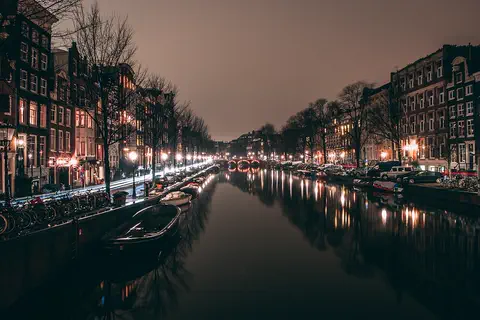
Amsterdam is the capital of the Netherlands. It began as a fishing village beside a dam on the Amstel River, which gave the city its name. Today about 942,000 people live among its rings of canals, hundreds of bridges, houseboats and bicycles.
-
 Watch
City
Antwerp
Antwerp is a city in Belgium on the Scheldt river, and Universalis calls it the second port of continental Europe, after Rotterdam. Belgium's statistics office estimated 565,615 people in the city on 1 January 2026. In the 1500s it was one of Europe's great trading cities.
-
 Watch
City
Athens
Athens is the capital of Greece and one of the oldest cities in the world. Above it rises the Acropolis, a rocky hill crowned by the marble Parthenon, built about 2,500 years ago. Ancient Athens was home to early democracy, great thinkers and theater.
-
 Watch
City
Barcelona
Barcelona, the capital of Catalonia in northeastern Spain, lies on the Mediterranean between mountains and the sea. It is famous for the buildings of the architect Antoni Gaudí, including the Sagrada Família, a giant church begun in 1882. About 1.7 million people live in the city (2025).
-
 Watch
City
Belgrade
Belgrade, the capital of Serbia, stands where the Sava River flows into the Danube. Its name, Beograd, means "white city", probably because of the white limestone walls of its old fortress above the rivers. At the 2022 census, about 1.2 million people lived in the city itself and about 1.7 million in the wider City of Belgrade.
For parents & teachers
What children will learn
- Locate Oxford on the Thames and explain why a place where rivers meet can become a crossroads.
- Describe how a group of schools grew into a university.
- Read a climate summary and compare rainy days with sunny days.
- Explain why long weather records are useful for studying climate.
Recommended ages: 3 to 17 · About 15 minutes
Talk about it
- Why might a university town also become a place that visitors want to see?
- What could we learn from writing down the weather every day for 250 years?
- How can a city change when a big factory opens there?
Try at home or in class
- Weather diary: record the temperature and whether it rains every day for two weeks.
- Skyline drawing: draw a city skyline with spires, towers and a dome, using only straight lines and curves.
- Rain gauge: make a simple rain gauge from a clear bottle and measure a week's rain.
Key vocabulary: university, college, spire, tributary, statutes, census
Where these facts come from
- Wikidata , Wikimedia Foundation (CC0 1.0)
- Natural Earth vector data , Natural Earth (NACIS) (Public domain)
- Oxford, Royaume-Uni , Encyclopaedia Universalis
- United Kingdom: South East England (Local Authority Districts and Parishes) , City Population (Thomas Brinkhoff), from the Office for National Statistics
- Radcliffe Meteorological Station , University of Oxford, School of Geography and the Environment
- A Brief Summary of Oxford's Climate , University of Oxford, School of Geography and the Environment
- File:Oxford from Boars Hill.jpg (Andrew Gray, 30 September 2007) , Wikimedia Commons
- Wikimedia Commons , Wikimedia Foundation (Per file (public domain, CC0, CC BY or CC BY-SA); see each media record)
Checked, not yet human-reviewed. Last updated November 1, 2026. Spotted a mistake? Tell us.