
City Europe
Belgrade
Belgrade is the capital city of Serbia. Two big rivers meet there. On a hill above the rivers stands an old fortress.
Belgrade, the capital of Serbia, stands where the Sava River flows into the Danube. Its name, Beograd, means "white city", probably because of the white limestone walls of its old fortress above the rivers. At the 2022 census, about 1.2 million people lived in the city itself and about 1.7 million in the wider City of Belgrade.
Belgrade grew around a fortress on the Kalemegdan headland, at the confluence of the Sava and the Danube, where routes between central Europe, the Balkans and the Aegean meet. Roman Singidunum, it changed hands many times, became the capital of Serbia and from 1921 of successive Yugoslav states. The 2022 census counted 1,197,714 in the settlement of Belgrade and 1,681,405 in the City of Belgrade.
Photo: Bestalex, CC BY-SA 4.0, via Wikimedia Commons
Discover Belgrade
Belgrade is the capital city of Serbia.
Two big rivers meet there: the Sava and the Danube. An old stone fortress stands on a hill above them. More than a million people live in Belgrade.
Belgrade is the capital and biggest city of Serbia, in southeastern Europe. It stands where the Sava River joins the Danube, one of Europe's great rivers. In Serbian the city is called Beograd, "white city", a name first written down in a letter in 878, probably because of the white limestone walls of its fortress.
At the 2022 census, 1,197,714 people lived in the city itself, and 1,681,405 lived in the larger City of Belgrade, which also takes in towns and villages around it. Belgrade is Serbia's largest center of business and trade.
Belgrade lies at the junction of three historic routes between central Europe and the Balkans: east–west along the Danube valley from Vienna to the Black Sea, west along the Sava valley toward Trieste and northern Italy, and southeast along the Morava and Vardar valleys to the Aegean. North and west stretches the Pannonian Basin, with the grain-growing region of Vojvodina.
Population figures depend on the boundary. The Statistical Office of the Republic of Serbia's 2022 census counted 1,197,714 people in the settlement of Belgrade, the continuous city, which covers six municipalities wholly and four in part, and 1,681,405 in the City of Belgrade, the wider administrative unit. Britannica describes Belgrade as Serbia's largest commercial center.
- Country
- Serbia (capital)
- People in the settlement of Belgrade (2022 census)
- 1,197,714
- People in the City of Belgrade (2022 census)
- 1,681,405
- Rivers
- the Sava and the Danube
Famous places
Belgrade's most famous place is an old fortress.
It sits on a hill where the two rivers meet. Today, its old walls are surrounded by a big park. From the top, you can see far across the rivers.
The Kalemegdan fortress sits on a headland, a point of high land with rivers on three sides. Fortresses have stood here for more than 2,000 years, and they were destroyed and rebuilt many times. Today the fortress is a historic monument, and the old open ground in front of it is a garden with a famous view across the Sava and the Danube.
The city has many museums; the oldest, the National Museum, was founded in 1844. The photo shows another landmark: the National Assembly building, with its green domes.
The Kalemegdan headland, bounded on three sides by the Sava and the Danube, has carried a fortress since the Celts built the first one in the 4th century BCE; the Romans knew the site as Singidunum. Repeatedly destroyed and rebuilt, the fortress is now a historical monument, and its former glacis, the open slope that once kept attackers in view, has been rebuilt as a garden with a celebrated view over the plain across the rivers.
Belgrade is home to many government offices and to cultural and educational institutions, including the University of Belgrade (1863) and many museums and galleries, the oldest being the National Museum (Narodni Muzej), founded in 1844. The hero photo shows the National Assembly building, with its columned portico and green domes.
- Kalemegdan fortress
- first fortress built by Celts, 4th century BCE
- National Museum
- founded 1844, the city's oldest museum
- University of Belgrade
- founded 1863
A crossroads fortress
People have lived in Belgrade since the Stone Age.
Long ago, Romans built a fort here. Many different rulers came and went. Each time, people built the city up again.
People lived here in the Stone Age. The first fortress on the headland was built by the Celts more than 2,000 years ago, and the Romans called the place Singidunum. Because it sat at a crossroads of rivers and routes, many different peoples fought over it.
In 1402 Belgrade became the capital of Serbia. From 1521 it was ruled by the Ottoman Turks for most of the next 300 years, and it was a lively trading town. In 1867 Serbs took control of the fortress, and Belgrade became Serbia's capital once more. From 1921 it was also the capital of Yugoslavia.
Stone Age settlements show early occupation. After the Celtic fortress of the 4th century BCE and Roman Singidunum, the town was destroyed by the Huns in 442 and passed among Sarmatians, Goths and Gepidae before the Byzantine emperor Justinian retook it; Franks and Bulgars followed, and in the 11th century it was a Byzantine frontier town. Serbian rule came in 1284, and in 1402 Stephen Lazarević made it the capital of Serbia.
After an Ottoman siege in 1440, the city was in Ottoman hands from 1521, apart from three periods of Austrian occupation (1688–90, 1717–39 and 1789–91), and it flourished as a commercial center. Following the first Serbian uprising in 1804, it was the Serbian capital from 1807 to 1813; Serbs gained the citadel in 1867, when Belgrade again became the capital. From 1921 it was the capital of three successive Yugoslav states. After World War II, migration from rural Serbia drove rapid growth as the city industrialized.
Rivers, rails and roads
Belgrade is a great place to travel from.
Big boats sail along the Danube River. Trains go to other countries. Airplanes fly from Nikola Tesla Airport.
Belgrade has always been a crossroads. River boats arrive along the Danube, from the Black Sea in the east and from western Europe through a canal that links the Danube with the Main River. Several international railway lines pass through the city, and highways run in all directions.
Nikola Tesla Airport lies west of the city at Surčin. As Belgrade grew, a new district called New Belgrade was built on the flat land across the Sava River.
Britannica notes that several international railroad lines pass through Belgrade, which is also served by highways and by river vessels coming up the Danube from the Black Sea or from western Europe via the Main–Danube Canal. Nikola Tesla Airport lies west of the city at Surčin.
The city's growth has followed its terrain: it spread south and southeast over hilly ground, while New Belgrade (Novi Beograd), a planned district, was built on the plain west of the old city, between the Sava and the Danube.
- Airport
- Nikola Tesla Airport, at Surčin, west of the city
- River ships
- up the Danube from the Black Sea, and from western Europe
- Railways
- several international lines
Weather and seasons
Belgrade has warm summers and chilly winters.
In winter, nights are often below freezing. In summer, days are warm and sunny. June is the rainiest month.
Belgrade has warm summers and chilly winters. At the World Meteorological Organization's Belgrade station, July days averaged about 27 °C and nights about 16 °C between 1961 and 1990.
In January, days averaged about 4 °C and nights about −2 °C, so frosty nights are common. Rain or snow falls in every month, adding up to about 680 millimeters a year, and June is usually the wettest month.
WMO normals for the Belgrade station (1961–1990) give average daily highs and lows of about 4 °C and −2 °C in January and about 27 °C and 16 °C in July and August.
Precipitation is spread through the year, with the monthly averages adding up to about 680 mm; June is the wettest month (about 90 mm) and October the driest (about 40 mm). January averages about 13 days with precipitation.
- January, average daily high and low (WMO Belgrade station, 1961–1990)
- about 4 °C and −2 °C
- July, average daily high and low (same station and period)
- about 27 °C and 16 °C
- Rain and snow in a year (sum of the monthly averages)
- about 680 mm
Living in Belgrade
Many people in Belgrade work in offices, shops and factories.
The park around the old fortress has a famous view over the two rivers. Students study at a big, old university.
Belgrade grew very fast after World War II, as many families moved in from the countryside to work in new factories. The city's factories make motors, tractors, farm machines, machine tools, electrical equipment and building materials.
Today it is Serbia's biggest center of business and trade. Students come to the University of Belgrade, founded in 1863, and families visit museums and galleries and the garden around the Kalemegdan fortress, with its view over the rivers.
Since World War II Belgrade has become an industrial city producing motors, tractors and combines, machine tools, electrical equipment, chemicals, textiles and building materials, and Britannica calls it the largest commercial center in Serbia. Its rapid postwar growth came mainly from migration out of rural Serbia as industry expanded.
As the capital it holds many government offices, and as a cultural center it has the University of Belgrade (1863), many museums and galleries, among them the National Museum (1844), and the Kalemegdan fortress park. In Ottoman times the city was already a lively market where goods from across the empire were traded.
- Factories make
- motors, tractors, machine tools, electrical equipment
- Biggest university
- University of Belgrade (1863)
- Under Ottoman rule
- a lively trading center
Belgrade on the map
Find Belgrade on the globe.
It is in Serbia, in Europe. Follow the long Danube River. Belgrade sits where another river, the Sava, joins it.
Belgrade is in northern Serbia, in southeastern Europe. It stands where the Sava flows into the Danube. The Danube carries on east toward the Black Sea, and upstream it passes Budapest and Vienna.
To the north and west lies a wide, flat plain where farmers grow grain. To the south, the land rises into hills.
Belgrade lies at about 44.8° N and 20.5° E, at the confluence of the Sava with the Danube, on the southern edge of the Pannonian Basin, whose Vojvodina region is a major grain-growing area. Along the Danube the city links upstream with Budapest and Vienna and downstream with the Black Sea.
The old city occupies the ridge and headland on the south bank, rising to hilly country to the south and southeast; New Belgrade spreads across the flat land between the two rivers to the west.
- Latitude
- about 44.8° north
- Longitude
- about 20.5° east
- Region to the north and west
- the Pannonian Basin
Amazing facts
-
Belgrade's name means "white city".
In Serbian, Belgrade is Beograd, the "white city", probably named for the white limestone walls of its fortress.
Beograd means "white city"; the City of Belgrade suggests the name came from the white limestone walls of the fortress.
-
The Romans had a fort where Belgrade is now.
The Romans called Belgrade's fortress Singidunum. The first fortress there was built by the Celts in the 300s BCE.
The first fortress on the Kalemegdan headland was Celtic (4th century BCE); the Romans knew it as Singidunum, and the Huns destroyed it in 442.
-
Belgrade's name was first written in a letter more than 1,100 years ago.
The Slavic name Beograd, "white city", was first written down in a letter of April 16, 878.
The name Beograd first appears in a papal letter of April 16, 878, to the Bulgarian prince Boris-Mihail; the City of Belgrade suggests it refers to the fortress's white limestone walls.
-
Ships can sail from the Black Sea all the way to Belgrade.
River ships reach Belgrade up the Danube from the Black Sea, and from western Europe through a canal joining the Danube to the Main River.
Belgrade is served by river vessels traveling up the Danube from the Black Sea or arriving from western Europe via the Main–Danube Canal.
Words to know
- capital
- the city where a country's government meets
- confluence
- the place where two rivers meet
- fortress
- a strong building or group of buildings made to defend a place
- headland
- a point of high land sticking out into water
- census
- an official count of all the people in a country
- basin
- a large, low area of land, often around a river
Discovery challenge
-
Which two rivers meet at Belgrade?
Belgrade stands where which two rivers meet?
The Kalemegdan headland is bounded on three sides by which two rivers?
- The Sava and the Danube
- The Thames and the Seine
- The Nile and the Congo
Show the answer
The Sava and the Danube
The Sava and the Danube! They meet below the fortress.
The Sava flows into the Danube at Belgrade, right below the old fortress.
The Sava and the Danube, whose confluence made the headland a natural stronghold.
-
What does Beograd mean?
Belgrade's Serbian name, Beograd, means what?
What does the Serbian name Beograd mean?
- Big river
- White city
- Green hill
Show the answer
White city
White city! Its fortress had white stone walls.
Beograd means "white city", probably because of the fortress's white limestone walls.
"White city", first recorded in 878 and probably named for the white limestone walls of the fortress.
-
What did the Romans call Belgrade?
What was Belgrade's fortress called in Roman times?
By what name did the Romans know the fortress on the Kalemegdan headland?
- Singidunum
- Londinium
- Lutetia
Show the answer
Singidunum
Singidunum! That is a long name.
Singidunum. The first fortress there was built by the Celts.
Singidunum, the Roman name for the Celtic fortress site of the 4th century BCE.
-
Which month is warmer in Belgrade?
In which month is Belgrade warmer, on average?
In which month do days at the WMO Belgrade station average about 27 °C?
- January
- July
Show the answer
July
July! Summer days are warm.
July days average about 27 °C, and January days about 4 °C.
WMO normals (1961–1990) give about 27 °C for July days and about 4 °C for January days.
-
Which is bigger: the city, or the City of Belgrade area around it?
At the 2022 census, which had more people: the city itself or the wider City of Belgrade?
In the 2022 census, which unit was larger: the settlement of Belgrade or the City of Belgrade?
- The city itself
- The wider City of Belgrade
Show the answer
The wider City of Belgrade
The bigger area around it has more people!
The wider City of Belgrade had 1,681,405 people; the city itself had 1,197,714.
The City of Belgrade (1,681,405) includes the settlement of Belgrade (1,197,714) and surrounding municipalities.
Nearby places
-
 Watch
City
Budapest
Budapest, the capital of Hungary, was made in 1873 by joining three towns on the Danube River: hilly Buda and old Óbuda on one bank and flat Pest on the other. About 1.7 million people live there (2026), with hot springs under the ground and the first underground railway built on the European mainland.
-
 Watch
City
Sofia
Sofia, the capital of Bulgaria, lies in a valley near the middle of the Balkans, at the foot of Vitosha Mountain. The Romans called it Serdica, and an old church of St. Sofia later gave the city its name. About 1.2 million people lived there in 2025.
-
 Watch
City
Tirana
Tirana is the capital and largest city of Albania, on a plain about 27 kilometers from the Adriatic Sea. Founded in the early 1600s, it became the capital in 1920. About 389,000 people lived in the city in 2023.
-
 Watch
City
Bucharest
Bucharest, the capital of Romania, lies on a wide plain beside the Dâmbovița River. First written about in 1459, it became the capital of Walachia in 1659 and of Romania in 1862. Today it is a city of broad boulevards, a huge parliament palace, the Romanian Athenaeum concert hall and an open-air Village Museum.
-
 Watch
City
Vienna
Vienna is the capital of Austria, on the Danube River. For centuries it was the home of emperors, and composers such as Haydn, Mozart and Beethoven lived and worked there. About 2 million people lived in the city at the start of 2026.
-
 Watch
Natural wonder
Mount Olympus
Mount Olympus is the highest mountain in Greece, about 2,918 meters tall, rising almost straight up from the shore of the Aegean Sea. It is made of limestone that formed in a warm, shallow sea long ago. Greece's first national park was created here in 1938, and nearly 2,000 kinds of plants grow on its slopes.
-
 Watch
City
Venice
Venice, in northern Italy, is spread over 118 small islands in a shallow lagoon off the Adriatic Sea. There are no cars in the old city: people walk or travel by boat along its canals, past palaces and over about 400 bridges. High tides sometimes flood its squares, so giant gates now protect the lagoon.
-
 Watch
Natural wonder
Mount Vesuvius
Mount Vesuvius is an active volcano that rises above the Bay of Naples in southern Italy. In AD 79 it erupted and buried the Roman towns of Pompeii and Herculaneum, which people can visit today. Its last eruption was in 1944. Because more than two million people live around it, scientists watch it closely, and Italy has a plan to keep everyone safe.
Explore next
-
Watch
 Country
Serbia
Serbia is a landlocked country in the Balkans. Its north is flat farmland, its middle is wooded hills, and its edges have mountains, while the Danube River cuts a deep gorge called the Iron Gate. About 6.5 million people lived there in 2025.
-
 Watch
Natural wonder
Danube
The Danube is Europe's second-longest river, after the Volga. It begins as two small streams in Germany's Black Forest and flows about 2,850 kilometers east to the Black Sea, passing through 10 countries and four capital cities. For more than 2,000 years it has been a border, a highway for boats and a home for wildlife, and it ends in a giant delta of reeds, lakes and birds.
-
Watch
City
Budapest
Budapest, the capital of Hungary, was made in 1873 by joining three towns on the Danube River: hilly Buda and old Óbuda on one bank and flat Pest on the other. About 1.7 million people live there (2026), with hot springs under the ground and the first underground railway built on the European mainland.
-
Watch
City
Vienna
Vienna is the capital of Austria, on the Danube River. For centuries it was the home of emperors, and composers such as Haydn, Mozart and Beethoven lived and worked there. About 2 million people lived in the city at the start of 2026.
-
Watch
City
Sofia
Sofia, the capital of Bulgaria, lies in a valley near the middle of the Balkans, at the foot of Vitosha Mountain. The Romans called it Serdica, and an old church of St. Sofia later gave the city its name. About 1.2 million people lived there in 2025.
- Watch Geography Rivers from source to mouth A river is fresh water that flows downhill, pulled by gravity. It begins at a source, such as a spring, melting snow or a lake. Smaller streams called tributaries join it along the way, so it grows bigger, until it empties into a lake, a larger river or the ocean at its mouth.
- Watch Geography Capital cities A capital is the city where a country's government is based. Many capitals grew up over hundreds of years beside rivers and trade routes. A few, like Brasília and Canberra, were built from scratch, and some countries share out their capital's jobs among two or three cities.
-
 Watch
City
Amsterdam
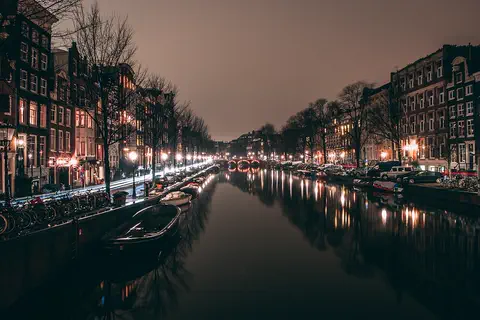
Amsterdam is the capital of the Netherlands. It began as a fishing village beside a dam on the Amstel River, which gave the city its name. Today about 942,000 people live among its rings of canals, hundreds of bridges, houseboats and bicycles.
For parents & teachers
What children will learn
- Locate Belgrade where the Sava meets the Danube and explain why a meeting of rivers and routes mattered.
- Explain why a city's population can be counted in different ways.
- Describe how Belgrade's fortress and history reflect many different rulers.
- Read temperature averages to describe a climate with cold winters and warm summers.
Recommended ages: 3 to 17 · About 15 minutes
Talk about it
- Why might people build a fortress on high land where two rivers meet?
- Belgrade's name means "white city". What would a good name for your town be, based on what it looks like?
- Many families moved to Belgrade from the countryside to work in factories. Why do people move to cities?
Try at home or in class
- With two strips of blue paper, make two rivers that join in a Y. Build a small fortress from blocks on the point between them and talk about how the rivers protect it on three sides.
- Trace the Danube on a map from Germany to the Black Sea and mark Vienna, Budapest and Belgrade.
Key vocabulary: capital, confluence, fortress, headland, census, basin
Where these facts come from
- Wikidata , Wikimedia Foundation (CC0 1.0)
- Natural Earth vector data , Natural Earth (NACIS) (Public domain)
- Belgrade , Encyclopaedia Britannica
- History , City of Belgrade
- 2022 Census of Population, Households and Dwellings: Ethnicity (data by municipalities and cities) , Statistical Office of the Republic of Serbia
- Belgrade: climatological information , World Meteorological Organization, World Weather Information Service
- Wikimedia Commons , Wikimedia Foundation (Per file (public domain, CC0, CC BY or CC BY-SA); see each media record)
Checked, not yet human-reviewed. Last updated October 27, 2026. Spotted a mistake? Tell us.