
City Europe
Barcelona
Barcelona is a big city in Spain, beside the sea. Some of its buildings have wavy walls and colorful tiles. A giant church with tall towers is still being built.
Barcelona, the capital of Catalonia in northeastern Spain, lies on the Mediterranean between mountains and the sea. It is famous for the buildings of the architect Antoni Gaudí, including the Sagrada Família, a giant church begun in 1882. About 1.7 million people live in the city (2025).
Barcelona, capital of Catalonia and Spain's chief Mediterranean port, grew from Roman Barcino and a walled medieval trading city into an industrial center. Its 19th-century grid extension, L'Eixample, and the Modernista works of Antoni Gaudí, seven of them on UNESCO's list, shape a city of about 1.7 million (2025) that was renewed for the 1992 Olympics.
Photo: dronepicr, CC BY 2.0, via Wikimedia Commons
Discover Barcelona
Barcelona is a big city in Spain.
It is beside the Mediterranean Sea. Mountains curve around the back of the city. Many people there speak two languages, Catalan and Spanish.
Barcelona is in northeastern Spain, on the Mediterranean Sea, about 150 kilometers south of the border with France. It is the capital of Catalonia, a region with its own language, Catalan, and it is Spain's main port on the Mediterranean.
About 1.7 million people lived in Barcelona in 2025. The city sits on a plain between two rivers, with a curve of mountains behind it and the sea in front. In 1862 the writer Hans Christian Andersen called it the "Paris of Spain."
Barcelona is a city, seaport and capital of both Barcelona province and the autonomous community of Catalonia, 150 km south of the French border. Facing the Mediterranean to the southeast, it lies on a plain bounded by the Besòs and Llobregat rivers, the rocky outcrop of Montjuïc (173 m) and a semicircle of mountains topped by Tibidabo (512 m).
Britannica calls it Spain's major Mediterranean port and commercial center, famed for its individuality, cultural interest and physical beauty. The city covers 98 km² (metropolitan area 3,235 km²) and had 1,732,066 registered residents on January 1, 2025. Since the late 1970s, official recognition of the Catalan language and regional self-government have revitalized cultural life; most school courses are taught in Spanish and Catalan.
- Country
- Spain (capital of Catalonia)
- People in the city (2025)
- about 1.7 million
- Area of the city
- 98 km²
- Distance to the French border
- about 150 km
Gaudí's city
Barcelona has some very unusual buildings.
The architect Antoni Gaudí designed many of them. One is a huge church with tall, pointy towers. It has been under construction for more than 140 years! A park he made has a reptile covered in colorful tiles.
The architect Antoni Gaudí (1852–1926) gave Barcelona some of its most famous buildings. The biggest is the Sagrada Família, a huge church whose cornerstone was laid in 1882. Gaudí never expected it to be finished in his lifetime. On February 20, 2026, its central tower reached its full height of 172.5 meters. It was already the world's tallest church, and work continues.
UNESCO protects seven of Gaudí's works, including Park Güell, with its colorful tiled sculptures, and the houses Casa Milà and Casa Batlló. In the old Gothic Quarter stand the cathedral and medieval palaces.
UNESCO's "Works of Antoni Gaudí" (inscribed 1984) groups seven buildings: Park Güell, Palau Güell, Casa Milà (La Pedrera), Casa Vicens, the Nativity Façade and Crypt of the Sagrada Família, Casa Batlló and the Crypt of the Colònia Güell. UNESCO calls Gaudí the most representative and outstanding of the Modernista architects, drawing on Catalan traditions and modern industrial technique.
The Sagrada Família's cornerstone was laid on March 19, 1882; only one of its towers was finished when Gaudí died in 1926. On February 20, 2026 a cross was placed on its central tower, bringing the basilica to its maximum height of 172.5 m; it had become the world's tallest church the year before, and completion is still years away. The Gothic Quarter, between the Ramblas and the Via Laietana, holds the cathedral, the 14th–15th-century Palace of the Generalitat and stretches of the Roman walls.
- Sagrada Família
- cornerstone laid 1882; 172.5 m tall since February 20, 2026
- Works of Antoni Gaudí (UNESCO)
- seven buildings; listed 1984
- Antoni Gaudí
- 1852–1926

From Barcino to the Olympics
Long ago, the Romans built a town here called Barcino.
Later it became a busy trading city with strong walls. Factories made cloth, and the city grew and grew. In 1992 Barcelona held the Olympic Games.
In Roman times the town was called Barcino, and pieces of its Roman walls still stand. In the Middle Ages, the counts of Barcelona gained power over Catalonia, and after Catalonia joined with Aragon in 1137, Barcelona became a great trading city.
For centuries the city was squeezed inside its walls. In the 1800s cotton mills and factories made Catalonia Spain's wealthiest region, and Barcelona finally spread out into a new district laid out in neat square blocks, called L'Eixample, "the Extension." In 1888 a world exhibition drew 400,000 visitors, and in 1992 the city hosted the Olympic Games.
Tradition credits Phoenicians or Carthaginians with founding a trading post here; Roman Barcino became important only in the 3rd century CE. Under the Visigoths it was Barcinona; the Moors arrived in 717 and the Carolingian Franks took the city in 801. The counts of Barcelona consolidated their power over Catalonia in the 10th and 11th centuries, and after the union with Aragon in 1137 the city grew into a major trading power, before plague and the shift of the court to Naples in 1442 brought decline. Philip V took the city in 1714 after a siege in the War of the Spanish Succession and abolished local self-government.
Cotton and textiles drove 19th-century industrialization; the walls came down and L'Eixample's geometric blocks were laid out, though later building tripled their density. Catalonia gained self-government in 1932; Barcelona was the main center of Republican strength in the Civil War from 1936 until it fell in January 1939, after which the Catalan language was banned for a time. The Generalitat was restored in 1977, and the 1992 Olympics renewed the waterfront with a promenade, marina and beaches.
Getting around Barcelona
In Barcelona you can ride a subway, a bus or a train.
There are cable cars that float through the air! Big ships and ferries sail from the port across the sea.
Barcelona's subway, the metro, opened in 1924. Today buses, subways and surface railways carry people around the city, and there are even cable cars. The metro and urban railway run out to nearby towns and to the international airport at El Prat, about 13 kilometers southwest of the city.
The port welcomes ships from all over the world, and ferries sail to the Balearic Islands and to Genoa in Italy. Freeways cross the Pyrenees mountains through the Cadí tunnel into France.
Public transport is provided by buses, subways, surface railways and cable cars. The metropolitan subway, opened in 1924, connects with the urban railway, serving municipalities of the metropolitan region and the international airport at El Prat de Llobregat, about 13 km southwest. Freeways link Barcelona to the Catalan highway network and, through the Cadí tunnel in the Pyrenees, to France.
The port receives ships from all parts of the world and runs ferries to the Balearic Islands and Genoa, making Barcelona an important European shipping center; a free economic zone near the port, the zona franca, concentrates distribution centers. Because the city stayed within its walls until the 19th century and then grew a dense industrial belt, Britannica describes it as one of the most congested cities in the world.
- Metro opened
- 1924
- Airport
- El Prat, about 13 km southwest
- Ferries
- to the Balearic Islands and Genoa, Italy
Weather and seasons
Barcelona has mild winters and warm summers.
The weather is mild for much of the year. Mountains behind the city block cold winds. The city has beaches by the sea.
Barcelona has a gentle climate. The mountains in a half-circle behind the city shield it from cold winds from the north and west. On a typical January day, the high is about 14 °C and the low about 5 °C. In August, the hottest month, highs average about 29 °C and lows about 20 °C.
About 580 millimeters of rain fall in a year. The wettest months are in autumn, especially October, and July is the driest. The mild weather helps make Barcelona's streets lively and full of people.
Britannica notes that although Barcelona is sometimes windy, its semicircle of mountains shields it from harsh, cold northerly and westerly winds; it gives an annual mean of 16 °C, January averaging 9 °C and August 24 °C, and about 600 mm of precipitation, and describes a benign climate that fosters street life.
World Meteorological Organization normals for 1981–2010 give mean daily maxima and minima of 13.6 °C and 4.7 °C in January and 28.5 °C and 20.2 °C in August. The monthly totals add up to about 582 mm, wettest in autumn (September about 81 mm, October about 91 mm) and driest in July (about 21 mm).
- January, average daily high and low
- about 14 °C and 5 °C
- August, average daily high and low
- about 29 °C and 20 °C
- Precipitation in a year
- about 580 mm
Living in Barcelona
In the middle of Barcelona is a wide street for walking called the Ramblas.
Stalls there sell flowers and books. On April 23, the city celebrates books. There are museums of art, a zoo and beaches by the sea.
The Ramblas, a string of wide, tree-lined boulevards, run down to the port, with stalls selling flowers, books and newspapers and artists drawing on the pavement. Every April 23, the Fiesta del Libro, a book festival, fills the city.
Barcelona has many museums, including ones for the painters Joan Miró and Pablo Picasso, and a maritime museum with a full-size copy of an old galley ship. The Liceu Opera House was founded in 1847. The University of Barcelona dates from 1450, and there is a zoo in Ciutadella Park.
Barcelona is a major publishing center for the Spanish-speaking world, and its April 23 Fiesta del Libro is a major event for the book trade. Culture ranges from the Liceu Opera House (1847, rebuilt after a 1994 fire), the Romea Theatre for Catalan drama and the Music Palace to the National Art Museum of Catalonia (formed 1990), the Joan Miró Foundation, the Picasso Museum and the maritime museum's full-size galley replica; Frank Gehry's copper fish sculpture marks the Olympic Port.
The University of Barcelona, founded in 1450, is one of seven universities. Up to a third of residents were born outside Catalonia. The service sector provides about four-fifths of jobs, alongside chemicals, pharmaceuticals, automobiles and electronics, and the Barcelona Fair has been held at Montjuïc since 1929. The Ramblas, with stalls of flowers, books and newspapers, lead down to the port and the Columbus monument.
- University of Barcelona
- founded 1450
- Liceu Opera House
- founded 1847; rebuilt after a fire in 1994

Barcelona on the map
Find Barcelona on the globe.
It is in Spain, in Europe. Look for the Mediterranean Sea and the border with France. Barcelona is on the coast, south of France.
Barcelona is on the northeastern coast of Spain, in Europe, facing the Mediterranean Sea to the southeast. France is about 150 kilometers to the north.
Two rivers, the Besòs to the north and the Llobregat to the south, frame the city's plain. Behind it, a half-circle of mountains rises to Tibidabo, 512 meters high, and near the port stands the rocky hill of Montjuïc.
Barcelona lies at about 41.4° N and 2.2° E on the Catalan coast, facing southeast over the Mediterranean, 150 km south of France. Its plain is confined by the Besòs (north) and Llobregat (south) rivers, Montjuïc (173 m) and the mountain semicircle culminating in Tibidabo (512 m).
Drinking water comes partly from the Llobregat upstream but more from the Ter River in Girona province, since local rivers cannot meet the needs of both industry and homes. Ferries link the port with the Balearic Islands.
- Latitude
- about 41.4° north
- Longitude
- about 2.2° east
- Highest point
- Tibidabo, 512 m
Amazing facts
-
Barcelona's giant church is the tallest church in the world.
On February 20, 2026, a cross was placed on the Sagrada Família's central tower, bringing it to 172.5 meters. It had already become the world's tallest church the year before.
The Sagrada Família reached its maximum height of 172.5 m on February 20, 2026, though completion remains years away; it became the world's tallest church in 2025.
-
A famous storyteller once called Barcelona the "Paris of Spain."
When Hans Christian Andersen, the writer of fairy tales, visited in 1862, he called Barcelona the "Paris of Spain."
On his 1862 visit, Hans Christian Andersen remarked that Barcelona was the "Paris of Spain."
-
Barcelona's metro is more than 100 years old.
Barcelona's metro opened in 1924 and now reaches the airport at El Prat.
The metropolitan subway, opened in 1924, connects with the urban railway to serve the metropolitan region and El Prat airport.
-
A giant metal fish sits by Barcelona's harbor.
A large copper fish sculpture by the architect Frank Gehry stands at the entrance to the Olympic Port.
Frank Gehry's large copper fish sculpture marks the Olympic Port entrance, a legacy of the 1992 Games.
Words to know
- architect
- a person who designs buildings
- Catalan
- the language of Catalonia, spoken in Barcelona along with Spanish
- Modernisme
- a Catalan movement in art and architecture of the late 1800s and early 1900s
- mosaic
- a picture or pattern made from small pieces of tile, glass or stone
- cornerstone
- the first stone laid when a building is begun
- grid
- a pattern of straight streets crossing to make square blocks
- port
- a town or city with a harbor where ships load and unload
Discovery challenge
-
Barcelona is beside which sea?
Which sea does Barcelona face?
Barcelona is Spain's major port on which sea?
- The Mediterranean Sea
- The North Sea
- The Red Sea
Show the answer
The Mediterranean Sea
The Mediterranean Sea! It is warm and blue.
The Mediterranean, which the city faces to the southeast.
The Mediterranean: Barcelona is Spain's major Mediterranean port and commercial center.
-
Who designed Barcelona's giant church and its tiled park?
Which architect designed the Sagrada Família and Park Güell?
Which Modernista architect's seven works in and around Barcelona are a UNESCO World Heritage Site?
- Antoni Gaudí
- Gustave Eiffel
- Frank Gehry
Show the answer
Antoni Gaudí
Antoni Gaudí! He loved curves and colors.
Antoni Gaudí (1852–1926), whose works UNESCO protects.
Antoni Gaudí; UNESCO calls him the most representative and outstanding of the Modernista architects.
-
When was the first stone of the Sagrada Família laid?
In which year was the Sagrada Família's cornerstone laid?
In which year was the cornerstone of the Sagrada Família laid, on March 19?
- 1882
- 1982
- 2022
Show the answer
1882
1882! It has been under construction ever since.
1882. Its tallest tower reached full height only in 2026.
March 19, 1882; the basilica reached its maximum height of 172.5 m on February 20, 2026.
-
Which big sports event came to Barcelona in 1992?
Which event did Barcelona host in 1992?
Which 1992 event led to the renovation of Barcelona's waterfront?
- The Olympic Games
- A World Cup final
- A space launch
Show the answer
The Olympic Games
The Olympic Games!
The Olympic Games, which helped renew the city and its waterfront.
The 1992 Olympics, which brought a promenade, marina, restaurants and beaches to the once run-down waterfront.
-
Which month is hottest in Barcelona?
Which is Barcelona's hottest month?
In which month do Barcelona's daily highs average 28.5 °C?
- January
- April
- August
Show the answer
August
August! It is a great time for the beach.
August, with highs of about 29 °C.
August: WMO normals for 1981–2010 give 28.5 °C highs and 20.2 °C lows.
Nearby places
-
Watch
Landmark
Sagrada Família
The Sagrada Família is a huge church in Barcelona, Spain, designed by the architect Antoni Gaudí. Building began in 1882 and is still going on. In February 2026 its tallest tower was finished at 172.5 meters, making it the tallest church in the world.
-
 Watch
City
Madrid
Madrid, the capital of Spain, sits almost exactly in the middle of the Iberian Peninsula, high on a flat plateau. Once a small fortress, it became the royal capital in the 1500s. About 3.5 million people lived there in 2025.
-
 Watch
Landmark
Museo del Prado
The Museo del Prado in Madrid opened in 1819 to show the paintings collected by Spain's kings and queens. Its stone building was first planned as a science museum. Today it holds about 8,600 paintings, including the world's most complete collections of the Spanish painters El Greco, Velázquez and Goya.
-
 Watch
Landmark
Royal Monastery of San Lorenzo de El Escorial
The Royal Monastery of San Lorenzo de El Escorial stands at the foot of the Guadarrama mountains, northwest of Madrid, Spain. King Philip II began it in 1563, and it was finished in 1584. Inside its granite walls are a monastery, a church, a royal palace, a school and a famous library.
- Watch Natural wonder Cave of Altamira The Cave of Altamira, in northern Spain, holds some of the most famous prehistoric paintings in the world. People who hunted and gathered their food used the cave between about 36,000 and 13,000 years ago, and painted and engraved bison, horses, deer, hands and signs on its walls and ceiling. It was the first cave where prehistoric cave art was ever recognized.
-
 Watch
Natural wonder
Mont Blanc
Mont Blanc is the highest peak in the Alps, on the border of France and Italy. Its snowy top changes height a little from year to year: in September 2026, French surveyors measured it at 4,807.47 meters. People first climbed it in 1786, and today a long tunnel runs right underneath it.
-
 Watch
Natural wonder
Matterhorn
The Matterhorn is a 4,478-meter mountain in the Alps, on the border between Switzerland and Italy. Its rock was pushed up when Africa moved toward Europe, and glaciers later carved its steep sides into a pyramid shape. Climbers first reached its top on 14 July 1865.
-
 Watch
Landmark
Alhambra
The Alhambra is a palace and fortress above the city of Granada, in Spain. The Nasrid rulers built most of it between 1238 and 1358. It is famous for its courtyards, fountains, carved plaster and tiles, and the gardens of the Generalife next door.
Explore next
-
Watch
 Country
Spain
Spain covers most of the Iberian Peninsula in southwestern Europe. Its middle is a high, flat plateau, the Pyrenees mountains stand between it and France, and almost 50 million people live there, with Madrid as the capital.
-
Watch
Landmark
Sagrada Família
The Sagrada Família is a huge church in Barcelona, Spain, designed by the architect Antoni Gaudí. Building began in 1882 and is still going on. In February 2026 its tallest tower was finished at 172.5 meters, making it the tallest church in the world.
-
Watch
City
Madrid
Madrid, the capital of Spain, sits almost exactly in the middle of the Iberian Peninsula, high on a flat plateau. Once a small fortress, it became the royal capital in the 1500s. About 3.5 million people lived there in 2025.
-
 Watch
City
Lisbon
Lisbon, the capital of Portugal, is the westernmost capital in mainland Europe, on the hills above the Tagus River near the Atlantic. By the 1400s it was the base for Portugal's voyages of exploration. Destroyed by an earthquake in 1755 and rebuilt, it is a city of steep streets, viewpoints and a famous tower at Belém. About 546,000 people lived there in 2021.
-
 Watch
City
Amsterdam
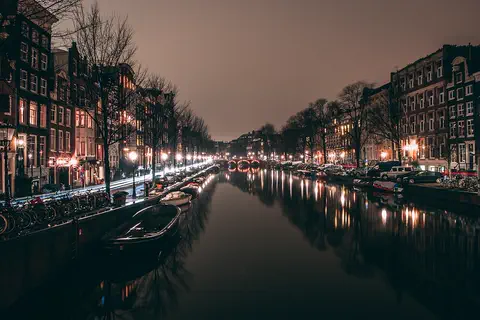
Amsterdam is the capital of the Netherlands. It began as a fishing village beside a dam on the Amstel River, which gave the city its name. Today about 942,000 people live among its rings of canals, hundreds of bridges, houseboats and bicycles.
-
 Watch
City
Athens
Athens is the capital of Greece and one of the oldest cities in the world. Above it rises the Acropolis, a rocky hill crowned by the marble Parthenon, built about 2,500 years ago. Ancient Athens was home to early democracy, great thinkers and theater.
-
 Watch
City
Belgrade
Belgrade, the capital of Serbia, stands where the Sava River flows into the Danube. Its name, Beograd, means "white city", probably because of the white limestone walls of its old fortress above the rivers. At the 2022 census, about 1.2 million people lived in the city itself and about 1.7 million in the wider City of Belgrade.
-
 Watch
City
Berlin
Berlin, the capital of Germany, grew from two small trading towns on the Spree River. From 1961 to 1989 the Berlin Wall divided it. Today about 3.7 million people live there (2025), among lakes, forests, museums and the Brandenburg Gate.
For parents & teachers
What children will learn
- Locate Barcelona on Spain's Mediterranean coast between mountains and the sea.
- Recognize Antoni Gaudí's buildings and describe what makes them unusual.
- Explain how a walled city grew into a planned grid, L'Eixample.
- Read average temperatures to describe a mild Mediterranean climate.
Recommended ages: 3 to 17 · About 15 minutes
Talk about it
- The Sagrada Família has been under construction since 1882. Why might a building take so long, and why keep going?
- Gaudí took ideas from nature for his buildings. What shape from nature would you use in a building?
- Barcelona stayed inside its walls for centuries, then planned a grid of blocks. What are the good and hard parts of a grid city?
Try at home or in class
- Make a mosaic like Park Güell's: cut colored paper into small pieces and glue them onto a simple animal shape.
- Draw a grid of square city blocks on paper, like L'Eixample, then add parks and open spaces in some of the squares.
Key vocabulary: architect, Catalan, Modernisme, mosaic, cornerstone, grid, port
Where these facts come from
- Wikidata , Wikimedia Foundation (CC0 1.0)
- Natural Earth vector data , Natural Earth (NACIS) (Public domain)
- UNESCO World Heritage List , UNESCO World Heritage Centre (Linked as a reference; site facts come from Wikidata)
- Barcelona , Encyclopaedia Britannica
- Barcelona: The people, economy, transportation and cultural life , Encyclopaedia Britannica
- Barcelona: History , Encyclopaedia Britannica
- Works of Antoni Gaudí , UNESCO World Heritage Centre
- History of the Temple , Sagrada Família (official site, Junta Constructora)
- Barcelona's Sagrada Familia reaches maximum height (Associated Press, February 20, 2026) , America Magazine
- Barcelona: climatological information , World Meteorological Organization, World Weather Information Service
- Barcelona's population stabilises at 1.7 million people , Ajuntament de Barcelona (Municipal Data Office figures), June 2, 2025
- Wikimedia Commons , Wikimedia Foundation (Per file (public domain, CC0, CC BY or CC BY-SA); see each media record)
Checked, not yet human-reviewed. Last updated October 27, 2026. Spotted a mistake? Tell us.