
City Europe
Turku
Turku is the oldest city in Finland. A river called the Aura flows through it to the sea.
Turku is a city in southwest Finland, at the mouth of the Aura River, west of Helsinki. Universalis calls it Finland's oldest city, and it was the capital until 1812. At the end of 2025 about 209,633 people lived there, according to Statistics Finland.
Turku (Swedish: Åbo), at the mouth of the Aura, began as a trading place a few kilometers north and moved to its present site in the early 13th century. It was Finland's capital until 1812, burned almost entirely in 1827 and was rebuilt to plans by Carl Ludwig Engel. Statistics Finland estimate 31 December 2025: 209,633.
Photo: Ninara, CC BY 2.0, via Wikimedia Commons
Discover Turku
Turku is a city in Finland. It is the oldest city in the country.
The Aura River flows through Turku to the sea.
Turku lies at the mouth of the Aura River, west of Helsinki. Universalis calls it the oldest city in Finland, and it was the country's capital until 1812. It is a bilingual city, where both Finnish and Swedish are spoken; its Swedish name is Åbo.
At the end of 2025 about 209,633 people lived in Turku, according to Statistics Finland. That makes it the sixth-largest city in Finland.
Universalis: the oldest town in Finland, at the mouth of the Aura, west of Helsinki; capital of Finland until 1812, under Swedish and then Russian rule; a bilingual town; 175,354 inhabitants (2007 estimate).
Statistics Finland (via City Population), city of Turku (Åbo): 163,680 (end of 1980), 159,180 (1990), 172,561 (2000), 177,326 (2010), 194,391 (2020) and 209,633 (estimate, 31 December 2025), rank 6 after Helsinki, Espoo, Tampere, Vantaa and Oulu; Southwest Finland region 497,800 (2025).
- Country
- Finland (the capital until 1812)
- People in Turku (estimate, 31 December 2025)
- 209,633
- River
- at the mouth of the Aura, west of Helsinki
- Languages
- a bilingual city (Finnish and Swedish)
A park between the river and a tall tower
Look at the tall red tower with its green, pointed top! Trees with yellow leaves stand in the park by the river.
This photo shows the Aura River, the Cathedral Park and the tower of Turku Cathedral on 18 October 2020. The river runs between stone walls in front. On the far bank, paths wind across a lawn covered with fallen leaves, under trees turning yellow and orange.
On the right rises the cathedral's tall tower, red below and green on top, with a pointed spire. Yellow buildings stand on the left.
Commons: Flickr photo by Ninara, 18 October 2020, CC BY 2.0 (FlickreviewR passed), uploaded in 2022 by another user whose caption reads: 'Turku Cathderal [sic] and the Aura River with the Cathedral Park in between.'
In the picture: the brown water of the Aura and a stone embankment; a lawn with fallen leaves, paths, benches, lamps and a few walkers; trees in autumn colors; the red-walled cathedral tower with a clock and a green upper stage and spire; yellow and cream buildings at left; a cloudy sky. Wikidata gives the cathedral a height of 101.9 m.
- Photo
- Turku Cathedral, the Aura River and the Cathedral Park between them, 18 October 2020
- Turku Cathedral
- dated to 1290 by Universalis, enlarged in the 16th century
- Cathedral height
- 101.9 m (Wikidata)
A capital, a fire and a new plan
Long ago, Turku was the capital of Finland. In 1827 a big fire burned almost the whole town, and people built it again with a new plan.
Turku began as a trading place a few kilometers north of where it stands today, Universalis says, and moved to its present site in the early 13th century. A court of appeal was set up there in 1623, and a university was founded in 1640.
Turku was Finland's capital until 1812. In 1827 a fire destroyed almost the whole town, and the university moved to Helsinki that year. The town was rebuilt to plans by the architect Carl Ludwig Engel.
Universalis: originally a trading center a few kilometers north of its present site, to which it moved at the start of the 13th century; the first known charter concerning the town dates from 1525; a court of appeal was established in 1623 and a university founded in 1640 (moved to Helsinki in 1827). Capital of Finland until 1812, under Swedish then Russian rule, Turku was almost entirely destroyed by fire in 1827 and rebuilt to plans by the architect Carl Ludwig Engel. Historic sites include the cathedral (1290, enlarged in the 16th century), the medieval castle (late 13th century, now a museum), the Swedish Theatre (1838) and the Greek Orthodox church (1846).
- Early 13th century
- the town moves from a trading place a few km north to its present site
- 1640
- a university is founded (moved to Helsinki in 1827)
- 1827
- a fire destroys almost the whole town; Carl Ludwig Engel plans the rebuilding
A winter port on the Baltic
Ships come to Turku's port even in winter. Ships are built there too.
Turku is Finland's largest winter port, Universalis says, and it has several big shipyards.
Turku lies at the mouth of the Aura River; Wikidata gives the river a length of 70 kilometers. Turku Castle, built at the end of the 13th century and now a museum, stands about 2.8 kilometers southwest of the city's center point on Wikidata.
Universalis: Finland's largest winter port, with several large shipyards; the medieval castle (built at the end of the 13th century) now houses a museum.
Wikidata (from the city point Q38511): Turku Market Square (Q4411397) at the point itself; Cathedral Park (Q11898663) 0.53 km ENE; Turku Cathedral (Q1187606) 0.64 km E; Turku Castle (Q136893) 2.82 km SW; Aura River (Q663607), 70 km long, its point 3.13 km SW.
- Port
- Finland's largest winter port (Universalis)
- Turku Castle
- a medieval castle, now a museum, about 2.8 km southwest of the city's Wikidata point
- Aura River
- 70 km long (Wikidata)
Snowy winters and mild summers
Winters in Turku are cold, with frost. Summers are mild, and late summer and autumn are the wettest time.
The World Meteorological Organization's averages for 1971 to 2000 show cold winters in Turku: in February the average daily high is -2.2 °C and the average low -8.5 °C. In July the average high is 21.7 °C.
About 698 millimeters of rain and snow fall in a year. August is the wettest month, with 78.7 millimeters, and May the driest, with 35.2.
WMO World Weather Information Service, Turku (60.52° N, 22.27° E), 1971–2000: mean daily maximum -2.2 °C (February) to 21.7 °C (July); mean daily minimum -8.5 °C (February) to 12.2 °C (July). Precipitation sums to 698.1 mm; July to December each bring more than 66 mm, with August (78.7 mm) the wettest month and May (35.2 mm) the driest. Days with at least 1 mm sum to 115 a year.
- Average daily highs (WMO, Turku, 1971–2000)
- -2.2 °C (February) to 21.7 °C (July)
- Average daily lows (same normals)
- -8.5 °C (February) to 12.2 °C (July)
- Rain and snow in a year (sum of the monthly normals)
- about 698 mm
Shipyards, universities and museums
In Turku, people build big ships and make things like sugar, steel and cloth. Students come to its universities.
Turku is still an important center of industry and culture, Universalis says. Besides its shipyards, it has sugar refining, pottery, and the making of steel, electronics, timber, flour and textiles.
Because it is a bilingual city, Turku has a university for Swedish speakers, since 1918, and one for Finnish speakers, since 1920. It also has art galleries, libraries, museums and the Swedish Theatre, from 1838.
Universalis: still an important industrial and cultural center; several large shipyards; local industries include sugar refining, pottery and the production of steel, electronic equipment, timber, flour and textiles. A bilingual town, it hosts universities for Swedish speakers (since 1918) and Finnish speakers (1920), specialized higher-education institutions, art galleries, libraries and museums.
Wikidata: Åbo Akademi University (Q917874), 1918, 0.69 km ENE; University of Turku (Q501841), 1920, 1.01 km ENE of the city point.
- Industries
- shipbuilding, sugar refining, pottery, steel, electronics, timber, flour and textiles
- Universities
- Swedish-speaking since 1918, Finnish-speaking since 1920
- Culture
- art galleries, libraries, museums and the Swedish Theatre (1838)
Turku on the map
Find Finland on the globe, in the north of Europe. Turku is in the southwest corner of the country.
Turku lies at about 60.5° north, in Southwest Finland, west of Helsinki.
Measured from the city's center point on Wikidata, which sits on the Market Square, the Cathedral Park is about 0.5 kilometers east-northeast, the cathedral about 0.6 kilometers east, the University of Turku about 1.0 kilometer east-northeast and Turku Castle about 2.8 kilometers southwest.
Turku lies at about 60.45° N and 22.26° E (Natural Earth point, 0.70 km WNW of the Wikidata point). From the Wikidata point (Q38511, at Turku Market Square): Cathedral Park 0.53 km ENE; Turku Cathedral 0.64 km E; Åbo Akademi University 0.69 km ENE; University of Turku 1.01 km ENE; Turku Castle 2.82 km SW. The WMO station point is 7.60 km N of the Wikidata point.
- Latitude
- about 60.5° north
- Longitude
- about 22.3° east
- Region
- Southwest Finland, west of Helsinki
Amazing facts
-
Turku has two names: Turku in Finnish and Åbo in Swedish.
Turku is a bilingual city: its Finnish name is Turku and its Swedish name is Åbo.
Universalis: a bilingual town, with universities for Swedish speakers (since 1918) and Finnish speakers (1920); City Population lists it as Turku (Åbo).
-
Turku's castle is more than 700 years old and is now a museum.
Turku's medieval castle was built at the end of the 13th century and now houses a museum, Universalis says.
Universalis: the medieval castle, built at the end of the 13th century, today houses a museum.
-
A university started in Turku in 1640 and later moved to Helsinki.
A university was founded in Turku in 1640 and moved to Helsinki in 1827, Universalis says.
Universalis: a university was founded in Turku in 1640 and transferred to Helsinki in 1827, the year of the fire.
-
In February in Turku, the average daytime high is below freezing.
In the WMO averages for 1971 to 2000, February's average daily high in Turku is -2.2 °C.
WMO 1971–2000, Turku: mean daily maximum -1.9 °C in January and -2.2 °C in February.
Words to know
- mouth
- the place where a river flows into the sea or a lake
- bilingual
- using two languages
- shipyard
- a place where ships are built and repaired
- winter port
- a harbor that ships can still use in winter
- court of appeal
- a court that looks again at decisions made by other courts
- estimate
- an official count worked out from records instead of asking everyone
Discovery challenge
-
Turku is a city in which country?
Turku is the oldest city of which country, Universalis says?
Turku was the capital of which country until 1812?
- Finland
- Italy
- Mexico
Show the answer
Finland
Finland!
Finland.
Finland.
-
Which river flows through Turku?
Turku lies at the mouth of which river?
Which 70-kilometer river (Wikidata) reaches the sea at Turku?
- The Aura
- The Seine
- The Nile
Show the answer
The Aura
The Aura!
The Aura.
The Aura.
-
What happened in Turku in 1827?
What destroyed almost the whole of Turku in 1827?
Universalis says Turku was almost entirely destroyed in 1827 by what?
- A fire
- A flood
- A volcano
Show the answer
A fire
A big fire!
A fire.
A fire; the town was rebuilt to Carl Ludwig Engel's plans.
-
What is Turku's name in Swedish?
Turku is bilingual. What is its Swedish name?
Which Swedish name does City Population give for Turku?
- Åbo
- Oslo
- Bergen
Show the answer
Åbo
Åbo!
Åbo.
Åbo.
-
Which month is the wettest in Turku?
In the WMO averages, which month gets the most rain and snow?
WMO 1971–2000: which month has the highest precipitation, 78.7 mm?
- August
- May
- February
Show the answer
August
August!
August.
August (78.7 mm).
Nearby places
-
 Watch
City
Mariehamn
Mariehamn is the only town on Åland, a group of thousands of islands in the Baltic Sea between Sweden and Finland. It is a busy port town with ferries, museums and two harbors. In 2024, 15,414 people lived in its built-up area, according to Statistics Finland.
-
 Watch
City
Tampere
Tampere is Finland's third-biggest municipality, with an estimated 263,337 people at the end of 2025. It was founded in 1779 on a narrow strip of land between the lakes Näsijärvi and Pyhäjärvi, joined by the Tammerkoski rapids, and grew into a factory town.
-
 Watch
City
Helsinki
Helsinki is the capital of Finland, on a peninsula in the Gulf of Finland. Founded in 1550 and made the capital in 1812, it has white stone buildings, a sea fortress on islands, and the world's most northern metro. About 694,000 people lived there at the end of 2025.
-
 Watch
Landmark
Suomenlinna
Suomenlinna is a sea fortress on a group of islands off Helsinki, Finland. Work on it began in 1748, when the area belonged to Sweden. Its stone walls, grassy ramparts and pointed bastions spread over six islands, and today it is a part of Helsinki where people live and visitors explore.
-
 Watch
Landmark
Kõpu Lighthouse
Kõpu Lighthouse stands on the island of Hiiumaa in Estonia. Built in the 1500s as a daymark for ships, it is 36 meters tall and stands on the island's highest point, so its light shines 102.6 meters above the sea. Visit Estonia calls it the oldest lighthouse on the Baltic Sea.
-
 Watch
Landmark
Keri Lighthouse
Keri Lighthouse stands on the small island of Keri in the Gulf of Finland, in Estonia. A light has guided sailors here since the early 1700s. Today's tower is a metal tower from 1858 set on top of an older stone base.
-
 Watch
City
Tallinn
Tallinn, the capital of Estonia, lies on a bay of the Gulf of Finland. Its walled Old Town, with towers, church spires and a town hall finished in 1404, is, says UNESCO, an exceptionally complete and well-preserved medieval trading town, and today the city is also known for its technology companies.
-
 Watch
City
Stockholm
Stockholm, the capital of Sweden, is built on islands and the mainland where Lake Mälaren meets an arm of the Baltic Sea. First mentioned as a town in 1252, it has a medieval Old Town, a royal palace, a 17th-century warship you can visit and subway stations full of art. About 985,000 people lived there in 2022.
Explore next
-
Watch
 Country
Finland
Finland is a northern European country covered mostly by forest and dotted with tens of thousands of lakes. About a third of it lies north of the Arctic Circle, where the summer sun shines all night. About 5.7 million people live there, most of them in the south.
-
Watch
City
Helsinki
Helsinki is the capital of Finland, on a peninsula in the Gulf of Finland. Founded in 1550 and made the capital in 1812, it has white stone buildings, a sea fortress on islands, and the world's most northern metro. About 694,000 people lived there at the end of 2025.
-
Watch
City
Stockholm
Stockholm, the capital of Sweden, is built on islands and the mainland where Lake Mälaren meets an arm of the Baltic Sea. First mentioned as a town in 1252, it has a medieval Old Town, a royal palace, a 17th-century warship you can visit and subway stations full of art. About 985,000 people lived there in 2022.
-
Watch
City
Mariehamn
Mariehamn is the only town on Åland, a group of thousands of islands in the Baltic Sea between Sweden and Finland. It is a busy port town with ferries, museums and two harbors. In 2024, 15,414 people lived in its built-up area, according to Statistics Finland.
-
 Watch
City
Amsterdam
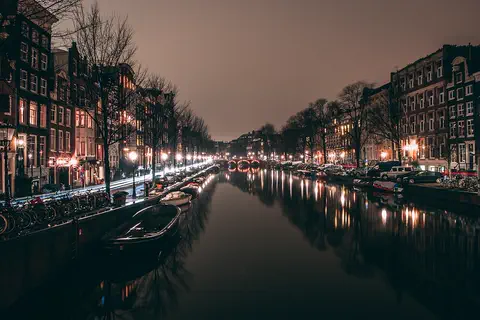
Amsterdam is the capital of the Netherlands. It began as a fishing village beside a dam on the Amstel River, which gave the city its name. Today about 942,000 people live among its rings of canals, hundreds of bridges, houseboats and bicycles.
-
 Watch
City
Antwerp
Antwerp is a city in Belgium on the Scheldt river, and Universalis calls it the second port of continental Europe, after Rotterdam. Belgium's statistics office estimated 565,615 people in the city on 1 January 2026. In the 1500s it was one of Europe's great trading cities.
-
 Watch
City
Athens
Athens is the capital of Greece and one of the oldest cities in the world. Above it rises the Acropolis, a rocky hill crowned by the marble Parthenon, built about 2,500 years ago. Ancient Athens was home to early democracy, great thinkers and theater.
-
 Watch
City
Barcelona
Barcelona, the capital of Catalonia in northeastern Spain, lies on the Mediterranean between mountains and the sea. It is famous for the buildings of the architect Antoni Gaudí, including the Sagrada Família, a giant church begun in 1882. About 1.7 million people live in the city (2025).
For parents & teachers
What children will learn
- Locate Turku at the mouth of the Aura in southwest Finland.
- Explain what it means for a city to be bilingual.
- Describe how a city can be rebuilt with a new plan after a great fire.
- Read a cold-climate table with freezing winter days.
Recommended ages: 3 to 17 · About 15 minutes
Talk about it
- Why might a town move a few kilometers to a new site?
- What changes when a city stops being a capital?
- Why would a port that stays open in winter be important in a cold country?
Try at home or in class
- Two languages: make labels for things in your room in two languages.
- Town plan: draw a street grid for a new town after a fire, with wide streets and a park.
- Temperature line: plot Turku's monthly average highs and find the months below freezing.
Key vocabulary: mouth, bilingual, shipyard, winter port, court of appeal, estimate
Where these facts come from
- Wikidata , Wikimedia Foundation (CC0 1.0)
- Natural Earth vector data , Natural Earth (NACIS) (Public domain)
- Turku , Encyclopaedia Universalis
- Finland: Regions and Major Cities , City Population (Thomas Brinkhoff), from Statistics Finland
- Turku: climatological information , World Meteorological Organization, World Weather Information Service
- File:Turku Cathedral Park 2020.jpg (Ninara, 18 October 2020) , Wikimedia Commons
- Wikimedia Commons , Wikimedia Foundation (Per file (public domain, CC0, CC BY or CC BY-SA); see each media record)
Checked, not yet human-reviewed. Last updated November 1, 2026. Spotted a mistake? Tell us.