
City Europe
Stockholm
Stockholm is the capital city of Sweden. It is built on islands where a lake meets the sea. It has a royal palace and a huge old ship in a museum.
Stockholm, the capital of Sweden, is built on islands and the mainland where Lake Mälaren meets an arm of the Baltic Sea. First mentioned as a town in 1252, it has a medieval Old Town, a royal palace, a 17th-century warship you can visit and subway stations full of art. About 985,000 people lived there in 2022.
Stockholm, Sweden's capital and the largest city and metropolitan region in the Nordic countries, spreads across islands and mainland at the junction of Lake Mälaren and Saltsjön, an arm of the Baltic. First recorded in 1252, it became the formal capital in 1634; its protected medieval core, Gamla Stan, sits at the center of a city of 984,748 people (2022) that is a leading European technology hub.
Photo: User:Goombah, CC BY-SA 3.0, via Wikimedia Commons
Discover Stockholm
Stockholm is the capital city of Sweden.
It is built on lots of islands. Bridges join the islands together. On one side is a big lake. On the other side is the sea.
Stockholm is the capital and biggest city of Sweden, in northern Europe. It is built on many islands and on the mainland, right where Lake Mälaren meets Saltsjön, an arm of the Baltic Sea. Old bridges link the islands, and water is everywhere, which is why Stockholm is one of several cities nicknamed "Venice of the North."
About 985,000 people lived in the city in 2022. Stockholm has buildings from the Middle Ages right up to today, and it is home to Sweden's king, its parliament and its government.
Stockholm lies at the junction of Lake Mälaren (Mälaren) and Saltsjön, an arm of the Baltic opposite the Gulf of Finland, on numerous islands as well as the mainland of Uppland to the north and Södermanland to the south. Britannica calls it the largest city and metropolitan region in the Nordic countries and, for its waterways and its well-preserved architecture from medieval to modern, one of Europe's most aesthetically attractive capitals.
The municipality had 984,748 people in 2022 (Statistics Sweden). Stockholm is Sweden's leading industrial area and chief commercial center, home to the largest stock exchange in the Nordic countries (founded 1863) and, Britannica notes, one of Europe's leading technology centers, with one of the continent's highest start-up rates. As of 2012 the region held 22 percent of Sweden's people and produced 29 percent of its GDP.
- Country
- Sweden (capital)
- People in the city (2022)
- 984,748
- First mentioned as a town
- 1252
- Nickname
- Venice of the North
Famous places
Stockholm's oldest part is called the Old Town.
It has narrow streets and the king's palace. In a museum, you can see a giant wooden ship. It sank long ago and was lifted out of the water. At Skansen, you can visit old houses and farm animals.
Gamla Stan, the Old Town, is where Stockholm began. Its narrow streets follow the medieval pattern, and most of its buildings are from the 1500s and 1600s. Here stand the Royal Palace, Stockholm Cathedral and the House of Parliament.
East of the Old Town is the island of Djurgården, full of museums. The Vasa Museum holds a warship that sank on its first voyage in 1628 and was raised in 1961. Skansen, founded in 1891, gathers old houses, farms and animals from all over Sweden. Across the water, City Hall hosts the Nobel Prize banquet every December.
The original nucleus, the 'city between the bridges', is Gamla Stan: Stads, Helgeands and Riddar islands. Its medieval street network and buildings, mainly of the 16th and 17th centuries, are legally protected. Stads Island holds the Royal Palace, Storkyrkan (the Church of St. Nicholas), the German Church, the House of Lords and the Stock Exchange; the Riksdag stands on Helgeands Island, and Riddarholm Church dominates Riddar Island.
On Djurgården, the Vasa Museum shows the warship Vasa: 69 m long and over 1,200 tonnes, with 64 cannons, it heeled over in a gust and sank 1,300 m into its maiden voyage on August 10, 1628, and was raised on April 24, 1961, after 333 years. Skansen, founded in 1891 by Artur Hazelius, calls itself the world's oldest open-air museum, with houses moved from across Sweden. Kungsholmen has City Hall, where the Nobel Prize banquet for 1,300 guests has been held in the Blue Hall since 1934.
- Vasa
- warship that sank in 1628, raised in 1961
- Skansen
- open-air museum, founded 1891
- Gamla Stan (Old Town)
- buildings mainly from the 1500s and 1600s
- Nobel Prize banquet
- Blue Hall of City Hall, since 1934
From island town to capital
Nobody knows exactly when Stockholm began.
It was first written about long ago, in 1252. Traders came by boat to buy and sell. The town grew bigger and bigger. Kings and queens made it their home.
Nobody knows exactly when Stockholm was founded. It was first mentioned as a town in 1252, in letters by a Swedish ruler called Birger Jarl. It grew quickly thanks to trade with merchants of the Hanseatic League, and soon kings lived there.
In the 1600s Sweden became a great power, and in 1634 Stockholm officially became the capital. Its population grew from about 10,000 to more than 50,000. In the 1800s industry grew and many schools, museums and parks were built, and by 1900 the city had 300,000 people. Stockholm hosted the Olympic Games in 1912, and the Metro opened in 1950.
The founding date is unknown. Stockholm first appears as a town in 1252, in letters of Birger Jarl, under whom it grew rapidly and became a royal residence and administrative center; a trade agreement giving Hanseatic merchants freedom from customs and the right to settle spurred growth. In 1397 Sweden joined the Kalmar Union with Norway and Denmark; conflict followed, and in 1520 the Danish king Christian II had dozens of Swedish nobles executed (the 'Stockholm Bloodbath'). Gustav I Vasa freed the city from Danish rule in 1523.
Stockholm formally became capital in 1634, during Sweden's 'Age of Greatness', and grew from about 10,000 people to more than 50,000 by the 1670s. Defeat in the Great Northern War (1700–21) brought decline; after fires, stone replaced wood. Gustav III's reign made it a cultural center. Industrialization, municipal cleaning (1859) and sanitation (1861) drove growth to 300,000 by 1900. The city hosted the 1912 Olympics, opened its Metro in 1950 and redeveloped older districts between the 1950s and 1970s.
Getting around Stockholm
To get around Stockholm, people cross lots of bridges.
They also ride trains under the ground. Most stations have art! Some look like caves, some have paintings, and some have statues.
Because Stockholm is spread over islands, bridges and overpasses tie the city together, linking the Old Town to the districts on the mainland to the north and south.
The Metro, or tunnelbana, opened in 1950. Since 1957 artists have helped design new stations, and older stations have been decorated too, so today more than 90 stations show art on platforms, walls or halls. Visit Stockholm, the city's official visitor guide, says the subway is said to be the world's longest art exhibition, about 110 kilometers long. Stockholm is also Sweden's second-biggest port.
Gamla Stan's islands are connected by old bridges and modern overpasses to districts on the mainland of Uppland (Norrmalm, Vasastaden, Östermalm, Kungsholmen) and Södermanland. The Metro opened in 1950, as older sections of the city were redeveloped between the 1950s and the 1970s.
Visit Stockholm, the city's official visitor site, describes the Metro as 'said to be the world's longest art exhibit', 110 km long: since 1957 artists have played a key role in each new station, and older stations built without art have since gained statues, murals and installations, so that more than 90 stations now show works of art. By sea, Stockholm is Sweden's second-largest port, after Gothenburg.
- Metro opened
- 1950
- Metro stations with art
- more than 90
- Art in the Metro since
- 1957
Weather and seasons
Winters in Stockholm are cold and dark.
In January, it is often around freezing. Summers are mild and pleasant. Spring is the driest time of year.
Stockholm has cold winters and mild summers. In January, the average daily high is only about 1 °C and the low about −3 °C. In July, highs average about 24 °C and lows about 15 °C.
It is not a very wet city: about 550 millimeters of rain and snow fall in a year, a little more in summer and autumn than in spring. Spring is the driest season, with only about 27 to 34 millimeters a month from March to May.
World Meteorological Organization normals for Stockholm (1991–2020) give a January mean daily maximum of 1.0 °C and minimum of −2.9 °C, and a July mean daily maximum of 23.6 °C and minimum of 14.8 °C, the warmest month. Monthly precipitation ranges from about 27 mm in March to about 66 mm in August, roughly 550 mm in total; November and December have the most days with precipitation.
Britannica credits the city's abundant waterways, Lake Mälaren to the west and Saltsjön to the east, together with its well-preserved architecture, for making Stockholm one of Europe's most aesthetically attractive capitals.
- January, average daily high and low
- about 1 °C and −3 °C
- July, average daily high and low
- about 24 °C and 15 °C
- Rain and snow in a year
- about 550 mm

Living in Stockholm
Many people in Stockholm work with computers and new ideas.
There are big universities and museums. Every December, Nobel Prize winners come to a grand dinner here. At Skansen, you can see old houses, animals and crafts.
Stockholm is Sweden's center for culture and learning, with Stockholm University, the Royal Institute of Technology and the Karolinska Institute, a famous center for medical research. Each December, Nobel Prize winners are honored in the city, and a banquet for 1,300 guests is held in the Blue Hall of City Hall.
Many people work in technology: Stockholm has one of the highest rates of new start-up companies in Europe. About 27 percent of people in Stockholm are immigrants or have a background from another country.
Britannica calls Stockholm Sweden's cultural and educational capital: Stockholm University (1877), the Royal Institute of Technology (1827) and the Karolinska Institute, a major center of medical research; the Royal Swedish Academy of Sciences selects Nobel laureates each year. The Royal Opera, the Stockholm Philharmonic and the Royal Dramatic Theatre (Dramaten) lead its cultural life. After the award ceremony on December 10, the Nobel banquet, with 1,300 guests, is held in City Hall's Blue Hall, as it has been since 1934.
The economy combines government, finance, the Nordic region's largest stock exchange and a technology sector with one of Europe's highest start-up rates; tourism also matters. Immigration from abroad and migration within Sweden fuelled 20th-century growth; about 27 percent of Stockholmers are immigrants or of non-Swedish background, and 15 percent were born abroad. At Skansen, Hazelius soon had people demonstrating spinning, weaving and other crafts in the historic houses, a 'living museum'; today it offers music, dance, crafts, gardens and historic houses all year.
- Stockholm University
- 1877
- Royal Institute of Technology
- 1827
- Olympic Games
- 1912
Stockholm on the map
Find Stockholm on the globe.
It is in Sweden, in the north of Europe. It sits on the east coast, by the Baltic Sea. Look for the lake and the many islands!
Stockholm is on the east coast of Sweden, in northern Europe. To its west is Lake Mälaren, and to its east is Saltsjön, a bay of the Baltic Sea that faces the Gulf of Finland.
The city's center is the Old Town, on islands between the lake and the sea. North of it lies the busy shopping district of Norrmalm, and to the east is the island of Djurgården, with its museums.
Stockholm lies at about 59.4° N and 18.1° E, where Lake Mälaren drains into Saltsjön, an arm of the Baltic opposite the Gulf of Finland. The city occupies islands and the mainland of two historic provinces, Uppland to the north and Södermanland to the south.
Gamla Stan sits at the hinge between lake and sea. Norrmalm, north of it, is the modern shopping, business and financial center; Kungsholmen, to the west, has City Hall; and Djurgården, to the east, is a cultural and recreational island of museums and parks.
- Latitude
- about 59.4° north
- Longitude
- about 18.1° east
- Between
- Lake Mälaren and Saltsjön (Baltic Sea)
Amazing facts
-
People once had ideas like filling the sunken Vasa with ping-pong balls to raise it!
Ideas for raising the Vasa included filling it with ping-pong balls or freezing it in a giant ice cube. Divers used cables instead.
Proposals to raise Vasa included ping-pong balls and freezing it in an ice cube; the Neptune Company used the medieval method of cables passed through tunnels under the hull to pontoons.
-
Skansen's old houses once had dolls inside instead of people.
When Skansen began, its old houses were filled with dolls in traditional clothes. Soon real people took their place, showing spinning and weaving.
Hazelius first furnished Skansen's relocated houses with costumed dolls, but soon replaced them with people demonstrating spinning, weaving and other crafts, creating a 'living museum'.
-
The Vasa lay under the water for 333 years.
The Vasa lay on the bottom of Stockholm's harbor for 333 years before it was lifted out in 1961.
Vasa rose on April 24, 1961, 333 years after sinking; Swedish Television broadcast the lift live across Europe.
-
Stockholm has a very old stock exchange.
Stockholm's stock exchange, founded in 1863, is the biggest in the Nordic countries.
Founded in 1863, Stockholm's stock exchange is the largest in the Nordic countries, and the city also has one of Europe's highest start-up rates.
-
In the 1600s, Stockholm grew more than five times bigger.
In the 1600s, Stockholm grew from about 10,000 people to more than 50,000.
During Sweden's 17th-century 'Age of Greatness', Stockholm's population rose from about 10,000 early in the century to more than 50,000 in the 1670s.
Words to know
- capital
- the city where a country's government meets
- island
- land with water all around it
- medieval
- from the Middle Ages, roughly the years 500 to 1500
- warship
- a ship built and armed for a navy
- open-air museum
- a museum outdoors, with real old buildings moved there to show how people lived
- metro
- a city railway, often running in tunnels under the ground
- port
- a town with a harbor where ships load and unload
Discovery challenge
-
What is Stockholm built on?
Stockholm is built on the mainland and on what?
Besides the mainland of Uppland and Södermanland, what does Stockholm stand on?
- Islands
- A volcano
- A glacier
Show the answer
Islands
Islands! Bridges join them together.
Many islands, joined by bridges, between Lake Mälaren and the Baltic Sea.
Numerous islands, with Gamla Stan's three islands at the core.
-
What can you see in the Vasa Museum?
What is shown in the Vasa Museum?
What did divers raise from Stockholm's harbor in 1961, now shown in its own museum?
- An old warship
- A space rocket
- A dinosaur
Show the answer
An old warship
An old wooden warship! It sank long ago.
The warship Vasa, which sank on its first voyage in 1628 and was raised in 1961.
Vasa, the 69 m warship that sank on August 10, 1628, raised on April 24, 1961.
-
What is special about Stockholm's subway stations?
What do more than 90 of Stockholm's Metro stations have?
What have artists added to Stockholm's Metro stations since 1957?
- Their own art
- A swimming pool
- A zoo
Show the answer
Their own art
Art! Paintings, statues and colors are everywhere.
Their own art, on platforms, walls or halls.
Art: since 1957 artists have shaped new stations, and older ones gained statues, murals and installations.
-
Which grand dinner happens in Stockholm every December?
Which famous banquet is held in Stockholm's City Hall each December?
Since 1934, which banquet for 1,300 guests has been held in the Blue Hall of Stockholm City Hall?
- The Nobel Prize banquet
- The World Cup dinner
- The Olympic opening
Show the answer
The Nobel Prize banquet
The Nobel Prize dinner! Prize winners are honored there.
The Nobel Prize banquet, for 1,300 guests.
The Nobel Prize banquet, which follows the award ceremony on December 10.
-
When was Stockholm first written about?
In which year was Stockholm first mentioned as a town?
In which year do Birger Jarl's letters first mention Stockholm as a town?
- 1252
- 1912
- 1961
Show the answer
1252
1252! That is more than 770 years ago.
1252, in letters by the Swedish ruler Birger Jarl.
1252; the exact founding date is unknown.
Nearby places
-
 Watch
City
Tallinn
Tallinn, the capital of Estonia, lies on a bay of the Gulf of Finland. Its walled Old Town, with towers, church spires and a town hall finished in 1404, is, says UNESCO, an exceptionally complete and well-preserved medieval trading town, and today the city is also known for its technology companies.
-
 Watch
City
Helsinki
Helsinki is the capital of Finland, on a peninsula in the Gulf of Finland. Founded in 1550 and made the capital in 1812, it has white stone buildings, a sea fortress on islands, and the world's most northern metro. About 694,000 people lived there at the end of 2025.
-
 Watch
City
Oslo
Oslo, the capital of Norway, lies at the head of the Oslo Fjord. It was founded about 1050, burned down in 1624 and was rebuilt under a new name, Christiania, before taking back the name Oslo in 1925. About 729,000 people lived there in 2026.
-
 Watch
City
Copenhagen
Copenhagen, the capital of Denmark, grew from a small harbor town into a royal city of palaces, canals and towers. Its name means "Merchants' Harbor." It has the Tivoli Gardens, opened in 1843, and the Little Mermaid statue, and about 673,000 people lived there in 2026.
-
 Watch
City
Vilnius
Vilnius, the capital of Lithuania, grew where the Vilnia River flows into the Neris, below a castle on a hill. It was first written about in 1323, when it was already the capital of a huge state, and its old town of Gothic, Renaissance and Baroque buildings is a UNESCO World Heritage Site. About 618,000 people lived there in 2026.
-
 Watch
Landmark
Hermitage Museum
The Hermitage in Saint Petersburg is one of the world's great art museums. Empress Catherine the Great started it in 1764 as her private collection, and it opened to the public in 1852. Today it fills five connected buildings, including the green and white Winter Palace, and holds nearly three million objects, from the Stone Age to today.
-
 Watch
City
Saint Petersburg
Saint Petersburg, in northwestern Russia, was founded by Tsar Peter the Great in 1703 on the islands of the Neva River delta. It was Russia's capital from 1712 to 1918 and is famous for the Winter Palace and Hermitage museum, its canals and bridges and its 'White Nights'. About 5.65 million people lived there in 2025.
-
 Watch
City
Warsaw
Warsaw is the capital of Poland, on the Vistula River. Much of the city was destroyed in World War II, and afterward its people rebuilt the Old Town so carefully that UNESCO made it a World Heritage Site. About 1.86 million people lived there in 2024.
Explore next
-
Watch
 Country
Sweden
Sweden is a country in northern Europe on the Scandinavian Peninsula. It stretches about 1,600 kilometers from north to south, with forests, many lakes and a rocky coast full of islands. About 10.6 million people live there, and its capital is Stockholm.
-
Watch
City
Helsinki
Helsinki is the capital of Finland, on a peninsula in the Gulf of Finland. Founded in 1550 and made the capital in 1812, it has white stone buildings, a sea fortress on islands, and the world's most northern metro. About 694,000 people lived there at the end of 2025.
-
Watch
City
Oslo
Oslo, the capital of Norway, lies at the head of the Oslo Fjord. It was founded about 1050, burned down in 1624 and was rebuilt under a new name, Christiania, before taking back the name Oslo in 1925. About 729,000 people lived there in 2026.
-
Watch
City
Copenhagen
Copenhagen, the capital of Denmark, grew from a small harbor town into a royal city of palaces, canals and towers. Its name means "Merchants' Harbor." It has the Tivoli Gardens, opened in 1843, and the Little Mermaid statue, and about 673,000 people lived there in 2026.
-
 Watch
City
Amsterdam
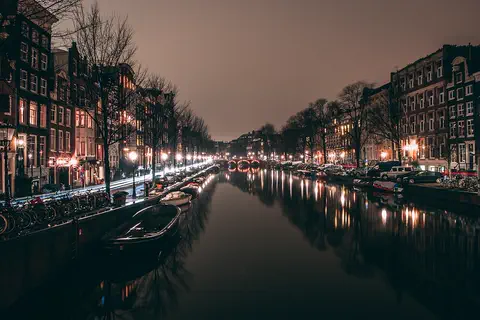
Amsterdam is the capital of the Netherlands. It began as a fishing village beside a dam on the Amstel River, which gave the city its name. Today about 942,000 people live among its rings of canals, hundreds of bridges, houseboats and bicycles.
-
Watch
City
Saint Petersburg
Saint Petersburg, in northwestern Russia, was founded by Tsar Peter the Great in 1703 on the islands of the Neva River delta. It was Russia's capital from 1712 to 1918 and is famous for the Winter Palace and Hermitage museum, its canals and bridges and its 'White Nights'. About 5.65 million people lived there in 2025.
-
 Watch
City
Athens
Athens is the capital of Greece and one of the oldest cities in the world. Above it rises the Acropolis, a rocky hill crowned by the marble Parthenon, built about 2,500 years ago. Ancient Athens was home to early democracy, great thinkers and theater.
-
 Watch
City
Barcelona
Barcelona, the capital of Catalonia in northeastern Spain, lies on the Mediterranean between mountains and the sea. It is famous for the buildings of the architect Antoni Gaudí, including the Sagrada Família, a giant church begun in 1882. About 1.7 million people live in the city (2025).
For parents & teachers
What children will learn
- Locate Stockholm on Sweden's east coast, between Lake Mälaren and the Baltic Sea.
- Describe how Stockholm grew from a trading town into a capital.
- Explain why the warship Vasa sank, using the idea of balance.
- Give examples of how a city uses bridges, ships and trains to join islands.
Recommended ages: 3 to 17 · About 15 minutes
Talk about it
- Stockholm is built on islands. What would be fun, and what would be hard, about living on an island in a city?
- The Vasa was too top-heavy. Why do you think the builders did not fix it before it sailed?
- Stockholm put art in its subway stations. Where would you put art in your town?
Try at home or in class
- Make a paper boat, then add coins high on its sides. When does it tip over? Move the coins low in the middle and try again.
- Draw a map of a city on five islands and design the bridges and ferry routes to join them.
Key vocabulary: capital, island, medieval, warship, open-air museum, metro, port
Where these facts come from
- Wikidata , Wikimedia Foundation (CC0 1.0)
- Natural Earth vector data , Natural Earth (NACIS) (Public domain)
- Stockholm , Encyclopaedia Britannica
- Stockholm: climatological information , World Meteorological Organization, World Weather Information Service
- Vasa timeline , Vasa Museum (Vasamuseet)
- The Disaster , Vasa Museum (Vasamuseet)
- The Salvage , Vasa Museum (Vasamuseet)
- Our history , Skansen
- Stockholm Metro Art – The World's Longest Art Gallery , Visit Stockholm
- Ceremonies archive , NobelPrize.org (Nobel Prize Outreach)
- Wikimedia Commons , Wikimedia Foundation (Per file (public domain, CC0, CC BY or CC BY-SA); see each media record)
Checked, not yet human-reviewed. Last updated October 27, 2026. Spotted a mistake? Tell us.