
 Country
Europe
Andorra
Andorra is a very small country in the mountains. It sits between France and Spain, and people ski there in winter.
Andorra is a tiny country high in the Pyrenees mountains, between France and Spain. It is made of steep mountain valleys, its official language is Catalan, and about 89,750 people lived there in 2026.
Andorra is a landlocked coprincipality of 468 square kilometers among the southern peaks of the Pyrenees, bounded by France and Spain. Its valleys drain into the Valira River, its heads of state are two co-princes, and Andorran nationals make up 44.7 percent of its 89,752 residents (June 2026).
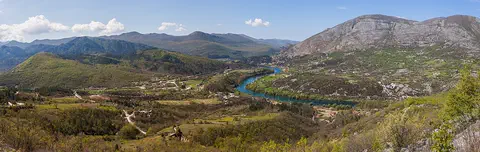
Photo: Ricardo Marques, CC BY 3.0, via Wikimedia Commons
Discover Andorra
Andorra is a very small country.
It is high up in the mountains. France is on one side. Spain is on the other side. The capital city is called Andorra la Vella.
Andorra is one of the smallest countries in Europe. It covers only 468 square kilometers, high in the Pyrenees, the mountains between France and Spain. The whole country is a group of mountain valleys, and their streams join to make the Valira River.
Andorra has no coast and no railway, but good roads link it to France and Spain. Its capital is Andorra la Vella. About 89,750 people lived in Andorra in June 2026, and many visitors come to shop, walk in the mountains and ski.
Andorra is a small, landlocked, independent coprincipality among the southern peaks of the Pyrenees, bounded by France to the north and east and Spain to the south and west. Its 468 square kilometers are a cluster of mountain valleys whose streams unite to form the Valira River. Britannica notes that only a tiny proportion of the land can be cultivated.
Andorra's Department of Statistics estimated 89,752 residents on 30 June 2026, 2.0 percent more than a year earlier, spread across seven parishes. Because there are no customs duties and taxes are low or absent, Andorra became an important center of retail trade for shoppers from across Europe; tourism, winter sports, construction and banking are other key parts of the economy. Andorra is not a member of the European Union, but the euro has been its official currency under a 2011 monetary agreement with the EU.
Towns and valleys
Andorra la Vella is the capital.
It is in a narrow valley between mountains. Two rivers meet near the town. There are many shops there. Ski slopes are close by.
Andorra la Vella, the capital, lies in a narrow valley on the southern side of the Pyrenees, near the place where two rivers meet. For a long time it was a quiet, out-of-the-way town. Roads were built in the 1930s, and in the 1960s and 1970s it grew into a busy shopping center. Andorra's parliament meets there.
Andorra is divided into seven parishes. The Madriu-Perafita-Claror Valley, in the southeast, is a wild valley with no roads, old stone shepherds' huts and mountain paths, and it is a UNESCO World Heritage Site.
Andorra la Vella lies near the confluence of the Valira and the Valira del Norte in the narrow Gran Valira valley, on the southern slopes of the Pyrenees. Britannica describes its modernization beginning with carriage roads in the 1930s and its transformation in the 1960s and 1970s from a rustic town into a commercial center for shoppers and tourists; the General Council, Andorra's parliament, meets there. The parish of Andorra la Vella had 24,877 residents in June 2026, the largest of the seven parishes.
The Madriu-Perafita-Claror Valley, inscribed by UNESCO in 2004, covers 4,247 hectares, a little more than 9 percent of the country, and is the last place in Andorra without roads. Its upper part is an exposed glacial landscape of steep cliffs and rock and lake glaciers; lower down it is wooded and ends in a short gorge. It holds stone huts with vaulted roofs, some still used by shepherds, terraced fields, paved tracks and the remains of the Catalan Forge, an old ironmaking method, and its communal land management has lasted more than 700 years.
High mountains and valleys
Andorra is all mountains and valleys.
The tallest peak is Comapedrosa. Little lakes and waterfalls sit high in the hills. In winter, people ski on the slopes.
All of Andorra is mountainous. The highest point is Comapedrosa peak, 2,942 meters high, in the northwest of the country. Around it is a nature park of forests, small lakes and waterfalls, with paths and mountain huts for hikers.
In the Madriu-Perafita-Claror Valley you can see a glacial landscape, shaped by ice: steep cliffs high up, with woods and a short gorge lower down. Andorra has three protected nature areas, and in winter its slopes are good for skiing.
Andorra's relief is entirely mountainous: its valleys are cut into the southern Pyrenees and drain to the Valira River. The highest point is Comapedrosa, 2,942 m, inside Les Valls del Comapedrosa Communal Natural Park, a protected area of 15.42 km² in the parish of La Massana, known for forests, small lakes and waterfalls.
UNESCO describes the upper Madriu-Perafita-Claror Valley as an exposed glacial landscape with steep cliffs, rock glaciers and lake glaciers, narrowing downstream into woodland and a short gorge; a secondary valley, the Perafita-Claror, joins from the southwest. Andorra has three protected natural spaces: the Sorteny Valley, Madriu-Perafita-Claror and the Comapedrosa valleys. In 2020 UNESCO also named the parish of Ordino a Biosphere Reserve. Britannica notes Andorra's excellent opportunities for winter sports.
Animals of Andorra
Chamois live in Andorra's mountain parks.
Golden eagles fly in the sky. Bearded vultures live here too. So do little rock lizards.
Andorra's three nature parks are home to many kinds of wildlife. In the Sorteny Valley, a small park in the parish of Ordino, live the Pyrenean chamois, the Pyrenean newt and the common frog. More than 700 kinds of flowers and other plants grow there.
In the Comapedrosa park, golden eagles and bearded vultures are regular residents, and so is Aurelio's rock lizard. Typical alpine flowers, such as the alpine violet, grow there too.
Andorra's protected areas hold typical high-Pyrenean species. The Sorteny Valley park in Ordino, more than 1,000 hectares on both banks of the Sorteny River, is the smallest of the three but has more than 700 species of flowers and plants, some found only in the Pyrenees; its animals include the Pyrenean chamois, the Pyrenean newt and the common frog.
In Les Valls del Comapedrosa park the regular inhabitants include Aurelio's rock lizard, the golden eagle and the bearded vulture, and the alpine flora includes the alpine violet and the Pyrenean mouse-ear. In the Madriu-Perafita-Claror Valley, UNESCO describes vast pastures and wooded valleys that reflect the persistence of pastoralism and a strong mountain culture.
People, languages and food
About 89,750 people lived in Andorra in 2026.
The main language is Catalan. Many people speak Spanish or French too. A warm stew called escudella is eaten in winter.
About 89,750 people lived in Andorra in June 2026. A little less than half of them were Andorran citizens. Many others were citizens of Spain, Portugal, France or other countries. Almost nine in ten people live in towns.
Catalan is Andorra's official language, and Spanish and French are also spoken. Andorran cooking uses local, seasonal food from the mountains. Escudella, a light pork stew with vegetables, is served in winter, and trinxat is made with winter cabbage, potatoes and garlic.
The Department of Statistics' June 2026 estimate gives 40,113 Andorran nationals (44.7 percent), 21,137 Spanish, 8,324 Portuguese and 4,246 French nationals, and 15,932 people of other nationalities; 10.6 percent of residents were under 15 and 16.0 percent were 65 or older. Britannica gives the urban share as 87.7 percent (2024). Andorra has long had a strong affinity with Catalonia: Catalan is the official language, its institutions are based on Catalan law, and many Spanish immigrants are Catalan. Most Andorrans are Roman Catholic.
Visit Andorra, the official tourism site, describes a cuisine of local, seasonal mountain produce, later influenced by French and Catalan cooking; a recipe book of Andorran gastronomy collects about thirty traditional recipes. Escudella, a light pork stew with seasonal vegetables, is served in winter and, at Christmas, with a traditional pasta called galets; trinxat de montanya combines winter cabbage, potatoes, garlic and tocino, a cured pork, and trout is pan-fried with almonds and cured ham. Old high-mountain barns called bordes, once used for grain and cattle, have become restaurants.
A long history
Andorra has a long history.
For hundreds of years it has had two princes. One is from France. One is from Spain. In 1993 Andorra wrote new rules for itself.
Andorra has an unusual history. Since the late 1200s it has had two princes at once, called co-princes: one in France and one in Spain. Today they are the president of France and the bishop of Urgell, in Spain. For centuries their representatives ran Andorra together.
In 1993, the people of Andorra voted for a constitution, a set of rules for running the country. It gave most power to an elected parliament, and the co-princes kept a mostly ceremonial role. Andorra joined the United Nations the same year.
Tradition credits Andorra's independence to Charlemagne, said to have recovered the region in 803, and to his son Louis I, who is said to have granted its people a charter of liberties; Charlemagne's grandson Charles II gave Andorra to the counts of Urgell, from whom it passed to the bishops of Urgell. The dual allegiance began in the late 13th century in a property dispute between the Spanish bishops of Urgell and the French heirs of the counts. From then on Andorra was governed jointly by representatives of the bishop and of the French head of state, each receiving a small yearly tribute.
This system lasted until 1993, when voters approved a constitution in a referendum. It moved most of the co-princes' powers to the General Council, now a parliament elected by universal suffrage, created separate executive, legislative and judicial branches, and let citizens form parties and trade unions. The co-princes remain heads of state, a largely ceremonial role. Andorra joined the United Nations in 1993 and the Council of Europe in 1994; its university was founded in 1997.
Andorra on the map
Find Andorra on the globe.
It is in Europe, in the mountains. It is so small it looks like a dot. France and Spain are its two neighbors.
Andorra is in southwestern Europe, in the Pyrenees. It is landlocked, which means it has no coast. It has only two neighbors: France to the north and east, and Spain to the south and west.
On a world map, Andorra is so small that it is hard to see: only 468 square kilometers. Roads cross the mountains into France and Spain, and a small airport in Spain serves the country.
Andorra lies among the southern peaks of the Pyrenees, between France to the north and east and Spain to the south and west. It is landlocked and, at 468 square kilometers, one of the smallest states in Europe. Its mountain valleys drain into the Valira River.
There is no railway; roads link Andorra with France and Spain, and Britannica notes that the principality is served by a small airport at Seo de Urgel (La Seu d'Urgell) in Spain. The Madriu-Perafita-Claror World Heritage property in the southeast has a buffer zone that, since a 2006 extension, reaches the international border with Spain.
- Area
- 468 km²
- Highest point
- Comapedrosa, 2,942 m
- Parishes
- 7
- People (30 June 2026)
- 89,752
Amazing facts
-
Andorra has two princes at the same time.
Andorra's two co-princes are the president of France and the bishop of Urgell in Spain.
The coprincipality's heads of state are the French president and the bishop of Urgell; since the 1993 constitution their role has been largely ceremonial.
-
One valley in Andorra has no roads at all.
The Madriu-Perafita-Claror Valley is the last place in Andorra without roads.
UNESCO notes that the Madriu-Perafita-Claror Valley, a little more than 9 percent of Andorra, is the last part of the country without roads.
-
Andorra has no trains.
Andorra has no railway. Roads link it to France and Spain.
Andorra has no railway system; roads link it with France and Spain, and a small airport at Seo de Urgel in Spain serves the principality.
-
Shepherds still use some very old stone huts.
In the Madriu-Perafita-Claror Valley, some small stone huts with stone roofs are still used by shepherds.
The valley's bornes, small huts with vaulted stone roofs, are still used by some shepherds, and its communal land management has survived for more than 700 years.
Words to know
- landlocked
- having no coast; surrounded by land
- co-prince
- one of two princes who share the role of head of state
- parish
- one of the seven areas Andorra is divided into
- glacier
- a huge, slow-moving river of ice that can carve valleys
- constitution
- a country's main set of rules about how it is governed
- Catalan
- a language spoken in Andorra and in parts of Spain, France and Italy
Discovery challenge
-
Which two countries are next to Andorra?
Which two countries border Andorra?
Andorra is bounded to the north and east, and to the south and west, by which two countries?
- France and Spain
- Italy and Germany
- Portugal and Morocco
Show the answer
France and Spain
France and Spain are Andorra's two neighbors.
France lies to the north and east of Andorra, and Spain to the south and west.
Andorra is bounded by France to the north and east and by Spain to the south and west, among the southern peaks of the Pyrenees.
-
Andorra is in which mountains?
Which mountains is Andorra in?
Andorra lies among the southern peaks of which mountain range?
- The Andes
- The Pyrenees
- The Himalayas
Show the answer
The Pyrenees
Andorra is in the Pyrenees mountains.
Andorra is high in the Pyrenees, the mountains between France and Spain.
Andorra is a cluster of valleys on the southern side of the Pyrenees, draining to the Valira River.
-
What is the main language in Andorra?
What is Andorra's official language?
Reflecting its long affinity with Catalonia, which is Andorra's official language?
- German
- English
- Catalan
Show the answer
Catalan
People in Andorra speak Catalan. Many speak Spanish or French too.
Catalan is the official language; Spanish and French are also spoken.
Catalan is official and Andorra's institutions are based on Catalan law; Spanish and French are also spoken.
-
How many princes does Andorra have?
How many co-princes share the role of head of state in Andorra?
Since the late 13th century, how many co-princes have shared Andorra's headship of state?
- One
- Two
- Seven
Show the answer
Two
Andorra has two princes: one in France and one in Spain.
Andorra has two co-princes: the president of France and the bishop of Urgell in Spain.
The dual allegiance began in the late 13th century; the co-princes, the French president and the bishop of Urgell, remain heads of state with a largely ceremonial role.
Animals of Andorra
-
 Watch
Animal
Golden eagle
The golden eagle is one of the largest and fastest birds of prey in North America, and it lives across much of the Northern Hemisphere. It soars over mountains and open country on wings more than two meters wide and dives at tremendous speed to catch rabbits, hares and ground squirrels.
-
 Watch
Animal
Common frog
The common frog is a familiar frog of ponds and gardens across Europe. It spends most of the year in damp grass, gardens and woods, and every spring it returns to ponds to lay clumps of frogspawn that grow into tadpoles and then little froglets.
Explore next
-
 Watch
 Country
Spain
Spain covers most of the Iberian Peninsula in southwestern Europe. Its middle is a high, flat plateau, the Pyrenees mountains stand between it and France, and almost 50 million people live there, with Madrid as the capital.
-
 Watch
 Country
France
France is a country in northwestern Europe, between the Atlantic Ocean and the Mediterranean Sea. It has high mountains such as the Alps and the Pyrenees, long rivers such as the Loire and the Seine, and about 69.1 million people (2026). Its capital is Paris.
-
Watch
Animal
Golden eagle
The golden eagle is one of the largest and fastest birds of prey in North America, and it lives across much of the Northern Hemisphere. It soars over mountains and open country on wings more than two meters wide and dives at tremendous speed to catch rabbits, hares and ground squirrels.
-
Watch
Animal
Common frog
The common frog is a familiar frog of ponds and gardens across Europe. It spends most of the year in damp grass, gardens and woods, and every spring it returns to ponds to lay clumps of frogspawn that grow into tadpoles and then little froglets.
-
 Watch
 Country
Belarus
Belarus is a landlocked country in eastern Europe. Ice sheets of the last ice age shaped its low hills and wide plains, it has more than 10,000 lakes and one of Europe's largest wetlands, and about 9.1 million people lived there in 2025.
-
 Watch
 Country
Bosnia and Herzegovina
Bosnia and Herzegovina is a mountainous country in southeastern Europe. It has forests, limestone hills and many rivers, and famous old stone bridges cross some of them. Its capital is Sarajevo. It touches the Adriatic Sea along only about 20 kilometers of coast.
-
 Watch
 Country
Bulgaria
Bulgaria is a country on the eastern side of the Balkan Peninsula, with the Danube River to the north and the Black Sea to the east. Mountains cross it from west to east, and about 6.4 million people lived there at the end of 2025.
-
 Watch
 Country
Croatia
Croatia is a crescent-shaped country in southeastern Europe. Its long coast on the Adriatic Sea is fringed by more than 1,100 islands, limestone mountains rise behind it, fertile plains lie in the north, and about 3.87 million people lived there in mid-2025.
For parents & teachers
What children will learn
- Locate Andorra in the Pyrenees between France and Spain and explain what landlocked means.
- Describe how Andorra's two co-princes and its 1993 constitution share the running of the country.
- Name some of Andorra's mountain wildlife and traditional foods.
Recommended ages: 3 to 17 · About 12 minutes
Talk about it
- What might be good and what might be hard about living in a country with no coast and no railway?
- Andorra is about 468 square kilometers. What place near you might be about that size?
- Why do you think people protect a valley with no roads, like Madriu-Perafita-Claror?
Try at home or in class
- Crumple a sheet of paper into mountains, flatten it gently, and trace with a finger how water would run down the valleys into one river, like the Valira.
- Draw a map with two big countries and a tiny one between them, and label France, Spain and Andorra.
Key vocabulary: landlocked, co-prince, parish, glacier, constitution, Catalan
Where these facts come from
- Wikidata , Wikimedia Foundation (CC0 1.0)
- Natural Earth vector data , Natural Earth (NACIS) (Public domain)
- UNESCO World Heritage List , UNESCO World Heritage Centre (Linked as a reference; site facts come from Wikidata)
- A001. Estimacions de població. Juny del 2026 , Departament d'Estadística, Govern d'Andorra (release of 16 July 2026, as republished by Altaveu)
- Andorra , Encyclopaedia Britannica
- Andorra la Vella , Encyclopaedia Britannica
- Madriu-Perafita-Claror Valley , UNESCO World Heritage Centre
- Les Valls del Comapedrosa Communal Natural Park , Comú de La Massana
- Andorra Nature Parks , Visit Andorra (Andorra Turisme)
- Andorran gastronomy , Visit Andorra (Andorra Turisme)
- PlayOwl region table, version 1 , PlayOwl (PlayOwl original data)
- flag-icons 7.5.0 , Panayiotis Lipiridis and contributors (MIT)
- Wikimedia Commons , Wikimedia Foundation (Per file (public domain, CC0, CC BY or CC BY-SA); see each media record)
Checked, not yet human-reviewed. Last updated October 24, 2026. Spotted a mistake? Tell us.