
 Country
Europe
Bulgaria
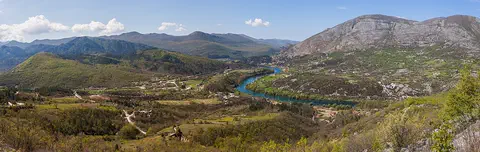
Bulgaria is a country in southeastern Europe by the Black Sea. It has high mountains, a big river and valleys full of roses.
Bulgaria is a country on the eastern side of the Balkan Peninsula, with the Danube River to the north and the Black Sea to the east. Mountains cross it from west to east, and about 6.4 million people lived there at the end of 2025.
Bulgaria occupies the eastern Balkan Peninsula, a nearly rectangular country of about 111,000 square kilometers between the lower Danube and the Black Sea. Founded in 681, it is one of Europe's oldest states; Bulgaria's National Statistical Institute counted 6,423,207 residents on December 31, 2025.
Photo: Deensel, CC BY 2.0, via Wikimedia Commons
Discover Bulgaria
Bulgaria is a country in Europe.
The big Danube River runs along its top. The Black Sea is on its side. Tall mountains cross the middle. The capital city is called Sofia.
Bulgaria is a country in southeastern Europe, on the eastern part of the Balkan Peninsula. On a map it is almost a rectangle. The Danube River forms most of its northern border, and the Black Sea lies to the east.
Inside that rectangle, flat farmland and rugged mountains take turns. The Balkan Mountains run across the middle, and higher mountains rise in the south. The capital, Sofia, sits in a mountain basin in the west. Bulgaria was founded in the year 681, which makes it one of the oldest countries in Europe. About 6.4 million people lived there at the end of 2025.
Bulgaria lies on the eastern Balkan Peninsula, crossed by historic routes from northern and eastern Europe to the Mediterranean and from western Europe to the Middle East. Britannica describes it as nearly rectangular: Romania to the north along most of the lower Danube, the Black Sea to the east, Türkiye (Turkey) and Greece to the south, North Macedonia to the southwest and Serbia to the west.
Three structural divisions run east to west: North Bulgaria, with the Danubian Plain and the Balkan Mountains; a transitional zone of block-faulted ranges and basins, including the Sofia basin and the Upper Thracian lowland; and South Bulgaria, dominated by the Rila-Rhodope Massif. The National Statistical Institute (NSI) counted 6,423,207 residents on December 31, 2025. Bulgaria joined NATO in 2004 and the EU in 2007, and the European Central Bank records that it joined the euro area on January 1, 2026.
Cities and famous places
Sofia is the biggest city in Bulgaria.
A big mountain called Vitosha stands right behind it. Plovdiv is an old city by a river. High in the mountains is Rila Monastery, with striped arches and painted walls.
Sofia, the capital, has more than a million people, about three times as many as the next biggest cities, Plovdiv and Varna. The Vitosha mountains rise just outside it. Plovdiv sits on the Maritsa River in the south, where ruins of Roman towns have been dug up.
On the Black Sea, the town of Nessebar stands on a rocky peninsula. It is more than 3,000 years old: it began as a Thracian settlement and became a Greek colony around 600 BCE. In the Rila Mountains, Rila Monastery was founded in the 900s and rebuilt between 1834 and 1862 after a fire. Both are World Heritage Sites.
Sofia, in a mountainous basin in the west, dominates Bulgaria's economic and cultural life and has about three times the population of Plovdiv or Varna; Wikidata gives 1,213,134 (2025). Plovdiv, on the Maritsa, is an industrial and cultural center with an international trade fair; Varna and Burgas have the coast's fine harbors, Burgas being the largest Black Sea port, and Ruse is the largest river port.
UNESCO inscribed Nessebar in 1983: a site more than 3,000 years old on a rocky peninsula, first a Thracian settlement, a Greek colony from the early 6th century BCE, and later one of the main Byzantine towns of the western Black Sea coast, with 19th-century wooden houses typical of the region. Rila Monastery (1983), founded in the 10th century by the hermit John of Rila, burned in the early 19th century and was rebuilt in 1834–62; UNESCO calls it a characteristic example of the Bulgarian Renaissance of the 18th–19th centuries. The Thracian tomb of Kazanlak (1979), from around the end of the 4th century BCE, holds Bulgaria's best-preserved Hellenistic paintings.

Mountains, rivers and springs
Bulgaria has many mountains.
The tallest is called Musala. High up there are hundreds of small lakes. Warm water bubbles out of the ground in many places. The beaches by the sea are long and sandy.
The Balkan Mountains run across the middle of Bulgaria, and north of them the fertile Danubian Plain slopes down to the Danube. In the south rise the Rila, Pirin and Rhodope mountains. Musala, in the Rila Mountains, is 2,925 meters high, the highest peak in the whole Balkan Peninsula. The Rila and Pirin ranges hold several hundred lakes left by ancient glaciers.
Bulgaria has about 500 mineral springs, and half of them are warm or hot. Most of the country has a moderate continental climate, and the lowlands have snow on the ground for about 25 to 30 days a year. The Black Sea coast has long sandy beaches and the harbors of Varna and Burgas.
The Danubian Plain, averaging 178 m and covering about 31,600 km², rises south to the Balkan Mountains, whose rounded summits average 722 m and reach 2,376 m at Botev. South of a transitional zone of block-faulted ranges lies the Rila-Rhodope Massif: Musala (2,925 m), in the Rila, is the highest point of the Balkan Peninsula, Vikhren in the Pirin reaches 2,914 m, and the Rila and Pirin hold several hundred lakes of glacial origin. UNESCO's Pirin National Park (1983, extended to about 40,000 ha) spans limestone landscapes with glacial lakes, waterfalls, caves and mostly coniferous forest.
Apart from the Danube, rivers are short (the Maritsa, Iskŭr, Struma, Arda, Tundzha and Yantra); more than half the runoff drains to the Black Sea and the rest to the Aegean. There are some 500 mineral springs, half of them warm or hot, reaching 103 °C at Sapareva Banya. The climate is moderate continental, tempered by Mediterranean influence in the south; the mean annual temperature is 10.5 °C, with recorded extremes of −38 °C and 45 °C, and precipitation from 450 mm in the northeast to more than 1,190 mm in the highest mountains.
Animals of Bulgaria
Chamois live high in the Rila Mountains.
Owls, bats and martens live there too. Pelicans, herons and egrets live at a lake by the Danube. Almost 100 kinds of birds raise their young there.
Bulgaria has many kinds of plants and animals because it sits where several great natural regions of Europe and Asia meet. In Rila National Park live chamois, wild animals of the high mountains, along with martens, owls, bats and birds such as the capercaillie and the wallcreeper. About one in three of Bulgaria's nesting bird species can be found in the park.
Beside the Danube, the Srebarna Nature Reserve is a freshwater lake where almost 100 kinds of birds breed. UNESCO names the Dalmatian pelican, great egret, purple heron and white spoonbill among its most interesting birds, and about 80 more species spend the winter there.
Britannica attributes Bulgaria's relatively large number of species to its position next to several Eurasian biogeographic zones. During the Pleistocene, life here was not destroyed by advancing glaciers, as in much of Europe, but enriched by species arriving from the north, some of which survive; steppe influences also reached it. Most plants and animals are central European, with Arctic-alpine types in the high mountains, steppe species in the northeast and southeast and Mediterranean species in the south.
Rila National Park shelters suslik, rock partridge, chamois, capercaillie, chough, accentor, wallcreeper, owls, bats and martens, with about a third of Bulgaria's nesting birds and a third of its invertebrates, and fish such as the Balkan trout. Srebarna Nature Reserve (UNESCO, 1983), a freshwater lake of more than 600 ha beside the Danube, is the breeding ground of almost 100 bird species; UNESCO's most interesting species there include the Dalmatian pelican, great egret, night heron, purple heron, glossy ibis and white spoonbill; Britannica notes it was placed on the danger list in 1992 after environmental decline and improved in the early 21st century.

People, languages and festivals
About 6.4 million people live in Bulgaria.
Most people speak Bulgarian. It is written with Cyrillic letters. In May and June, people pick roses to make a sweet-smelling oil.
About 6.4 million people lived in Bulgaria at the end of 2025, and almost three in four live in towns and cities. Bulgarian is a Slavic language written in the Cyrillic alphabet. Turks are the largest minority group, and there are Roma communities and smaller groups of Armenians, Russians, Greeks and others.
In May and June, the rose valleys around Karlovo and Kazanlak celebrate the roses in bloom. People pick oil-bearing roses, and their fresh petals are distilled into attar of roses, a perfume oil sold around the world. Summer brings folk and music festivals, such as the International Folklore Festival in Burgas.
NSI counted 6,423,207 residents at the end of 2025. Britannica gives Bulgarians as more than four-fifths of the population and Turks, the largest minority, as about one-tenth, living in parts of the northeast and the eastern Rhodopes; Roma are another sizable minority. Bulgarian is a South Slavic language, closely related to Macedonian and written in Cyrillic. There is no official religion; most religious Bulgarians belong to the Bulgarian Orthodox Church, with Muslim, Protestant, Catholic, Jewish and Armenian minorities. The urban share passed the rural in 1969 and is now almost three-fourths, and from 1949 to 1999 Sofia's population doubled while Plovdiv's grew more than ninefold.
Britannica describes contemporary culture as a blend of millennium-old folk traditions and a formal culture that helped build national consciousness under Ottoman rule. The mummer (kuker) tradition survives in the southwest. Rose harvests in the Karlovo and Kazanlŭk valleys in May and June supply attar of roses for export, and festivals include the International Folklore Festival in Burgas, the Varna Summer International Festival and Sofia Musical Weeks.
One of Europe's oldest states
Long, long ago, people called Thracians lived here.
They left behind a tomb with beautiful paintings. Later, Romans built towns. Bulgaria became a country more than 1,300 years ago.
In the Bronze Age, Thracian tribes lived in what is now Bulgaria. Greeks, Persians and Romans came later, and Roman towns stood at places such as Plovdiv and Varna. In the 500s and 600s, Slavs settled the land. The Bulgars, a people from the steppes north of the Black Sea, crossed the Danube, and in 681 the Byzantine Empire agreed by treaty to their rule. That was the beginning of Bulgaria.
In 864 Bulgaria's ruler, Boris I, became a Christian, and followers of Saints Cyril and Methodius brought their Slavic alphabet and books to Bulgaria. The Ottoman Empire ruled Bulgaria for centuries until a Bulgarian principality was created in 1878. Bulgaria became fully independent in 1908, joined the European Union in 2007 and began using the euro in 2026.
Human habitation dates from the Middle Paleolithic; farming communities appeared in the Neolithic, and in the Bronze Age the land was home to Thracian tribes. Under Rome it was divided between Moesia and Thrace. Slavs arrived in the 6th and 7th centuries CE; the Bulgars, whose origin is still debated, crossed the Danube under Asparukh, and in 681 Byzantium recognized by treaty their control between the Balkan Mountains and the Danube. Boris I was baptized in 864, and disciples of Cyril and Methodius, who had devised an alphabet for Old Church Slavonic, were welcomed in Bulgaria to translate church books. The second Bulgarian empire, centered on Tŭrnovo, reached its height under Ivan Asen II (1218–41).
Ottoman conquest followed in the late 14th century. The Treaty of Berlin (1878) created an autonomous principality, with Sofia soon its capital, and de jure independence was proclaimed in 1908. Britannica records that, during World War II, the government resisted Nazi Germany's demands and saved virtually all of Bulgaria's 50,000 Jews from deportation. From 1946 to 1990 the country had a communist system; the July 1991 constitution created a parliamentary government with a directly elected president serving five-year terms. Bulgaria joined NATO in 2004 and the EU in 2007.
Bulgaria on the map
Find Bulgaria on the globe.
It is in Europe, next to the Black Sea. A big river runs along its top edge. Five countries are its neighbors.
Bulgaria is in southeastern Europe, on the Black Sea. Its neighbors are Romania to the north, Serbia to the west, North Macedonia to the southwest, and Greece and Türkiye (Turkey) to the south.
The Danube River forms most of the border with Romania. Bulgaria's banks of the river are steep, while the Romanian side has swamps and lagoons. Sofia, the capital, is in the west of Bulgaria but close to the middle of the whole Balkan region.
Britannica describes Bulgaria as nearly rectangular, bounded by Romania to the north, with most of that border on the lower Danube; the Black Sea to the east; Türkiye (Turkey) and Greece to the south; North Macedonia to the southwest; and Serbia to the west. The Bulgarian bank of the Danube is abrupt and often steep, in contrast with the swamps and lagoons of the Romanian side.
The narrow Black Sea coastal strip runs north to south along the eastern edge of the three main regions; apart from the harbors of Varna and Burgas it has few bays but long sandy beaches. Sofia, although in western Bulgaria, is near the geographic center of the Balkan region. At Ruse the Friendship Bridge crosses the Danube to Giurgiu in Romania. The map follows Natural Earth's land borders.
- Northern border
- mostly the lower Danube River, with Romania
- Highest point
- Musala, 2,925 m (highest in the Balkan Peninsula)
- Mineral springs
- about 500, half warm or hot
- Where rivers drain
- more than half to the Black Sea, the rest to the Aegean
Amazing facts
-
Musala is the tallest mountain in the Balkans.
Musala, 2,925 meters high in the Rila Mountains, is the highest peak in the whole Balkan Peninsula.
Britannica gives Musala Peak in the Rila Mountains, 2,925 m, as the highest point in Bulgaria and in the whole Balkan Peninsula.
-
Some spring water in Bulgaria comes out very, very hot.
Bulgaria has about 500 mineral springs. At Sapareva Banya, the water comes out at 103 °C.
Of Bulgaria's some 500 mineral springs, about half are warm or hot, reaching 103 °C at Sapareva Banya in the west.
-
Roses from Bulgaria are made into perfume oil.
In the rose valleys around Karlovo and Kazanlak, fresh rose petals are distilled into attar of roses, an oil exported around the world.
The blooming of oil-bearing roses in the Karlovo and Kazanlŭk valleys is celebrated through May and June; attar of roses, distilled from fresh petals, is exported worldwide.
-
Nessebar is a town more than 3,000 years old.
The seaside town of Nessebar began as a Thracian settlement more than 3,000 years ago and became a Greek colony about 2,600 years ago.
UNESCO dates Nessebar's site to more than 3,000 years ago; the Thracian settlement became a Greek colony at the beginning of the 6th century BCE.
-
Almost 100 kinds of birds nest at Lake Srebarna.
At Srebarna Lake by the Danube, almost 100 kinds of birds breed, and about 80 more come to spend the winter.
UNESCO records almost 100 breeding bird species at Srebarna, many rare or endangered, and some 80 other species that winter there.
Words to know
- peninsula
- land with water on three sides
- mineral spring
- a place where water full of dissolved minerals flows out of the ground
- glacial lake
- a lake that fills a hollow carved by an ancient glacier
- Cyrillic
- an alphabet used to write Bulgarian, Russian and several other languages
- principality
- a state ruled by a prince
- monastery
- a place where monks live, work and pray
- World Heritage Site
- a place UNESCO lists as important to all people, to be protected
Discovery challenge
-
What is the capital city of Bulgaria?
Which city is the capital of Bulgaria?
Which city, in a mountain basin in the west, is Bulgaria's capital and about three times the size of the next cities?
- Sofia
- Plovdiv
- Bucharest
Show the answer
Sofia
Sofia is the capital. A big mountain stands behind it.
Sofia is the capital. Plovdiv and Varna are the next-largest cities, and Bucharest is the capital of Romania.
Sofia dominates economic and cultural life; Plovdiv and Varna are the next largest; Bucharest is in Romania.
-
What is the tallest mountain in Bulgaria?
Which peak in the Rila Mountains is Bulgaria's highest?
Which 2,925 m peak is the highest point of the whole Balkan Peninsula?
- Mount Fuji
- Musala
- Mont Blanc
Show the answer
Musala
Musala is the tallest mountain in Bulgaria.
Musala, 2,925 meters, is in the Rila Mountains. Mount Fuji and Mont Blanc are in other countries.
Musala, in the Rila range of the Rila-Rhodope Massif, is Bulgaria's and the Balkan Peninsula's highest point.
-
Which letters are used to write Bulgarian?
Which alphabet is used to write the Bulgarian language?
In which script is Bulgarian, a South Slavic language, written?
- Latin letters
- Arabic letters
- Cyrillic letters
Show the answer
Cyrillic letters
Bulgarian is written with Cyrillic letters.
Bulgarian uses the Cyrillic alphabet. English uses Latin letters, and Arabic uses Arabic letters.
Bulgarian, a South Slavic language closely related to Macedonian, is written in the Cyrillic alphabet.
-
Which flowers are picked in Bulgaria to make a sweet-smelling oil?
In the valleys around Karlovo and Kazanlak, which flowers are distilled into a perfume oil?
Which flowers' fresh petals are distilled into the attar exported from the Kazanlŭk valley?
- Roses
- Sunflowers
- Tulips
Show the answer
Roses
Roses! Their petals make a sweet-smelling oil.
Oil-bearing roses are picked in May and June, and their petals are distilled into attar of roses.
Attar of roses, an essential oil distilled from fresh petals of oil-bearing roses, is exported worldwide.
-
Which sea is next to Bulgaria?
Which sea lies on Bulgaria's eastern side?
More than half of Bulgaria's runoff drains to which sea on its eastern coast?
- The Red Sea
- The Black Sea
- The North Sea
Show the answer
The Black Sea
The Black Sea is next to Bulgaria.
The Black Sea is to the east, with the ports of Varna and Burgas.
More than half the runoff drains to the Black Sea and the rest to the Aegean.
Places to discover in Bulgaria
-
Watch
City
Sofia
Sofia, the capital of Bulgaria, lies in a valley near the middle of the Balkans, at the foot of Vitosha Mountain. The Romans called it Serdica, and an old church of St. Sofia later gave the city its name. About 1.2 million people lived there in 2025.
-
 Watch
Natural wonder
Danube
The Danube is Europe's second-longest river, after the Volga. It begins as two small streams in Germany's Black Forest and flows about 2,850 kilometers east to the Black Sea, passing through 10 countries and four capital cities. For more than 2,000 years it has been a border, a highway for boats and a home for wildlife, and it ends in a giant delta of reeds, lakes and birds.
Animals of Bulgaria
Explore next
-
Watch
City
Sofia
Sofia, the capital of Bulgaria, lies in a valley near the middle of the Balkans, at the foot of Vitosha Mountain. The Romans called it Serdica, and an old church of St. Sofia later gave the city its name. About 1.2 million people lived there in 2025.
-
Watch
Natural wonder
Danube
The Danube is Europe's second-longest river, after the Volga. It begins as two small streams in Germany's Black Forest and flows about 2,850 kilometers east to the Black Sea, passing through 10 countries and four capital cities. For more than 2,000 years it has been a border, a highway for boats and a home for wildlife, and it ends in a giant delta of reeds, lakes and birds.
-
 Watch
3D
Animal
Great egret
The great egret is a tall, all-white heron that lives in wetlands on every continent except Antarctica. It wades slowly through shallow water, waits, then strikes like lightning to catch fish. Once nearly wiped out in the United States by hunters who wanted its lacy feathers, it made a remarkable comeback.
- Watch Geography Glaciers A glacier is a huge mass of ice and snow that slowly flows over land. It forms where more snow falls than melts, year after year, until the snow is squeezed into ice. Pulled by its own weight, it creeps downhill, carving wide valleys and carrying rocks along.
-
 Watch
 Country
Belarus
Belarus is a landlocked country in eastern Europe. Ice sheets of the last ice age shaped its low hills and wide plains, it has more than 10,000 lakes and one of Europe's largest wetlands, and about 9.1 million people lived there in 2025.
-
 Watch
 Country
Bosnia and Herzegovina
Bosnia and Herzegovina is a mountainous country in southeastern Europe. It has forests, limestone hills and many rivers, and famous old stone bridges cross some of them. Its capital is Sarajevo. It touches the Adriatic Sea along only about 20 kilometers of coast.
-
 Watch
 Country
Croatia
Croatia is a crescent-shaped country in southeastern Europe. Its long coast on the Adriatic Sea is fringed by more than 1,100 islands, limestone mountains rise behind it, fertile plains lie in the north, and about 3.87 million people lived there in mid-2025.
-
 Watch
 Country
Czechia
Czechia, also called the Czech Republic, is a landlocked country in central Europe. Mountains ring the old land of Bohemia, the Vltava River flows through the capital, Prague, and about 10.9 million people lived there in 2026.
For parents & teachers
What children will learn
- Locate Bulgaria between the Danube and the Black Sea and name its neighbors.
- Describe Bulgaria's east-west mountain belts, glacial lakes and mineral springs.
- Describe some of Bulgaria's languages, festivals, wildlife and ways of life without treating them as one single culture.
- Outline Bulgaria's history from the Thracians and the state of 681 to independence (1908) and the EU (2007).
Recommended ages: 3 to 17 · About 15 minutes
Talk about it
- Disciples of Cyril and Methodius translated church books into Slavic in Bulgaria. Why might it matter to people to read books in their own language?
- Why do you think lakes formed in hollows high in the Rila and Pirin mountains?
- Rila Monastery was rebuilt after a fire. What old building near you has been rebuilt or restored?
Try at home or in class
- Write your name in Cyrillic letters using an alphabet chart, then compare it with the Latin letters you usually use.
- Fold a sheet of paper into three strips from top to bottom and draw Bulgaria's belts: the Danubian Plain, the Balkan Mountains and the high southern ranges.
Key vocabulary: peninsula, mineral spring, glacial lake, Cyrillic, principality, monastery, World Heritage Site
Where these facts come from
- Wikidata , Wikimedia Foundation (CC0 1.0)
- Natural Earth vector data , Natural Earth (NACIS) (Public domain)
- UNESCO World Heritage List , UNESCO World Heritage Centre (Linked as a reference; site facts come from Wikidata)
- Bulgaria (introduction and Land) , Encyclopaedia Britannica
- Bulgaria: People (ethnic groups, languages, religion, settlement, demographic trends) , Encyclopaedia Britannica
- Bulgaria: Cultural life , Encyclopaedia Britannica
- Bulgaria: Government and society , Encyclopaedia Britannica
- Bulgaria: History , Encyclopaedia Britannica
- Bulgaria: The first Bulgarian empire , Encyclopaedia Britannica
- Bulgaria: The second Bulgarian empire , Encyclopaedia Britannica
- Bulgaria: Treaties of San Stefano and Berlin , Encyclopaedia Britannica
- Bulgaria: Bulgaria at the end of the 19th century , Encyclopaedia Britannica
- Bulgaria: Bulgaria's transition , Encyclopaedia Britannica
- Population by districts, municipalities, place of residence and sex (as of 31.12.2025) , National Statistical Institute of Bulgaria
- Pirin National Park , UNESCO World Heritage Centre
- Srebarna Nature Reserve , UNESCO World Heritage Centre
- Ancient City of Nessebar , UNESCO World Heritage Centre
- Thracian Tomb of Kazanlak , UNESCO World Heritage Centre
- Rila Monastery , UNESCO World Heritage Centre
- Bulgaria joins the euro area , European Central Bank
- PlayOwl region table, version 1 , PlayOwl (PlayOwl original data)
- flag-icons 7.5.0 , Panayiotis Lipiridis and contributors (MIT)
- Wikimedia Commons , Wikimedia Foundation (Per file (public domain, CC0, CC BY or CC BY-SA); see each media record)
Checked, not yet human-reviewed. Last updated October 24, 2026. Spotted a mistake? Tell us.