
 Country
Europe
Spain
Spain is a country in the southwest of Europe. It has high mountains, old castles, islands and the big city of Madrid.
Spain covers most of the Iberian Peninsula in southwestern Europe. Its middle is a high, flat plateau, the Pyrenees mountains stand between it and France, and almost 50 million people live there, with Madrid as the capital.
Spain occupies about 85 percent of the Iberian Peninsula, plus the Balearic and Canary islands and the North African cities of Ceuta and Melilla. Its heart is the Meseta, a high central plateau ringed by mountains, and its 49.8 million people (July 2026) speak Castilian Spanish and, in several regions, co-official languages such as Catalan, Galician and Basque.
Photo: Jebulon, CC0 1.0, via Wikimedia Commons
Discover Spain
Spain is a country in Europe.
It is next to the Mediterranean Sea. Spain has high mountains and wide, flat land. It has islands too. The capital city is called Madrid.
Spain is in the far southwest of Europe. It shares the Iberian Peninsula with Portugal and covers about 85 percent of it. A peninsula is land with water on most sides, and Spain has the Mediterranean Sea to the east, the Atlantic Ocean to the northwest and southwest and the Bay of Biscay to the north.
The middle of Spain is the Meseta, a broad plateau about half a mile above sea level. Spain also includes two groups of islands: the Balearic Islands in the Mediterranean and the Canary Islands in the Atlantic. Almost 50 million people live in Spain, and its capital is Madrid.
Spain lies at the extreme southwest of Europe, occupying about 85 percent of the Iberian Peninsula (Britannica also puts it at five-sixths), with a total area of about 506,000 square kilometers. Beyond the mainland it includes the Balearic Islands in the Mediterranean, the volcanic Canary Islands in the Atlantic off northwest Africa, and Ceuta and Melilla, two small enclaves on the coast of northern Morocco that Spain has ruled for centuries.
Most of the mainland is the Meseta Central, a plateau divided by the Central Sierras and ringed by mountain ranges; the northern Meseta averages about 700 meters above sea level. Spain's national statistics institute, INE, counted 49,801,559 residents on 1 July 2026 (a provisional figure, the highest in its records), and about 82 percent of people lived in urban areas in 2024. Spain is a constitutional monarchy: the monarch is head of state and the Cortes Generales, a parliament of two chambers, makes the laws.
Cities and famous places
Madrid is the biggest city in Spain.
It has many museums. Barcelona is a big city by the sea. A man named Gaudí made buildings there in his own special style. In Granada, an old palace sits on a green hill.
Madrid is Spain's capital and largest city, with about 3.5 million people (2025), and it is the country's center for business and culture. Barcelona, on the Mediterranean coast, is the second-largest city. The architect Antoni Gaudí (1852–1926) built seven famous works in and near Barcelona, including Park Güell and parts of the Sagrada Família church, and they are now a World Heritage Site.
In Granada, the Alhambra fortress and palace stands on a hill above the city. Next to it are the gardens of the Generalife, once the country home of the emirs, Muslim rulers who governed this part of Spain in the 1200s and 1300s.
Madrid, with 3,506,730 people (2025), is Spain's largest city and, as Britannica puts it, its financial and cultural center, as it has been for hundreds of years. Barcelona (1.73 million in 2025), capital of Catalonia, is known for its maritime industry and architecture. UNESCO lists seven works by Antoni Gaudí in or near Barcelona as one World Heritage Site (inscribed in 1984 and extended in 2005), among them Park Güell, Casa Milà, Casa Batlló and his Nativity façade and crypt of the Sagrada Família, for his exceptional contribution to architecture and building technology around 1900.
In Granada, the Alhambra and the Albaicín occupy two adjacent hills and form the medieval part of the city; east of the Alhambra lie the gardens of the Generalife, the country residence of the emirs who ruled this region in the 13th and 14th centuries (World Heritage Site, 1984). Segovia's Roman aqueduct, probably built around 50 CE, still stands on two tiers of arches.

Plateaus, mountains and a volcano
Spain has many mountains.
The Pyrenees mountains are in the north. The tallest mountain of all is on an island. It is a volcano called Teide. Some parts of Spain are very dry.
Mountains ring the central plateau, and the Pyrenees form a long wall along the border with France. In the south, the snowcapped Sierra Nevada rises above the Guadalquivir River valley.
The highest point of all is not on the mainland. Teide, a volcano on the island of Tenerife in the Canary Islands, reaches 3,715 meters. Spain's longest river, the Tagus, flows more than 1,000 kilometers west to the Atlantic. The north is rainy and green, while much of the south and east is hot and dry.
Most of Spain is the Meseta Central, an ancient block of Hercynian rock around which younger sediments were later pushed up into mountains. The Pyrenees stretch about 430 km from the Mediterranean to the Bay of Biscay, peaking at Aneto (3,404 m); the Baetic Cordillera in the south holds the mainland's highest summit, Mulhacén (3,479 m, IGN). Three of Spain's rivers, the Tagus (1,007 km), Ebro (909 km) and Douro (895 km), rank among Europe's longest, and all the major rivers except the Ebro drain to the Atlantic.
The Canary Islands are volcanic. UNESCO describes the Teide-Pico Viejo volcano as the highest peak on Spanish soil; rising about 7,500 m from the ocean floor, it is regarded as the world's third-tallest volcanic structure. Spain's National Geographic Institute (IGN) lists Teide at 3,715 m, although UNESCO and Britannica still give 3,718 m. The climate ranges from the humid, maritime north, from Galicia to northern Catalonia, to Mediterranean and continental conditions elsewhere. Britannica reports that nearly half of Spain is moderately or severely affected by the threat of desertification, especially in the arid east.

Animals of Spain
A wild cat called the Iberian lynx lives in Spain.
Not long ago, very few were left. Now there are many more. Lots of birds visit a big wetland called Doñana.
The Iberian lynx is a wild cat of Spain and Portugal. In 2001 there were just 62 adult lynx left. People protected the places where lynx live, helped the rabbits they eat, and moved lynx to new areas. By 2022 there were 648 adults, and today there are more than 2,000 lynx, young ones included.
In the southwest, Doñana National Park is a huge area of lagoons, marshes and sand dunes where the Guadalquivir River meets the Atlantic. More than 500,000 water birds spend the winter there every year. Wolves and brown bears survive in a few wild areas, while wild boar, ibex and red deer are more common.
In June 2024 the IUCN moved the Iberian lynx (Lynx pardinus) from Endangered to Vulnerable. Its mature population rose from 62 in 2001 to 648 in 2022, and the total, including young, is now estimated at more than 2,000. Conservation focused on its prey, the Endangered European rabbit, on restoring Mediterranean scrub and forest, and on cutting deaths caused by people; since 2010 more than 400 lynx have been reintroduced to parts of Portugal and Spain. Virus outbreaks in rabbits, disease from domestic cats, poaching and road traffic remain threats.
Britannica notes that Spain's closeness to Africa gives it more African wildlife than other Mediterranean peninsulas. The wolf and the brown bear survive in Spain's few wild areas; wild boar, ibex and red and fallow deer are more common. Doñana National Park, a World Heritage Site since 1994, is home to five threatened bird species and is the wintering site for more than 500,000 waterfowl each year. Striped dolphins live off the southeast coast and bottlenose dolphins off the Ebro delta.
People, languages and food
Almost 50 million people live in Spain.
Most people speak Spanish. Some people also speak Catalan, Galician or Basque. In many homes, lunch is the big meal of the day. Paella is a rice dish from Valencia.
Almost 50 million people live in Spain, and most of them live in towns and cities. Spanish, called Castilian in Spain, is the official language of the whole country and the language most people speak. In some regions other languages are official too: Catalan, Valencian, Galician and Basque. Basque is not related to any other language in the world.
In many homes, lunch is the main meal of the day, eaten between 2 and 3 in the afternoon, and supper comes late. Cooking changes from region to region: Valencia is the home of paella, a rice dish with seafood, meat and vegetables, and Andalusia is known for gazpacho, a cold tomato soup. Flamenco, a mix of song, dance and guitar, has its heartland in Andalusia in the south.
Spain had 49.8 million residents on 1 July 2026 (INE, provisional), and 81.8 percent of people were urban in 2024. Castilian is the official language of the state; the statutes of 6 of the 17 autonomous communities make another language co-official as well: Catalan (Catalonia and the Balearic Islands), Valencian, Galician and Euskera (Basque). All except Basque are Romance languages descended from Latin; Basque is a language isolate. The Roma, known in Spain as Gitanos, are the country's long-standing ethnic minority, and since the 1980s Spain has received large numbers of immigrants, most of them from other EU countries and Latin America.
Britannica describes a day organized around a late main meal between 2:00 and 3:00 pm and supper around 9:00 to 10:00 pm, with bar snacks called tapas. Regional dishes include Galician seafood, Valencian paella and Andalusian gazpacho. UNESCO inscribed flamenco, which fuses song (cante), dance (baile) and guitar playing (toque), on its Intangible Cultural Heritage list in 2010; Andalusia is its heartland.

A long history
People have lived in Spain for a very, very long time.
Long ago, people painted animals on cave walls. Later, the Romans built roads and stone bridges for water. Old palaces and castles still stand today.
People painted animals on the walls of caves in northern Spain many thousands of years ago, in the Old Stone Age. Much later, traders from the eastern Mediterranean built towns on the coast, and then the Romans ruled the whole peninsula. They left their language, roads, monuments and the great aqueduct of Segovia, which carried water.
In 711, Muslim armies from North Africa arrived, and Muslim states lasted in parts of Spain until 1492. That same year, ships led by Christopher Columbus reached the Americas, and Spain built a huge empire. Today Spain has a king or queen as head of state, and people elect the leaders who run the country.
Spain's caves hold some of humanity's earliest accomplished art: UNESCO lists Altamira and 17 other decorated caves of northern Spain as high points of the Paleolithic cave art that developed across Europe between about 35,000 and 11,000 BCE. From about 1100 BCE Phoenicians, Greeks and Carthaginians set up trading posts on the coasts; the Romans drove out the Carthaginians and, after almost 200 years of warfare, secured all of Iberia in 19 BCE. Roman power collapsed in the 5th century CE as Germanic peoples invaded, and by the end of the 6th century the Visigoths ruled all of Spain.
In 711 Muslim Arabs invaded from North Africa, and Muslim states lasted until 1492, the year the last Moorish rulers were expelled and Columbus's ships reached the Americas. For 300 years Spain built an empire that spanned the world, which eroded in the 18th and 19th centuries. The Spanish Civil War (1936–39) was followed by about four decades of rule by the dictator Francisco Franco. After Franco's death in 1975, King Juan Carlos returned to the throne and established a constitutional monarchy, and elected governments have ruled since.

Spain on the map
Find Spain on the globe.
It is at the bottom left corner of Europe. Portugal is next door. France is on the other side of the mountains. Africa is just across the sea.
Spain sits in the southwest corner of Europe. Portugal lies to the west, and France lies to the northeast, beyond the Pyrenees. The tiny country of Andorra sits in the mountains between Spain and France.
At the southern tip, the narrow Strait of Gibraltar separates Spain from Africa. The Balearic Islands lie east of Spain in the Mediterranean, and the Canary Islands lie far to the southwest in the Atlantic Ocean, off the coast of northwest Africa.
Peninsular Spain is bordered by Portugal to the west and by France to the northeast, from which it is separated by the Pyrenees and the principality of Andorra. Its only other land border on the peninsula is with Gibraltar, in the far south, which belonged to Spain until 1713, when it was ceded to Great Britain in the Treaty of Utrecht; it is now a self-governing overseas territory of the United Kingdom. Ceuta and Melilla, on the North African coast, also give Spain land borders with Morocco.
Water bounds the rest: the Mediterranean to the east and southeast, the Atlantic to the northwest and southwest, and the Bay of Biscay to the north. The Balearic Islands are an above-water part of the Baetic mountain system, while the Canary Islands, of volcanic origin, lie in the Atlantic off the northwestern African mainland.
- Share of the Iberian Peninsula
- about 85 percent
- Longest river
- Tagus, 1,007 km
- Highest peak
- Teide, 3,715 m, on Tenerife
- Island groups
- Balearic Islands and Canary Islands
Amazing facts
-
Spain's tallest mountain is a volcano on an island.
Spain's highest point, Teide, is a volcano on the island of Tenerife, far from the mainland.
Teide-Pico Viejo rises about 7,500 m above the ocean floor, which UNESCO says makes it the world's third-tallest volcanic structure.
-
The Iberian lynx was almost gone, but now there are many more.
In 2001 only 62 adult Iberian lynx were left; today there are more than 2,000 lynx, young ones included.
The IUCN calls the Iberian lynx's recovery, from 62 mature individuals in 2001 to 648 in 2022, the result of sustained conservation; it moved to Vulnerable in 2024.
-
The Basque language is not like any other language.
Basque, spoken in northern Spain, is not related to any other language in the world.
Euskera (Basque) is a language isolate; Spain's other co-official languages, Catalan, Valencian and Galician, are Romance languages descended from Latin.
-
Lots and lots of water birds spend the winter in Doñana.
More than 500,000 water birds spend the winter in Doñana National Park every year.
Doñana, on the Guadalquivir estuary, is one of the largest heronries in the Mediterranean region and the wintering site for more than 500,000 waterfowl a year.
-
A stone water bridge in Segovia is about 2,000 years old.
The Roman aqueduct of Segovia was probably built around the year 50 and still stands on two rows of arches.
UNESCO dates Segovia's aqueduct to about 50 CE and describes it as remarkably well preserved, with two tiers of arches.
Words to know
- peninsula
- land with water on most sides, joined to a larger piece of land
- plateau
- a large area of high, mostly flat land
- aqueduct
- a channel or bridge built to carry water a long way
- co-official language
- a language that is official in a region alongside the country's main language
- language isolate
- a language with no known relatives among the world's other languages
- constitutional monarchy
- a country with a king or queen whose powers are limited by law, where elected leaders govern
Discovery challenge
-
What is the capital city of Spain?
Which city is the capital of Spain?
Which city is Spain's capital and its largest city?
- Barcelona
- Madrid
- Seville
Show the answer
Madrid
Madrid is the capital of Spain.
Madrid is the capital and the largest city, with about 3.5 million people.
Madrid (3,506,730 people in 2025) is the capital and largest city; Barcelona is second.
-
Where is Spain's tallest mountain?
Where is Teide, Spain's highest mountain?
Teide, the highest peak on Spanish soil, stands on which island?
- Tenerife
- Mallorca
- Sicily
Show the answer
Tenerife
Teide is on an island called Tenerife. It is a volcano.
Teide, 3,715 meters tall, is a volcano on Tenerife in the Canary Islands.
Teide-Pico Viejo stands on Tenerife in the volcanic Canary Islands; Mallorca is a Balearic island and Sicily is Italian.
-
Which wild cat lives in Spain?
Which wild cat, almost lost in 2001, now numbers more than 2,000?
Which cat did the IUCN move from Endangered to Vulnerable in 2024?
- Snow leopard
- Iberian lynx
- Cheetah
Show the answer
Iberian lynx
The Iberian lynx lives in Spain. People helped it come back.
The Iberian lynx fell to 62 adults in 2001; today there are more than 2,000 lynx.
Lynx pardinus recovered to 648 mature individuals by 2022 thanks to work on its rabbit prey, its habitat and reintroductions.
-
Which language do the most people speak in Spain?
Which language is official in every part of Spain?
Which language does Spain's constitution make the official language of the whole state?
- Castilian Spanish
- Basque
- Catalan
Show the answer
Castilian Spanish
Spanish is the language the most people speak in Spain.
Spanish, called Castilian, is official everywhere in Spain; Basque and Catalan are official in some regions too.
Castilian is the state's official language; Catalan, Valencian, Galician and Basque are co-official in six autonomous communities.
-
Who built the stone water bridge in Segovia?
Who built the great aqueduct of Segovia?
Which people built Segovia's aqueduct, probably around 50 CE?
- The Vikings
- The Romans
- The Aztecs
Show the answer
The Romans
The Romans built it long ago to carry water.
The Romans built it about 2,000 years ago, and its arches still stand.
The Roman aqueduct of Segovia, probably built about 50 CE, has two tiers of arches and is a World Heritage Site.
Places to discover in Spain
-
Watch
City
Barcelona
Barcelona, the capital of Catalonia in northeastern Spain, lies on the Mediterranean between mountains and the sea. It is famous for the buildings of the architect Antoni Gaudí, including the Sagrada Família, a giant church begun in 1882. About 1.7 million people live in the city (2025).
-
 Watch
City
Madrid
Madrid, the capital of Spain, sits almost exactly in the middle of the Iberian Peninsula, high on a flat plateau. Once a small fortress, it became the royal capital in the 1500s. About 3.5 million people lived there in 2025.
-
Watch
Landmark
Alhambra
The Alhambra is a palace and fortress above the city of Granada, in Spain. The Nasrid rulers built most of it between 1238 and 1358. It is famous for its courtyards, fountains, carved plaster and tiles, and the gardens of the Generalife next door.
-
 Watch
Landmark
Museo del Prado
The Museo del Prado in Madrid opened in 1819 to show the paintings collected by Spain's kings and queens. Its stone building was first planned as a science museum. Today it holds about 8,600 paintings, including the world's most complete collections of the Spanish painters El Greco, Velázquez and Goya.
-
 Watch
Landmark
Royal Monastery of San Lorenzo de El Escorial
The Royal Monastery of San Lorenzo de El Escorial stands at the foot of the Guadarrama mountains, northwest of Madrid, Spain. King Philip II began it in 1563, and it was finished in 1584. Inside its granite walls are a monastery, a church, a royal palace, a school and a famous library.
-
 Watch
Landmark
Sagrada Família
The Sagrada Família is a huge church in Barcelona, Spain, designed by the architect Antoni Gaudí. Building began in 1882 and is still going on. In February 2026 its tallest tower was finished at 172.5 meters, making it the tallest church in the world.
-
 Watch
Landmark
Way of Saint James
The Way of Saint James, or Camino de Santiago, is a network of old pilgrim routes across Europe that all end at the cathedral of Santiago de Compostela in northwest Spain. People have walked it for more than 1,000 years, and each year hundreds of thousands still set out on foot, by bicycle or on horseback.
- Watch Natural wonder Cave of Altamira The Cave of Altamira, in northern Spain, holds some of the most famous prehistoric paintings in the world. People who hunted and gathered their food used the cave between about 36,000 and 13,000 years ago, and painted and engraved bison, horses, deer, hands and signs on its walls and ceiling. It was the first cave where prehistoric cave art was ever recognized.
Animals of Spain
-
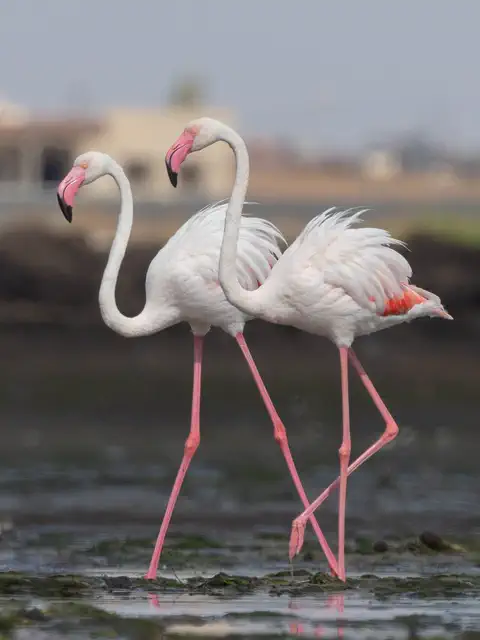 Watch
Animal
Greater flamingo
The greater flamingo is the tallest and heaviest flamingo, standing up to about 1.45 meters tall. It lives in salty lagoons and lakes across Africa, southern Europe, the Middle East and South Asia. It feeds by holding its bent bill upside down in the water and filtering out tiny animals, and it gets its pink color from what it eats.
-
 Watch
3D
Animal
Red swamp crayfish
The red swamp crayfish is a dark red freshwater crustacean with long claws covered in bright red bumps. It comes from the swamps and streams of the southern United States and northern Mexico, where it digs burrows in the mud. People have carried it around the world for food, and in many new places it harms the plants and animals that already live there.
-
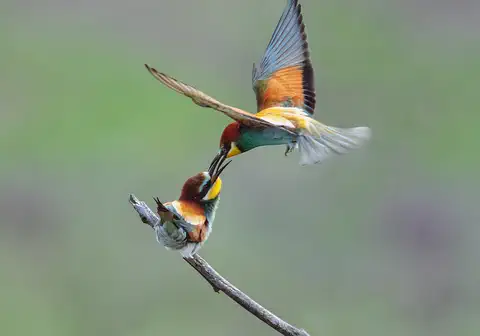 Watch
3D
Animal
European bee-eater
The European bee-eater is one of the most colorful birds in Europe. It catches bees, dragonflies and other flying insects in midair, knocks out the stings on a branch, and digs a long tunnel in a sandy bank for its nest. Every autumn it flies to Africa for the winter.
-
 Watch
Animal
Fire salamander
The fire salamander is a shiny black amphibian with bold yellow spots, found in cool, damp forests across much of Europe. Its colors warn predators that its skin makes bad-tasting toxins. Unlike most amphibians, the mother keeps her eggs inside her body and gives birth to live larvae in a stream.
-
 Watch
Animal
Common cuttlefish
The common cuttlefish lives in the eastern Atlantic Ocean and the Mediterranean Sea. It is a relative of octopuses and squids, and it is a champion of camouflage: it can change its colors and patterns in moments to match the sea floor, and it floats using a light, hollow shell inside its body called a cuttlebone.
-
 Watch
Animal
Atlantic bluefin tuna
The Atlantic bluefin tuna is the largest of all tunas: big ones can be about 4 meters long. Its torpedo-shaped body is built for long journeys, and it can keep its body warmer than the water around it. Bluefin tuna were badly overfished, but with fishing limits set by countries working together, the numbers caught are now controlled.
-
 Watch
Animal
Common nightingale
The common nightingale is a plain brown songbird with one of the most famous songs in the world. Males sing from thick bushes, often in the middle of the night, and every year the birds fly from Europe and Asia to Africa for the winter.
-
 Watch
Animal
Swordfish
The swordfish is a huge ocean hunter with a long, flat bill like a sword. It swings its bill to slash at fish and squid, then eats them. It dives deep into cold, dark water by day, and a special 'brain heater' near its eyes keeps its brain warm. Grown-up swordfish have no scales and no teeth.
-
 Watch
3D
Animal
Atlantic blue crab
The Atlantic blue crab is a swimming crab with bright blue claws and back legs shaped like paddles. It lives along the Atlantic coast of the Americas, especially in bays where rivers meet the sea, like the Chesapeake Bay. A mother crab carries up to two million eggs in a spongy orange mass under her body.
-
 Watch
3D
Animal
Common octopus
The common octopus is a soft-bodied mollusc with eight sucker-lined arms. It lives in coastal waters, hides in a den by day, hunts snails and clams at night, and can change its color, skin texture and shape to vanish against rocks or sand. It lives only one to two years.
-
 Watch
Animal
White stork
The white stork is a tall white bird with black flight feathers, a red bill and long orange legs. It nests on rooftops, chimneys and trees across Europe, North Africa and western Asia, and many storks soar south to spend the winter in Africa or South Asia.
Explore next
-
Watch
City
Madrid
Madrid, the capital of Spain, sits almost exactly in the middle of the Iberian Peninsula, high on a flat plateau. Once a small fortress, it became the royal capital in the 1500s. About 3.5 million people lived there in 2025.
-
Watch
City
Barcelona
Barcelona, the capital of Catalonia in northeastern Spain, lies on the Mediterranean between mountains and the sea. It is famous for the buildings of the architect Antoni Gaudí, including the Sagrada Família, a giant church begun in 1882. About 1.7 million people live in the city (2025).
-
Watch
Landmark
Alhambra
The Alhambra is a palace and fortress above the city of Granada, in Spain. The Nasrid rulers built most of it between 1238 and 1358. It is famous for its courtyards, fountains, carved plaster and tiles, and the gardens of the Generalife next door.
- Watch Natural wonder Cave of Altamira The Cave of Altamira, in northern Spain, holds some of the most famous prehistoric paintings in the world. People who hunted and gathered their food used the cave between about 36,000 and 13,000 years ago, and painted and engraved bison, horses, deer, hands and signs on its walls and ceiling. It was the first cave where prehistoric cave art was ever recognized.
-
Watch
Landmark
Way of Saint James
The Way of Saint James, or Camino de Santiago, is a network of old pilgrim routes across Europe that all end at the cathedral of Santiago de Compostela in northwest Spain. People have walked it for more than 1,000 years, and each year hundreds of thousands still set out on foot, by bicycle or on horseback.
-
Watch
Animal
Greater flamingo
The greater flamingo is the tallest and heaviest flamingo, standing up to about 1.45 meters tall. It lives in salty lagoons and lakes across Africa, southern Europe, the Middle East and South Asia. It feeds by holding its bent bill upside down in the water and filtering out tiny animals, and it gets its pink color from what it eats.
-
Watch
3D
Animal
Red swamp crayfish
The red swamp crayfish is a dark red freshwater crustacean with long claws covered in bright red bumps. It comes from the swamps and streams of the southern United States and northern Mexico, where it digs burrows in the mud. People have carried it around the world for food, and in many new places it harms the plants and animals that already live there.
-
Watch
3D
Animal
European bee-eater
The European bee-eater is one of the most colorful birds in Europe. It catches bees, dragonflies and other flying insects in midair, knocks out the stings on a branch, and digs a long tunnel in a sandy bank for its nest. Every autumn it flies to Africa for the winter.
For parents & teachers
What children will learn
- Locate Spain on the Iberian Peninsula and name its neighbors, seas and island groups.
- Describe Spain's landscapes, from the Meseta and the Pyrenees to the volcano Teide.
- Explain how conservation helped the Iberian lynx recover.
- Outline Spain's history from cave art and Roman rule to a modern constitutional monarchy.
Recommended ages: 3 to 17 · About 15 minutes
Talk about it
- Spain has several official languages in different regions. What languages do people speak where you live?
- Why might helping rabbits also help lynx?
- The Romans built an aqueduct to carry water. How does water reach your home today?
Try at home or in class
- On a map, trace the coast of the Iberian Peninsula and color the part that is Spain; then find the Balearic and Canary islands.
- Build a small arch from sugar cubes or blocks and test how much weight it holds, like the arches of Segovia's aqueduct.
Key vocabulary: peninsula, plateau, aqueduct, co-official language, language isolate, constitutional monarchy
Where these facts come from
- Wikidata , Wikimedia Foundation (CC0 1.0)
- Natural Earth vector data , Natural Earth (NACIS) (Public domain)
- UNESCO World Heritage List , UNESCO World Heritage Centre (Linked as a reference; site facts come from Wikidata)
- Spain , Encyclopaedia Britannica
- Spain: Climate, plant and animal life, people and languages , Encyclopaedia Britannica
- Spain: Daily life and social customs , Encyclopaedia Britannica
- Continuous Population Statistics (ECP), 1 July 2026, provisional data , Instituto Nacional de Estadística (INE)
- Atlas Nacional de España, chapter 2: Cartografía general de referencia y toponimia (Datos geográficos: highest summits) , Instituto Geográfico Nacional (IGN)
- Tagus River , Encyclopaedia Britannica
- Altamira , Encyclopaedia Britannica
- Teide National Park , UNESCO World Heritage Centre
- Alhambra, Generalife and Albayzín, Granada , UNESCO World Heritage Centre
- Works of Antoni Gaudí , UNESCO World Heritage Centre
- Cave of Altamira and Paleolithic Cave Art of Northern Spain , UNESCO World Heritage Centre
- Old Town of Segovia and its Aqueduct , UNESCO World Heritage Centre
- Doñana National Park , UNESCO World Heritage Centre
- Flamenco , UNESCO Intangible Cultural Heritage
- Iberian lynx rebounding thanks to conservation action - IUCN Red List , IUCN
- PlayOwl region table, version 1 , PlayOwl (PlayOwl original data)
- flag-icons 7.5.0 , Panayiotis Lipiridis and contributors (MIT)
- Wikimedia Commons , Wikimedia Foundation (Per file (public domain, CC0, CC BY or CC BY-SA); see each media record)
Checked, not yet human-reviewed. Last updated October 24, 2026. Spotted a mistake? Tell us.
Picture credits
- Photo: Jebulon, CC0 1.0, via Wikimedia Commons · source · license
- Photo: dronepicr, CC BY 2.0, via Wikimedia Commons · source · license
- Photo: Thomas Wolf, CC BY-SA 3.0 DE, via Wikimedia Commons · source · license
- Photo: El-mejor, CC BY-SA 3.0, via Wikimedia Commons · source · license
- Photo: Bernard Gagnon, CC BY-SA 3.0, via Wikimedia Commons · source · license
- Photo: Dmitry Dzhus from London, CC BY 2.0, via Wikimedia Commons · source · license