 Country
Asia
Brunei
Brunei is a small country on a big island called Borneo. It has rainforests and rivers. Some people live in houses on stilts over the water.
Brunei is a small country on the north coast of the island of Borneo, in Southeast Asia. Most of it is covered in rainforest, where proboscis monkeys and sun bears live. Its capital has a famous water village built on stilts, and about 459,000 people lived in Brunei in 2025.
Brunei Darussalam is an Islamic sultanate on the northern coast of Borneo, split into two segments by the Malaysian state of Sarawak. Four-fifths of it is forest, three-fifths untouched rainforest, while offshore oil and natural gas, produced since 1929, pay for one of Asia's highest incomes per person. It had an estimated 458,600 people in 2025 (Department of Economic Planning and Statistics).
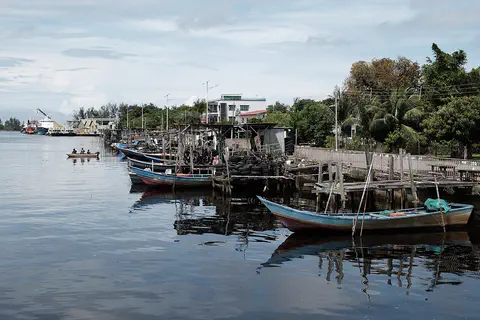
Photo: Yu Chu Chin, CC BY-SA 4.0, via Wikimedia Commons
Discover Brunei
Brunei is a small country in Southeast Asia.
It is on the island of Borneo, by the sea. Most of the land is green rainforest. The capital city is called Bandar Seri Begawan.
Brunei is a small country on the north coast of Borneo, a large island in Southeast Asia. The South China Sea lies to the north, and Malaysia wraps around it on every other side. In fact, a strip of Malaysia splits Brunei into two separate pieces.
About three-fifths of Brunei is untouched rainforest. Rivers flow north from the hills to the sea. About 459,000 people lived in Brunei in 2025, and about two-thirds of them live in and around the capital, Bandar Seri Begawan.
Brunei lies on the northern coast of Borneo, bounded by the South China Sea to the north and on all other sides by the Malaysian state of Sarawak, which divides it into two unequal segments. The larger western segment holds the capital, Bandar Seri Begawan. Britannica describes a narrow coastal plain giving way to rugged hills in the south, rising to Pagon Peak, 1,850 m, in the southeast.
Brunei's Department of Economic Planning and Statistics estimated 458,600 people in 2025 on 5,765 km². The population is young: more than one-fifth are under 15 and roughly half under 30. Brunei became a British protectorate in 1888 and independent in 1984. It is a monarchy: Sultan Hassanal Bolkiah is head of state and, as prime minister, head of government, and the members of the Legislative Council are appointed.
Cities and famous places
Bandar Seri Begawan is the capital.
It is beside a river. A big building with a golden dome shines there. Next to the city is a village where houses stand on stilts over the water.
Bandar Seri Begawan, the capital, stands on the Brunei River. The golden dome of the Sultan Omar Ali Saifuddien Mosque, finished in 1958, rises above the city. It was built with marble from Italy, granite from China and chandeliers from England.
Right next to the city is Kampong Ayer, the water village. Its wooden houses, schools and clinics stand on stilts above the river, linked by long raised walkways. In the southwest, near the towns of Seria and Kuala Belait, is the area where Brunei's oil is found.
Bandar Seri Begawan lies on the Brunei River about 14 km from its mouth on Brunei Bay. The Sultan Omar Ali Saifuddien Mosque (1958), whose high golden dome dominates the skyline, was furnished with Italian marble, Chinese granite, English chandeliers and stained glass, and carpets from Saudi Arabia; the Jame' Asr Hassanal Bolkiah Mosque, built in the mid-1990s in Kampong Kiarong, is the country's largest. Istana Nurul Iman, the sultan's residence and offices, combines Islamic and Malay styles beside the river.
Kampong Ayer, the Water Village, is a group of long-established villages whose houses, clinics and schools stand on stilts above the Brunei River, joined by elevated walkways. The region around Kuala Belait and Seria, on the oil-rich southwestern coast, is the next most densely settled. Muara, on Brunei Bay, has the country's large deepwater harbor.

Rainforest, rivers and rain
Brunei is warm every day.
It rains a lot. Tall trees make a thick rainforest. Mangrove trees grow along the rivers and the sea.
Brunei is warm all year: most days go from about 23 °C at night to about 32 °C in the afternoon. It is also very wet. The coast gets about 2,900 millimeters of rain a year, and inland it can be more than 3,800.
About three-fifths of the country is untouched rainforest, full of tall hardwood trees, and another fifth is forest that has grown back. Swamps cover the low land along the Belait and Tutong rivers, and mangroves grow along the coast. The Belait is Brunei's largest river.
Brunei's climate is governed by the equatorial monsoons: the northeast monsoon usually blows from December to March and the southwest monsoon from May to September. Daily temperatures typically range from about 23 °C to 32 °C. Rainfall averages about 2,900 mm a year on the coast and can exceed 3,800 mm inland, heavier from October to January.
About three-fifths of the land is virgin tropical rainforest and another fifth secondary forest. The undisturbed forest is dominated by dipterocarp hardwoods, especially Shorea. Freshwater and peat swamps cover the poorly drained Belait and Tutong lowlands, and mangroves line the lower rivers and sheltered coasts. The Belait, Tutong and Brunei rivers drain the western segment and the Pandaruan and Temburong the eastern one, all flowing north. Laws from the late 20th century restrict logging, and timber is not exported.
Animals of Brunei
Monkeys with big noses live in Brunei.
They are called proboscis monkeys. Small bears called sun bears climb the trees. A very long snake called a python lives there too.
Brunei's rainforest is home to many animals. Proboscis monkeys live in its forests, and the males have very big noses. Sun bears live there too.
Other monkeys, deer, bats and many kinds of birds share the forest. The large reticulated python lives in the swamps and woods. In the warm sea off the coast swim green sea turtles and dugongs.
Britannica describes a rainforest whose complex vegetation gives niches to a rich variety of mammals, birds and reptiles, among them proboscis monkeys, sun bears, deer and bats, and the large reticulated python in the swamps and woodlands. The proboscis monkey (Nasalis larvatus), the sun bear (Helarctos malayanus) and the reticulated python (Malayopython reticulatus) all have Brunei within their current IUCN ranges.
Offshore, the IUCN ranges of the green turtle and the dugong include Brunei's waters. About four-fifths of the land is still forested, and late 20th-century laws restrict logging, so that plantations supply only enough sawn wood for local use.

People, languages and food
About 459,000 people live in Brunei.
Many people speak Malay. Many people also learn English. Fish is a very popular food.
About 459,000 people lived in Brunei in 2025. Nearly two-thirds are counted as Malay, a group that includes several local peoples such as the Dusun and Kedayan. About one in ten people is Chinese, and the Iban live mostly in the far west. Malay is the official language, and English is a major second language.
People in Brunei eat more fish per person than people almost anywhere in the world. Brunei is famous for its metalwork, such as brass gongs, and gong music plays at royal events and village festivals. Basic health care is free for citizens, and children go to school from age 5 to 16.
Nearly two-thirds of people are classed officially as Malay, a category that also includes the Dusun, Belait, Kedayan, Murut and Bisaya. Chinese make up about one-tenth; others include the Iban, people of South Asian descent and temporary workers. Malay is official, English is a major second language, and many Chinese speak southern Chinese varieties and learn Mandarin at school. Most people are Sunni Muslim; many Chinese follow Buddhism, Daoism, Confucianism or Christianity, and some Indigenous people are Christian or follow local religions.
Oil and gas generate more than half of GDP. Brunei is among the world's largest consumers of fish per person and is self-sufficient in poultry and eggs. Its brass and silver metalwork, prized in the 16th and 17th centuries, is still known across Borneo; the royal nobat ensemble of gongs, double-reed serunai and drums marks palace events. Education is free and compulsory from 5 to 16, and citizens receive basic medical and dental care at no charge.
A sultanate on Borneo
Long ago, Brunei traded with China.
Sultans have ruled Brunei for a very long time. Later, Britain protected it. In 1984, Brunei became fully independent.
Long ago, in the 500s, Brunei was already trading with China. When the ships of Ferdinand Magellan's expedition arrived in 1521, Brunei's sultan controlled almost the whole of Borneo and many nearby islands.
Over the next centuries Brunei lost most of that land, including what are now parts of Malaysia. In 1888 it became a British protectorate. Oil was first produced in 1929, and it made Brunei rich. Brunei became fully independent on January 1, 1984.
Brunei was trading with and paying tribute to China in the 6th century CE and later came under the influence of the Java-based Majapahit empire. When ships of Ferdinand Magellan's expedition anchored off Brunei in 1521, the fifth sultan, Bolkiah, controlled practically all of Borneo, the Sulu Archipelago and nearby islands. Power declined after internal strife in the late 16th century; Sarawak was ceded to James Brooke in 1841, Labuan to Britain, and later what is now Sabah was lost.
Brunei became a British protectorate in 1888, with a British resident from 1906. Oil production began in 1929, and Japan occupied the country in 1941–45. Self-government came in 1959; a revolt in 1962 was put down with British help, and a state of emergency followed. Sultan Omar Ali Saifuddien abdicated in 1967 in favor of his son Hassanal Bolkiah. Brunei became fully independent on January 1, 1984, as an Islamic sultanate, and joined ASEAN that year.
Brunei on the map
Find Brunei on the globe.
It is on the big island of Borneo. The sea is to the north. Brunei is made of two pieces of land.
Brunei is on the north coast of Borneo, a little north of the equator. The South China Sea lies to the north, and the Malaysian state of Sarawak surrounds it on all other sides.
A strip of Sarawak cuts Brunei in two. The western part is bigger and has the capital and the oil towns. The smaller eastern part is the district of Temburong.
Brunei is bounded by the South China Sea to the north and on all other sides by Sarawak, part of East Malaysia, which divides it into two segments of unequal size. It has four districts: Temburong in the east and Belait, Brunei and Muara, and Tutong in the west.
All its rivers flow generally north to the South China Sea. Offshore fields off the western segment produce nearly all of its oil and gas. Bandar Seri Begawan stands on the Brunei River near Brunei Bay, and Muara, on the bay, is the main deepwater port; a smaller port lies at Kuala Belait, at the mouth of the Belait River.
- Highest point
- Pagon Peak, 1,850 m
- Rainforest
- about three-fifths of the land
- Rain on the coast
- about 2,900 mm a year
- People (2025 official estimate)
- 458,600
Amazing facts
-
In Brunei, a whole village stands on stilts over a river.
In Kampong Ayer, houses, schools and clinics stand on stilts above the Brunei River, joined by raised walkways.
Kampong Ayer's long-established villages hover on stilts above the Brunei River, with houses, clinics and schools linked by an extensive network of elevated walkways.
-
Brunei is split into two pieces.
A strip of Malaysia cuts Brunei into two separate pieces of land.
The Malaysian state of Sarawak surrounds Brunei on its landward sides and divides it into two disconnected segments of unequal size.
-
People in Brunei eat lots of fish.
Brunei is one of the countries where people eat the most fish per person in the world.
Brunei ranks among the largest per capita consumers of fish in the world, and within a decade of new programs it was producing more fish at home than it imported.
-
Gongs made in Brunei are used across Borneo.
Brunei is famous for its metalwork. Many gongs kept by peoples deep in Borneo's forests were made in Brunei.
Many of the gongs held as heirlooms by interior peoples of Brunei, Malaysian Borneo and Indonesian Borneo are of Bruneian origin.
Words to know
- sultanate
- a country ruled by a sultan, a Muslim king
- protectorate
- a place that runs some of its own affairs but is protected and partly controlled by a stronger country
- rainforest
- a thick forest in a place where it rains a lot
- stilts
- tall posts that hold a building up above water or ground
- monsoon
- a wind that changes direction with the seasons and brings wet or dry weather
- natural gas
- a gas fuel found underground, often near oil
Discovery challenge
-
What is the capital city of Brunei?
Which city is the capital of Brunei?
Which city, on the Brunei River near Brunei Bay, is the capital of Brunei?
- Kuala Lumpur
- Jakarta
- Bandar Seri Begawan
Show the answer
Bandar Seri Begawan
Bandar Seri Begawan is the capital of Brunei.
Bandar Seri Begawan is the capital. Kuala Lumpur is in Malaysia and Jakarta is in Indonesia.
Bandar Seri Begawan lies about 14 km up the Brunei River from Brunei Bay; about two-thirds of Bruneians live in and around it.
-
Brunei is on which big island?
On which large island is Brunei?
Brunei lies on the northern coast of which island, which it shares with Malaysia and Indonesia?
- Borneo
- Madagascar
- Iceland
Show the answer
Borneo
Brunei is on the island of Borneo.
Brunei is on the north coast of Borneo, in Southeast Asia.
Brunei is on Borneo's north coast; Malaysian and Indonesian Borneo make up the rest of the island.
-
In the water village, what holds the houses up?
In Kampong Ayer, what do the houses, schools and clinics stand on?
Kampong Ayer's buildings are raised above the Brunei River on what?
- Floating ice
- Stilts
- Tree trunks on hills
Show the answer
Stilts
The houses stand on stilts above the river.
The buildings stand on stilts over the river, linked by raised walkways.
The structures hover on stilts above the river and are joined by elevated walkways.
-
Which monkey in Brunei has a very big nose?
Which monkey of Brunei's forests is famous for the males' huge noses?
Which primate, Nasalis larvatus, lives in Brunei's forests?
- Proboscis monkey
- Snow monkey
- Howler monkey
Show the answer
Proboscis monkey
The proboscis monkey has a big nose.
Male proboscis monkeys have big, droopy noses. They live in Brunei's forests.
Nasalis larvatus is listed by Britannica among Brunei's rainforest mammals, and its IUCN range includes Brunei.
-
What brings Brunei most of its money?
What makes up most of what Brunei sells to other countries?
Which resources generate more than half of Brunei's GDP and nearly all its export earnings?
- Wheat and corn
- Oil and natural gas
- Gold and diamonds
Show the answer
Oil and natural gas
Oil and gas from under the sea bring Brunei its money.
Brunei sells oil and natural gas from fields under the sea off its coast.
Petroleum and LNG generate more than half of GDP; oil has been produced since 1929 and gas exploited intensively since the 1970s.
Animals of Brunei
-
Watch
Animal
Proboscis monkey
The proboscis monkey is named for the grown-up male's huge, drooping nose. It lives only on Borneo, in forests along rivers, swamps and coasts. It eats mostly leaves and fruit, sleeps by the river every night and is a strong swimmer.
-
 Watch
Animal
Sun bear
The sun bear is the smallest of the world's eight kinds of bear, and it has the longest tongue. It lives in the forests of Southeast Asia, climbs trees with long curved claws, and rips open logs to find insects and honey. Every bear has its own chest patch, like a fingerprint.
-
 Watch
Animal
Reticulated python
The reticulated python lives in the forests, riversides and even towns of Southeast Asia. It can grow longer than any other kind of snake, it is covered in a net-like pattern, and it is such a good swimmer that it has reached many small islands across the sea.
Explore next
-
 Watch
 Country
Malaysia
Malaysia is a country in Southeast Asia, just north of the Equator. One part is on the Malay Peninsula and the other is on the island of Borneo. It has rainforests, huge caves, Mount Kinabalu and the city of Kuala Lumpur, with about 34.4 million people (2026).
-
Watch
Animal
Proboscis monkey
The proboscis monkey is named for the grown-up male's huge, drooping nose. It lives only on Borneo, in forests along rivers, swamps and coasts. It eats mostly leaves and fruit, sleeps by the river every night and is a strong swimmer.
-
Watch
Animal
Sun bear
The sun bear is the smallest of the world's eight kinds of bear, and it has the longest tongue. It lives in the forests of Southeast Asia, climbs trees with long curved claws, and rips open logs to find insects and honey. Every bear has its own chest patch, like a fingerprint.
-
Watch
Animal
Reticulated python
The reticulated python lives in the forests, riversides and even towns of Southeast Asia. It can grow longer than any other kind of snake, it is covered in a net-like pattern, and it is such a good swimmer that it has reached many small islands across the sea.
- Watch Geography Monsoons A monsoon is a seasonal change in the direction of a region's strongest winds. In South Asia, the summer monsoon blows warm, wet air in from the Indian Ocean and brings months of heavy rain, while the winter monsoon blows dry air from the land. About three-quarters of India's yearly rain falls in the monsoon season, so farms, wells, rivers and power stations all depend on it.
-
 Watch
 Country
Afghanistan
Afghanistan is a landlocked country in south-central Asia. The high Hindu Kush mountains run across its middle, sandy deserts lie in the southwest, and the capital, Kabul, sits in a valley about 1,800 meters above sea level.
-
 Watch
 Country
Azerbaijan
Azerbaijan is a country on the southern side of the Caucasus Mountains, along the western shore of the Caspian Sea. It has high mountains, wide lowlands and forests, its capital is Baku, and about 10.3 million people lived there in mid-2026.
-
 Watch
 Country
Indonesia
Indonesia is a country of about 17,500 islands in Southeast Asia, spread across the Equator between the Indian and Pacific oceans. It has more than 100 active volcanoes, rainforests full of wildlife, and about 286 million people (2025).
For parents & teachers
What children will learn
- Locate Brunei on Borneo and explain how Sarawak divides it into two parts.
- Describe Brunei's hot, wet climate and its rainforest, swamps and mangroves.
- Explain how oil and gas shape the economy, and why the country wants other industries too.
- Outline Brunei's history from trade with China to independence in 1984, and describe the water village of Kampong Ayer.
Recommended ages: 3 to 17 · About 15 minutes
Talk about it
- What would be fun, and what would be hard, about living in a house on stilts over a river?
- Why might a country that earns most of its money from oil want to try other kinds of work too?
- Brunei keeps most of its rainforest. Why might that matter for animals like proboscis monkeys?
Try at home or in class
- Build a stilt house from craft sticks and clay, stand it in a shallow tray of water, and test how many stilts it needs to stay steady.
- Measure 2,900 millimeters with a tape measure (taller than a grown-up) to see how much rain falls on Brunei's coast in a year.
Key vocabulary: sultanate, protectorate, rainforest, stilts, monsoon, natural gas
Where these facts come from
- Wikidata , Wikimedia Foundation (CC0 1.0)
- Natural Earth vector data , Natural Earth (NACIS) (Public domain)
- The IUCN Red List of Threatened Species , International Union for Conservation of Nature (IUCN terms of use (no redistribution of Red List data or range maps))
- Brunei (introduction, quick facts, land, climate, plant and animal life, people, languages, religion, settlement, demographic trends) , Encyclopaedia Britannica
- Brunei: Economy (resources, fishing, petroleum, transport, government) , Encyclopaedia Britannica
- Brunei: Justice (security, health, education, cultural life, architecture) , Encyclopaedia Britannica
- Brunei: History , Encyclopaedia Britannica
- Population estimates 2025 (press release: 458,600 persons) , Department of Economic Planning and Statistics, Brunei Darussalam
- PlayOwl region table, version 1 , PlayOwl (PlayOwl original data)
- flag-icons 7.5.0 , Panayiotis Lipiridis and contributors (MIT)
- Wikimedia Commons , Wikimedia Foundation (Per file (public domain, CC0, CC BY or CC BY-SA); see each media record)
Checked, not yet human-reviewed. Last updated October 27, 2026. Spotted a mistake? Tell us.
Picture credits
- Photo: Yu Chu Chin, CC BY-SA 4.0, via Wikimedia Commons · source · license
- Photo: sam garza from Los Angeles, USA, CC BY 2.0, via Wikimedia Commons · source · license
- Photo: Charles J. Sharp, CC BY-SA 4.0, via Wikimedia Commons · source · license
- Photo: Ryan E. Poplin, CC BY-SA 2.0, via Wikimedia Commons · source · license