
Animal
Reticulated python
The reticulated python is a very long snake from Southeast Asia. It has a pattern like a net on its skin. It is a great swimmer.
The reticulated python lives in the forests, riversides and even towns of Southeast Asia. It can grow longer than any other kind of snake, it is covered in a net-like pattern, and it is such a good swimmer that it has reached many small islands across the sea.
Malayopython reticulatus is a large, egg-laying constrictor of Southeast Asia and the Indo-Australian islands, and the IUCN calls it the world's longest snake. It adapts to forests, plantations and even cities, and it is listed as Least Concern globally, though hunting for skins and habitat loss have reduced some populations, especially in Indochina.
Photo: Rina.saa, CC BY-SA 4.0, via Wikimedia Commons
Meet the reticulated python
The reticulated python is a very, very long snake.
Its skin has a pattern that looks like a net. It has no legs, but it can climb, crawl and swim.
The reticulated python is a giant snake from Southeast Asia. Zoo experts say it can grow longer than any other kind of snake: big ones are often 5 meters long, about as long as a car.
Its name comes from its skin. "Reticulated" means "like a net," and its back is covered in dark shapes joined together like the strings of a fishing net. Pythons catch their food by holding on and squeezing.
Malayopython reticulatus is a member of the python family (Pythonidae), the egg-laying constrictors of Africa, Asia and Australia. The IUCN describes it as the world's longest snake; the Toronto Zoo reports that 5-meter adults are common, lengths over 7 meters occur regularly and the record is 10 meters. Females grow larger than males.
For most of its history it was called Python reticulatus. Genetic and anatomical studies grouped it with the Timor python (Python timorensis), and in 2014 the new genus name Malayopython was coined for the pair. The species varies a lot from place to place, and three subspecies are recognized.
Quick facts
- Group
- Reptile
- Length
- 5 to 7 m
- Weight
- up to 158 kg
- Lifespan in the wild
- up to 25 years
Where it lives
Reticulated pythons live in Southeast Asia.
They live in warm forests and near rivers and lakes. Some even live near towns.
Reticulated pythons live across much of Southeast Asia: from Bangladesh and Myanmar through Thailand, Laos, Cambodia, Vietnam and Malaysia to the islands of Indonesia and the Philippines.
They live in rainforests, woodlands and nearby grasslands, and they are often found close to streams and lakes. They are excellent swimmers and have even been seen far out at sea, which is how they have reached many small islands. Some live in farms, plantations and cities too.
The IUCN range runs from the Nicobar Islands and Bangladesh (Chittagong) through Myanmar, Thailand, Laos, Cambodia, Vietnam, Malaysia, Singapore and Brunei to Indonesia and the Philippines. It reaches north to central Vietnam and Laos but is absent from northern Thailand and northern Myanmar; it may no longer survive in Timor-Leste, and a single record from mainland India may have been a wanderer.
It uses rainforest, woodland and adjacent grassland and is closely tied to rivers and lakes. Strong swimming has let it colonize many small islands; it was among the first species to reach the newly formed island of Krakatau. Habitat use varies: it lives in sewers in Singapore and Malaysian Borneo but only in pristine forest in Myanmar.
Continent
Its habitats


Where can you find this animal?
- Lives here naturally · Countries and seas named by a scientific source
- Sightings recorded · Records of wild sightings (GBIF)
Lives here naturally · Countries and seas named by a scientific source
Rainforest, woodland, grassland edges, riversides, plantations and towns across Southeast Asia, from Bangladesh and Myanmar to Indonesia and the Philippines. It also lives in Singapore (too small to show on this map) and on India's Nicobar Islands; mainland India is not shaded. It is absent from northern Thailand and northern Myanmar and may be gone from Timor-Leste.
Places: Bangladesh, Myanmar, Thailand, Laos, Cambodia, Vietnam, Malaysia, Brunei and 2 more places.
Source: iucn-red-list · checked October 2026
Sightings recorded · Records of wild sightings (GBIF)
Counts of GBIF records of wild observations (human and machine) and preserved specimens. Records include introduced populations, vagrants, escaped or released animals and misidentifications, so a country with records is not necessarily part of the native range.
Wild sightings have been recorded in Indonesia, Thailand, Malaysia, Philippines, Vietnam, Timor-Leste, India, Brunei and 24 more places.
Source: gbif · checked October 2026
Range maps show where scientists say an animal lives, often country by country. An animal may live in only part of a country shown, and sightings records can include animals that wandered far from home.
What it eats
Reticulated pythons eat animals.
Young pythons eat rats and mice. Big pythons can eat bigger animals. They swallow their food whole!
Reticulated pythons are ambush hunters: they wait quietly for food to come close instead of chasing it. Young pythons eat mostly rats and mice. As they grow, they can catch bigger animals, such as pigs, deer and monkeys.
A python grabs its prey with its teeth, wraps its coils around it and squeezes, then swallows it whole, head first. Young pythons are common in plantations, where they feed on rats.
This snake has a low metabolic rate and is mainly an ambush predator (Toronto Zoo). The IUCN notes that smaller individuals feed mainly on rodents that live alongside people and are abundant in oil palm plantations, while animals longer than about 4 meters need vegetated undergrowth and larger prey; the Toronto Zoo lists pigs, deer, pangolins, porcupines and monkeys.
Pythons are constrictors. San Diego Zoo Wildlife Alliance explains that the coils do not crush the prey; they tighten each time it breathes out until it can no longer breathe. Flexible skull joints and stretchy skin then let the snake swallow food wider than its own body.
Did you know?
Pythons have swum across the sea to reach new islands.
Reticulated pythons have been seen swimming far out at sea, and they were among the first animals to reach the new island of Krakatau.
Ocean swimming explains the species' presence on many small islands; it was among the first colonists of the recently emerged island of Krakatau (IUCN).
A body built for big meals
A python's jaws can open very wide.
Its skin stretches, so it can swallow big meals. Little pits on its lips can feel warmth.
A python's lower jaw is not joined tightly to its skull, and the two halves of the jaw are linked at the chin by stretchy muscle. That lets the mouth open wide and "walk" forward around a meal, held by sharp, backward-curving teeth.
Along its upper lips are small pits that sense heat, so a python can find a warm animal even in the dark. It smells with its flicking tongue. Its pattern helps it blend into leaves and shadows.
The Toronto Zoo describes the feeding apparatus: the quadrate bone hinges the lower jaw loosely to the skull, the two halves of the lower jaw are joined only by elastic muscle, and recurved teeth hold prey while the jaws are moved forward one side at a time. Overlapping scales spread apart to fit a large meal.
Four upper lip scales on each side carry pits; San Diego Zoo Wildlife Alliance explains that these temperature-sensitive pits let pythons find warm-blooded prey in darkness or dense cover. Pythons have two lungs, while most snakes have only one, and remnants of hind legs and a pelvis. The iridescent, net-patterned skin is highly effective camouflage.
Growing up
Mother pythons lay eggs.
The mother curls around her eggs to keep them warm and safe. The babies hatch and look after themselves right away.
Reticulated pythons lay eggs, most often between 25 and 80 at a time. The mother coils around them and "shivers," twitching her muscles to make warmth, and she guards them. The eggs hatch after about 80 to 90 days.
The babies are already 55 to 75 centimeters long, longer than your arm, and they look after themselves from the start. They grow fast: a 3-meter python is only three to four years old.
The Toronto Zoo reports breeding between September and March, triggered by changes in light and temperature, with clutches usually of 25 to 80 eggs (larger females lay more). In a study in Sumatra cited by the IUCN, clutches averaged 24.2 eggs and females bred only once every two to four years. Brooding females coil around the eggs and raise their temperature by shivering thermogenesis, rhythmic muscle contractions, and defend them.
The eggs hatch in 80 to 90 days, producing independent young 55 to 75 centimeters long that weigh 250 grams or more. Growth is rapid at first and slows with age; sexual maturity comes within about four years.
A quiet swimmer
Reticulated pythons are quiet and slow on land.
They love water. They swim well, and some have swum all the way to new islands.
Big pythons move slowly on land. Instead of wiggling from side to side, a heavy python often creeps forward in a straight line, using the scales on its belly to grip the ground.
In water, though, reticulated pythons are excellent swimmers. They have been seen swimming in the ocean far from land, and scientists think that is how they reached many islands. As an ambush hunter, a python often lies hidden and still, waiting.
Heavy pythons often use rectilinear progression: ribs stiffen to support the body while sets of belly scales are lifted, moved forward and planted, pushing the snake ahead in a straight line. San Diego Zoo Wildlife Alliance gives a top speed of only about 1.6 kilometers per hour on open ground, enough for an ambush hunter that does not chase prey.
The IUCN calls the species an excellent swimmer that has been reported far out at sea and has colonized many small islands this way. Habitat use varies across its huge range, and its adaptability lets it persist in plantations and towns.
Did you know?
A python can breathe while it swallows a big meal.
While a python slowly swallows a big meal, a special tube at the bottom of its mouth stays open so it can still breathe.
During a long swallow, a special tube on the floor of the mouth stays open to one side to take in air (San Diego Zoo Wildlife Alliance).
Hunted, but still widespread
There are still many reticulated pythons.
But people catch lots of them for their skins. Some places have fewer pythons than before.
The reticulated python is listed as least concern, because it lives across a huge area and copes well with change. It is still common in places such as Thailand, Singapore, the Philippines and parts of Malaysia and Indonesia.
But it is one of the most hunted snakes. Large numbers are caught every year, mostly for their skins, and for food and the pet trade. In Vietnam, Laos and Cambodia, hunting and the clearing of forests for farms have made it much rarer.
The IUCN assessed the species as Least Concern (assessed 2011, published 2018, marked as needing an update), citing its wide distribution, adaptability and abundance even where it is heavily harvested. About 180,000 a year were being harvested from Indonesia (a 2016 estimate), and more than 340,000 skins of wild snakes were reported as legal exports in 2016, mainly from Indonesia and Malaysia.
A 20-year study of more than 4,000 snakes from heavily harvested sites in Sumatra found no evidence that harvesting had harmed the population, but hunting probably reduces the number of truly giant (6-meter-plus) snakes. In Vietnam, Laos and Cambodia, habitat conversion and overharvesting have caused steep declines, and the species is treated as locally threatened there. As the longest snake, it is also often killed out of fear.
IUCN Red List
How is the reticulated python doing in the wild?
- Least Concern (this animal)
- Near Threatened
- Vulnerable
- Endangered
- Critically Endangered
- Extinct in the Wild
- Extinct
Least Concern
Not at risk of disappearing from the wild right now.
See the IUCN Red List assessment · The IUCN Red List of Threatened Species 2022.2
Amazing facts
-
A baby reticulated python can be longer than your arm when it hatches.
Reticulated python hatchlings are already 55 to 75 centimeters long, and a 3-meter python is only three or four years old.
Hatchlings measure 55 to 75 centimeters and weigh 250 grams or more; early growth is fast, with a 3-meter snake typically three to four years old (Toronto Zoo).
-
A mother python shivers to keep her eggs warm.
Snakes cannot make much body heat, but a mother python can warm her eggs by twitching her muscles, like shivering.
Brooding females use shivering thermogenesis, rhythmic muscle contractions that San Diego Zoo Wildlife Alliance says can raise egg temperature by a few degrees.
-
Pythons have swum across the sea to reach new islands.
Reticulated pythons have been seen swimming far out at sea, and they were among the first animals to reach the new island of Krakatau.
Ocean swimming explains the species' presence on many small islands; it was among the first colonists of the recently emerged island of Krakatau (IUCN).
-
A python can breathe while it swallows a big meal.
While a python slowly swallows a big meal, a special tube at the bottom of its mouth stays open so it can still breathe.
During a long swallow, a special tube on the floor of the mouth stays open to one side to take in air (San Diego Zoo Wildlife Alliance).
Words to know
- reticulated
- marked with a pattern like a net
- constrictor
- a snake that wraps around its prey and squeezes
- ambush
- to wait hidden and then catch something by surprise
- albino
- an animal born without the dark coloring most of its kind have
- clutch
- a group of eggs laid at one time
- heat pit
- a small hole on a snake's lip that senses warmth
Discovery challenge
-
What does a reticulated python's skin pattern look like?
What does the word "reticulated" describe?
What does the species name reticulatus refer to?
- A net
- Stripes like a zebra
- Polka dots
Show the answer
A net
The pattern looks like a net, with shapes joined together.
"Reticulated" means net-like: dark shapes on the back join up like the strings of a net.
Reticulatus means net-like, after the joined dark markings on a lighter yellowish or brown background.
-
What do mother pythons lay?
How do reticulated pythons have babies?
How does the reticulated python reproduce?
- They give birth to live babies
- They lay eggs and coil around them
- They lay eggs in the sea and leave
Show the answer
They lay eggs and coil around them
Mother pythons lay eggs and curl around them to keep them warm.
Pythons lay eggs. The mother coils around them and shivers to keep them warm until they hatch.
Pythons are oviparous; the female broods the clutch, warming it by shivering thermogenesis, for 80 to 90 days.
-
How does a python find a warm animal in the dark?
What helps a python find warm animals in the dark?
Which structures let a python detect warm-blooded prey in darkness?
- Big ears
- A glowing tail
- Heat pits on its lips
Show the answer
Heat pits on its lips
Little pits on its lips feel the warmth of animals.
Heat-sensing pits along the upper lips help it find warm animals, even at night.
Pitted upper labial scales sense radiant heat; snakes have no external ears.
-
Where do reticulated pythons live?
In which part of the world do reticulated pythons live in the wild?
Which region holds the reticulated python's native range?
- South America
- Southeast Asia
- Europe
Show the answer
Southeast Asia
They live in Southeast Asia.
They live in Southeast Asia, from Bangladesh and Myanmar to Indonesia and the Philippines.
Southeast Asia and the Indo-Australian islands, from the Nicobar Islands and Bangladesh to Indonesia and the Philippines.
Places where you might see it
-
 Watch
 Country
Indonesia
Indonesia is a country of about 17,500 islands in Southeast Asia, spread across the Equator between the Indian and Pacific oceans. It has more than 100 active volcanoes, rainforests full of wildlife, and about 286 million people (2025).
-
 Watch
 Country
Thailand
Thailand is a tropical country in the middle of mainland Southeast Asia, with forested mountains in the north, rice fields on its central plains and a long, narrow peninsula in the south. Its capital is Bangkok, and about 65.8 million people were on its civil register at the end of 2025.
-
 Watch
 Country
Philippines
The Philippines is an island country in Southeast Asia, in the western Pacific Ocean. It has more than 7,000 islands, about 50 volcanoes and rich coral reefs, and about 112.7 million people were counted there in 2024.
-
 Watch
 Country
Brunei
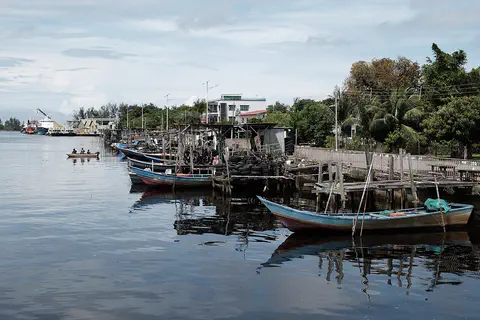
Brunei is a small country on the north coast of the island of Borneo, in Southeast Asia. Most of it is covered in rainforest, where proboscis monkeys and sun bears live. Its capital has a famous water village built on stilts, and about 459,000 people lived in Brunei in 2025.
Explore next
-
 Watch
Animal
Burmese python
The Burmese python is one of the largest snakes in the world. In its home in South and Southeast Asia it has become rare because so many are caught, but in southern Florida, where people let pet pythons go, it has spread through the Everglades and eats many of the animals that live there.
-
 Watch
3D
Animal
Green anaconda
The green anaconda is one of the largest snakes on Earth. This olive-green, spotted boa lives in the rivers, swamps and flooded grasslands of northern South America, where it lies hidden in shallow water with only its eyes and nose showing.
-
 Watch
Animal
Boa constrictor
The boa constrictor is a large, heavy snake of South America. Of all the boas, it lives in the greatest variety of places, from rainforests to dry scrub and farms. It catches food by squeezing, it has no venom, and mothers give birth to live babies.
-
Watch
Country
Indonesia
Indonesia is a country of about 17,500 islands in Southeast Asia, spread across the Equator between the Indian and Pacific oceans. It has more than 100 active volcanoes, rainforests full of wildlife, and about 286 million people (2025).
-
Watch
Country
Thailand
Thailand is a tropical country in the middle of mainland Southeast Asia, with forested mountains in the north, rice fields on its central plains and a long, narrow peninsula in the south. Its capital is Bangkok, and about 65.8 million people were on its civil register at the end of 2025.
-
Watch
Country
Philippines
The Philippines is an island country in Southeast Asia, in the western Pacific Ocean. It has more than 7,000 islands, about 50 volcanoes and rich coral reefs, and about 112.7 million people were counted there in 2024.
-
 Watch
Animal
King cobra
The king cobra is the largest venomous snake in the world, growing to more than 5 meters long. It lives in forests and near streams in South and Southeast Asia, eats mainly other snakes, and the mother builds a nest of leaves and guards her eggs.
-
 Watch
Animal
Philippine eagle
The Philippine eagle is one of the largest and rarest eagles in the world. It lives only in the mountain rainforests of four Philippine islands, where it hunts monkeys, civets, flying squirrels and other forest animals. It is the national bird of the Philippines, and it is critically endangered.
For parents & teachers
What children will learn
- Describe how a python's jaws, heat pits and coils help it catch and swallow food.
- Explain what "reticulated" means and how the pattern works as camouflage.
- Describe the python life cycle, including how the mother warms her eggs.
- Understand why a widespread species can still decline in some places.
Recommended ages: 3 to 17 · About 15 minutes
Talk about it
- Why might a snake that waits for its food not need to move fast?
- How could a snake reach an island that is far from the mainland?
- Pythons are common in some countries and rare in others. What might explain the difference?
Try at home or in class
- Lay out a 6-meter string in a hallway or yard and walk along it to feel how long a big reticulated python is.
- Draw a net pattern on paper, cut it out, and lay it on leaves or a patterned rug to see how it helps hide a shape.
Key vocabulary: reticulated, constrictor, ambush, albino, clutch, heat pit
Where these facts come from
- The IUCN Red List of Threatened Species , International Union for Conservation of Nature (IUCN terms of use (no redistribution of Red List data or range maps))
- GBIF Backbone Taxonomy and GBIF Occurrence Search , Global Biodiversity Information Facility (CC0 1.0 (backbone); occurrence counts are facts derived from records under CC0, CC BY and CC BY-NC)
- Wikimedia Commons , Wikimedia Foundation (Per file: Public domain, CC0, CC BY or CC BY-SA only (credited on each page))
- Malayopython reticulatus (Reticulated Python), IUCN Red List assessment 2018 , IUCN
- Reticulated python , Toronto Zoo
- Python , San Diego Zoo Wildlife Alliance
- Reticulated Python , Houston Zoo
- Python reticulatus (Reticulated Python) , Animal Diversity Web, University of Michigan Museum of Zoology
- Wikidata , Wikimedia Foundation (CC0 1.0)
Checked, not yet human-reviewed. Last updated October 27, 2026. Spotted a mistake? Tell us.