
 Country
Asia
Malaysia
Malaysia is a country in two parts, with the sea between them. It has thick rainforests, a very tall mountain and two giant towers.
Malaysia is a country in Southeast Asia, just north of the Equator. One part is on the Malay Peninsula and the other is on the island of Borneo. It has rainforests, huge caves, Mount Kinabalu and the city of Kuala Lumpur, with about 34.4 million people (2026).
Malaysia is a federation in two noncontiguous parts, Peninsular Malaysia on the Malay Peninsula and East Malaysia (Sarawak and Sabah) on northern Borneo, separated by about 640 km of the South China Sea. Formed in 1963 from former British territories, it has an estimated 34.4 million people (2026) of great ethnic, linguistic and religious diversity.
Photo: naim fadil, CC BY-SA 2.0, via Wikimedia Commons
Discover Malaysia
Malaysia is a country in two parts.
One part is on a long piece of land. The other part is on a big island called Borneo. The sea lies between them. The capital city is Kuala Lumpur.
Malaysia is in Southeast Asia, just north of the Equator, and it is split into two parts. Peninsular Malaysia is on the Malay Peninsula, a long, narrow arm of land, and East Malaysia is on the island of Borneo. About 640 kilometers of the South China Sea lie between them.
East Malaysia is the bigger part, about 60 percent of the land, but most people live on the peninsula. The capital, Kuala Lumpur, is on the peninsula's west side. About 34.4 million people lived in Malaysia in 2026, and the national language is Malay, called Bahasa Malaysia.
Malaysia lies just north of the Equator and consists of two noncontiguous regions: Peninsular (West) Malaysia, on the southern part of the Malay Peninsula, and East Malaysia, the states of Sarawak and Sabah, which occupy roughly the northern fourth of Borneo. The peninsula makes up about 40 percent of the total area of about 330,800 square kilometers and East Malaysia about 60 percent, yet the vast majority of people live on the peninsula.
Malaysia was established on September 16, 1963, from Malaya (now Peninsular Malaysia), Singapore, Sarawak and Sabah; Singapore left the federation in August 1965. The Department of Statistics Malaysia (DOSM) estimates the population at 34.4 million in 2026, 31.0 million of them citizens. Kuala Lumpur is the capital, and Putrajaya, about 25 km to the south, is the administrative center.
Cities and famous places
Kuala Lumpur is the biggest city in Malaysia.
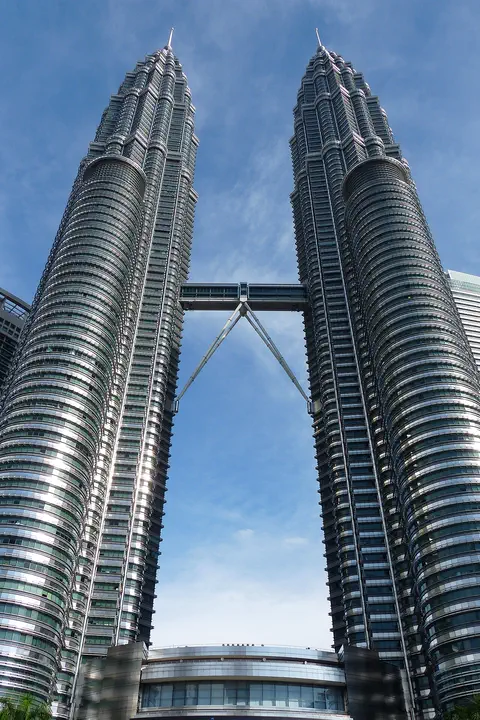
Its name means 'muddy estuary'. It grew where two rivers meet. It has two giant, shiny towers joined by a bridge in the sky. George Town and Melaka are old port towns by the sea.
Kuala Lumpur began in 1857, when Chinese tin miners started a settlement there. The city stands where two rivers meet, and its name means 'muddy estuary' in Malay. Today it is the country's largest city, with skyscrapers, mosques and old shop-houses. The Petronas Twin Towers, finished in 1998, are 452 meters tall and joined by a two-story skybridge.
Melaka and George Town grew up over 500 years of trade between East and West. Their old centers, full of shop-houses, places of worship of many faiths and buildings from Malay, Portuguese, Dutch and British times, are a World Heritage Site.
Kuala Lumpur, at the confluence of the Kelang and Gombak rivers, dates to 1857, when 87 Chinese tin miners founded a settlement at what is now the suburb of Ampang. It became capital of the Federated Malay States in 1895, of the independent Federation of Malaya in 1957 and of Malaysia in 1963. Its Golden Triangle holds the 118-story Merdeka 118 and the 88-story Petronas Twin Towers, designed by Cesar Pelli for the national petroleum company and completed in 1998: each eight-lobed tower rises to 452 m, including a 73.6 m pinnacle and spire, and a two-story skybridge links them between the 41st and 42nd stories.
UNESCO inscribed Melaka and George Town, Historic Cities of the Straits of Malacca, in 2008. Melaka shows the 15th-century Malay sultanate and the Portuguese and Dutch periods from the early 16th century; George Town represents the British era from the end of the 18th century, with an exceptional range of shop-houses and townhouses.
Mountains, caves and rain
Malaysia is warm and rainy all year.
Thick green rainforest covers much of the land. Mount Kinabalu is the tallest mountain. Under the ground there are giant caves. Millions of bats live in one of them.
Down the middle of the peninsula run mountain ranges, with flatter land along the coasts. In Sabah, on Borneo, Mount Kinabalu rises 4,095 meters, the highest peak in Malaysia. In Sarawak, Gunung Mulu National Park has some of the biggest caves on Earth: the Sarawak Chamber is 600 meters long, 415 meters wide and 80 meters high.
Malaysia is hot and humid all year, with heavy rain. Its year is shaped by two monsoons, seasonal winds from the northeast (about November to March) and from the southwest (about May to September). Thick evergreen rainforest still covers more than two-fifths of the peninsula and about two-thirds of Sarawak and Sabah.
Peninsular Malaysia has a mountainous core of roughly parallel north-south ranges; the Main Range is about 480 km long, with peaks above 2,100 m, and limestone karst hills with caves mark the center and north. East Malaysia has a coastal plain, a hill-and-valley belt and a mountainous backbone along the border with Kalimantan, above which Mount Kinabalu reaches 4,095 m, the highest peak in Malaysia. UNESCO describes Kinabalu as a granite intrusion formed 15 million years ago and pushed upward one million years ago. At Gunung Mulu, at least 295 km of explored caves include the Sarawak Chamber (600 × 415 × 80 m), the largest known cave chamber in the world.
The climate is equatorial: lowland temperatures on the peninsula average about 27 °C, and mean annual rainfall there is about 2,540 mm, from about 1,650 mm at Kuala Kelawang to some 5,000 mm at Maxwell's Hill. The northeast monsoon runs from November or December to March and the southwest monsoon from May or June to September or early October. Neither part of Malaysia lies in the typhoon belt. The longest rivers are the Pahang (434 km) on the peninsula and the Rajang (about 563 km) in Sarawak.

Animals and plants of Malaysia
Elephants and tigers live in the forests of Malaysia.
On Borneo, orangutans and sun bears live in the forest. Reddish proboscis monkeys live in the trees. Sea turtles lay their eggs on the beaches. One plant has the biggest flower anyone has found.
On the peninsula, the forests are home to elephants, tigers, tapirs and small mouse deer, as well as crocodiles, monitor lizards and cobras. Green sea turtles and giant leatherback turtles come to the beaches of the east coast to nest.
East Malaysia, on Borneo, has even more kinds of animals, including orangutans, sun bears and reddish proboscis monkeys. The rainforest has more than 2,000 kinds of trees, meat-eating pitcher plants, and Rafflesia, whose flower is nearly 1 meter across, the largest known flower in the world.
Britannica lists elephants, tigers, Malayan gaurs (seladang), tapirs, wild pigs and chevrotains (mouse deer) among the peninsula's mammals, with crocodiles, monitor lizards and cobras; green and leatherback turtles nest on the east-coast beaches. East Malaysia adds orangutans, sun bears and proboscis monkeys, and vast numbers of cave swiftlets. Kinabalu Park alone records 90 lowland mammal species, 22 montane mammal species and 326 bird species; Deer Cave at Mulu holds one of the world's largest colonies of free-tailed bats, more than 3 million.
The flora is among the richest in the world: several thousand vascular plant species, more than 2,000 of them trees, carnivorous pitcher plants (Nepenthes) and the parasitic Rafflesia arnoldii, with the largest known flower, nearly 1 m across. Kinabalu holds an estimated 5,000 to 6,000 vascular plant species, including about 1,000 orchids. Much of the original rainforest has been cleared for farming and commerce; UNESCO notes settlement, farming and logging right up to the boundary of Kinabalu Park in many places, and heavy logging in the forests around Gunung Mulu.
People, languages and food
People in Malaysia speak many languages.
Most people speak Malay. Many also speak Chinese languages or Tamil. Festivals include Hari Raya, Chinese New Year and Deepavali. Nasi lemak is coconut rice with peanuts and little fish.
Malaysia's people come from many backgrounds. Malays make up about half of the population and Chinese Malaysians about one-fourth, and there are Indian Malaysians, the Orang Asli ('Original People') of the peninsula, and many Indigenous peoples on Borneo, such as the Iban in Sarawak and the Kadazan in Sabah. Malay is the national language and is used in public schools.
Islam is the official religion, and many people follow Buddhism, Hinduism, Christianity and other faiths. People celebrate Hari Raya, Chinese New Year, Deepavali and Christmas, often with an 'open house' for guests. Among the most common Malay foods are nasi lemak, sate and nasi goreng (fried rice).
For administrative purposes Malaysia distinguishes Indigenous peoples, including Malays, collectively called bumiputra, from immigrant populations, mainly Chinese and South Asians. Malays form about half the population and are officially defined partly by their adherence to Islam; Chinese Malaysians, about one-fourth, speak several Chinese languages such as Hokkien, Cantonese and Hakka; Tamil speakers are the largest South Asian group. In Sarawak the Iban are more than one-fourth of the state's people, and in Sabah the Kadazan, Bajau and Malays together make up about half. Bahasa Malaysia is the national language and the main medium of public schooling.
Islam, the official religion, is followed by about three-fifths of the population; many Chinese follow Buddhism or Daoism, most Indians practice Hinduism, Sikhs follow Sikhism, and many Indigenous Borneans are Christian. Many of Borneo's Indigenous peoples traditionally live in longhouses raised on piles, with one bilik room for each family. Traditional Malay cuisine is white rice served with curries and fried dishes; sate, nasi goreng and nasi lemak (coconut rice with fried anchovies, peanuts and a curry) are among the most common Malay foods. DOSM reports that 8.4 percent of people were 65 or older in 2026 and the median age was 31.7.
A long history
People have lived in Malaysia for a very, very long time.
Long ago, ships from many lands came to trade. Melaka became a busy port. Later, Malaysia became its own country. It joined together in 1963.
People lived in the Niah Cave in Sarawak about 40,000 years ago. Around the year 1400, the port of Malacca, now Melaka, was founded. Ships brought spices, gold, silk and tea through it, and merchants from China, Arabia, Persia and India traded there. Islam spread along these trade routes.
Later, Portugal, the Netherlands and Britain each took control of parts of the land. Under British rule, tin mines and rubber plantations grew, and many workers came from China and India. The Federation of Malaya became independent in 1957, and in 1963 it joined with Sarawak, Sabah and Singapore to form Malaysia.
In the Lenggong Valley on the peninsula, UNESCO describes open-air and cave sites with evidence spanning 1.83 million to 1,700 years ago, and Perak Man, radiocarbon dated to about 10,120 years ago, is South-East Asia's oldest most complete human skeleton. At Niah Cave, Homo sapiens lived about 40,000 years ago. Small Malay kingdoms appeared in the 2nd or 3rd century CE, and from the 7th to the 13th century many likely came under the loose control of Srivijaya, based in Sumatra. Malacca, founded about 1400, became Southeast Asia's principal trading port, hosting some 15,000 merchants at its height; its ruler converted to Islam, and the Chinese admiral Zheng He called there several times.
Portugal captured Malacca in 1511 and the Dutch took it in 1641. Under British rule, rubber, introduced from Brazil in the 1870s, and tin became the main exports. Japan occupied Kuala Lumpur from 1942 to 1945, during World War II, and a communist-led guerrilla insurgency followed from 1948 to 1960. The Federation of Malaya became independent in 1957; Malaysia was formed in 1963, Singapore left in 1965, and Malaysia was a founding member of ASEAN in 1967. Britannica notes that the way Malaysia selects its king draws on the Minangkabau custom of electing chiefs from among eligible candidates.

Malaysia on the map
Find Malaysia on the globe.
It is in Asia, near the Equator. One part touches Thailand. The other part is on the island of Borneo. The South China Sea lies between the two parts.
Peninsular Malaysia shares a land border with Thailand to the north. At its southern tip, Singapore is joined to it by a causeway and a bridge, and across the Strait of Malacca to the southwest lies the Indonesian island of Sumatra.
East Malaysia, the states of Sarawak and Sabah, covers the northern part of Borneo. It shares the island with Indonesia to the south and with the small country of Brunei, which sits inside Sarawak along the coast.
Peninsular Malaysia occupies most of the southern Malay Peninsula, about 800 km long and up to 320 km wide; its land boundary with Thailand is about 480 km. Singapore, at the tip, is connected by a causeway and a separate bridge, and the Strait of Malacca separates the peninsula from Sumatra. Coastal lowlands are 15 to 80 km wide on the west coast but narrower on the east.
East Malaysia is an elongated strip about 1,125 km long and up to 275 km wide, with a coastline of about 2,250 km and a boundary of about 1,450 km with Kalimantan, Indonesian Borneo. Brunei forms a small coastal enclave surrounded by Sarawak. The two halves of Malaysia are about 640 km apart across the South China Sea.
- Two parts
- Peninsular Malaysia (about 40%) and East Malaysia on Borneo (about 60%)
- Sea between them
- about 640 km of the South China Sea
- Land neighbors
- Thailand, Brunei and Indonesia; Singapore by causeway and bridge
- Highest point
- Mount Kinabalu, 4,095 m
Amazing facts
-
Kuala Lumpur's name means 'muddy estuary'.
Kuala Lumpur means 'muddy estuary' in Malay. The city grew where two rivers, the Kelang and the Gombak, meet.
Kuala Lumpur ('muddy estuary') lies at the confluence of the Kelang and Gombak rivers; it began in 1857, when 87 Chinese tin miners founded a settlement at what is now Ampang.
-
A Malaysian plant has a flower nearly 1 meter across.
The flower of Rafflesia arnoldii can be nearly 1 meter across, the largest known flower in the world.
The parasitic Rafflesia arnoldii bears the world's largest known flower, nearly 1 m in diameter.
-
More than 3 million bats live in one cave.
Deer Cave in Gunung Mulu National Park is home to more than 3 million free-tailed bats.
Deer Cave holds one of the world's largest colonies of free-tailed bats (Chaerephon plicata), over 3 million, and more bat species than any other single cave.
-
Players kick a woven ball over a net in sepak takraw.
Sepak takraw is like volleyball, but players use a woven rattan ball and may not use their hands.
Sepak takraw ('kick ball'), a Southeast Asian game played with a woven rattan ball and no hands, is internationally competitive, and Malaysia has fielded winning teams.
-
The Petronas Twin Towers are joined by a bridge in the sky.
A skybridge two stories tall links the two Petronas Towers, between the 41st and 42nd stories.
In 1996, when their spires were attached, the 452 m Petronas Twin Towers were declared the world's tallest buildings; Taipei 101 overtook them in 2003.
Words to know
- peninsula
- a long piece of land with water on three sides
- monsoon
- a wind that changes direction with the seasons and brings a rainy season
- rainforest
- a thick forest that gets heavy rain all year
- karst
- limestone land where water has dissolved the rock into caves and steep hills
- longhouse
- a long building on stilts where several families live, each in its own room
- federation
- a country made of states that share one national government
- World Heritage Site
- a place UNESCO lists as important to all people, to be protected
Discovery challenge
-
What is the capital city of Malaysia?
Which city is the capital of Malaysia?
Which city, founded by tin miners in 1857, is Malaysia's capital?
- Kuala Lumpur
- George Town
- Kota Kinabalu
Show the answer
Kuala Lumpur
Kuala Lumpur is the capital of Malaysia.
Kuala Lumpur is the capital. Its name means 'muddy estuary', where two rivers meet.
Kuala Lumpur grew from an 1857 tin miners' settlement and became the capital of Malaya in 1957 and of Malaysia in 1963.
-
Part of Malaysia is on a big island. What is the island called?
East Malaysia is on which large island?
Sarawak and Sabah occupy roughly the northern fourth of which island?
- Sumatra
- Borneo
- Java
Show the answer
Borneo
Part of Malaysia is on the island of Borneo.
East Malaysia, the states of Sarawak and Sabah, is on the island of Borneo.
Sarawak and Sabah cover roughly the northern fourth of Borneo; the rest is Indonesian Kalimantan and Brunei.
-
What is the tallest mountain in Malaysia?
Which mountain in Sabah is the highest in Malaysia?
Which mountain, 4,095 meters high, is the highest peak in Malaysia?
- Mount Everest
- Mount Fuji
- Mount Kinabalu
Show the answer
Mount Kinabalu
Mount Kinabalu is the tallest mountain in Malaysia.
Mount Kinabalu, in Sabah on Borneo, is 4,095 meters tall.
Mount Kinabalu, 4,095 m, is a granite intrusion formed 15 million years ago and pushed up about one million years ago.
-
Which plant has a giant flower?
Which rainforest plant in Malaysia has a flower nearly 1 meter across?
Which parasitic plant of Malaysia's rainforest bears the largest known flower in the world?
- Rafflesia
- Pitcher plant
- Orchid
Show the answer
Rafflesia
Rafflesia has a giant flower.
The flower of Rafflesia can be nearly 1 meter across. Pitcher plants are meat-eating plants.
Rafflesia arnoldii, a parasitic plant, bears the largest known flower, nearly 1 m in diameter.
-
Which language do most people in Malaysia speak?
What is Malaysia's national language, used in public schools?
Which language, officially called Bahasa Malaysia, is Malaysia's national language?
- Tamil
- English
- Malay
Show the answer
Malay
Most people in Malaysia speak Malay.
Malay, called Bahasa Malaysia, is the national language and is used in public schools.
A standardized form of Malay, Bahasa Malaysia, is spoken to some degree by most communities and is the main medium of public schooling.
Places to discover in Malaysia
Animals of Malaysia
-
 Watch
3D
Animal
Bornean orangutan
The Bornean orangutan is a shaggy red great ape that spends almost all its life in the treetops of Borneo's rainforests. It eats mostly ripe fruit, builds a new leafy bed every night, and lives a quieter, more solitary life than other great apes.
-
 Watch
Animal
Proboscis monkey
The proboscis monkey is named for the grown-up male's huge, drooping nose. It lives only on Borneo, in forests along rivers, swamps and coasts. It eats mostly leaves and fruit, sleeps by the river every night and is a strong swimmer.
-
 Watch
Animal
Orchid mantis
The orchid mantis is a praying mantis from the rainforests of Southeast Asia that looks like a flower. Its white and pink colors fool bees and other insects that visit flowers, and the mantis catches them. Its leg flaps look like petals, and scientists recently found that they also help young mantises glide through the air.
-
 Watch
Animal
Sun bear
The sun bear is the smallest of the world's eight kinds of bear, and it has the longest tongue. It lives in the forests of Southeast Asia, climbs trees with long curved claws, and rips open logs to find insects and honey. Every bear has its own chest patch, like a fingerprint.
Explore next
-
Watch
Landmark
Petronas Towers
The Petronas Twin Towers in Kuala Lumpur, Malaysia, are two matching skyscrapers 452 meters tall, finished in 1998. Seen from above, each floor is shaped like an eight-pointed star, a pattern from Islamic art. A two-story skybridge joins them 170 meters above the ground, and from 1996 to 2003 they were counted as the tallest buildings in the world.
-
Watch
3D
Animal
Bornean orangutan
The Bornean orangutan is a shaggy red great ape that spends almost all its life in the treetops of Borneo's rainforests. It eats mostly ripe fruit, builds a new leafy bed every night, and lives a quieter, more solitary life than other great apes.
-
Watch
Animal
Proboscis monkey
The proboscis monkey is named for the grown-up male's huge, drooping nose. It lives only on Borneo, in forests along rivers, swamps and coasts. It eats mostly leaves and fruit, sleeps by the river every night and is a strong swimmer.
-
 Watch
 Country
Singapore
Singapore is a city-state, a country that is also one city, on an island at the southern tip of the Malay Peninsula in Southeast Asia. It is small but crowded: about 6.21 million people lived there in 2026, and its port is one of the busiest in the world.
-
Watch
Animal
Orchid mantis
The orchid mantis is a praying mantis from the rainforests of Southeast Asia that looks like a flower. Its white and pink colors fool bees and other insects that visit flowers, and the mantis catches them. Its leg flaps look like petals, and scientists recently found that they also help young mantises glide through the air.
-
Watch
Animal
Sun bear
The sun bear is the smallest of the world's eight kinds of bear, and it has the longest tongue. It lives in the forests of Southeast Asia, climbs trees with long curved claws, and rips open logs to find insects and honey. Every bear has its own chest patch, like a fingerprint.
-
 Watch
 Country
Brunei
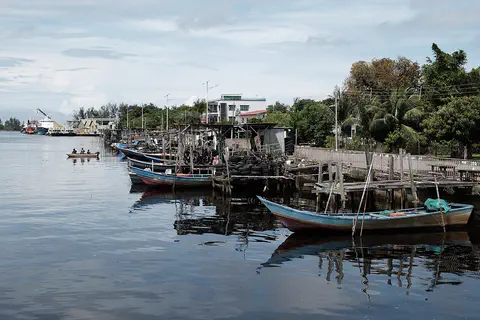
Brunei is a small country on the north coast of the island of Borneo, in Southeast Asia. Most of it is covered in rainforest, where proboscis monkeys and sun bears live. Its capital has a famous water village built on stilts, and about 459,000 people lived in Brunei in 2025.
-
 Watch
 Country
Afghanistan
Afghanistan is a landlocked country in south-central Asia. The high Hindu Kush mountains run across its middle, sandy deserts lie in the southwest, and the capital, Kabul, sits in a valley about 1,800 meters above sea level.
For parents & teachers
What children will learn
- Locate Malaysia's two parts, the Malay Peninsula and northern Borneo, and the sea between them.
- Describe Malaysia's equatorial climate, monsoons, rainforests and caves.
- Describe the many peoples, languages, faiths and foods of Malaysia without treating them as one single culture.
- Outline Malaysia's history from early cave dwellers and the port of Malacca to independence in 1957 and the federation of 1963.
Recommended ages: 3 to 17 · About 15 minutes
Talk about it
- How might living in a country split by the sea change how people travel and share news?
- Melaka and George Town grew as trading ports. What goods come to your town from far away?
- Why might a festival 'open house', where guests are treated to food and hospitality, help neighbors from different backgrounds get to know each other?
Try at home or in class
- On a map, find Kuala Lumpur and Kota Kinabalu and measure the distance between them across the South China Sea.
- Make a model longhouse from a shoebox, dividing it into a row of small rooms, one for each family.
Key vocabulary: peninsula, monsoon, rainforest, karst, longhouse, federation, World Heritage Site
Where these facts come from
- Wikidata , Wikimedia Foundation (CC0 1.0)
- Natural Earth vector data , Natural Earth (NACIS) (Public domain)
- UNESCO World Heritage List , UNESCO World Heritage Centre (Linked as a reference; site facts come from Wikidata)
- Current Population Estimates, Malaysia, 2026 , Department of Statistics Malaysia (DOSM)
- Malaysia (introduction, Land, Relief, Drainage, Soils) , Encyclopaedia Britannica
- Malaysia: Climate , Encyclopaedia Britannica
- Malaysia: Plant and animal life , Encyclopaedia Britannica
- Malaysia: People , Encyclopaedia Britannica
- Malaysia: Religion , Encyclopaedia Britannica
- Malaysia: Settlement patterns , Encyclopaedia Britannica
- Malaysia: Daily life and social customs , Encyclopaedia Britannica
- Malaysia: History , Encyclopaedia Britannica
- Malaysia: The advent of Islam , Encyclopaedia Britannica
- Malaysia: The impact of British rule , Encyclopaedia Britannica
- Malaysia: Malaysia from independence to c. 2000 , Encyclopaedia Britannica
- Kuala Lumpur , Encyclopaedia Britannica
- Petronas Twin Towers , Encyclopaedia Britannica
- Kinabalu Park , UNESCO World Heritage Centre
- Gunung Mulu National Park , UNESCO World Heritage Centre
- Melaka and George Town, Historic Cities of the Straits of Malacca , UNESCO World Heritage Centre
- Archaeological Heritage of the Lenggong Valley , UNESCO World Heritage Centre
- PlayOwl region table, version 1 , PlayOwl (PlayOwl original data)
- flag-icons 7.5.0 , Panayiotis Lipiridis and contributors (MIT)
- Wikimedia Commons , Wikimedia Foundation (Per file (public domain, CC0, CC BY or CC BY-SA); see each media record)
Checked, not yet human-reviewed. Last updated October 24, 2026. Spotted a mistake? Tell us.
Picture credits
- Photo: naim fadil, CC BY-SA 2.0, via Wikimedia Commons · source · license
- Photo: AwOiSoAk KaOsIoWa, CC BY-SA 3.0, via Wikimedia Commons · source · license
- Photo: Flanegan, CC BY 3.0, via Wikimedia Commons · source · license
- Photo: HundenvonPenang, CC BY-SA 4.0, via Wikimedia Commons · source · license