
Animal
Proboscis monkey
The proboscis monkey has a big, long nose. It lives in trees beside rivers on the island of Borneo, and it can swim!
The proboscis monkey is named for the grown-up male's huge, drooping nose. It lives only on Borneo, in forests along rivers, swamps and coasts. It eats mostly leaves and fruit, sleeps by the river every night and is a strong swimmer.
Nasalis larvatus, endemic to Borneo, lives in riverine, mangrove and swamp forest and rarely strays far from water. Males carry an enlarged, pendulous nose that resonates their calls. Its numbers are estimated to have fallen by over 70 percent in 36 years, and the IUCN lists it as Endangered.
Photo: Charles J. Sharp, CC BY-SA 4.0, via Wikimedia Commons
Meet the proboscis monkey
The proboscis monkey has a very long nose.
Grown-up males have the biggest noses of all. Its fur is reddish-brown, and its arms and legs are gray. It has a long tail.
A proboscis is a long nose, and this monkey is named for the grown-up male's long, droopy one. Females have smaller noses, and babies have little upturned noses.
Proboscis monkeys have reddish-brown fur with paler underparts, and gray arms, legs and tail. The tail is about as long as the body. Males are about twice as heavy as females: a big male weighs about 20 kilograms, a female about 10. Babies are born with blue faces!
Nasalis larvatus is named for the male's long, pendulous nose; females have smaller noses and juveniles upturned ones. The Animal Diversity Web suggests the male's nose enhances his calls through resonance. The coat is pinkish to red-brown, reddest on the head and shoulders, with pale underparts and gray limbs and tail; the tail is about as long as the body.
Sexual dimorphism is strong. Britannica gives males 56 to 72 centimeters and an average of 20 kilograms against about 10 for females; the Animal Diversity Web gives males 16 to 22 kilograms and females 7 to 12. Two subspecies were once described, but they differ so little that the IUCN now treats the species as having none.
Quick facts
- Group
- Mammal
- Length
- 0.56 to 0.72 m
- Weight
- 7 to 22 kg
Where it lives
Proboscis monkeys live on Borneo.
Borneo is a big island in Asia. The monkeys live in trees next to rivers and the sea. They stay close to the water.
Proboscis monkeys live only on Borneo, a large island shared by Brunei, Indonesia and Malaysia. They live in forests along rivers, in mangrove forests by the sea and in swamp forests, always in the lowlands, no higher than about 350 meters above sea level.
They hardly ever go far from water; they are never more than about 600 meters from a river. During the day a group may move inland to feed, but every night it comes back to sleep in trees by the riverbank.
The IUCN records the species in Brunei, Indonesian Kalimantan and Malaysia's Sabah and Sarawak; it was originally found along the whole coast of Borneo and on the nearby islands of Berhala, Sebatik and Pulau Laut. Habitats are riparian forest, coastal lowland forest including mangroves, peat swamp and freshwater swamp forest, at no more than about 350 meters.
Groups rarely range far from a waterway; at Sukau they moved inland by day and returned to the river every night, and the Animal Diversity Web reports sleeping sites 0 to 15 meters from the water's edge. One suggestion is that interior soils lack the minerals and salts the species needs. A one-male group's home range measured 220.5 hectares.
Continent
Its habitats


Where can you find this animal?
- Lives here naturally · Countries and seas named by a scientific source
- Sightings recorded · Records of wild sightings (GBIF)
Lives here naturally · Countries and seas named by a scientific source
Borneo only: riverine, mangrove and swamp forests in Brunei, Indonesian Kalimantan and Malaysia's Sabah and Sarawak, below about 350 m. The monkeys live only on Borneo, not elsewhere in Indonesia or Malaysia.
Places: Brunei, Indonesia and Malaysia.
Source: iucn-red-list · checked October 2026
Sightings recorded · Records of wild sightings (GBIF)
Counts of GBIF records of wild observations (human and machine) and preserved specimens. Records include introduced populations, vagrants, escaped or released animals and misidentifications, so a country with records is not necessarily part of the native range.
Wild sightings have been recorded in Malaysia, Indonesia, Brunei, Germany, Japan, United States, India and Central African Rep..
Source: gbif · checked October 2026
Range maps show where scientists say an animal lives, often country by country. An animal may live in only part of a country shown, and sightings records can include animals that wandered far from home.
What it eats
Proboscis monkeys eat mostly leaves.
They like soft young leaves best. They also eat fruit and seeds.
Proboscis monkeys are mostly leaf-eaters and fruit-eaters. About half of their feeding is on leaves and about two-fifths on fruit. They prefer soft young leaves and fruits that are not yet ripe, along with seeds and mangrove shoots. Now and then they eat caterpillars or other small insect larvae.
What they eat changes through the year as different foods become available. Because their diet is so special, they are very hard to keep healthy in zoos, and they are almost never seen in zoos outside Asia.
The IUCN gives about 52 percent of feeding records as leaves and about 40 percent as fruit, with a preference for young leaves and unripe, non-fleshy fruits; the monthly diet tracks availability. The Animal Diversity Web adds seeds, mangrove shoots and occasional invertebrates such as caterpillars and larvae, and notes a more frugivorous diet from January to May.
This specialization has practical consequences: the species is almost never kept in captivity outside Asia, because its diet of particular leaves and other plant material makes it hard to keep alive.
Did you know?
They sleep in a new spot by the river every night.
Proboscis monkeys sleep in trees near the river and pick a different place each night.
Sleeping sites lie 0 to 15 meters from the river's edge and are not reused on consecutive nights.
A monkey that swims
Proboscis monkeys are great swimmers.
They jump from trees into the river with a splash. They have a bit of webbing between their toes.
Proboscis monkeys are excellent swimmers. They have webbing between their fingers and toes, and they will leap from trees straight into the water. They can even swim about 20 meters underwater!
They also wade through water standing upright on two legs, which is unusual for a monkey. In the trees they move on all fours. A group crossing a narrow river may jump from a tree on one bank to a tree on the other, while a monkey on its own often swims across.
The Animal Diversity Web describes webbing between the digits, leaps from trees into water and swims of up to 20 meters underwater; the IUCN cites regular swimming across the Kinabatangan River and its tributaries. Individuals alone may swim across rivers, while groups often jump between trees at narrow points.
Britannica notes that proboscis monkeys wade upright through water, making them exceptional among monkeys in being habitually bipedal. In the canopy they are quadrupedal. Infants are born with blue faces that darken to gray at about 2.5 months and become cream-colored, like an adult's, by about 8.5 months.
Growing up
A baby proboscis monkey has a blue face!
Its mother carries it and gives it milk. Its face changes color as it grows.
A proboscis monkey mother is pregnant for about 166 days, five to six months, and has one baby, often at night while she sits on a branch. A newborn weighs about 455 grams and has a bright blue face.
The mother carries her baby until it can walk on its own and nurses it until it is about 7 months old. The baby's face turns gray at about 2.5 months and cream-colored by about 8.5 months. Young ones stay close to their mothers for about a year.
The Animal Diversity Web gives a breeding season from February to November and a gestation of 166 days; Britannica says births apparently happen at any time of year and estimates gestation at five to six months. The single infant, about 455 grams according to Wikidata, is usually born at night while the mother sits on a branch.
Newborns are fairly helpless and are carried until they can walk; mothers nurse them to about 7 months and groom them, and infants stay close for about a year. Females remain in their natal group, while males disperse at about 18 months. Wild lifespan is unknown; in captivity the longest lives recorded are about 23 years.

Life by the river
Proboscis monkeys live in family groups.
A grown-up male leads most groups. At night, lots of groups sleep together in trees by the river.
Most proboscis monkey groups have one grown-up male, several females and their young. Other groups are made up only of males. Groups usually have about 3 to 32 members.
The male leads the group and decides where it goes. He growls to calm the group and honks to warn of danger. In the evening, several groups gather to sleep in trees close to the river, and they choose a different spot each night. Proboscis monkeys are most active from late afternoon until dark.
The Animal Diversity Web describes one-male groups with 2 to 7 adult females, and all-male groups, of 3 to 32 individuals; Britannica gives groups of about 20 with a single male and up to a dozen females. Adult males coordinate group movement. Several groups gather in the evening into sleeping bands near the river and do not sleep in the same place on consecutive nights.
Calls include male growls that calm the group, male honks used as threats or warnings of predators, shrieks from females and juveniles, and screams during conflicts. Grooming, mostly between females, lasts 1 to 5 minutes. Leopards and crocodiles are known predators.
Did you know?
Proboscis monkeys can swim underwater.
Proboscis monkeys can swim about 20 meters underwater, and they dive into rivers from the trees.
Swims of up to 20 meters underwater have been recorded, aided by webbing between the digits.
Protecting proboscis monkeys
Proboscis monkeys need their riverside forests.
Some of these forests are protected in parks. Laws say people must not hunt the monkeys.
The proboscis monkey is endangered. Its numbers have fallen by more than 70 percent in about 36 years. People clear riverbanks and mangroves for logging, farms, shrimp ponds and homes, and fires have burned large areas of forest. Because they are slow-moving and easy to hunt, hunting can wipe out a whole local population.
Proboscis monkeys are protected by law in every country where they live, and they are found in at least 16 protected areas, including the Lower Kinabatangan Wildlife Sanctuary in Malaysia.
The IUCN lists Nasalis larvatus as Endangered (assessed 2015, published 2021 and flagged as needing an update), estimating a decline of over 70 percent, probably under 80, across three generations (36 years). Habitat loss is the main driver because riverine and coastal forest is favored for logging, cultivation and settlement; the Mahakam Delta population was decimated by conversion to shrimp farms, and the 1997 to 1998 fires destroyed much habitat in Kalimantan.
The species is easily hunted, for food and for bezoar stones used in traditional medicine. It is protected by law throughout its range and on CITES Appendix I, and occurs in 16 protected areas, although enforcement is weak in places. In Sarawak fewer than 1,000 are thought to remain.
IUCN Red List
How is the proboscis monkey doing in the wild?
- Least Concern
- Near Threatened
- Vulnerable
- Endangered (this animal)
- Critically Endangered
- Extinct in the Wild
- Extinct
Endangered
At very high risk of disappearing from the wild.
See the IUCN Red List assessment · The IUCN Red List of Threatened Species 2022.2
Amazing facts
-
Baby proboscis monkeys are born with blue faces.
Newborn proboscis monkeys have blue faces that turn gray, then cream-colored, by about 8.5 months.
Infant facial color changes from blue at birth to gray at about 2.5 months and cream by about 8.5 months.
-
Proboscis monkeys can swim underwater.
Proboscis monkeys can swim about 20 meters underwater, and they dive into rivers from the trees.
Swims of up to 20 meters underwater have been recorded, aided by webbing between the digits.
-
They sleep in a new spot by the river every night.
Proboscis monkeys sleep in trees near the river and pick a different place each night.
Sleeping sites lie 0 to 15 meters from the river's edge and are not reused on consecutive nights.
-
Proboscis monkeys can walk on two legs in the water.
When they wade through water, proboscis monkeys stand upright on two legs.
Habitual upright wading makes the species exceptional among monkeys in its bipedalism.
Words to know
- proboscis
- a long nose or snout
- mangrove
- a tree that grows in salty water along tropical coasts
- webbing
- skin between fingers or toes that helps with swimming
- folivore
- an animal that eats mostly leaves
- endemic
- found naturally in only one place
- endangered
- at risk of disappearing from the wild
Discovery challenge
-
Which proboscis monkeys have the biggest noses?
Which proboscis monkeys have the longest noses?
In which proboscis monkeys is the nose largest and most pendulous?
- Grown-up males
- Babies
- Grown-up females
Show the answer
Grown-up males
Grown-up males have the biggest noses.
Adult males have the long, droopy nose; females' noses are smaller and babies' are upturned.
Adult males; the nose may amplify their calls through resonance.
-
What can proboscis monkeys do in rivers?
Which is true about proboscis monkeys and water?
Which describes the proboscis monkey's relationship with water?
- They swim, even underwater
- They breathe underwater like fish
- They never go near water
Show the answer
They swim, even underwater
They are great swimmers!
They swim well, leap into rivers and can swim about 20 meters underwater.
Strong swimmers with webbed digits that rarely range far from waterways and sleep beside rivers.
-
What do proboscis monkeys eat most?
What do proboscis monkeys mostly eat?
Which foods make up most of the proboscis monkey's feeding records?
- Leaves and fruit
- Fish
- Only insects
Show the answer
Leaves and fruit
They eat lots of leaves and some fruit.
About half their feeding is on leaves and about two-fifths on fruit.
About 52 percent leaves and 40 percent fruit.
-
Where do proboscis monkeys live?
On which island do wild proboscis monkeys live?
To which island is Nasalis larvatus endemic?
- Borneo
- Madagascar
- Tasmania
Show the answer
Borneo
They live on Borneo.
They live only on Borneo, which is shared by Brunei, Indonesia and Malaysia.
Endemic to Borneo, in lowland riverine, swamp and coastal forest.
Places where you might see it
-
 Watch
 Country
Malaysia
Malaysia is a country in Southeast Asia, just north of the Equator. One part is on the Malay Peninsula and the other is on the island of Borneo. It has rainforests, huge caves, Mount Kinabalu and the city of Kuala Lumpur, with about 34.4 million people (2026).
-
 Watch
 Country
Brunei
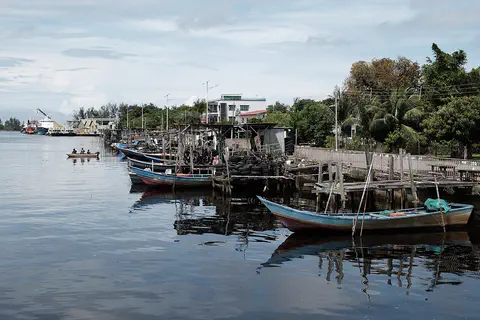
Brunei is a small country on the north coast of the island of Borneo, in Southeast Asia. Most of it is covered in rainforest, where proboscis monkeys and sun bears live. Its capital has a famous water village built on stilts, and about 459,000 people lived in Brunei in 2025.
Explore next
-
 Watch
3D
Animal
Bornean orangutan
The Bornean orangutan is a shaggy red great ape that spends almost all its life in the treetops of Borneo's rainforests. It eats mostly ripe fruit, builds a new leafy bed every night, and lives a quieter, more solitary life than other great apes.
-
 Watch
Animal
Japanese macaque
The Japanese macaque, or snow monkey, lives farther north than any other monkey or ape except people. Thick fur keeps it warm through snowy winters, and some troops have learned to sit in warm hot springs.
-
Watch
Country
Malaysia
Malaysia is a country in Southeast Asia, just north of the Equator. One part is on the Malay Peninsula and the other is on the island of Borneo. It has rainforests, huge caves, Mount Kinabalu and the city of Kuala Lumpur, with about 34.4 million people (2026).
-
Watch
Country
Brunei
Brunei is a small country on the north coast of the island of Borneo, in Southeast Asia. Most of it is covered in rainforest, where proboscis monkeys and sun bears live. Its capital has a famous water village built on stilts, and about 459,000 people lived in Brunei in 2025.
-
 Watch
Animal
Aardvark
The aardvark is a shy night digger of African savannas. It sniffs out ant and termite nests, rips them open with its spade-like claws and laps up the insects with a sticky tongue about 30 centimeters long. Its name means 'earth pig' in Afrikaans.
-
 Watch
Animal
African buffalo
The African buffalo is a huge, cow-like grazer with heavy, curving horns. It lives in herds that can number in the thousands, and a herd will rush to protect a calf in danger. It lives across much of Africa south of the Sahara, from open savannas to rainforests.
-
 Watch
Animal
African forest elephant
The African forest elephant is a separate species from the bigger bush elephant. It lives in the rainforests of central and western Africa, eats lots of fruit and spreads the seeds of forest trees in its dung. It is Critically Endangered.
-
 Watch
3D
Animal
African wild dog
The African wild dog, or painted dog, has a patchy coat unlike any other dog's, big round ears and only four toes on its front feet. It lives in close packs that hunt together, share food and care for the pups. It is endangered: the IUCN estimated in 2025 that only about 1,676 adults are left in the wild.
For parents & teachers
What children will learn
- Describe how male, female and young proboscis monkeys differ.
- Explain why proboscis monkeys live close to rivers and how they are adapted to water.
- Describe the leaf-and-fruit diet and why it makes zoo care hard.
- Explain the threats to riverside forests in Borneo.
Recommended ages: 3 to 17 · About 15 minutes
Talk about it
- Why might an animal that eats leaves need to live near rivers or coasts?
- Why do you think a baby's face changes color as it grows?
- What could be done so that rivers in Borneo keep their forests?
Try at home or in class
- Spread your fingers in a bowl of water and push; then try with a plastic bag over your hand to feel how webbing helps you push water.
- Measure 20 meters outdoors: that is how far a proboscis monkey can swim underwater.
Key vocabulary: proboscis, mangrove, webbing, folivore, endemic, endangered
Where these facts come from
- The IUCN Red List of Threatened Species , International Union for Conservation of Nature (IUCN terms of use (no redistribution of Red List data or range maps))
- GBIF Backbone Taxonomy and GBIF Occurrence Search , Global Biodiversity Information Facility (CC0 1.0 (backbone); occurrence counts are facts derived from records under CC0, CC BY and CC BY-NC)
- Wikidata , Wikimedia Foundation (CC0 1.0)
- Nasalis larvatus (Proboscis Monkey), global assessment , IUCN Red List of Threatened Species
- Nasalis larvatus (proboscis monkey) , Animal Diversity Web, University of Michigan Museum of Zoology
- Proboscis monkey , Encyclopaedia Britannica
- Wikimedia Commons , Wikimedia Foundation (Per file: Public domain, CC0, CC BY or CC BY-SA only (credited on each page))
Checked, not yet human-reviewed. Last updated October 24, 2026. Spotted a mistake? Tell us.