
 Country
Europe
Czechia
Czechia is a country in the middle of Europe with no sea. It has old castles, green hills and forests, and a capital city full of towers.
Czechia, also called the Czech Republic, is a landlocked country in central Europe. Mountains ring the old land of Bohemia, the Vltava River flows through the capital, Prague, and about 10.9 million people lived there in 2026.
Czechia (the Czech Republic) is a landlocked central European state made up of the historical lands of Bohemia and Moravia and the southern tip of Silesia. A former kingdom and, from 1918, half of Czechoslovakia, it became independent on January 1, 1993; the Czech Statistical Office put its population at 10.904 million at the end of June 2026.
Photo: Diego Delso, CC BY-SA 4.0, via Wikimedia Commons
Discover Czechia
Czechia is a country in the middle of Europe.
It has no seaside. It has hills, forests and rivers. There are many old castles. The capital city is called Prague.
Czechia is a country in the middle of Europe. Its full name is the Czech Republic, and Czech people often call it Česko. It has no coast, so it is landlocked. Its neighbors are Germany, Poland, Slovakia and Austria.
The country is made of old regions with their own history: Bohemia in the west, Moravia in the east and a small part of Silesia in the northeast. Castles and old town centers dot the countryside. The capital, Prague, sits on the Vltava River. About 10.9 million people lived in Czechia in the middle of 2026.
The Czech Republic comprises the historical provinces of Bohemia and Moravia and the southern tip of Silesia, often called together the Czech Lands. Since 2016 the government has promoted Czechia, a translation of the Czech informal name Česko, as the short English name. The country is landlocked, bordered by Poland, Slovakia, Austria and Germany, and covers about 78,900 km².
Britannica notes that castles such as Karlštejn and many medieval town centers survive across the country. The Czech Statistical Office's provisional figures put the population at 10.904 million at the end of June 2026, down 12.2 thousand since January, as deaths (57.6 thousand) outnumbered births (36.5 thousand) and net migration (8.9 thousand) did not make up the difference. About three-quarters of people live in towns and cities.
Cities and famous places
Prague is the biggest city in Czechia.
A big river runs through it. A long stone bridge crosses the river. It has statues all along it. A huge castle sits on a hill above the city.
In the 1300s Prague was a royal and imperial capital. Its old towns were built between the 1000s and the 1700s, and UNESCO lists the historic center as a World Heritage Site. On a hill above the river stands Prague Castle, a group of palaces, churches, courtyards and gardens that covers about 45 hectares. The kings of Bohemia lived there, and today it is the official home of the country's president.
Charles Bridge, a stone bridge with 16 arches, was built between 1357 and 1402. Thirty statues line it, and only people on foot may cross it today. Outside Prague, Karlštejn Castle once guarded the royal crown, and in Olomouc a 35-meter column from the early 1700s rises in a town square.
UNESCO inscribed the Historic Centre of Prague in 1992: the Old Town, Lesser Town and New Town were built between the 11th and 18th centuries, and many monuments, including Hradčany Castle, St. Vitus Cathedral and Charles Bridge, date mostly from the 14th century under Charles IV, Holy Roman Emperor. Prague Castle began in the late 9th century; St. Vitus Cathedral, begun in 1344, was not finished until 1929. Charles Bridge (1357–1402), designed by Petr Parléř to replace the flood-damaged Judith Bridge, was Prague's only bridge over the Vltava until 1841; its 30 statues are mostly Baroque, and it has been closed to vehicles since 1965.
Beyond the capital, Český Krumlov (also 1992) grew around a 13th-century castle on the Vltava and kept its medieval plan through more than five centuries of peaceful change. Olomouc's Holy Trinity Column (2000), 35 m high, is UNESCO's outstanding example of a column type specific to central Europe. Brno, Moravia's largest city, was where Gregor Mendel did his 19th-century genetic experiments; Ostrava is the leading coal-mining and steel center.

Hills, rivers and forests
Mountains go almost all the way around Bohemia.
The tallest one is called Sněžka. Big rivers start in Czechia and flow to other countries. Forests of oak, beech and spruce cover many hills.
Most of Czechia is a high, rounded basin called the Bohemian Plateau, with ranges of mountains around its edges. The Ore Mountains form the border with Germany, and the Giant Mountains in the north hold the highest peak, Sněžka, about 1,603 meters tall. Southeast of the plateau, the Bohemian-Moravian Highlands include the Moravian Karst.
Czechia lies where several of central Europe's rivers begin. The Elbe, joined by the Vltava, flows north into Germany. The Morava flows south to the Danube, and the Oder flows north into Poland. Oak, beech and spruce forests grow at higher and higher levels, and there are many mineral springs.
The Bohemian Massif occupies most of the country: a roughly oval elevated basin, the Bohemian Plateau, encircled by six groups of mountains, from the Šumava (Bohemian Forest) in the southwest and the Ore Mountains (Krušné hory) in the northwest to the Sudeten system in the northeast. The lowest point, 117 m, is where the Elbe breaks through the Ore Mountains. Sněžka, in the Giant Mountains (Krkonoše), is the highest; in 2014 the Land Survey Office measured its natural summit at 1,603.296 m and found it lies just inside Poland, with the highest point on Czech territory about 10 cm lower on the border. In the east rise the westernmost ranges of the Western Carpathians.
Czechia lies in the headwater area of the central European watershed: the Elbe, joined by the Vltava, flows north into Germany, the Morava flows south toward the Danube, and the Oder flows north into Poland. The climate mixes continental and oceanic influences; mean annual temperatures range from 7 °C at Cheb to 9 °C at Brno, and precipitation from 450 mm in central Bohemia to more than 1,500 mm in the Krkonoše. Oak, beech and spruce dominate successive forest zones up to a timberline near 1,400 m.

Animals of Czechia
Lynx and wolves live in Czechia.
Otters swim in rivers and wetlands. Storks and big owls live there too. Some wild sheep called mouflon live in special parks.
Czechia's wild animals include bears, wolves, lynx and wildcats. Smaller animals such as marmots, otters, martens and minks live in the forests and wetlands, and pheasants, partridges, wild geese and ducks are common.
Some rarer birds, such as eagles, ospreys, storks, eagle owls and bustards, are generally protected. Mouflon, a kind of mountain sheep, are bred in game reserves. In the Giant Mountains, Krkonoše National Park, set up in 1963, protects glacial landscapes, Alpine plants and rare animals such as the Alpine shrew.
Britannica describes Czech wildlife as extensive and varied: large mammals include bears, wolves, lynx and wildcats (Felis silvestris), and smaller ones include marmots, otters, martens and minks. Game birds such as pheasants, partridges, wild geese and ducks are common, while rarer species, among them eagles, vultures, ospreys, storks, eagle owls, bustards and capercaillies, are generally protected.
Rare or endangered species such as the mouflon are bred in game reserves, and nature reserves protect the Šumava Forest, the Moravian Karst and the Jizera Mountains, with controlled access for visitors. Krkonoše National Park, established in 1963, protects glacial landscapes, Alpine vegetation and relict boreal-Arctic species such as the Alpine shrew (Sorex alpinus), although Britannica notes that the park has also been extensively developed as a ski resort. High in the Krkonoše, the tree cover below the timberline is little more than dwarf pine, and the Alpine zone holds grasses and low-growing bushes.

People, languages and food
About 10.9 million people live in Czechia.
Most people speak Czech. Children go to school from age 6. Dumplings, soups and apple strudel are well-known foods. At Christmas, many families eat fish.
About 10.9 million people lived in Czechia in 2026, and about three in every four live in towns and cities. Czech is the official language. It is a Slavic language written in the Latin alphabet, and it is so close to Slovak that Czechs and Slovaks can understand each other. Smaller groups speak Romani, German and Polish.
Favorite foods include potato and sauerkraut soups, chicken and pork with bread or potato dumplings, and for dessert fruit-filled dumplings, apple strudel and honey cake. On Christmas Eve, many families eat carp. Children must go to school for 10 years, from age 6 to 16, and Charles University in Prague was founded in 1348.
The Czech Statistical Office counted 10.904 million people at the end of June 2026 (provisional). Britannica gives Czechs as roughly two-thirds of the population; many Moravians see themselves as a distinct group within that majority, and there are Slovak, Polish, German and Roma minorities. Czech, a literary language since the late 13th century, is official; it and Slovak are mutually intelligible West Slavic languages written in the Latin alphabet. In the early 21st century almost nine-tenths of Czechs claimed no religious affiliation and about one-tenth were Roman Catholic.
Southern Bohemia and southeastern Moravia keep local cuisines and folk costumes for special occasions, and traditional wooden architecture survives in some rural areas. Staples include potato and sauerkraut soups, chicken and pork with houskové and bramborové knedlíky (bread and potato dumplings), and fruit dumplings, strudel and honey cake; Moravia produces wine and Bohemia has a brewing tradition dating to the early 19th century. Schooling is compulsory for 10 years, from 6 to 16, and Charles University (1348) and the Czech Technical University (1707) are among central Europe's oldest universities.

From kingdom to republic
Long ago, kings ruled a land called Bohemia.
They lived in Prague Castle. One king had a long stone bridge built. Later, Czechia became a country with a president.
For about 1,000 years, the Czech lands have had a long and changing history. As the Kingdom of Bohemia, the country was at its richest and most powerful in the 1200s and 1300s. Prague became a royal and imperial capital, and Charles University was founded there in 1348. King Charles IV, who was also Holy Roman Emperor, had work begin on Charles Bridge in 1357.
From 1526 the Habsburg family ruled Bohemia for nearly 400 years. In 1918 Czechs and Slovaks joined to form a new country, Czechoslovakia. On January 1, 1993, Czechoslovakia split into two countries, the Czech Republic and Slovakia, so smoothly that people called it the "Velvet Divorce." Czechia joined the European Union in 2004.
As the kingdom of Bohemia, the Czech Lands reached their height of wealth and power in the 13th and 14th centuries, when Bohemian kings became involved in the affairs of the Holy Roman Empire and German settlement brought silver mining and rapid urbanization. Prague, with Charles University (1348), became a royal and imperial capital. In the early 15th century came the Hussite movement, named for the reformer Jan Hus, and in 1618 a Protestant uprising began the Thirty Years' War against the Habsburgs, who ruled Bohemia from 1526 to 1918.
After the collapse of Austria-Hungary, Czechs and Slovaks came together in 1918 in Czechoslovakia, whose founders were Tomáš G. Masaryk and Edvard Beneš. Britannica describes the Munich Agreement of 1938 and six years of Nazi occupation, a communist coup in 1948, and the Prague Spring reform movement of 1968, ended by a Soviet invasion; the dissident playwright Václav Havel became president after the communists were overthrown in 1989. Czechoslovakia dissolved amicably on January 1, 1993. Under its constitution of December 16, 1992, the Czech Republic is a parliamentary democracy with a two-chamber parliament and, since 2013, a directly elected president; it joined NATO in 1999 and the EU on May 1, 2004.
Czechia on the map
Find Czechia on the globe.
It is in the middle of Europe, far from the sea. Four countries are its neighbors. Mountains run along many of its borders.
Czechia is in central Europe. It has four neighbors: Poland to the north, Slovakia to the east, Austria to the south and Germany to the west. It has no coast at all.
Mountains form long stretches of its borders, such as the Ore Mountains with Germany and the Giant Mountains with Poland. Even without a coast, boats can travel from Prague down the Vltava and Elbe rivers all the way to the port of Hamburg in Germany.
Czechia lies in the heart of central Europe, bordered by Poland to the north and northeast, Slovakia to the east, Austria to the south and Germany to the west and northwest. Mountains of the Bohemian Massif frame much of the frontier: the Ore Mountains with Germany and the Sudeten ranges, including the Krkonoše, with Poland west of Ostrava. Along the Slovak border rise the White Carpathians and Javorníky.
Britannica notes that the Vltava is navigable from Prague to Mělník, where it joins the Elbe, and from there river traffic can reach Hamburg. In 2000 the country re-established 13 regions plus the capital city of Prague. The map follows Natural Earth's land borders.
- Neighbors
- Poland, Slovakia, Austria, Germany
- Lowest point
- 117 m, where the Elbe leaves the country
- Highest point
- Sněžka, about 1,603 m (summit 1,603.296 m, measured 2014)
- Main rivers
- Elbe and Vltava (north into Germany), Morava (south toward the Danube), Oder (north into Poland)
Amazing facts
-
Czechia's tallest mountain top is just over the border in Poland.
When surveyors measured Sněžka in 2014, they found that its very highest point is a few steps over the border, in Poland.
The Czech Land Survey Office measured Sněžka's natural summit in February 2014 at 1,603.296 m and confirmed it lies on Polish territory; the highest point on Czech soil is about 10 cm lower, on the border.
-
Charles Bridge has 30 statues.
Charles Bridge in Prague has 16 stone arches and 30 statues, and only people on foot may use it.
Charles Bridge (1357–1402) has 16 arches and 30 statues, mostly Baroque; vehicles were banned in 1965, when the originals also began to be replaced with replicas.
-
Prague Castle took a very long time to finish.
St. Vitus Cathedral, inside Prague Castle, was begun in 1344 but not finished until 1929.
The foundation stone of St. Vitus Cathedral was laid in 1344 at the wish of Charles IV, and construction was completed only in 1929.
-
Boats can travel from Prague all the way to Hamburg in Germany.
Even though Czechia has no coast, boats can travel from Prague down the Vltava and the Elbe to the port of Hamburg in Germany.
The Vltava is navigable from Prague to Mělník, where it joins the Elbe; from there river traffic can travel all the way to Hamburg.
-
Many families in Czechia eat fish on Christmas Eve.
On Christmas Eve, many Czech families eat carp, often bought live from big wooden tubs set up in Czech cities at Christmastime.
Britannica describes the traditional Christmas Eve meal as fish, preferably carp, bought live from large wooden tubs set up in Czech cities during Christmas week.
Words to know
- landlocked
- surrounded by land, with no coast on the sea
- basin
- a wide, low area of land with higher ground all around it
- plateau
- a large area of high, fairly flat land
- watershed
- high ground where rivers begin and flow away in different directions
- karst
- a landscape of limestone rock worn into caves and holes by water
- Baroque
- a richly decorated style of art and building from the 1600s and 1700s
- World Heritage Site
- a place UNESCO lists as important to all people, to be protected
Discovery challenge
-
What is the capital city of Czechia?
Which city is the capital of Czechia?
Which city on the Vltava, home of Charles University (1348), is the capital of Czechia today?
- Prague
- Brno
- Vienna
Show the answer
Prague
Prague is the capital. It has a big castle.
Prague is the capital. Brno is the largest city in Moravia, and Vienna is the capital of Austria.
Prague, on the Vltava, was a royal and imperial capital in the 14th century and is the capital today; Brno is Moravia's largest city; Vienna is in Austria.
-
Which river flows through Prague?
Which river does Charles Bridge cross in Prague?
Which river, navigable from Prague to Mělník, joins the Elbe and is crossed by Charles Bridge?
- The Thames
- The Vltava
- The Nile
Show the answer
The Vltava
The Vltava River flows through Prague.
Charles Bridge crosses the Vltava. The Thames is in England and the Nile is in Africa.
The Vltava flows through Prague and joins the Elbe at Mělník; from there boats can reach Hamburg.
-
What is the tallest mountain in Czechia?
Which mountain, in the Giant Mountains, is the highest in Czechia?
Which peak in the Krkonoše, measured at 1,603.296 m in 2014, is the country's highest?
- Mont Blanc
- Mount Fuji
- Sněžka
Show the answer
Sněžka
Sněžka is the tallest mountain in Czechia.
Sněžka, about 1,603 meters, is in the Giant Mountains on the border with Poland. Mont Blanc and Mount Fuji are in other countries.
Sněžka's natural summit, 1,603.296 m, lies just inside Poland; the highest point on Czech territory is about 10 cm lower, on the border.
-
What is Charles Bridge made of?
What material was Charles Bridge built from between 1357 and 1402?
Charles Bridge, designed by Petr Parléř, is an arch bridge built of what material?
- Stone
- Wood
- Glass
Show the answer
Stone
It is made of stone, with 16 arches.
Charles Bridge is a stone bridge with 16 arches and 30 statues.
It is a stone arch bridge of 16 arches, built 1357–1402 to replace the Judith Bridge, which a flood had damaged in 1342.
-
In 1993, one country split into Czechia and which other country?
On January 1, 1993, Czechoslovakia split into the Czech Republic and which other country?
The 'Velvet Divorce' of January 1, 1993, divided Czechoslovakia into the Czech Republic and which state?
- Hungary
- Austria
- Slovakia
Show the answer
Slovakia
It split into Czechia and Slovakia.
Czechoslovakia became two countries, the Czech Republic and Slovakia, so smoothly that people called it the Velvet Divorce.
The federation was dissolved amicably on January 1, 1993; its assets were divided two to one in favor of the Czechs.
Places to discover in Czechia
Animals of Czechia
-
 Watch
Animal
Eurasian lynx
The Eurasian lynx is the largest of the four kinds of lynx. It has black ear tufts, a ruff of fur around its face, a short black-tipped tail and big furry paws for snow. It hides in forests and ambushes deer such as roe deer, and it has returned to parts of Europe where it had disappeared.
-
 Watch
Animal
White stork
The white stork is a tall white bird with black flight feathers, a red bill and long orange legs. It nests on rooftops, chimneys and trees across Europe, North Africa and western Asia, and many storks soar south to spend the winter in Africa or South Asia.
Explore next
-
Watch
City
Prague
Prague, the capital of the Czech Republic, lies on the Vltava River in the heart of Europe. With Prague Castle on its hill, the 14th-century Charles Bridge and so many church towers that it is called the 'City of a Hundred Spires', its historic center is a UNESCO World Heritage Site. About 1.4 million people lived there in 2025.
-
Watch
Animal
Eurasian lynx
The Eurasian lynx is the largest of the four kinds of lynx. It has black ear tufts, a ruff of fur around its face, a short black-tipped tail and big furry paws for snow. It hides in forests and ambushes deer such as roe deer, and it has returned to parts of Europe where it had disappeared.
-
Watch
Animal
White stork
The white stork is a tall white bird with black flight feathers, a red bill and long orange legs. It nests on rooftops, chimneys and trees across Europe, North Africa and western Asia, and many storks soar south to spend the winter in Africa or South Asia.
-
 Watch
 Country
Belarus
Belarus is a landlocked country in eastern Europe. Ice sheets of the last ice age shaped its low hills and wide plains, it has more than 10,000 lakes and one of Europe's largest wetlands, and about 9.1 million people lived there in 2025.
-
 Watch
 Country
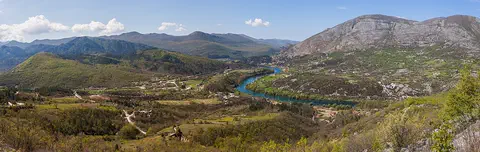
Bosnia and Herzegovina
Bosnia and Herzegovina is a mountainous country in southeastern Europe. It has forests, limestone hills and many rivers, and famous old stone bridges cross some of them. Its capital is Sarajevo. It touches the Adriatic Sea along only about 20 kilometers of coast.
-
 Watch
 Country
Bulgaria
Bulgaria is a country on the eastern side of the Balkan Peninsula, with the Danube River to the north and the Black Sea to the east. Mountains cross it from west to east, and about 6.4 million people lived there at the end of 2025.
-
 Watch
 Country
Croatia
Croatia is a crescent-shaped country in southeastern Europe. Its long coast on the Adriatic Sea is fringed by more than 1,100 islands, limestone mountains rise behind it, fertile plains lie in the north, and about 3.87 million people lived there in mid-2025.
-
 Watch
 Country
Hungary
Hungary is a landlocked country in central Europe, in a wide lowland called the Carpathian Basin. Wide plains cover much of it, the Danube River flows through its capital, Budapest, and about 9.5 million people lived there in 2026.
For parents & teachers
What children will learn
- Locate Czechia, name its four neighbors and explain what landlocked means.
- Describe the Bohemian basin and how its rivers flow to different seas.
- Describe some of Czechia's wildlife, languages, foods and ways of life without treating them as one single culture.
- Outline Czech history from the Kingdom of Bohemia to the Czech Republic of 1993.
Recommended ages: 3 to 17 · About 15 minutes
Talk about it
- How can boats from a country with no coast reach a big port like Hamburg?
- Why do you think so many old castles and town centers have survived in Czechia?
- Czechoslovakia split into two countries without fighting. What helps people settle a big disagreement calmly?
Try at home or in class
- Make a basin of modeling clay with raised edges, pour in a little water and watch which way it runs out where you cut a gap in the rim.
- On a map of Europe, trace the Elbe from Czechia to Hamburg and the Morava to the Danube, and name the seas they reach.
Key vocabulary: landlocked, basin, plateau, watershed, karst, Baroque, World Heritage Site
Where these facts come from
- Wikidata , Wikimedia Foundation (CC0 1.0)
- Natural Earth vector data , Natural Earth (NACIS) (Public domain)
- UNESCO World Heritage List , UNESCO World Heritage Centre (Linked as a reference; site facts come from Wikidata)
- Czech Republic (introduction) , Encyclopaedia Britannica
- Czech Republic: Land (relief, drainage, soils, climate, plant and animal life) , Encyclopaedia Britannica
- Czech Republic: People (languages, religion, settlement, demographic trends) , Encyclopaedia Britannica
- Czech Republic: Cultural life (daily life and social customs) , Encyclopaedia Britannica
- Czech Republic: Government and society (education) , Encyclopaedia Britannica
- Czech Republic: History , Encyclopaedia Britannica
- Prague Castle , Encyclopaedia Britannica
- Charles Bridge , Encyclopaedia Britannica
- Population change - 1st half of 2026 , Czech Statistical Office
- K výšce Sněžky (On the height of Sněžka), 25 February 2014 , Czech Office for Surveying, Mapping and Cadastre (Land Survey Office)
- Historic Centre of Prague , UNESCO World Heritage Centre
- Historic Centre of Český Krumlov , UNESCO World Heritage Centre
- Holy Trinity Column in Olomouc , UNESCO World Heritage Centre
- PlayOwl region table, version 1 , PlayOwl (PlayOwl original data)
- flag-icons 7.5.0 , Panayiotis Lipiridis and contributors (MIT)
- Wikimedia Commons , Wikimedia Foundation (Per file (public domain, CC0, CC BY or CC BY-SA); see each media record)
Checked, not yet human-reviewed. Last updated October 27, 2026. Spotted a mistake? Tell us.
Picture credits
- Photo: Diego Delso, CC BY-SA 4.0, via Wikimedia Commons · source · license
- Photo: Marc-Olivier Giguere, CC BY-SA 4.0, via Wikimedia Commons · source · license
- Photo: Jürgen Regel, Marian…, CC BY 3.0, via Wikimedia Commons · source · license
- Photo: Marek Slusarczyk, CC BY 3.0, via Wikimedia Commons · source · license
- Photo: Jorge Franganillo, CC BY 2.0, via Wikimedia Commons · source · license
- Photo: Txllxt TxllxT, CC BY-SA 4.0, via Wikimedia Commons · source · license