
City Europe
Sofia
Sofia is the capital city of Bulgaria. It sits in a wide valley. A big mountain called Vitosha rises right next to it.
Sofia, the capital of Bulgaria, lies in a valley near the middle of the Balkans, at the foot of Vitosha Mountain. The Romans called it Serdica, and an old church of St. Sofia later gave the city its name. About 1.2 million people lived there in 2025.
Sofia grew from a Thracian settlement of the 8th century BCE into Roman Serdica, medieval Sredets and an Ottoman provincial seat. Liberated from Ottoman rule on January 4, 1878, it became Bulgaria's capital on April 3, 1879, and is now the country's center of government, industry, learning and transport, with Vitosha Mountain at its edge.
Photo: Deensel, CC BY 2.0, via Wikimedia Commons
Discover Sofia
Sofia is the capital city of Bulgaria.
It lies in a wide, flat valley. Right next to the city rises a big mountain called Vitosha. People can ride up the mountain on cable lifts.
Sofia is the capital and biggest city of Bulgaria, in southeastern Europe. It lies near the middle of the Balkan region, in the Sofia Basin, a long valley shaped like a trough in the west of the country. About 1.2 million people lived there in 2025.
The city is very old. Its name comes from the Church of St. Sofia, which has stood since the 500s. Beside the city rises Vitosha Mountain, and cable lifts carry people up its slopes.
Sofia, capital of Bulgaria, stands near the geographical center of the Balkans in the Sofia Basin, a troughlike valley in the west of the country, with the Vitosha massif rising beside it. Bulgaria's National Statistical Institute figure for 2025, cited by Wikidata, was 1,213,134 residents; Britannica gives 1,291,591 for 2011.
The city's name comes from the Church of St. Sofia, restored in the 6th century under the Byzantine emperor Justinian, which survives from that period. Over its history the place has been Thracian, Roman (Serdica), Byzantine, Bulgarian (Sredets), Ottoman and, since 1879, the capital of modern Bulgaria.
- Country
- Bulgaria (capital)
- People in the city (2025)
- about 1.2 million
- Setting
- the Sofia Basin, near the center of the Balkans
- Capital since
- April 3, 1879
Famous places
Sofia has some very old churches.
One small church, at the edge of the city, has wall paintings more than 750 years old. A big cathedral stands in the center.
Boyana Church, on the edge of Sofia, is made of three buildings. The oldest part dates from the 900s, and the paintings on its walls, made in 1259, are one of the most important collections of medieval paintings, says UNESCO. It is a World Heritage Site.
In the center stand the Church of St. Sofia, which gave the city its name, and the large St. Alexander Nevsky Cathedral, built to honor the Russian soldiers who freed the city from Ottoman rule in 1878. The city also has two historic mosques, a national theater and a national library.
UNESCO, which inscribed Boyana Church in 1979, describes three buildings on the city's outskirts: an eastern church of the 10th century, enlarged in the early 13th century by the sebastocrator Kaloyan with a second, two-story building, whose frescoes of 1259 make it one of the most important collections of medieval painting.
Britannica lists the restored churches of St. George, Boyana and St. Sofia; two mosques, one housing an archaeological collection; and the St. Alexander Nevsky Cathedral, erected to commemorate Bulgarian gratitude to the Russian liberators of 1878. Cultural institutions include the Cyril and Methodius National Library, the Ivan Vazov National Theatre, an astronomical observatory and the University of Sofia (1888), the oldest institution of higher learning in Bulgaria.
- Boyana Church
- frescoes painted in 1259; UNESCO site 1979
- Church of St. Sofia
- restored in the 6th century
- St. Alexander Nevsky Cathedral
- honors the liberation of 1878
- University of Sofia
- 1888, Bulgaria's oldest university
Serdica, Sredets, Sofia
People have lived in Sofia for almost 3,000 years.
The Romans built a town here. Later, the city got new rulers and new names. About 150 years ago, Sofia became Bulgaria's capital.
A Thracian people called the Serdi settled here in the 700s BCE. Soon after 29 BCE the Romans took the town and named it Serdica, and it flourished under Roman emperors. In 809 the Bulgarian ruler Krum made it part of Bulgaria, and it was called Sredets.
From 1382 the Ottoman Turks ruled Sofia for almost 500 years. Russian troops freed the city on January 4, 1878, and on April 3, 1879, Sofia became the capital of Bulgaria. After World War II it grew into a city of factories.
The Serdi, a Thracian tribe, settled here in the 8th century BCE; the Romans conquered the community soon after 29 BCE and named it Serdica. It flourished under Trajan (98–117) and reached its height under Constantine I. Plundered by the Huns in 441–447, it gained a restored Church of St. Sofia under Justinian in the 6th century. In 809 Khan Krum incorporated it into the Bulgarian state as Sredets; it was Byzantine from 1018 until 1185.
Sofia fell to the Ottomans in 1382 and became the residence of the governor of Rumelia, gradually taking on what Britannica calls a distinctive Oriental appearance. Russian troops ended Ottoman rule on January 4, 1878, and Sofia was designated Bulgaria's capital on April 3, 1879. After World War II the city was further industrialized.
Getting around Sofia
In Sofia, people ride trams, buses and trains under the ground.
The underground trains are called the metro. To go up the mountain, people can ride in cable lifts high above the trees.
Sofia's metro opened on January 28, 1998, with a first stretch of 6.5 kilometers and five stations. It has grown a lot since then: by January 2026 it had four lines, 52 kilometers of track and 47 stations.
Above ground, trams, trolleybuses and buses carry people around the city. Sofia is also the center of Bulgaria's railways and air travel. For a trip to the mountain, several cable lifts climb Vitosha.
The first section of the Sofia metro, 6.5 km with five stations (Slivnitsa, Lyulin, Zapaden Park, Vardar and Konstantin Velichkov), opened on January 28, 1998; according to the Bulgarian News Agency, BTA, the network had four lines, 52 km and 47 stations in January 2026.
Britannica describes local transport by tramways, trolleybuses and buses, and Sofia as the center of Bulgarian air and rail traffic, linked to neighboring towns by roads. Several cable lifts ascend the Vitosha massif from the city's edge.
- Metro opened
- January 28, 1998 (6.5 km, 5 stations)
- Metro in January 2026
- 4 lines, 52 km, 47 stations
- Other transport
- trams, trolleybuses, buses; cable lifts up Vitosha
Weather and seasons
Sofia has cold winters and warm summers.
In winter, nights are below freezing. In summer, days are warm and sunny. Late spring and early summer bring the most rain.
Sofia has cold winters and warm summers. At the World Meteorological Organization's Sofia Observatory station, January days averaged about 2 °C and nights about −5 °C between 1961 and 1990.
In July, days averaged about 26 °C and nights about 14 °C. Rain or snow adds up to about 570 millimeters a year, with the most in May and June.
WMO normals for the Sofia Observatory station (1961–1990) give average daily highs and lows of about 2 °C and −5 °C in January and about 26 °C and 14 °C in July and August. Average lows fall below freezing from December to February.
The monthly precipitation averages add up to about 570 mm, with the most in May and June (about 73 and 75 mm) and the least in January (about 28 mm). January averages about 10 days with precipitation.
- January, average daily high and low (WMO Sofia Observatory station, 1961–1990)
- about 2 °C and −5 °C
- July, average daily high and low (same station and period)
- about 26 °C and 14 °C
- Rain and snow in a year (sum of the monthly averages)
- about 570 mm
Living in Sofia
Many people in Sofia work in offices, factories and shops.
Farms around the city grow fruit and vegetables and keep dairy cows. Vitosha Mountain is close by.
Sofia is Bulgaria's biggest center of work and learning. Its factories make machines, metals, food, cloth and clothing, and printing is important too. Around the city, farms grow fruit and vegetables and keep dairy cattle.
Students attend the University of Sofia, the oldest in Bulgaria, and scientists work at the Bulgarian Academy of Sciences. The city has a national theater, a national library, museums and an observatory, and Vitosha Mountain lies close by.
Britannica lists Sofia's chief industries as engineering, metallurgy, food processing, and textiles and clothing, with printing, rubber, footwear, furniture and woodworking, and chemicals also well represented; the city was further industrialized after World War II. An agricultural belt of fruit and vegetable growing and dairy farming surrounds it.
As the national center of learning, Sofia hosts the Bulgarian Academy of Sciences, the Academy of Agricultural Sciences and the University of Sofia (1888), the country's oldest institution of higher education, along with the Cyril and Methodius National Library, the Ivan Vazov National Theatre and many museums.
- Industries
- engineering, metals, food, textiles and clothing, printing
- Around the city
- fruit and vegetable farms and dairy farms
- Learning
- Bulgarian Academy of Sciences; University of Sofia
Sofia on the map
Find Sofia on the globe.
It is in Bulgaria, in southeastern Europe. Sofia is in the west of the country, in a valley between mountains.
Sofia is in western Bulgaria, in the Balkan region of southeastern Europe. It sits in the Sofia Basin, a long valley, with Vitosha Mountain beside it.
Plovdiv, another big Bulgarian city, is to the southeast. Belgrade, the capital of Serbia, is to the northwest. Sofia is also the center of Bulgaria's rail and air travel, and roads link it with the neighboring towns.
Sofia lies at about 42.7° N and 23.3° E, near the geographical center of the Balkan Peninsula, in the troughlike Sofia Basin of western Bulgaria. The Vitosha massif rises beside the city.
Plovdiv lies to the southeast, and Belgrade, on the Danube, to the northwest.
- Latitude
- about 42.7° north
- Longitude
- about 23.3° east
- Region
- western Bulgaria, near the center of the Balkans
Amazing facts
-
Sofia is named after an old church.
The city takes its name from the Church of St. Sofia, which survives from the 500s.
The restored Church of St. Sofia, from Justinian's 6th century, later gave the town its name.
-
A little church near Sofia has paintings more than 750 years old.
The wall paintings in Boyana Church were made in 1259, and UNESCO calls them one of the most important collections of medieval paintings.
Boyana Church's second, two-story building, added in the early 13th century, holds frescoes of 1259, one of the most important collections of medieval paintings according to UNESCO.
-
Sofia's metro started with just five stations.
When the Sofia metro opened on January 28, 1998, it had 6.5 kilometers of track and five stations.
The 1998 first section, 6.5 km with five stations, had grown to 4 lines, 52 km and 47 stations by January 2026, according to BTA.
-
The Romans called Sofia Serdica.
The Romans named the town Serdica, after the Serdi, the Thracian people who had settled there.
Roman Serdica took its name from the Serdi, a Thracian tribe settled there from the 8th century BCE; it flourished under Trajan and Constantine I.
Words to know
- capital
- the city where a country's government meets
- basin
- a wide, low valley surrounded by higher land
- fresco
- a painting made on wet plaster on a wall
- cable lift
- a line of seats or cabins pulled up a mountain by a moving cable
- metro
- a railway that runs in tunnels under a city
- liberation
- being set free from someone else's rule
Discovery challenge
-
Which mountain rises next to Sofia?
Which mountain rises right beside Sofia?
Which massif, reached from the city by several cable lifts, rises beside Sofia?
- Mont Blanc
- Vitosha
- Kilimanjaro
Show the answer
Vitosha
Vitosha! People ride cable lifts up it.
Vitosha Mountain rises beside the city, and cable lifts climb it.
The Vitosha massif, served by several cable lifts from Sofia.
-
What did the Romans call Sofia?
What did the Romans name the town that became Sofia?
Under what name did the Romans know Sofia after conquering it soon after 29 BCE?
- Serdica
- Lutetia
- Londinium
Show the answer
Serdica
Serdica! Later it got the name Sofia.
Serdica, after the Serdi people who lived there before.
Serdica, after the Thracian Serdi; it later became Sredets under the Bulgarians and finally Sofia.
-
Where does Sofia's name come from?
Sofia is named after what?
What gave the city the name Sofia?
- A church
- A river
- A queen
Show the answer
A church
A church! It is called the Church of St. Sofia.
The Church of St. Sofia, which has stood since the 500s.
The Church of St. Sofia, restored under Justinian in the 6th century, later gave the town its name.
-
When did Sofia's metro open?
In which year did the Sofia metro's first section open?
In which year did the 6.5 km first section of the Sofia metro open?
- 1898
- 1998
- 2018
Show the answer
1998
1998! It started with five stations.
It opened on January 28, 1998. By 2026 it had 47 stations.
January 28, 1998; by January 2026 the network had 4 lines, 52 km and 47 stations.
-
Which month is colder in Sofia?
In which month is Sofia colder, on average?
In which month do nights at the WMO Sofia Observatory station average about −5 °C?
- January
- July
Show the answer
January
January! Nights are freezing.
January days average about 2 °C, and July days about 26 °C.
WMO normals (1961–1990) give about −5 °C for January nights and about 14 °C for July nights.
Nearby places
-
 Watch
City
Bucharest
Bucharest, the capital of Romania, lies on a wide plain beside the Dâmbovița River. First written about in 1459, it became the capital of Walachia in 1659 and of Romania in 1862. Today it is a city of broad boulevards, a huge parliament palace, the Romanian Athenaeum concert hall and an open-air Village Museum.
-
 Watch
Natural wonder
Mount Olympus
Mount Olympus is the highest mountain in Greece, about 2,918 meters tall, rising almost straight up from the shore of the Aegean Sea. It is made of limestone that formed in a warm, shallow sea long ago. Greece's first national park was created here in 1938, and nearly 2,000 kinds of plants grow on its slopes.
-
 Watch
City
Tirana
Tirana is the capital and largest city of Albania, on a plain about 27 kilometers from the Adriatic Sea. Founded in the early 1600s, it became the capital in 1920. About 389,000 people lived in the city in 2023.
-
 Watch
City
Belgrade
Belgrade, the capital of Serbia, stands where the Sava River flows into the Danube. Its name, Beograd, means "white city", probably because of the white limestone walls of its old fortress above the rivers. At the 2022 census, about 1.2 million people lived in the city itself and about 1.7 million in the wider City of Belgrade.
-
 Watch
City
Istanbul
Istanbul is the biggest city in Türkiye, built on both sides of the Bosporus, the narrow strait between Europe and Asia. Once called Byzantium and then Constantinople, it was the capital of two great empires. About 15.7 million people lived in Istanbul province in 2023.
-
 Watch
Landmark
Sultan Ahmed Mosque
The Sultan Ahmed Mosque in Istanbul was built between 1609 and about 1616 for the Ottoman ruler Sultan Ahmed I. Its central dome is ringed by half-domes and smaller domes, and six slender minarets rise around it. Many people call it the Blue Mosque because of the blue and green tiles and painted decoration inside. It is still a working mosque, where Muslims come to pray.
-
 Watch
Landmark
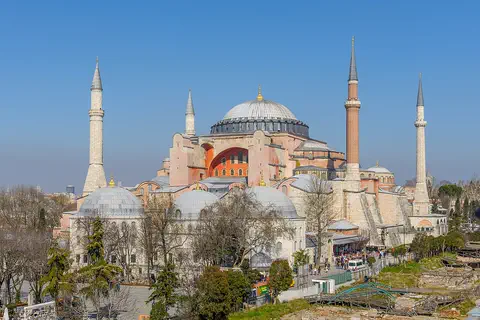
Hagia Sophia
Hagia Sophia in Istanbul was built in under six years, from 532 to 537, for the emperor Justinian. Its enormous dome seems to float on a ring of 40 windows. Over almost 1,500 years it has been a church, a mosque and a museum, and since 2020 it has been a mosque.
-
 Watch
Landmark
Topkapı Palace
Topkapı Palace sits on a point of land where the Bosphorus Strait meets the sea in Istanbul. Sultan Mehmed II built it between 1460 and 1478, and for nearly 400 years it was the home of the Ottoman sultans and the center of their government. In 1924 it became a museum.
Explore next
-
Watch
 Country
Bulgaria
Bulgaria is a country on the eastern side of the Balkan Peninsula, with the Danube River to the north and the Black Sea to the east. Mountains cross it from west to east, and about 6.4 million people lived there at the end of 2025.
-
Watch
City
Belgrade
Belgrade, the capital of Serbia, stands where the Sava River flows into the Danube. Its name, Beograd, means "white city", probably because of the white limestone walls of its old fortress above the rivers. At the 2022 census, about 1.2 million people lived in the city itself and about 1.7 million in the wider City of Belgrade.
-
Watch
City
Bucharest
Bucharest, the capital of Romania, lies on a wide plain beside the Dâmbovița River. First written about in 1459, it became the capital of Walachia in 1659 and of Romania in 1862. Today it is a city of broad boulevards, a huge parliament palace, the Romanian Athenaeum concert hall and an open-air Village Museum.
- Watch Geography What is a World Heritage Site? World Heritage Sites are places so important that they belong, in a way, to everyone. Under a 1972 agreement, countries nominate their most outstanding places, experts check them, and a UNESCO committee decides. By 2026 the list held 1,273 sites: cultural places like the Taj Mahal, natural places like the Galápagos, and mixed ones like Machu Picchu.
- Watch Geography Capital cities A capital is the city where a country's government is based. Many capitals grew up over hundreds of years beside rivers and trade routes. A few, like Brasília and Canberra, were built from scratch, and some countries share out their capital's jobs among two or three cities.
-
 Watch
City
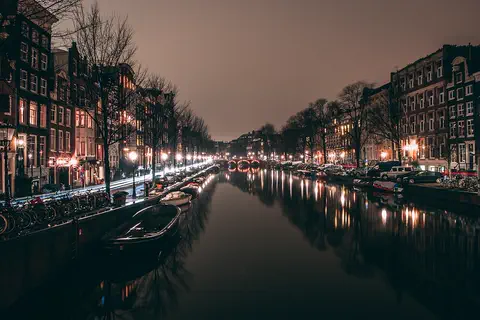
Amsterdam
Amsterdam is the capital of the Netherlands. It began as a fishing village beside a dam on the Amstel River, which gave the city its name. Today about 942,000 people live among its rings of canals, hundreds of bridges, houseboats and bicycles.
-
 Watch
City
Athens
Athens is the capital of Greece and one of the oldest cities in the world. Above it rises the Acropolis, a rocky hill crowned by the marble Parthenon, built about 2,500 years ago. Ancient Athens was home to early democracy, great thinkers and theater.
-
 Watch
City
Barcelona
Barcelona, the capital of Catalonia in northeastern Spain, lies on the Mediterranean between mountains and the sea. It is famous for the buildings of the architect Antoni Gaudí, including the Sagrada Família, a giant church begun in 1882. About 1.7 million people live in the city (2025).
For parents & teachers
What children will learn
- Locate Sofia in a valley in western Bulgaria, near the center of the Balkans.
- Explain how a city can have several names over its history, from Serdica to Sofia.
- Describe a medieval fresco and why UNESCO protects Boyana Church.
- Read temperature averages to describe a climate with cold winters and warm summers.
Recommended ages: 3 to 17 · About 15 minutes
Talk about it
- Sofia has had different names under different rulers. Does your town have an older name?
- A mountain rises right at the edge of Sofia. How would living next to a mountain change what you do on weekends?
- Why do you think people protect very old wall paintings?
Try at home or in class
- Fresco experiment: spread a thin layer of plaster of Paris or wet clay on a paper plate and paint on it with watercolors before it dries. Compare it with painting on dry plaster.
- Make a name timeline for Sofia: Serdica, Sredets, Sofia, with a drawing for each period.
Key vocabulary: capital, basin, fresco, cable lift, metro, liberation
Where these facts come from
- Wikidata , Wikimedia Foundation (CC0 1.0)
- Natural Earth vector data , Natural Earth (NACIS) (Public domain)
- UNESCO World Heritage List , UNESCO World Heritage Centre (Linked as a reference; site facts come from Wikidata)
- Sofia , Encyclopaedia Britannica
- Boyana Church , UNESCO World Heritage Centre
- January 28, 1998: Sofia Metro's first section goes into service , BTA (Bulgarian News Agency)
- Sofia: climatological information , World Meteorological Organization, World Weather Information Service
- Wikimedia Commons , Wikimedia Foundation (Per file (public domain, CC0, CC BY or CC BY-SA); see each media record)
Checked, not yet human-reviewed. Last updated October 27, 2026. Spotted a mistake? Tell us.