
 Country
Europe
Slovenia
Slovenia is a small country in Europe. It has tall mountains, deep caves, green forests and a little bit of seaside.
Slovenia is a small country in central Europe where the Alps meet the Mediterranean. Forests cover much of the land, the Karst region is full of caves and underground rivers, and about 2.1 million people lived there in 2026.
Slovenia is a small but topographically diverse central European state that takes in parts of the Alps, the karstic Dinaric Alps, the Pannonian lowlands and a short Adriatic coast; the word karst itself comes from its Kras region. Part of Yugoslavia for most of the 20th century, it became independent in 1991, and its statistics office counted 2,136,385 residents on 1 April 2026.
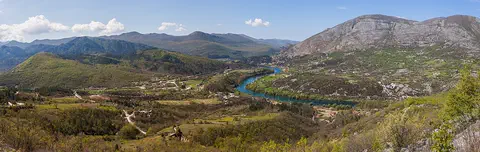
Photo: Sieglinde Hankele, CC BY-SA 4.0, via Wikimedia Commons
Discover Slovenia
Slovenia is a small country in Europe.
It has high mountains and deep caves. It has thick green forests. It has a short coast by the sea. The capital city is called Ljubljana.
Slovenia is a small country in central Europe. In this small country there are high Alpine peaks, caves and underground rivers, fertile river valleys in the east and a short Mediterranean coast in the southwest. Forests cover about three-fifths of the land.
Its capital, Ljubljana, sits near the middle of the country. About 2.1 million people lived in Slovenia in 2026, and most of them speak Slovene, a South Slavic language. Slovenia became independent in 1991 and joined the European Union in 2004.
Britannica describes Slovenia as small but topographically diverse, made up of portions of four major European landscapes: the Alps, the karstic Dinaric Alps, the Pannonian and Danubian lowlands and hills, and the Mediterranean coast. The country is mostly elevated; the only major flat area is in the northeast, and tectonic fault lines cross it (Ljubljana suffered a devastating earthquake in 1895). Easily crossed mountain passes, now replaced by tunnels, long made it a route between the Mediterranean and transalpine Europe.
The Statistical Office of the Republic of Slovenia (SURS) counted 2,136,385 residents on 1 April 2026, of whom 10.7 percent were foreign citizens. Slovenia covers 20,271 square kilometers. It was largely ruled by the Habsburgs for most of its history and was part of Yugoslavia for most of the 20th century; it seceded in 1991 and joined NATO and the European Union in 2004.
Cities and famous places
Ljubljana is the capital of Slovenia.
A castle stands on a green hill above the old town. A river runs through the city. Not far away are lakes, and caves with underground rivers.
Ljubljana, the capital, is Slovenia's most important city, with a castle on a wooded hill above its old town. Between the two world wars, the architect Jože Plečnik reshaped the city with a green promenade and a riverside walk with bridges along the Ljubljanica River, and UNESCO listed his work in 2021.
Beneath Mount Triglav, in the Alps, lie Lake Bohinj and Lake Bled. In the southwest, the Škocjan Caves hold a huge underground canyon carved by the Reka River. Koper, on the short coast, is Slovenia's main port, and Maribor is a city on the Drava River in the east.
Ljubljana, in the Ljubljana basin on the southern edge of Gorenjska, is the capital and most important city. UNESCO inscribed "The works of Jože Plečnik in Ljubljana" in 2021: between the two world wars Plečnik (1872–1957) designed a land axis, the Green Promenade, and a water axis of embankments and bridges along the Ljubljanica River, connecting the historic center with the suburbs as the town grew from a peripheral town of the Austro-Hungarian Empire into a national capital.
The Škocjan Caves, inscribed in 1986, protect 413 hectares on the Kras Plateau, where the Reka River disappears underground into a canyon about 2 km long, up to some 150 m high and in places more than 120 m wide; its Martel Chamber exceeds two million cubic meters. Idrija, inscribed in 2012 with Almadén in Spain, was one of the two largest mercury mines in the world until recent times. Koper, just south of Trieste, is Slovenia's major port on a coast only 47 km long.
Alps, karst and coast
Slovenia has very tall mountains called the Alps.
The tallest one is Triglav. In another part, rain sinks into the ground. It makes caves and rivers under the ground.
About two-fifths of Slovenia is Alpine mountains. The highest peak, Triglav, is 2,864 meters tall, in the Julian Alps. Triglav National Park, Slovenia's only national park, protects the mountains around it.
In the southwest is the Kras, or Karst, a limestone region dotted with caves and underground rivers. It gave its name to all landscapes like it: scientists everywhere call them karst. Water is scarce there. In the east, the valleys of the Sava, Drava and Mura rivers have fertile farmland, and most of Slovenia's rivers flow toward the Danube.
Slovenia has four main physiographic regions. The Alpine region, about two-fifths of the country, includes the Kamnik-Savinja Alps, the Karavanke and the Julian Alps with Triglav, 2,864 m (Slovenia's Surveying and Mapping Authority refined the figure to 2,863.65 m in 2016). The Kras, a spur of the Dinaric Alps covering one-fourth of the land, is dotted with caves and underground rivers; scientific study of karst began here in the 18th century. Subpannonia, a fertile fifth in the east, holds the Sava, Drava and Mura valleys, and Primorska, barely one-twelfth, includes Slovenia's part of Istria.
Most rivers drain toward the Danube; the Soča rises beneath Triglav and reaches the Gulf of Venice in Italy. Istria is transitional between Mediterranean and moderate continental climates, with the cold bora wind; central and northern Slovenia have a cool-summer continental climate and the east has warmer summers. Below freezing is frequent from November to February, but snow cover has become less frequent. Forests, noted for their mushrooms, cover about three-fifths of the country, and Triglav National Park, first protected in 1924, covers 840 km², 4 percent of Slovenia.
Animals of Slovenia
Brown bears live in Slovenia.
Chamois and ibex live high in the mountains. A pale salamander called the olm lives in dark caves. It has no eyes you can see.
Slovenia is home to brown bears, wild boar and red, fallow and roe deer, and the lynx has come back. In Triglav National Park, chamois live on rocky ground above the trees in summer, and Alpine ibex were brought back starting in 1964. Alpine marmots, which had died out in the area long ago, were returned at the end of the 20th century.
Deep in the caves lives the olm, a pale salamander 25 to 30 centimeters long. It is the only animal with a backbone in Europe that lives only in caves, and it can live for up to 100 years.
Britannica lists protected species including the reintroduced but still rare ibex, the European brown bear, the chamois, the wild boar and red, fallow and roe deer, and notes that the lynx has reappeared; the Subpannonian lowlands suit migratory fowl, and the Soča is known for trout and grayling. Triglav National Park records about 7,000 species. There, chamois keep to open rocky terrain above the tree line in summer and move into forest in winter, ibex have been reintroduced since 1964 (all of Europe's ibex descend from the Gran Paradiso population in Italy), and Alpine marmots, extinct in the region since the end of the Ice Age, were reintroduced in the late 20th century.
The olm (Proteus anguinus), endemic to the Dinaric karst, is 25–30 cm long and, according to Slovenia's government information site, the only European vertebrate strictly bound to caves. Its eyes are vestigial and covered by skin, it keeps larval gills, it eats crustaceans, worms and snails, and it can live up to a hundred years. In 2016 an olm laid 64 eggs in Postojna Cave, and 22 young hatched.
People, languages and food
About 2.1 million people lived in Slovenia in 2026.
Most people speak Slovene. Some people speak Italian or Hungarian too. Many families keep bees and make honey.
About 2.1 million people lived in Slovenia in 2026; early in the 2000s, only about half of the people lived in towns and cities. Most speak Slovene, a South Slavic language with a special feature: besides words for one thing and many things, it has a form for exactly two. Italian and Hungarian are also spoken in the areas where those communities live.
Beekeeping is a way of life for many families in Slovenia. Beekeepers care for about 200,000 bee colonies of the Carniolan bee, kept mostly in wooden bee houses near their homes, and many hives carry painted panels, a traditional art.
Britannica estimates that about nine-tenths of Slovenia's people are ethnically Slovene, descendants of Slavic settlers who arrived in the 6th century CE; Italians (mainly in Istria) and Hungarians (mainly in Prekmurje) are the two main ethnic minorities, and Roma communities are long established in the northeast and south. Many people also came from other former Yugoslav republics. SURS counted 10.7 percent foreign citizens among residents on 1 April 2026. Slovene, the official language, is one of the few languages to keep the dual number of Proto-Indo-European, used for exactly two persons or things. In the early 21st century about three-fifths of Slovenes were Roman Catholic, with smaller Muslim, Orthodox and Protestant communities.
In 2022 UNESCO added "Beekeeping in Slovenia, a way of life" to its Intangible Cultural Heritage list. The only bee kept in Slovenia is the Carniolan bee, in around 200,000 colonies, mostly in wooden apiaries near beekeepers' homes; bee products are used for food and traditional medicine, and hives carry characteristic painted panels.
A long history
People have lived in Slovenia for a very long time.
Long ago, other countries ruled it. Then it was part of a bigger country called Yugoslavia. In 1991 Slovenia became its own country.
Slavic people settled in this land in the 500s. About the year 1000, someone wrote down confessions and sermons in the Freising Manuscripts, the oldest known writing in an early form of Slovene. From the late 1200s and the 1300s, most of the Slovene lands came under the Habsburg family of Austria, who ruled them for hundreds of years.
In the 1500s, scholars printed a Slovene translation of the Bible, and in 1843 the first Slovene-language newspaper appeared in Ljubljana. After 1918, Slovenia became part of a new kingdom that was later called Yugoslavia. In 1991 Slovenia became independent, and in 2004 it joined the European Union.
The ancestors of most Slovenes, Slavs probably from between the Black Sea and the Carpathians, settled in the 6th century CE; Christianity was accepted in the 8th century. The Freising Manuscripts of about 1000 CE are the earliest known document in what became Slovene. Styria passed to the Habsburgs after 1278, and Carinthia and Carniola in 1335, beginning centuries of Habsburg rule. Protestant scholars such as Primož Trubar printed in Slovene in the 16th century; from 1809 to 1814 much of the land formed Napoleon's Illyrian Provinces, which favored Slovene as an official language, and Jernej Kopitar published the first Slovene grammar in 1808.
After Austria-Hungary collapsed in 1918, Slovenia joined the Kingdom of Serbs, Croats and Slovenes (Yugoslavia from 1929). During World War II it was divided among Germany, Italy and Hungary, and after the war it became a republic of communist Yugoslavia. In December 1990 more than 90 percent of voters backed independence in a referendum, and Slovenia seceded on June 25, 1991; Britannica records a short conflict, known in Slovenia as the Ten-Day War, after which the last Yugoslav soldier left on October 25, 1991. A democratic constitution followed on December 23, 1991. Slovenia joined NATO and the EU in 2004 and adopted the euro in 2007.
Slovenia on the map
Find Slovenia on the globe.
It is in Europe, near the top of the Adriatic Sea. It has four neighbor countries. Its piece of coast is very short.
Slovenia is in central Europe, at the northern end of the Adriatic Sea. It has four neighbors: Austria to the north, Hungary to the northeast, Croatia to the east and south, and Italy to the west.
Its border with Croatia is about 670 kilometers long. In the southwest, Slovenia has a short strip of coast, only 47 kilometers long, on the Gulf of Venice, with the port of Koper.
Slovenia is bordered by Austria to the north, Hungary to the far northeast, Croatia to the east, southeast and south along a border about 670 km long, and Italy's Friuli-Venezia Giulia region to the west. To the southwest it adjoins the Italian port of Trieste and occupies part of the Istrian Peninsula, with a 47 km coastline on the Gulf of Venice; Koper is its major port.
The Sava rises in the Julian Alps and flows past Ljubljana toward Croatia, its valley carrying the railway to Zagreb and Belgrade; the Drava and Mura enter from Austria and meet in Croatia, and all three reach the Danube. Britannica notes that the largest Slovene communities outside the country live in Italy's Friuli-Venezia Giulia, Austria's Carinthia and Styria, and Hungary's Vas and Zala counties.
- Area
- 20,271 km²
- Highest point
- Triglav, 2,864 m (2,863.65 m in the 2016 survey)
- Coastline
- 47 km, on the Gulf of Venice
- People (1 April 2026)
- 2,136,385
Amazing facts
-
The word karst comes from Slovenia.
Landscapes of caves and underground rivers are called karst everywhere, after the Kras region of Slovenia.
UNESCO notes that the term karst derives from the name of the Kras plateau, the Classical Karst where karst research began.
-
The olm can live for a hundred years.
The olm, a pale cave salamander, can live up to 100 years and go years without food.
The olm, 25–30 cm long, can live up to a hundred years and go several years without food; it is the only European vertebrate strictly bound to caves.
-
Slovene has a special way to talk about two things.
Slovene has word forms for one thing, two things and many things.
Slovene is one of the few languages to keep the Proto-Indo-European dual number, used for exactly two persons or things.
-
Lots of bees live in Slovenia.
Slovenian beekeepers look after about 200,000 colonies of Carniolan bees.
Beekeepers in Slovenia keep around 200,000 colonies of the Carniolan bee, the only subspecies kept there; UNESCO listed the practice in 2022.
-
A river runs through a giant cave.
At the Škocjan Caves, the Reka River flows through an underground canyon up to 150 meters high.
Škocjan's canyon, cut by the Reka River, is about 2 km long, up to some 150 m high and more than 120 m wide in places.
Words to know
- karst
- a landscape of limestone where water dissolves the rock and makes caves and underground rivers
- limestone
- a kind of rock that slowly dissolves in rainwater
- salamander
- an amphibian with a long body, a tail and short legs
- national park
- a large area a country protects for its nature and wildlife
- reintroduce
- to bring an animal back to a place where it had disappeared
- colony
- a group of bees that live together in one hive
- independence
- when a country governs itself and is not ruled by another
Discovery challenge
-
What is the capital city of Slovenia?
Which city is the capital of Slovenia?
Which city, reshaped by the architect Jože Plečnik between the world wars, is Slovenia's capital?
- Ljubljana
- Koper
- Vienna
Show the answer
Ljubljana
Ljubljana is the capital. A castle stands on a hill there.
Ljubljana is Slovenia's capital and most important city. Koper is its main port.
Ljubljana is the capital; UNESCO inscribed Plečnik's works there in 2021. Koper is the major port and Vienna is Austria's capital.
-
What is the tallest mountain in Slovenia?
Which mountain in the Julian Alps is Slovenia's highest?
Which peak, 2,864 m by the usual figure, is the highest in Slovenia and gives its name to the only national park?
- Mont Blanc
- Triglav
- Mount Etna
Show the answer
Triglav
Triglav is the tallest mountain in Slovenia.
Triglav, 2,864 meters tall, is in the Julian Alps, inside Triglav National Park.
Triglav, in the Julian Alps, rises 2,864 m; the 2016 survey gave 2,863.65 m. Triglav National Park covers 840 km².
-
Which animal lives in Slovenia's dark caves?
Which pale salamander lives only in karst caves?
Which animal is the only European vertebrate strictly bound to cave habitats?
- The olm
- The brown bear
- The chamois
Show the answer
The olm
The olm lives in the dark water of caves.
The olm is a pale salamander 25 to 30 centimeters long that lives only in caves and can live up to 100 years.
Proteus anguinus, endemic to the Dinaric karst, is strictly bound to caves; brown bears live in forests and chamois on Alpine rock.
-
What do many families in Slovenia keep?
Which animals are at the heart of the Slovenian way of life that UNESCO listed in 2022?
Slovenians keep around 200,000 colonies of the Carniolan subspecies, the only one kept in the country. Which animal is it?
- Camels
- Bees
- Penguins
Show the answer
Bees
Many families keep bees. The bees make honey.
UNESCO listed beekeeping in Slovenia in 2022. Beekeepers care for about 200,000 bee colonies.
"Beekeeping in Slovenia, a way of life" was inscribed in 2022; the Carniolan bee is the only subspecies kept, in around 200,000 colonies.
-
In what year did Slovenia become its own country?
In which year did Slovenia become independent?
In which year did Slovenia secede from Yugoslavia, on June 25?
- 1918
- 1991
- 2004
Show the answer
1991
Slovenia became its own country in 1991.
Slovenia became independent in 1991. In 1918 it joined what became Yugoslavia, and in 2004 it joined the EU.
Slovenia seceded on June 25, 1991, after a referendum in December 1990, and adopted its constitution on December 23, 1991.
Places to discover in Slovenia
Animals of Slovenia
-
 Watch
Animal
Olm
The olm is a long, pale salamander that spends its whole life in underground rivers and lakes in the caves of southeastern Europe. Its eyes are covered by skin, it keeps pink feathery gills all its life, and it finds food by smell and by feeling vibrations. Olms can live for many decades and survive years without eating.
-
 Watch
3D
Animal
Brown bear
The brown bear lives in more places than any other bear, from European forests to the mountains of Asia and the rivers of Alaska. It eats almost anything, from berries to salmon, and spends the long winter asleep in a cozy den. Grizzly bears and Kodiak bears are brown bears too.
-
 Watch
Animal
Eurasian lynx
The Eurasian lynx is the largest of the four kinds of lynx. It has black ear tufts, a ruff of fur around its face, a short black-tipped tail and big furry paws for snow. It hides in forests and ambushes deer such as roe deer, and it has returned to parts of Europe where it had disappeared.
Explore next
-
 Watch
Natural wonder
Alps
The Alps are Europe's great mountain range, an arc about 1,200 kilometers long that runs from the Mediterranean coast near Nice, in France, to Vienna, in Austria. Their highest peak is Mont Blanc, which Britannica gives as 4,807 meters. The Alps rose when the plate carrying Africa pushed north into Europe, and Ice Age glaciers carved their sharp peaks and deep valleys.
-
Watch
Animal
Olm
The olm is a long, pale salamander that spends its whole life in underground rivers and lakes in the caves of southeastern Europe. Its eyes are covered by skin, it keeps pink feathery gills all its life, and it finds food by smell and by feeling vibrations. Olms can live for many decades and survive years without eating.
-
Watch
3D
Animal
Brown bear
The brown bear lives in more places than any other bear, from European forests to the mountains of Asia and the rivers of Alaska. It eats almost anything, from berries to salmon, and spends the long winter asleep in a cozy den. Grizzly bears and Kodiak bears are brown bears too.
-
Watch
Animal
Eurasian lynx
The Eurasian lynx is the largest of the four kinds of lynx. It has black ear tufts, a ruff of fur around its face, a short black-tipped tail and big furry paws for snow. It hides in forests and ambushes deer such as roe deer, and it has returned to parts of Europe where it had disappeared.
-
 Watch
 Country
Croatia
Croatia is a crescent-shaped country in southeastern Europe. Its long coast on the Adriatic Sea is fringed by more than 1,100 islands, limestone mountains rise behind it, fertile plains lie in the north, and about 3.87 million people lived there in mid-2025.
-
 Watch
 Country
Belarus
Belarus is a landlocked country in eastern Europe. Ice sheets of the last ice age shaped its low hills and wide plains, it has more than 10,000 lakes and one of Europe's largest wetlands, and about 9.1 million people lived there in 2025.
-
 Watch
 Country
Bosnia and Herzegovina
Bosnia and Herzegovina is a mountainous country in southeastern Europe. It has forests, limestone hills and many rivers, and famous old stone bridges cross some of them. Its capital is Sarajevo. It touches the Adriatic Sea along only about 20 kilometers of coast.
-
 Watch
 Country
Bulgaria
Bulgaria is a country on the eastern side of the Balkan Peninsula, with the Danube River to the north and the Black Sea to the east. Mountains cross it from west to east, and about 6.4 million people lived there at the end of 2025.
For parents & teachers
What children will learn
- Locate Slovenia and name its four neighbors and its four main landscapes.
- Explain what karst is and how rivers can flow underground through limestone.
- Describe animals of Slovenia's mountains and caves, including the olm.
- Outline Slovenia's path from Habsburg rule and Yugoslavia to independence in 1991.
Recommended ages: 3 to 17 · About 15 minutes
Talk about it
- Why might a river disappear into the ground in some places and not in others?
- How do you think an animal that lives in total darkness finds its food?
- Why do people bring animals like ibex and marmots back to places where they had disappeared?
Try at home or in class
- Put a sugar cube on a saucer and drip water on it with a spoon to see how water slowly dissolves it, a little like rain on limestone.
- Draw a map of Slovenia's four landscapes, mountains, caves, farmland and coast, and add one animal to each.
Key vocabulary: karst, limestone, salamander, national park, reintroduce, colony, independence
Where these facts come from
- Wikidata , Wikimedia Foundation (CC0 1.0)
- Natural Earth vector data , Natural Earth (NACIS) (Public domain)
- UNESCO World Heritage List , UNESCO World Heritage Centre (Linked as a reference; site facts come from Wikidata)
- In the first quarter of 2026, the number of population increased by 1,278 , Statistical Office of the Republic of Slovenia (SURS)
- Slovenia , Encyclopaedia Britannica
- Slovenia: Climate (plant and animal life, ethnic groups, languages) , Encyclopaedia Britannica
- Slovenia: Religion (settlement patterns, demographic trends) , Encyclopaedia Britannica
- Slovenia: The Middle Ages , Encyclopaedia Britannica
- Slovenia since 1918 , Encyclopaedia Britannica
- Slovenia: The postcommunist era , Encyclopaedia Britannica
- Triglav je 34 cm nižji, kot smo mislili doslej , RTV Slovenija
- Triglav National Park: basic information , Triglav National Park Public Institution
- Triglav National Park: fauna , Triglav National Park Public Institution
- Škocjan Caves , UNESCO World Heritage Centre
- The works of Jože Plečnik in Ljubljana – Human Centred Urban Design , UNESCO World Heritage Centre
- Heritage of Mercury. Almadén and Idrija , UNESCO World Heritage Centre
- Beekeeping in Slovenia, a way of life , UNESCO Intangible Cultural Heritage
- Olm offspring on display at Postojna Cave , slovenia.si, Government Communication Office of the Republic of Slovenia
- Olm , Encyclopaedia Britannica
- PlayOwl region table, version 1 , PlayOwl (PlayOwl original data)
- flag-icons 7.5.0 , Panayiotis Lipiridis and contributors (MIT)
- Wikimedia Commons , Wikimedia Foundation (Per file (public domain, CC0, CC BY or CC BY-SA); see each media record)
Checked, not yet human-reviewed. Last updated October 24, 2026. Spotted a mistake? Tell us.