
Animal
Olm
The olm is a pale, pinkish salamander that lives in dark caves in Europe. It cannot see. It smells and feels its way around in the water.
The olm is a long, pale salamander that spends its whole life in underground rivers and lakes in the caves of southeastern Europe. Its eyes are covered by skin, it keeps pink feathery gills all its life, and it finds food by smell and by feeling vibrations. Olms can live for many decades and survive years without eating.
Olms (genus Proteus) are fully aquatic, neotenic cave salamanders endemic to the Dinaric Karst of Slovenia, Croatia, Bosnia and Herzegovina and the nearby edge of Italy. They have reduced, skin-covered eyes, lifelong external gills and extremely slow lives. Long treated as one species, Proteus anguinus, they were described as nine separate species in a study published in August 2026. The IUCN, assessing olms as one species, lists them as Vulnerable (2024).
Photo: Arne Hodalič, CC BY-SA 3.0, via Wikimedia Commons
Meet the olm
The olm is a salamander that lives in caves.
It is long and thin, like a pale pink ribbon. It has tiny legs and pink gills on its head. Its eyes are hidden under its skin.
The olm is an amphibian, a cousin of newts and salamanders, but it lives somewhere very few animals can: in underground rivers and lakes deep in caves, where it is always dark.
It is long and thin, about 20 to 30 centimeters from snout to tail. Its skin is pale and pinkish, its legs are small and far apart, and it has three toes on each front foot and two on each back foot. Behind its flat head grow two tufts of pink gills. Its eyes are tiny and hidden under its skin, because there is no light to see by.
Olms belong to the family Proteidae; the Australian Museum calls them Europe's only blind, cave-dwelling salamanders. Adults measure about 20 to 30 centimeters. The body is elongated and pale, with a flat, pear-shaped head and blunt snout, a short, laterally flattened tail and small, widely spaced limbs bearing three front and two hind digits.
Since 1768 they have usually been treated as one species, Proteus anguinus. Genetic studies over two decades found nine deeply separated, mostly isolated lineages. On 28 August 2026, Peter Trontelj and nine colleagues, writing in the peer-reviewed journal Natura Sloveniae, treated these lineages as nine species: five take older names and four were named for the first time. In their scheme the name Proteus anguinus belongs only to the olms around Stična in Slovenia, the olms of Postojna Cave are a different species, and the dark, eyed black olm of Bela Krajina becomes Proteus parkelj. The proposal is very new, and the IUCN has not yet assessed the nine species, so this page covers olms as one group, as the IUCN's 2024 assessment does.
Quick facts
- Group
- Amphibian
- Length
- 20 to 30 cm
- Lifespan in the wild
- from 70 years
Life in the dark
Olms live under the ground in caves.
They swim in cold, dark water. Sometimes a big flood washes an olm out of its cave.
Olms live only in the Dinaric Karst, a region of limestone rock in southeastern Europe where rainwater has carved caves and underground rivers. They are found in Slovenia, Croatia, Bosnia and Herzegovina and the nearby edge of Italy.
Some olms live close to the surface, and some as much as 300 meters underground. Their water stays cold, about 5 to 15 degrees Celsius. People usually find olms in streams outside caves only after heavy rain, when flood water washes out the ones that did not hide in time.
The IUCN (2024) describes olms as restricted to subterranean waters of the Dinaric Karst, from southern Slovenia and adjoining northeastern Italy through disjunct areas of western Croatia and western Bosnia and Herzegovina south to the Trebišnjica basin; environmental DNA has also been detected in western Montenegro. The area actually occupied is only about 1,132 square kilometers.
Olms live in karst systems of limestone and dolomite, from near the surface to about 300 meters underground, in caves reached by up to 1,500 meters of vertical depth and in water up to 113 meters deep, withstanding pressures of up to 12 atmospheres. Many of these caves are fed by rivers that run on the surface for 50 to 100 kilometers before sinking underground. Water temperature ranges from about 5 to 15 °C. Olms are sometimes found at cave entrances or washed out after floods.
Continent
Its habitat

Where can you find this animal?
- Lives here naturally · Countries and seas named by a scientific source
- Sightings recorded · Records of wild sightings (GBIF)
Lives here naturally · Countries and seas named by a scientific source
Underground rivers and lakes of the Dinaric Karst: southern Slovenia and the adjoining corner of northeastern Italy, western Croatia and western Bosnia and Herzegovina, south to the Trebišnjica basin. Olms live only in caves, so just small parts of each country are home to them. Environmental DNA suggests they may also live in western Montenegro (not shaded). An introduced population has lived in
Places: Slovenia, Croatia, Bosnia & Herz. and Italy.
Source: iucn-red-list · checked October 2026
Sightings recorded · Records of wild sightings (GBIF)
Counts of GBIF records of wild observations (human and machine) and preserved specimens. Records include introduced populations, vagrants, escaped or released animals and misidentifications, so a country with records is not necessarily part of the native range.
Wild sightings have been recorded in Slovenia, Croatia, Austria, Italy, Bosnia & Herz., Germany, UK, Czechia and 3 more places.
Source: gbif · checked October 2026
Range maps show where scientists say an animal lives, often country by country. An animal may live in only part of a country shown, and sightings records can include animals that wandered far from home.
Hunting without eyes
Olms eat tiny cave animals.
They cannot see, so they smell their food and feel it moving in the water. An olm can go a very long time without eating.
Olms eat small invertebrates that live in cave water, plus insect larvae and little crayfish that streams carry into the caves. They swim by wriggling their bodies like snakes.
Without sight, olms rely on other senses. They have one of the best senses of smell of any amphibian, and they can feel tiny vibrations in the water. Food is scarce in caves, and olms can survive for up to ten years without eating.
The IUCN lists detritus and endemic cave invertebrates as food; Notranjska Regional Park adds crayfish and insect larvae swept underground by surface water, caught after quick, snake-like swimming.
The Australian Museum describes the olm's senses: one of the best senses of smell among amphibians, specialized ears that detect vibrations through ground and water, and an ampullary organ in the head that can detect prey through electrical changes in the water. Very slow living lets olms survive extreme food shortage, up to about ten years without food.
Did you know?
An olm can feel tiny animals moving in the water near its head.
A special sense organ in the olm's head can pick up tiny electrical signals from prey in the water.
An ampullary organ in the olm's head can detect prey through electrical changes in the water (Australian Museum).
A body made for caves
Olms have pink, fluffy gills to breathe in water.
Their eyes are covered with skin. Their whole body can feel light, even without eyes.
Olms keep the feathery gills of a baby salamander all their lives. The gills are pink and sit on each side of the head, behind the flat snout. Olms also grow simple lungs. Growing up while keeping baby features like this is called neoteny.
Their eyes are small and covered with skin, so they cannot see pictures, but their whole skin can sense light. Tiny sense organs spread over the skin pick up vibrations, helping the olm feel what is around it in total darkness.
Olms are neotenic: they mature sexually while keeping larval features, including pink external gills on both sides of the head, though simple lungs also develop (Notranjska Regional Park). The reduced eyes are covered by skin, but the whole body surface is sensitive to light, and sensory organs distributed in the skin detect vibrations.
The black olm (Proteus parkelj in the 2026 scheme), known from a few sites with warmer waters in Bela Krajina, Slovenia, is the exception: the IUCN describes it as dark-colored and eyed. Its range is documented at no more than about 3 square kilometers.
A very slow life
A mother olm lays eggs under stones in the cave water.
Baby olms grow very slowly. They take many years to grow up, and they can live for a very, very long time.
A female olm lays eggs about 1 centimeter across and sticks them one by one to the undersides of stones in underground streams, up to about 70 eggs. Sometimes she gives birth to live young instead.
Everything in an olm's life is slow. In cave laboratories, olms became adults only at about 15 years old and bred on average just once every 12 years. They live for about 70 years on average, and in captivity some have lived more than 100 years.
Females lay up to about 70 eggs, roughly 1 centimeter across, attached singly to the undersides of stones; occasionally eggs are retained and two fully formed young are born (IUCN; Notranjska Regional Park). Because olms are so hard to study underground, most life-history data come from cave laboratories.
There, olms reach sexual maturity at about 15 years and reproduce on average only every 12 years, and lifespan can exceed 100 years (Voituron and colleagues, 2011, cited by the IUCN). The Australian Museum gives an average lifespan of about 70 years.
The champion of staying still
Olms do not move around much.
One olm stayed in the same spot for seven years! When it is scared, an olm hides in a crack or in the mud.
Olms have a very calm, slow way of life. One olm in the wild was recorded staying in exactly the same spot for seven years.
When disturbed, an olm hides in a crevice or burrows into the soft sediment on the bottom. Where conditions are good, many olms can live close together: in one Croatian cave system, scientists counted up to about 11 olms in every 10 square meters of cave.
The Australian Museum reports an olm in the wild recorded in exactly the same spot for seven years, part of an extremely slow, energy-saving lifestyle. Disturbed olms hide in crevices or bottom sediment (IUCN).
Abundance is hard to measure underground. A study of four Croatian cave systems (Vörös and colleagues, 2019, cited by the IUCN) found densities from 0.45 to 1.08 individuals per 10 square meters at the lowest to 7 to 11.45 at the highest. More than half of all olms live in small, isolated patches with little or no movement between them, so the population is considered severely fragmented.
Did you know?
Olms have no eyes you can see, but their skin can feel light.
An olm's eyes are hidden under its skin, but its whole body can sense light.
Although the reduced eyes are covered by skin, the whole body surface is light-sensitive (Notranjska Regional Park).
Clean water for olms
Olms need clean water.
Water from farms and towns can seep down into their caves. People protect olms by keeping the land and water above the caves clean.
The IUCN lists the olm as Vulnerable. Olms live only in a small area, and they depend on very clean water. Pollution from farms, towns, roads and factories can soak down through the cracked limestone into their caves.
Dams and big water projects, fish put into their waters, and disease are other dangers. The same underground water that olms live in is also the main drinking water for many people in the region, so protecting it helps people and olms together.
The IUCN assessed the olm (in its 2024 broad sense) as Vulnerable, B2ab(ii,iii,v): an area of occupancy of about 1,132 square kilometers, a severely fragmented population, and continuing declines in area, habitat quality and numbers. Declines have been reported around Gorizia (Italy), Postojna, Dolenjska and Bela Krajina (Slovenia) and in Croatia; local populations near Kočevje have disappeared.
The main threat is groundwater pollution from intensive farming, poorly treated sewage, landfills and dumping, traffic and industry, with old contamination (heavy metals, PCBs) still found in olm tissues in Slovenia. Hydroelectric works, groundwater pumping, fish farming and introduced fish, cave diving, disease and changing flood patterns add pressure. The IUCN asks that the separate olm lineages (the ones named as species in 2026) each be treated as a distinct unit for conservation.
IUCN Red List
How is the olm doing in the wild?
- Least Concern
- Near Threatened
- Vulnerable (this animal)
- Endangered
- Critically Endangered
- Extinct in the Wild
- Extinct
Vulnerable
At high risk of disappearing from the wild.
See the IUCN Red List assessment · The IUCN Red List of Threatened Species 2022.2
Amazing facts
-
An olm can go years without eating!
Food is scarce in caves, and an olm can survive up to ten years without eating.
An extremely slow, energy-saving lifestyle lets olms survive up to about ten years of starvation (Australian Museum).
-
One olm stayed in the same place for seven years.
Scientists recorded one wild olm staying in exactly the same spot for seven years.
One olm in the wild was recorded in the same spot for seven years, an extreme example of the species' sedentary life.
-
Olms have no eyes you can see, but their skin can feel light.
An olm's eyes are hidden under its skin, but its whole body can sense light.
Although the reduced eyes are covered by skin, the whole body surface is light-sensitive (Notranjska Regional Park).
-
An olm can feel tiny animals moving in the water near its head.
A special sense organ in the olm's head can pick up tiny electrical signals from prey in the water.
An ampullary organ in the olm's head can detect prey through electrical changes in the water (Australian Museum).
Words to know
- cave
- a natural hollow space under the ground
- karst
- a landscape of limestone rock where water has carved caves and underground rivers
- gills
- body parts that take oxygen from water
- neoteny
- growing up while keeping some baby features, like gills
- endemic
- found naturally in only one place in the world
- groundwater
- water that flows and collects under the ground
Discovery challenge
-
Where do olms live?
Where do olms spend their whole lives?
What is the olm's natural habitat?
- In treetops
- In underground cave water
- In the open ocean
Show the answer
In underground cave water
Olms live in water in dark caves.
They live in underground rivers and lakes in caves, where it is always dark.
Subterranean waters of the Dinaric Karst, from near the surface to about 300 meters underground.
-
What helps an olm breathe in water?
What does an olm keep all its life to breathe underwater?
Which larval structure does an adult olm keep for breathing?
- Pink gills on its head
- A long trunk
- A blowhole
Show the answer
Pink gills on its head
Olms have pink gills behind their heads.
Olms keep their pink, feathery gills all their lives.
External gills, retained through life by neoteny; simple lungs also develop.
-
How does an olm find food in the dark?
How does an olm find food in total darkness?
Which senses do olms rely on to find prey?
- By seeing bright colors
- By smelling and feeling vibrations
- By using a flashlight
Show the answer
By smelling and feeling vibrations
Olms smell their food and feel it moving.
They have an excellent sense of smell and can feel tiny vibrations in the water.
Smell, vibration-sensing ears and skin organs, and an ampullary organ that detects electrical changes in water.
-
How long can an olm live without food?
How long can an olm survive without eating?
How long can an olm survive without food, according to the Australian Museum?
- One hour
- One day
- Up to ten years
Show the answer
Up to ten years
An olm can go years and years without food!
Olms live so slowly that they can survive up to ten years without eating.
Up to about ten years, thanks to an extremely slow, low-energy way of life.
Places where you might see it
-
 Watch
 Country
Slovenia
Slovenia is a small country in central Europe where the Alps meet the Mediterranean. Forests cover much of the land, the Karst region is full of caves and underground rivers, and about 2.1 million people lived there in 2026.
-
 Watch
 Country
Croatia
Croatia is a crescent-shaped country in southeastern Europe. Its long coast on the Adriatic Sea is fringed by more than 1,100 islands, limestone mountains rise behind it, fertile plains lie in the north, and about 3.87 million people lived there in mid-2025.
-
 Watch
 Country
Bosnia and Herzegovina
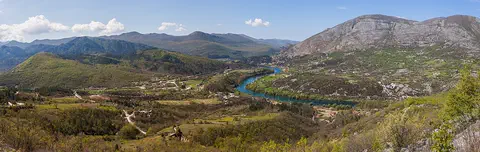
Bosnia and Herzegovina is a mountainous country in southeastern Europe. It has forests, limestone hills and many rivers, and famous old stone bridges cross some of them. Its capital is Sarajevo. It touches the Adriatic Sea along only about 20 kilometers of coast.
Explore next
-
 Watch
3D
Animal
Axolotl
The axolotl is a salamander from the canals and lakes of Mexico City. Unlike most amphibians, it keeps its baby features, such as feathery gills and a fin, its whole life. It can regrow lost legs and even parts of its heart, but in the wild it is critically endangered.
-
 Watch
Animal
Fire salamander
The fire salamander is a shiny black amphibian with bold yellow spots, found in cool, damp forests across much of Europe. Its colors warn predators that its skin makes bad-tasting toxins. Unlike most amphibians, the mother keeps her eggs inside her body and gives birth to live larvae in a stream.
-
Watch
Country
Slovenia
Slovenia is a small country in central Europe where the Alps meet the Mediterranean. Forests cover much of the land, the Karst region is full of caves and underground rivers, and about 2.1 million people lived there in 2026.
-
Watch
Country
Croatia
Croatia is a crescent-shaped country in southeastern Europe. Its long coast on the Adriatic Sea is fringed by more than 1,100 islands, limestone mountains rise behind it, fertile plains lie in the north, and about 3.87 million people lived there in mid-2025.
-
Watch
Country
Bosnia and Herzegovina
Bosnia and Herzegovina is a mountainous country in southeastern Europe. It has forests, limestone hills and many rivers, and famous old stone bridges cross some of them. Its capital is Sarajevo. It touches the Adriatic Sea along only about 20 kilometers of coast.
-
 Watch
Animal
Japanese giant salamander
The Japanese giant salamander is one of the biggest salamanders in the world, growing up to 1.5 meters long. It lives its whole life in cool, clear rivers in Japan, breathes mostly through its wrinkly skin, and the fathers guard the eggs and babies for months.
-
 Watch
3D
Animal
Amazon milk frog
The Amazon milk frog is a large tree frog that lives high in the treetops of the rainforest in northeastern South America. It is active at night, has big golden eyes, and lays its eggs in pools of rainwater trapped in holes in trees, where its tadpoles grow up.
-
 Watch
3D
Animal
American bullfrog
The American bullfrog is the largest true frog in North America. It lives in warm, still ponds and lakes, sits and waits for food to come close, and the males' deep 'jug-o-rum' call carries more than a kilometer. Its tadpoles can take years to turn into frogs.
For parents & teachers
What children will learn
- Describe how the olm's body is adapted to life in permanent darkness.
- Explain neoteny and why olms keep their gills.
- Explain how pollution on the surface can reach underground water.
- Understand that scientists can discover that one species is really several.
Recommended ages: 3 to 17 · About 15 minutes
Talk about it
- If you lived in total darkness, which of your senses would you use most?
- How could fertilizer used on a farm end up in a cave far below?
- Why might animals that live in caves grow and breed so slowly?
Try at home or in class
- With eyes closed, try to find a small object in a bowl of water by touch alone, then talk about how olms find food.
- Pour water onto a sponge sitting on a plate and watch it soak through: compare it with rain soaking down through cracked limestone into caves.
Key vocabulary: cave, karst, gills, neoteny, endemic, groundwater
Where these facts come from
- The IUCN Red List of Threatened Species , International Union for Conservation of Nature (IUCN terms of use (no redistribution of Red List data or range maps))
- GBIF Backbone Taxonomy and GBIF Occurrence Search , Global Biodiversity Information Facility (CC0 1.0 (backbone); occurrence counts are facts derived from records under CC0, CC BY and CC BY-NC)
- Wikimedia Commons , Wikimedia Foundation (Per file: Public domain, CC0, CC BY or CC BY-SA only (credited on each page))
- Proteus anguinus (Olm), IUCN Red List assessment 2024 , IUCN
- Human fish (olm) , Notranjska Regional Park
- Just how did Europe's only blind, cave-dwelling salamander turn up in Sydney? , Australian Museum
- Four new species of the genus Proteus (Amphibia: Proteidae) (Trontelj et al., Natura Sloveniae 28(1), 28 August 2026) , University of Ljubljana, Natura Sloveniae
- Wikidata , Wikimedia Foundation (CC0 1.0)
Checked, not yet human-reviewed. Last updated October 27, 2026. Spotted a mistake? Tell us.