Geography
Islands
An island is land with water all around it. Some islands are made by volcanoes. Some are made by tiny corals. Some broke off big land long ago.
An island is a piece of land surrounded by water that is smaller than a continent. Islands form in different ways: some broke away from continents, some were built by volcanoes on the sea floor, and some were made by corals or by waves piling up sand. Because they are cut off by water, islands often have unusual plants and animals.
An island is land surrounded by water but too small to count as a continent. Geographers group islands by origin: continental islands on continental shelves, oceanic (volcanic) islands built at subduction zones, rifts or hotspots, coral islands and atolls, barrier islands of sediment, and artificial islands. Isolation shapes island life, from adaptive radiation to gigantism and dwarfism.
Land with water all around
An island is land with water all around it.
Some islands are tiny. You could walk around them in a few minutes. Some islands are huge, with big cities on them.
An island is a body of land surrounded by water. Continents are surrounded by water too, but they are so big that they are not called islands. National Geographic points out that Australia, the smallest continent, is more than three times the size of Greenland, the largest island.
Islands come in every size. Many cover less than half a hectare, about one acre, and are often called islets. Greenland covers about 2,166,000 square kilometers. Some islands are icy all year, like the Aleutian Islands in Alaska, and some lie in warm tropical seas, like Tahiti. Islands can be in the ocean, in lakes or even in rivers.
National Geographic defines an island as a body of land surrounded by water, distinguished from continents only by size: Australia, the smallest continent, is more than three times the size of Greenland, the largest island, at about 2,166,000 km² (836,000 square miles). At the other extreme, islets may cover less than half a hectare, and islands in rivers are sometimes called aits or eyots.
Islands range from bare rock to great cities: Tokyo, one of the world's largest cities, stands on Honshu, and New York City's skyscrapers rise on Manhattan. Some are isolated, like Easter Island, thousands of kilometers from the nearest mainland; others cluster in archipelagoes, like the Cyclades in the Aegean Sea. For centuries, islands have also been stopping places for ships.
Pieces of continents
Some islands used to be joined to a big piece of land.
Long ago, the sea was lower. When the ice melted, the sea rose. It covered low land and made new islands.
Continental islands were once joined to a continent and still sit on its continental shelf. Some, like Greenland and Madagascar, are pieces that split off when the giant continent Pangaea broke apart.
Others were made when the sea rose. About 18,000 years ago, at the peak of the last ice age, so much water was frozen in glaciers that the sea was much lower. As the ice melted, the sea flooded low land. That is how the British Isles became islands; they were once part of mainland Europe.
Continental islands rest on continental shelves. National Geographic describes several origins. Some are fragments from the break-up of Pangaea, such as Greenland and Madagascar. Others formed as sea level rose after the most recent glacial maximum, about 18,000 years ago, flooding low-lying areas; the British Isles were once part of mainland Europe.
Larger fragments that broke off a continental shelf but remain associated with a continent are called microcontinents or continental crustal fragments. Zealandia, almost completely underwater except for New Zealand, is one. Tidal islands are continental islands whose link to the mainland has not fully eroded but is underwater at high tide; Mont Saint-Michel in France is a famous example.
Islands made by volcanoes
Some islands are the tops of volcanoes.
The volcano starts deep under the sea. Lava piles up and up. One day, the top pokes out of the water. A new island!
Oceanic islands are built by volcanoes on the sea floor. As a volcano erupts again and again, layers of lava pile up. While it is still underwater it is called a seamount; when its top breaks the surface, it becomes an island.
The Hawaiian Islands were made this way, over millions of years, by a hot spot under the Pacific Plate. The U.S. Geological Survey explains that the plate slowly moves over the hot spot, so the islands form one after another in a line. Kauai's oldest rocks are about 5.5 million years old; the Big Island's oldest exposed rocks are less than 0.7 million years old.
Volcanic (oceanic) islands form in three settings, National Geographic explains. At subduction zones, oceanic plates sink beneath others: Japan sits where four plates meet, and its islands are among the most actively volcanic in the world. Where plates rift apart, eruptions can build new land: Surtsey rose off Iceland, where the Eurasian and North American plates separate; UNESCO dates its eruptions to 1963–1967.
The third setting is a hotspot. In 1963, J. Tuzo Wilson proposed that the Hawaiian Island-Emperor Seamounts chain formed as the Pacific Plate moved over a deep, stationary hotspot, the U.S. Geological Survey recounts. Each volcano is eventually carried off its magma source and becomes extinct while a new one grows. The islands' ages fit this pattern, growing older with distance from the hotspot: about 5.5 million years on Kauai, under 0.7 million on the Big Island, where Mauna Loa and Kilauea still sit over the hotspot.
Coral islands and sand islands
Some islands are made by tiny sea animals called corals.
Other islands are long strips of sand. Waves pile up the sand near the coast.
Coral islands form in warm water. Corals are tiny animals that build hard skeletons of limestone. Over a very long time, a reef can grow up from the sea floor until it reaches the surface and becomes an island, as in the Bahamas. An atoll is a ring-shaped coral reef that grew around a volcanic island as the volcano slowly sank.
Barrier islands are long, narrow islands of sand that lie along a coast. NOAA explains that waves keep dropping sand there, so these islands are always moving, wearing away and growing. The Outer Banks of North Carolina are barrier islands. Their dunes and grasses soak up the energy of storm waves before they reach the mainland.
Coral islands are low islands built in warm water from the calcium carbonate skeletons of corals, with other material such as rock and sand. An atoll begins as a reef fringing a volcanic island; as the volcano subsides, the reef keeps growing into a ring around a lagoon. National Geographic notes atolls are found chiefly in the Pacific and Indian Oceans.
Barrier islands, NOAA explains, are constantly changing deposits of sand parallel to the coast, separated from the mainland by tidal creeks, bays and lagoons. They form near river deltas on flat coasts with low tectonic activity, such as the U.S. Gulf and East coasts, but not along the rocky, tectonically active West Coast. Their dunes and grasses absorb wave energy, generally meaning smaller storm surges and less flooding inland. National Geographic adds that some, like Long Island and Nantucket, are glacial moraines surrounded by the rising sea.
Life on an island
How do plants and animals get to an island?
Some seeds float in the sea, like coconuts. Some fly on the wind. Birds carry some seeds on their feet!
Living things reach faraway islands in surprising ways. Coconut seeds have tough shells that float a long way. Light, fluffy seeds blow on the wind, and birds carry seeds in mud on their feet. Small animals such as lizards can even ride on floating tangles of plants torn from coasts by storms.
Once there, island life can change. On the Galápagos Islands, finches developed different beaks for different foods, and giant tortoises that can weigh up to 250 kilograms grew from smaller ancestors. On Surtsey, scientists have watched plants and animals arrive on brand-new land since 1964.
Organisms colonize isolated oceanic and coral islands by water, wind and animals, National Geographic explains, including floating mats of vegetation that can carry snakes, turtles, insects, rodents and lizards hundreds of kilometers. Surtsey has made the process measurable: UNESCO reports seeds carried by ocean currents, then molds, bacteria and fungi, the first vascular plant in 1965, 10 species within a decade and 60 by 2004.
Isolation drives change. Darwin's finches on the Galápagos are a famous example of adaptive radiation, with beaks suited to different foods. With few competitors, Galápagos tortoises show island gigantism, up to 250 kg; scalesia, a relative of sunflowers, grew into 6–9 m trees. The reverse, insular dwarfism, is seen in the smaller Sumatran tiger. Islands can also be vulnerable: introduced species arrive in ship ballast, cargo or as released pets.
Island voyagers
Long ago, people sailed across the big ocean in canoes.
They found islands far away. They used the stars, the wind and the waves to find their way.
Many Pacific islands, such as Hawaii and Easter Island, are very far from any continent. Yet when Europeans began exploring the Pacific in the 1500s, people were already living there. These people are known today as Polynesians.
National Geographic explains that, beginning around 3,000 to 4,000 years ago, early Polynesians sailed great oceangoing canoes across thousands of kilometers of ocean, without compasses or maps. Archaeologists say they navigated by the stars and knew how to read winds and ocean waves. Recent evidence suggests they also sailed west across the Indian Ocean and were probably the first people to live on Madagascar.
When Europeans began exploring the Pacific in the 1500s, people were already living on its remote islands. National Geographic notes that most scientists trace the ancestors of Pacific islanders to Southeast Asia, probably around Taiwan. Thor Heyerdahl argued for an American origin and sailed the raft Kon-Tiki from Peru to Raroia in 1947; that showed the journey was possible, but linguistic and genetic evidence suggests it is unlikely.
Beginning around 3,000–4,000 years ago, Polynesian voyagers crossed thousands of kilometers in oceangoing canoes, reaching as far east as Hawaii and Easter Island, navigating by the stars and reading winds and swells. Some voyages were probably accidental, others almost certainly intentional, and recent evidence suggests westward voyages across the Indian Ocean that probably made them the first inhabitants of Madagascar.
Will it float to an island?
Try this with a grown-up. Fill a big bowl with water.
Drop in some seeds and nuts, like a bean, an acorn or a sunflower seed. Which ones float? Those could travel to an island!
National Geographic explains that some seeds, like coconuts, can float a long way across the sea to reach islands. Test the idea at home with a grown-up: fill a bowl with salty water (stir in a few spoons of salt) and drop in different seeds, such as dried beans, sunflower seeds, an acorn and a piece of coconut shell.
Which float, and which sink? Leave the floaters overnight. Are they still floating in the morning? A seed that floats for a long time is a good island traveler.
Turn National Geographic's account of seed dispersal into an experiment. Test a range of seeds in fresh and salty water, record how long each floats, and repeat with three samples of each. Then estimate how far a seed could drift: if a current carried it at, say, 1 kilometer per hour, how far would it travel in the time it stayed afloat?
Think about the other routes too. Which of your seeds are light enough to blow on the wind, or small enough to stick in mud on a bird's feet? Compare your results with UNESCO's record of Surtsey, where the first arrivals included seeds carried by ocean currents.
Amazing facts
-
Greenland is the biggest island in the world.
Greenland is the largest island, but Australia, the smallest continent, is more than three times bigger.
Greenland, about 2,166,000 km², is the largest island; Australia, the smallest continent, is more than three times its size.
-
Surtsey is a new island. It came out of the sea in 1963.
Surtsey, off Iceland, was born in volcanic eruptions from 1963 to 1967.
Surtsey formed in eruptions from 1963 to 1967 about 32 km off Iceland's south coast and has been protected since its birth as a natural laboratory.
-
Coconut seeds can float across the sea.
Coconut seeds have tough, buoyant shells that can float long distances to new islands.
Coconut palm seeds are encased in durable, buoyant shells that can drift significant distances on the ocean.
-
Some islands move a little all the time!
Barrier islands keep moving, wearing away and growing as wind and waves shift their sand. They can even disappear.
NOAA notes that barrier islands constantly move, erode and grow with shifting wind and waves, and can disappear entirely.
Words to know
- island
- land with water all around it, smaller than a continent
- islet
- a very small island
- archipelago
- a group of islands close together
- seamount
- an underwater volcano or mountain that has not reached the surface
- hot spot
- a very hot place deep under Earth's crust where melted rock rises and can build volcanoes
- atoll
- a ring-shaped coral reef or island around a lagoon
- barrier island
- a long, narrow island of sand that lies along a coast
Discovery challenge
-
What is an island?
What makes a piece of land an island?
Which definition of an island do geographers use?
- Land with water all around it, smaller than a continent
- Land at the top of a mountain
- Land with a river through it
Show the answer
Land with water all around it, smaller than a continent
An island has water all around it.
An island is land surrounded by water. Continents are too, but they are much bigger, so they are not called islands.
An island is a body of land surrounded by water, distinguished from continents by size.
-
What made the islands of Hawaii?
How did the Hawaiian Islands form?
Which process best explains the Hawaiian Island-Emperor Seamounts chain?
- Waves piling up sand
- Volcanoes over a hot spot
- Ice breaking off a glacier
Show the answer
Volcanoes over a hot spot
Volcanoes made them, over a hot spot deep under the sea.
The Pacific Plate slowly moved over a hot spot, and volcanoes built the islands one after another.
Wilson's hotspot theory: the Pacific Plate moving over a stationary mantle hotspot left a chain of volcanoes that age with distance.
-
Which tiny sea animals build some islands?
Which animals build the reefs that make coral islands and atolls?
Which organisms' calcium carbonate skeletons form coral islands and atolls?
- Jellyfish
- Crabs
- Corals
Show the answer
Corals
Corals! They build hard skeletons that pile up into reefs.
Corals build hard limestone skeletons. Their reefs can grow up to the surface and become islands.
Corals build calcium carbonate (limestone) skeletons; reefs that reach the surface, or ring a sinking volcano, become coral islands and atolls.
-
How can a seed get to a faraway island?
Which is one way plant seeds reach faraway islands?
By which route did UNESCO record the first seeds arriving on Surtsey?
- Floating on the sea
- Walking across the sea floor
- Digging a tunnel
Show the answer
Floating on the sea
Some seeds float on the sea, like coconuts.
Seeds such as coconuts float across the sea; others blow on the wind or ride on birds.
UNESCO records seeds carried by ocean currents among Surtsey's first arrivals.
Experiments to try
Explore next
-
 Watch
Natural wonder
Galápagos Islands
The Galápagos Islands are a group of volcanic islands in the Pacific Ocean, about 1,000 kilometers off the coast of Ecuador. Many of their animals live nowhere else on Earth, and they helped inspire Charles Darwin's theory of evolution by natural selection.
- Watch Try it What If? Lab What if an island experienced more erosion? Wave power grows with the square of wave height, so a wave about three times taller carries about 11 times the power. In our model, swapping 1.5-meter waves for 5-meter storm waves makes a sandy island wear away about 11 times faster, though plant roots help hold it together.
-
 Watch
 Country
Bahrain
Bahrain is a small island country in the Persian Gulf, linked to Saudi Arabia by a long causeway. Long ago it was the center of a trading land called Dilmun, and for centuries its people dived for pearls. About 1.6 million people live there today.
-
 Watch
 Country
Croatia
Croatia is a crescent-shaped country in southeastern Europe. Its long coast on the Adriatic Sea is fringed by more than 1,100 islands, limestone mountains rise behind it, fertile plains lie in the north, and about 3.87 million people lived there in mid-2025.
-
 Watch
City
Mumbai
Mumbai, once called Bombay, is a giant port city on India's west coast, by the Arabian Sea. It grew on seven small islands that were joined into one, and it is India's main center of business and banking. At the 2011 census, more than 12 million people lived in the city and more than 18 million in its urban area.
-
 Watch
City
Hong Kong
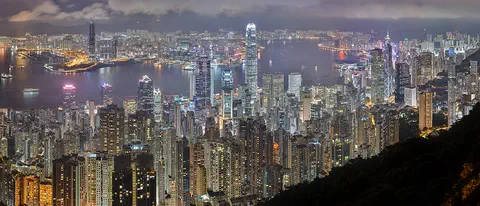
Hong Kong, on the south coast of China, grew around one of the world's great natural harbors. It was a British colony for 156 years and has been a special administrative region of China since 1997. About 7.5 million people lived there in mid-2026.
-
 Watch
Landmark
Mont-Saint-Michel
Mont-Saint-Michel is a small rocky island off the coast of Normandy, in France. On top stands a Benedictine abbey built between the 1000s and 1500s, with a village and strong walls below. Around it, some of the biggest tides in Europe rush in and out across a huge sandy bay.
- Watch Geography Coasts and beaches Coasts are where land meets the sea, and they are always changing. Waves wear away rocky cliffs into caves, arches and stacks. Rivers and waves carry sand along the shore to build beaches. Beach sand can come from rocks worn down over millions of years, from volcanoes, from tiny shells, and even from fish!
For parents & teachers
What children will learn
- Define an island and tell it apart from a continent.
- Describe at least three ways islands form.
- Explain how plants and animals reach islands.
- Recognize that isolation can change island life.
Recommended ages: 4 to 10 · About 12 minutes
Talk about it
- What would you need to bring if you went to live on a small island?
- Why do you think many island animals are found nowhere else?
- How do you think early sailors knew there might be an island ahead?
Try at home or in class
- Test which seeds float in a bowl of salty water, the way National Geographic says coconut seeds drift to islands.
- Build a 'volcanic island' in a deep bowl by stacking spoonfuls of play dough under water until the top pokes out above the surface.
- On a world map, find one continental island, one volcanic island and one coral island.
Key vocabulary: island, islet, archipelago, seamount, hot spot, atoll, barrier island
Where these facts come from
- Island , National Geographic Society (Education)
- Hotspots (This Dynamic Earth) , U.S. Geological Survey
- What is a barrier island? , NOAA National Ocean Service
- Surtsey , UNESCO World Heritage Centre
- Wikidata , Wikimedia Foundation (CC0 1.0)
Checked, not yet human-reviewed. Last updated October 24, 2026. Spotted a mistake? Tell us.